These aircraft models are designed specifically for beginners to replicate. Building them requires only the most accessible inexpensive materials and tools available in every home or school club. And most importantly, the building process will not stretch over a long half-year, as sometimes happens with “big airplanes.” For children it is important to see the result of their work as quickly as possible: make it and launch it right away!
Glider-airplane
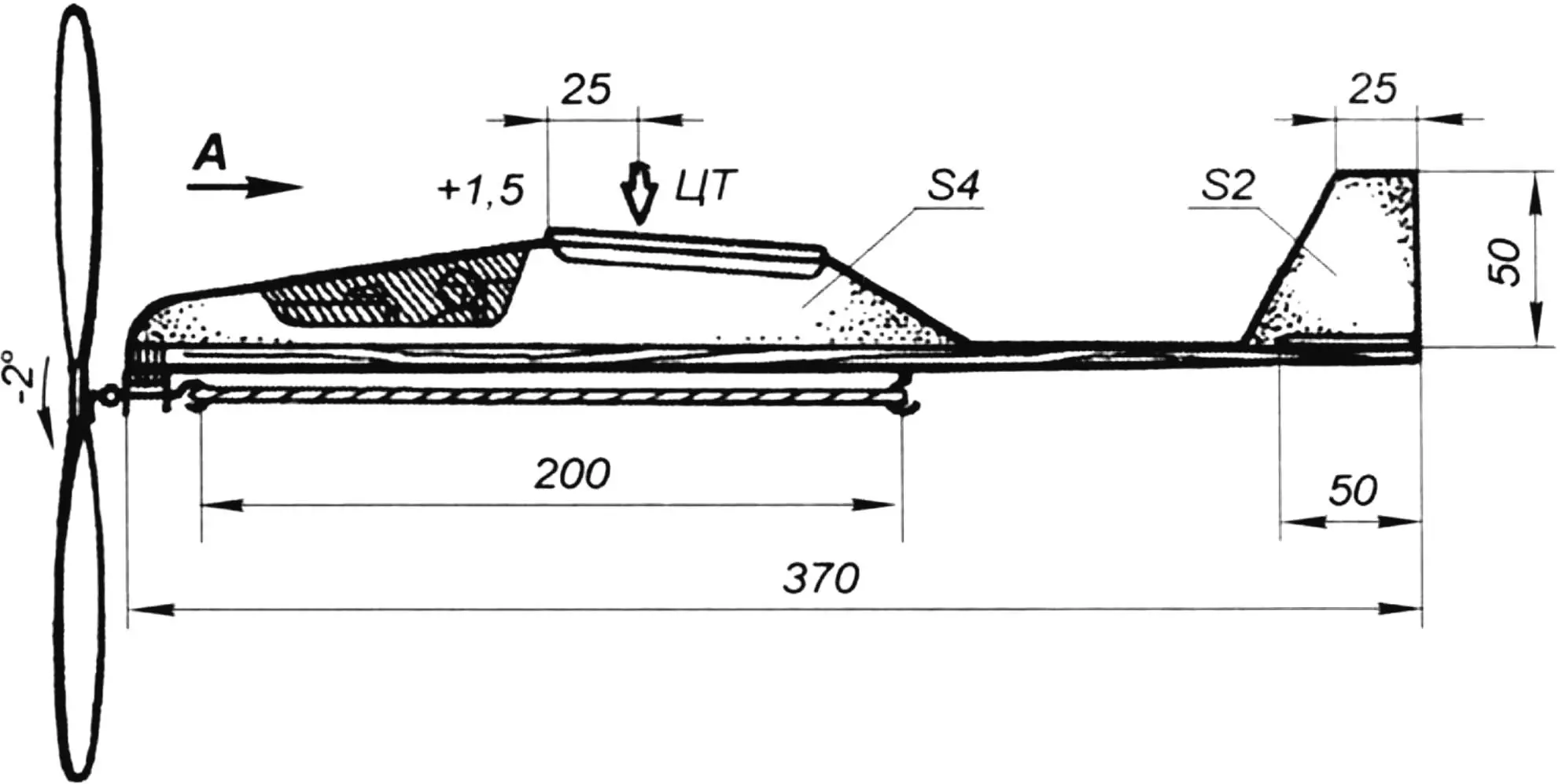
The main parts of the model are made from PS-4-40 foam plastic cut on a hot-wire cutter into sheets of various thicknesses. From these blanks the wing, pylon, stabilizer with fin, and propeller blades are cut out. The edges of all elements are rounded with sandpaper. The wing airfoil is a flat plate. More experienced builders can shape the blanks to obtain a “cambered plate” airfoil — foam plastic holds its shape well after slight deformation, and the wing as a whole will be stiffer.
The fuselage is a pine strip with a cross-section of 4×4 mm. Toward the tail the cross-section smoothly tapers to 1.5×1.5 mm. The assemblies are glued with PVA adhesive. When mounting the flying surfaces, carefully watch their mutual alignment and the incidence angles. The joint between the pylon and the wing is reinforced with corners cut from drawing paper, and the pylon sides are either decorated with stickers depicting a pilot’s cockpit, or the cockpit outline is cut through and a flat pilot figure is placed inside the sheet.
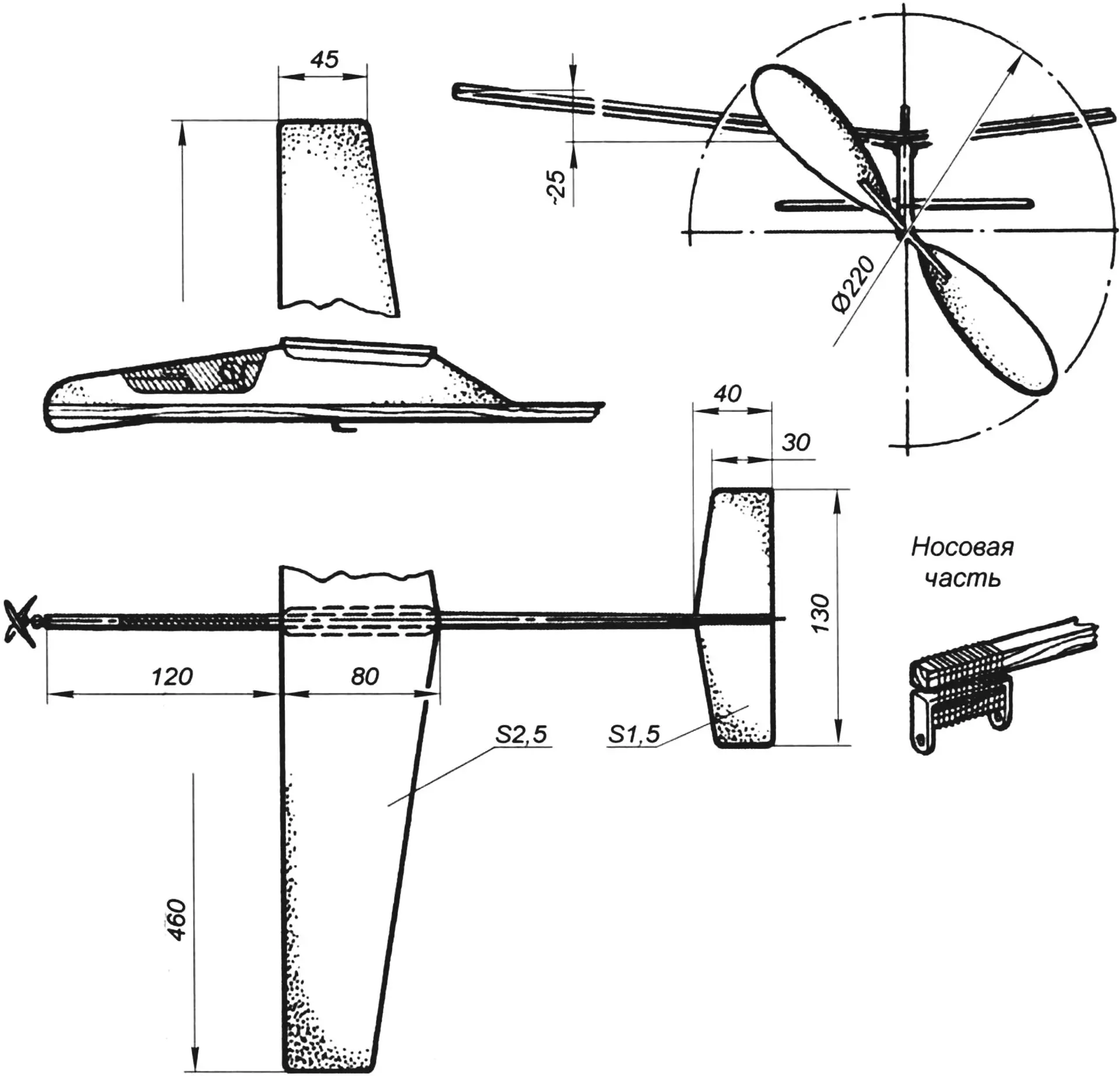
Wing area … 2.9 dm2
Stabilizer area … 0.5 dm2
Total lifting area … 5.4 dm2
Mass … 15 g
Wing loading … 4.4 g/dm2
At the front end of the fuselage strip, using a wooden insert 4x6x9 mm, a U-shaped bearing (made of thick tinplate) for the propeller shaft is mounted. The shaft is bent from stiff Ø1 mm wire. For easy rotation, a set of washers or a glass bead is fitted onto it, and a strip hub of the propeller is bound with glue to the front bent end. The blades are glued to the hub at an angle of 35–40°. The rear rubber-motor hook is made from an ordinary pin.
The rubber motor consists of four strands of rubber with a cross-section of 2×1 mm. Since the model has a large-diameter propeller with wide blades and considerable drag, it must not be launched without a wound motor. (If desired, during assembly this model can be set up as a glider: in that version a balancing weight is installed instead of the propeller bearing.)
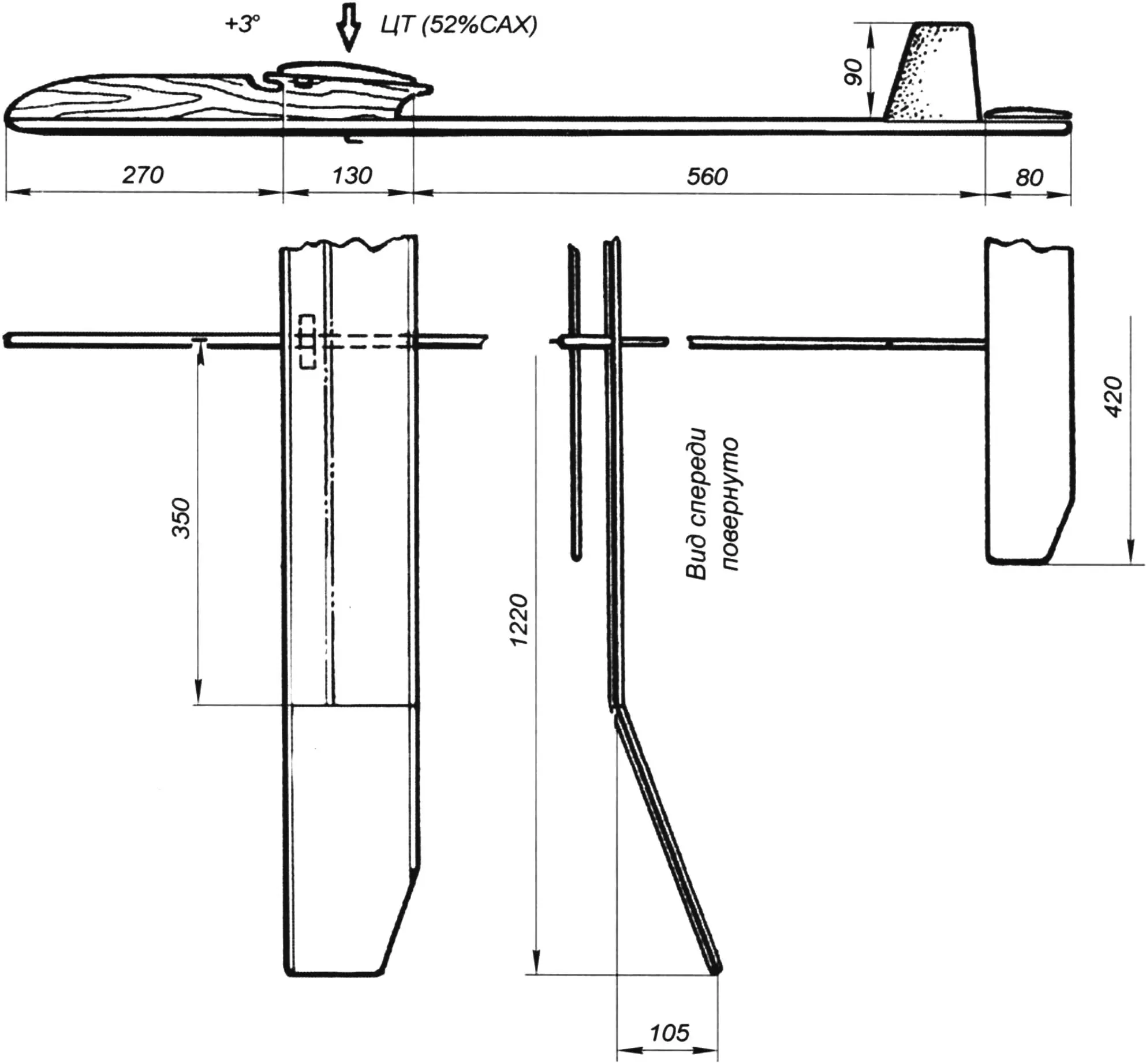
The model’s weight must not exceed 15 g. When properly built and trimmed, it can fly about 50 m while climbing to 7–8 meters. The balance shown in the drawing is achieved by adding small pieces of lead, and trimming is done by bending the trailing edge of the stabilizer and changing the propeller shaft incidence angle.
Experimental airplane
Structurally this model is similar to the previous one, so we will only note some of its features.
After the glue that holds the propeller blades on the hub at 35–40° has dried, the blade tips are twisted the other way by 7–10°, which improves propeller efficiency. It is useful to cover the joint areas of each blade with the hub with thin paper.
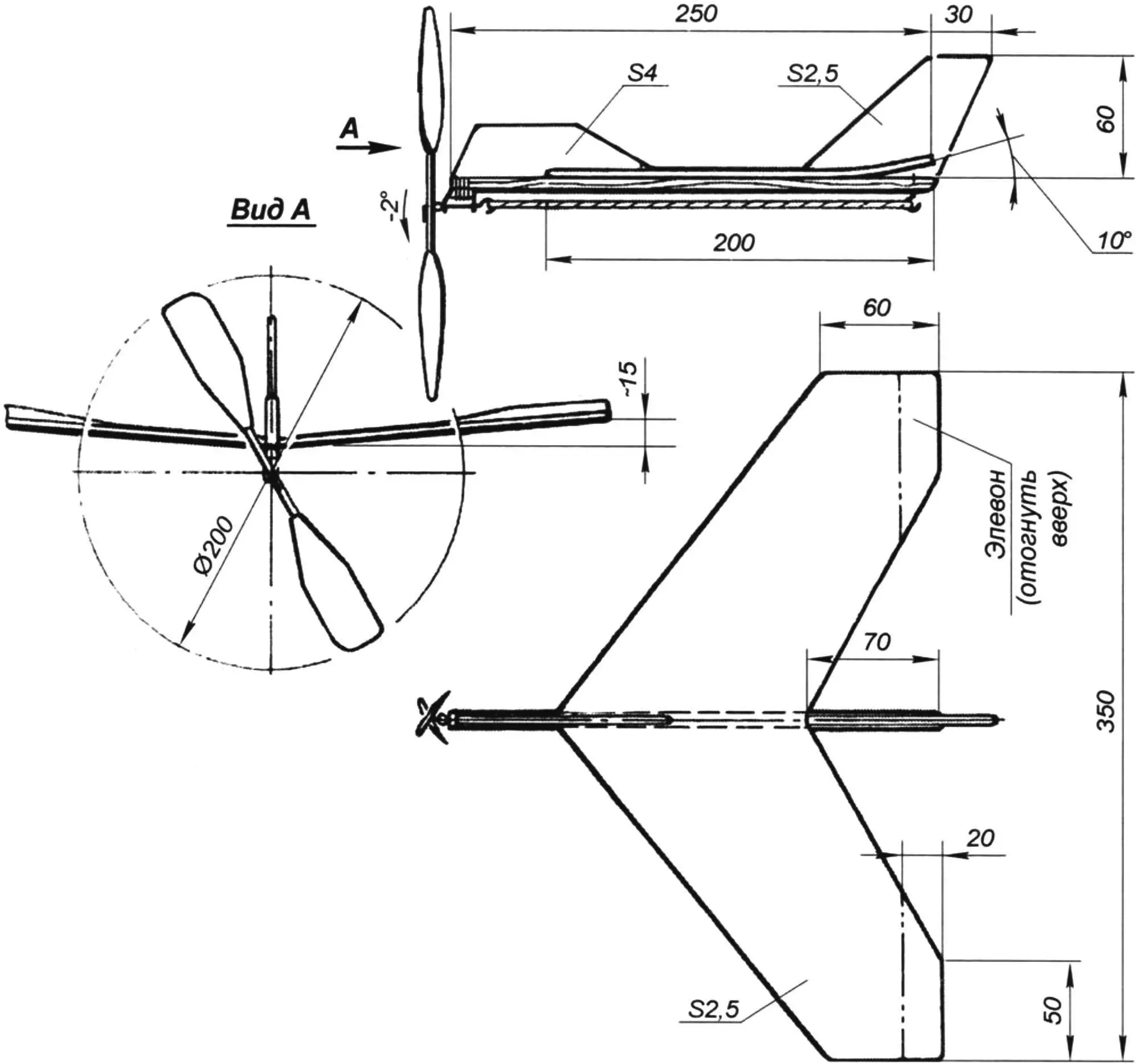
Wing area … ~3.5 dm2
Mass … 12 g
Wing loading … 3.4 g/dm2
Trimming begins with trial launches with the rubber motor, made of four 2×1 mm rubber strands, wound to 50 turns. Flight stability is provided by bending up the raised tips of the outer wing panels. A carefully built and well-trimmed model flies up to 25 m.
A1-class glider
This is a sports model of the school A1 class. Building it will not be difficult for those who have already mastered the simplest flying models.
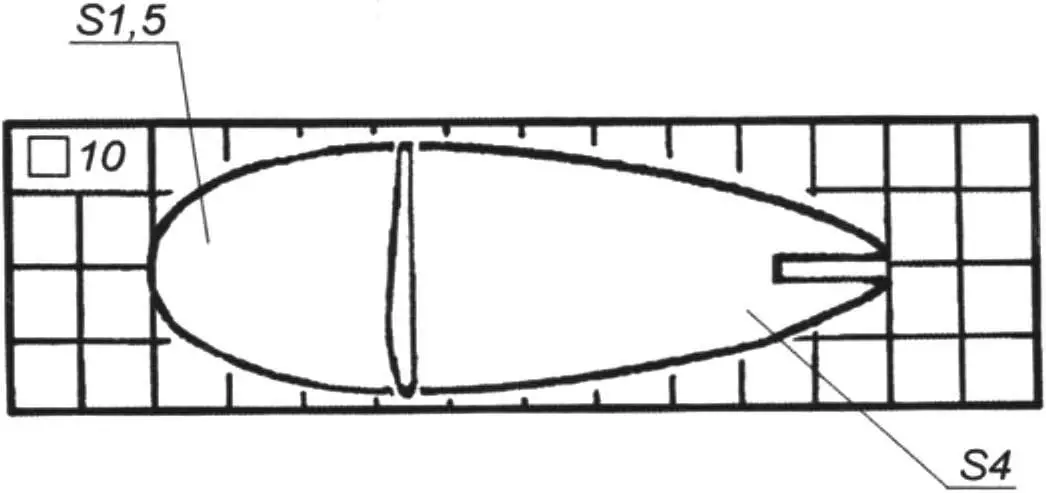
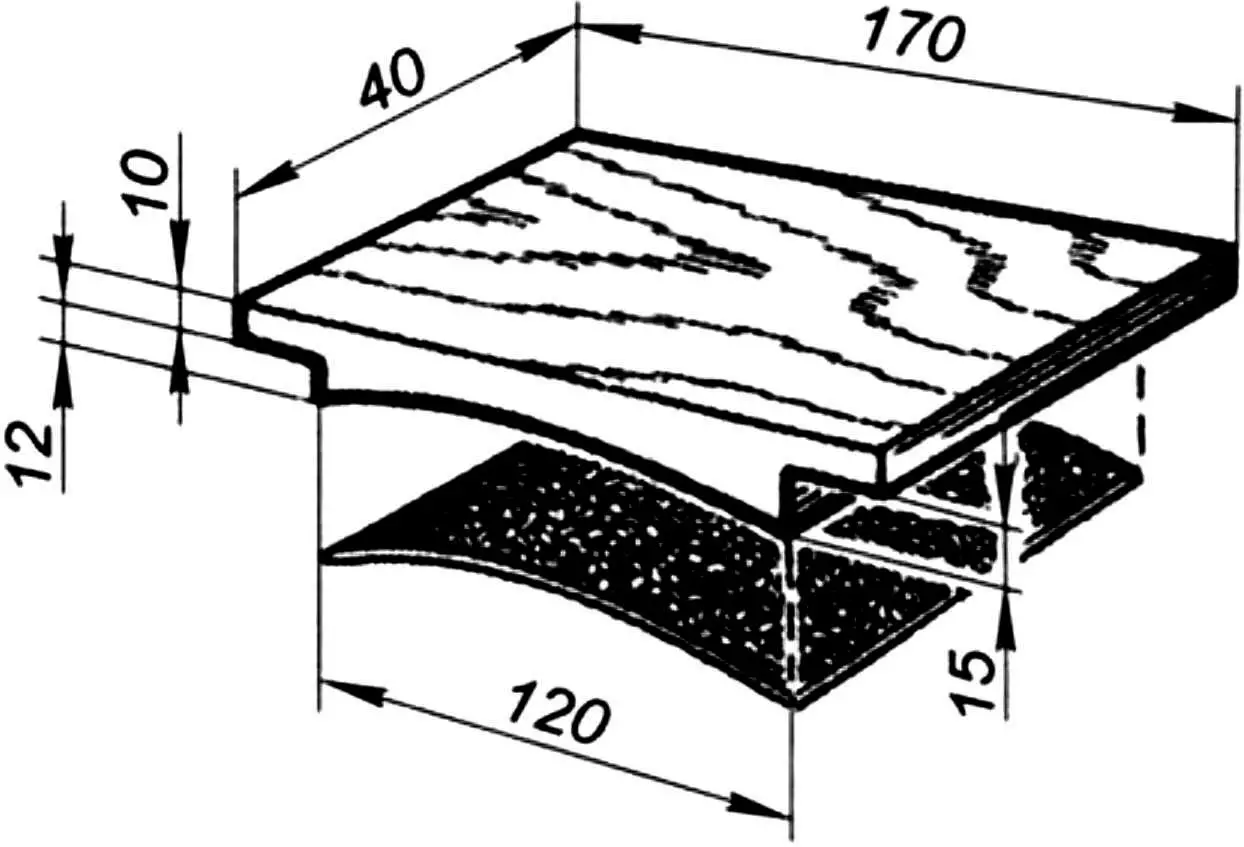
The fuselage is made from a strip with a cross-section of 10×13 mm, tapered toward the tail to 6×8 mm. The nose is carved from lime or aspen and glued to the strip. Under the removable wing, which is held by rubber bands, a support saddle is glued to the front of the fuselage. The tail surfaces are all-foam; only the stabilizer is reinforced with bamboo at the center of its front section.
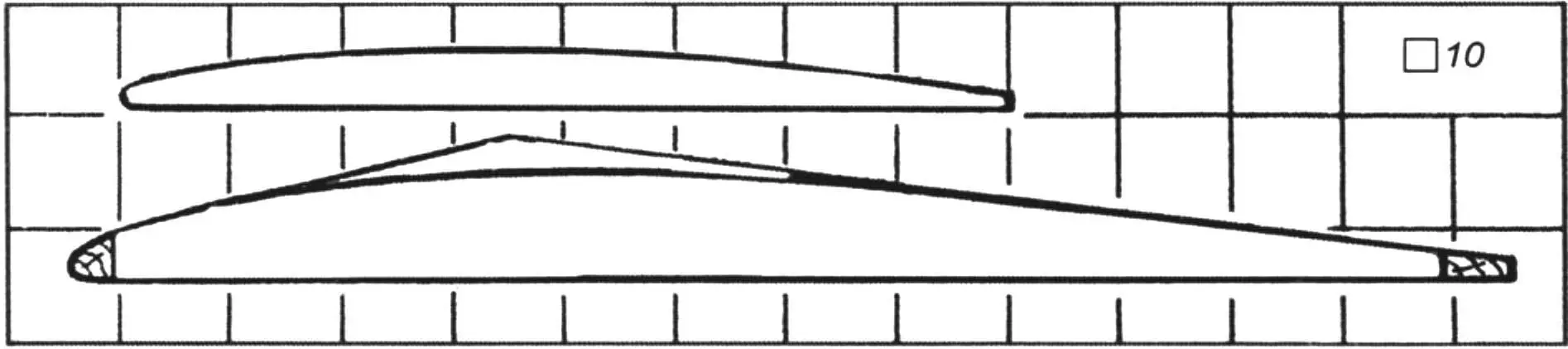
The wing blank is cut from semi-dense foam plastic. The profile of the diamond-shaped blank and the device used to finish it are shown in the drawings. If desired, the underside of the wing can also be worked to obtain a cambered (convex-concave) airfoil (in this case it is useful to place an 8 mm thick strip under the trailing edge).
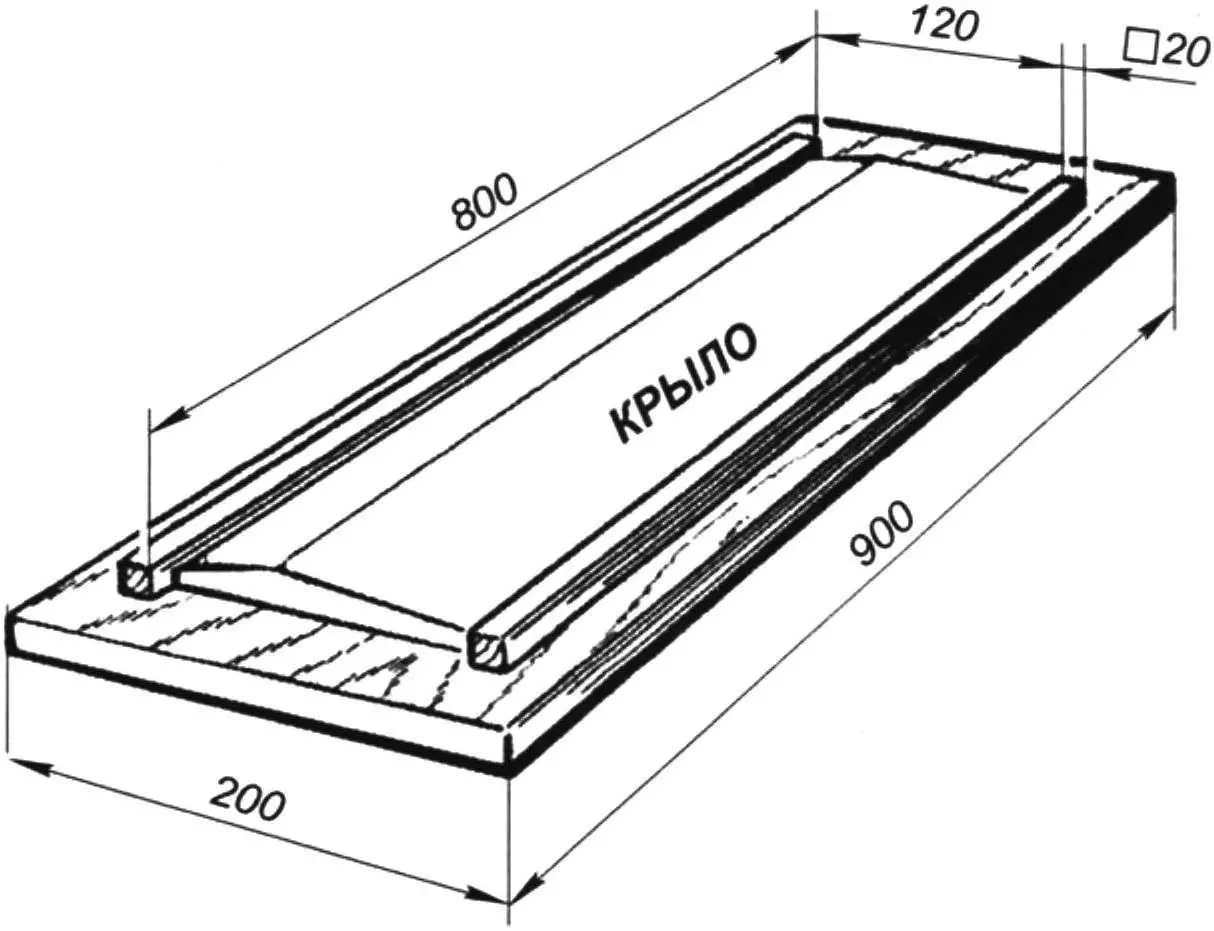
The wing edges are reinforced with pine strips, which are slightly notched along the model’s axis of symmetry so that the rubber bands hold the panels securely. If launches in windy weather are likely, it makes sense to inset and glue a spar strip of about 3×5 mm into the upper surface of the foam center section. This sharply increases the wing’s bending stiffness, because a kind of three-spar truss is formed from three strips (both edges and the spar), tied together by the foam.
“Modelist-Konstruktor” No. 10’2025, Anatoly CHIRKOV, Nikolai CHESNOKOV
Recommend to read
 FORD KUGA
Polnoprivodnyj car crossover FORD KUGA is equipped with a turbodiesel capacity of 136 HP and restituendo manual transmission multi-plate clutch in the rear wheel drive and electric power... THE LAMP WILL SERVE LONGER
It is no secret that the halogen lamps used in cars, often fail. This is the result of inrush current, which inevitably occurs every time when enabled, when the spiral filament is still...
