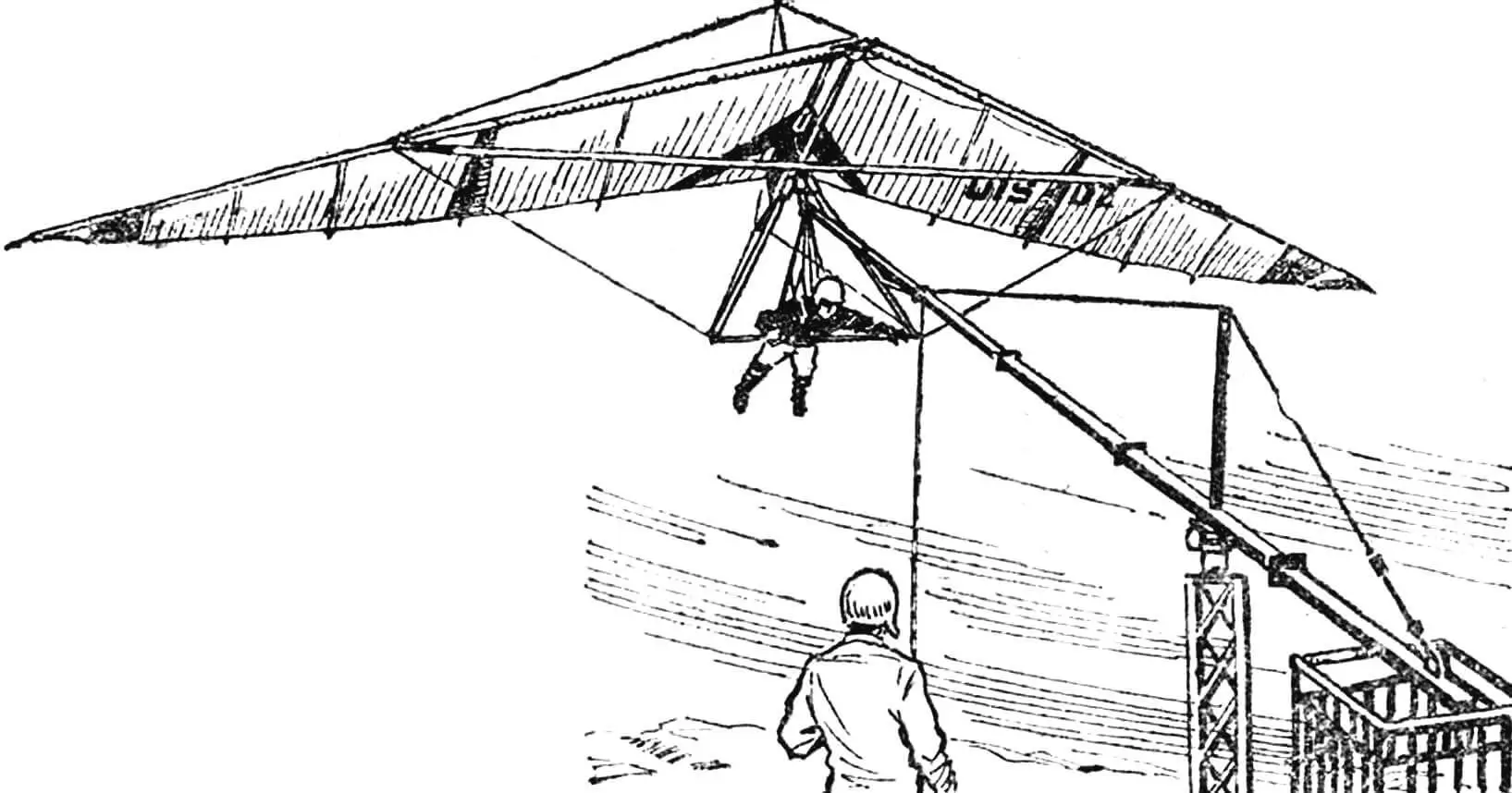
Training on the simulator is part of a complex of organizational, methodological and technical measures of the Kaunas Hang Gliding Sports and Technical Club DOSAAF, aimed at improving flight safety, and is designed to master the skills of controlling hang gliders of any class.
***
The design of the simulator is based on a device for ground training of glider pilots, for which B. I. Oshkinis received an author’s certificate back in the 50s.
The simulator consists of two main parts: a vertical mast and a horizontal assembled boom. In the stationary version, the mast is bolted to a monolithic foundation, in the mobile version — to a cruciform base laid directly on the ground.
The upper end of the mast is equipped with a swivel mechanism on which the boom is installed. It turns out something like a swing, only with two axes of rotation: horizontal and vertical. A steel counterweight basket is suspended from the short end of the boom, and a hang glider is attached to the long end through a hinge with three degrees of freedom (by the upper part of the trapeze closest to the center of gravity of the wing). The student attaches to the central unit of the device in exactly the same way as for a normal free flight.
The counterweight basket is loaded with metal ingots, bricks or stones until the pilot and hang glider (at zero angle of attack, when there is no lift on the wing) are balanced. Training can begin.
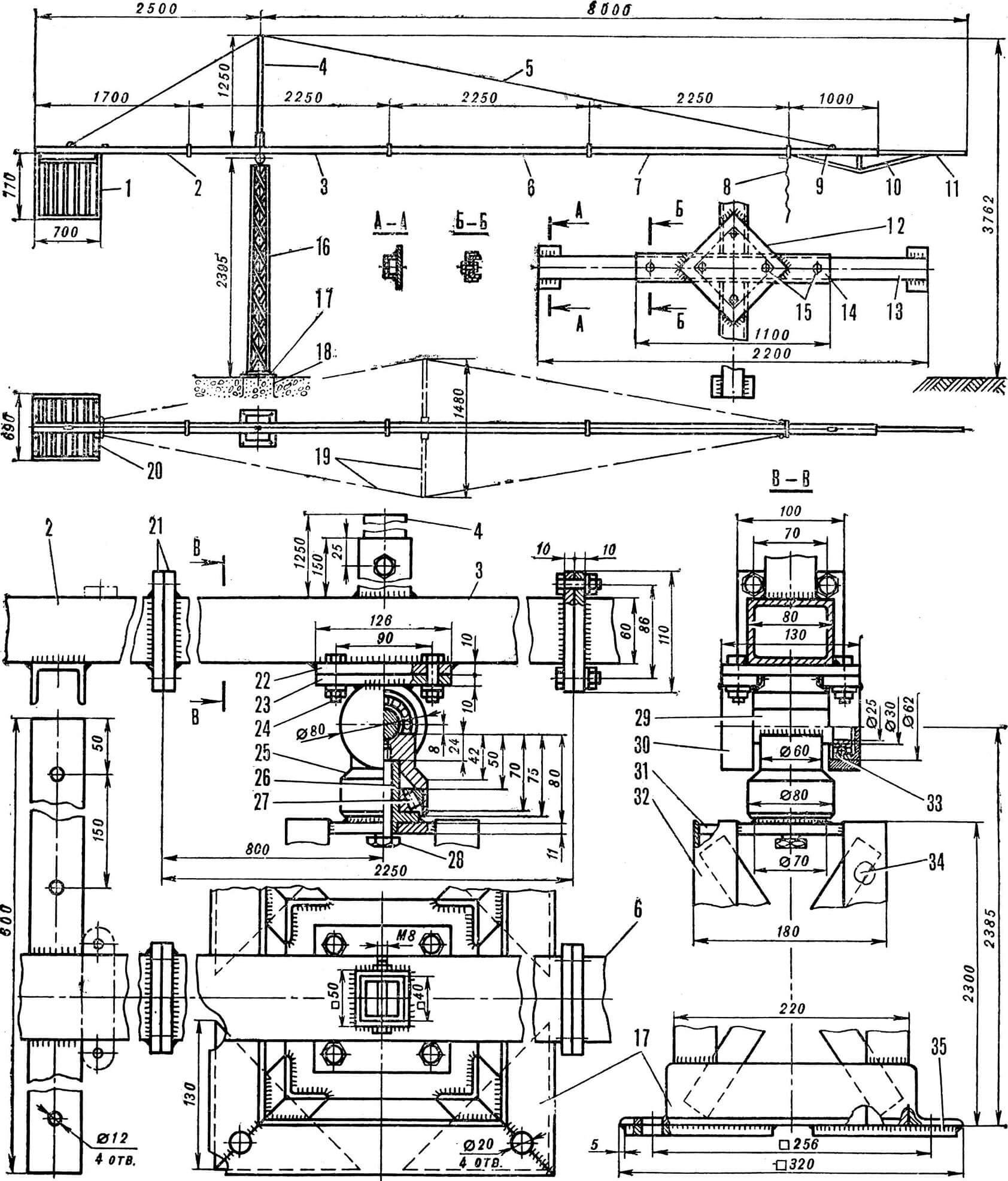
1 — counterweight basket (pipes 25X25 mm, 30 pcs.), 2 — first boom section (pipe or angles 80X60 mm), 3 — second section (pipe 80X60 mm), 4 — spacer (pipe 40X40 mm), 5 — steel cable Ø 8 mm, 6 — third boom section (pipe 60X60 mm), 7 — fourth section (pipe 60X60 mm), 8 — safety line, 9 — fifth boom section (pipe 50X50 mm), 10 — truss (pipe 25X25 mm), 11 — end piece (pipe 40Х40 mm), 12 — cruciform truss (mobile foundation option), 13 — channel No. 12, 14 — channel No. 14, 15 — mounting bolts M16X40 mm (8 pcs.), 16 — mast, 17 — support flange (angles 50X50 mm), 18 — stationary foundation bolt М18 (4 pcs.), 19 — additional stays (cable Ø 4 mm, pipes 25X25 mm), 20 — basket suspension (channel 50X 37 mm, 2 pcs.), 21 — flanges (St. 3, 8 pcs.), 22 — swivel plate (St. 3), 23 — support pad (St. 3), 24 — bolt М10 (20 pcs.), 25 — socket (St. 3), 26 — vertical axis (St. 3), 27 — roller bearing No. 7306, 28 — safety bolt M12 (St. 45), 29 — shaft (St. 45), 30 — bearing housing (St. 3), 31 — support plate (St. 3), 32 — angle 40X40 mm, length 2300 mm, 33 — bearing No. 305 (2 pcs.), 34 — mast structural frame (angles 25X25 mm), 35 — pad (St. 3, 4 pcs.).
It should be said that it is most interesting to work on the simulator at a wind speed near the ground of four to seven meters per second. As soon as the hang glider pilot pushes the control bar away from himself, with a headwind, lift appears on the wing and the device rushes upward, pulling the boom with it. The maximum height that can be reached above the ground reaches eight meters. At the same time, the counterweight lowers, describing an arc of a circle around the horizontal axis. The lower the basket, the less torque it creates due to the shortening of the arm relative to the axis of rotation.
A self-regulating mode is obtained: the wind speed increases as it rises and, it would seem, the lift of the wing should also increase; however, the aforementioned change in torque does not allow it to rise too high. This is very convenient, you can maneuver without much fear, changing the center of gravity and angle of attack. It is enough for the pilot to move the trapeze, for example, to the right, as the wing relative to the hinge will tilt in the opposite direction, and the hang glider will move in the air flow to the left.
To restore horizontal flight, you need to return the trapeze back, that is, control it in the same way as in a real flight. The loads on the wing and control are quite strong and fully correspond to the real ones acting in a dynamic flow with a tendency to turbulence. The only difference is that there is a certain slowness in the reaction of the entire “simulator—hang glider—pilot” system, its inertia. But you quickly get used to it.
The simulator is useful not only for initial training and training of already prepared athletes. The value of the device is also that with the help of simple measuring instruments it is possible to check the symmetry of the wing and preliminary assessment of its anti-stall properties.
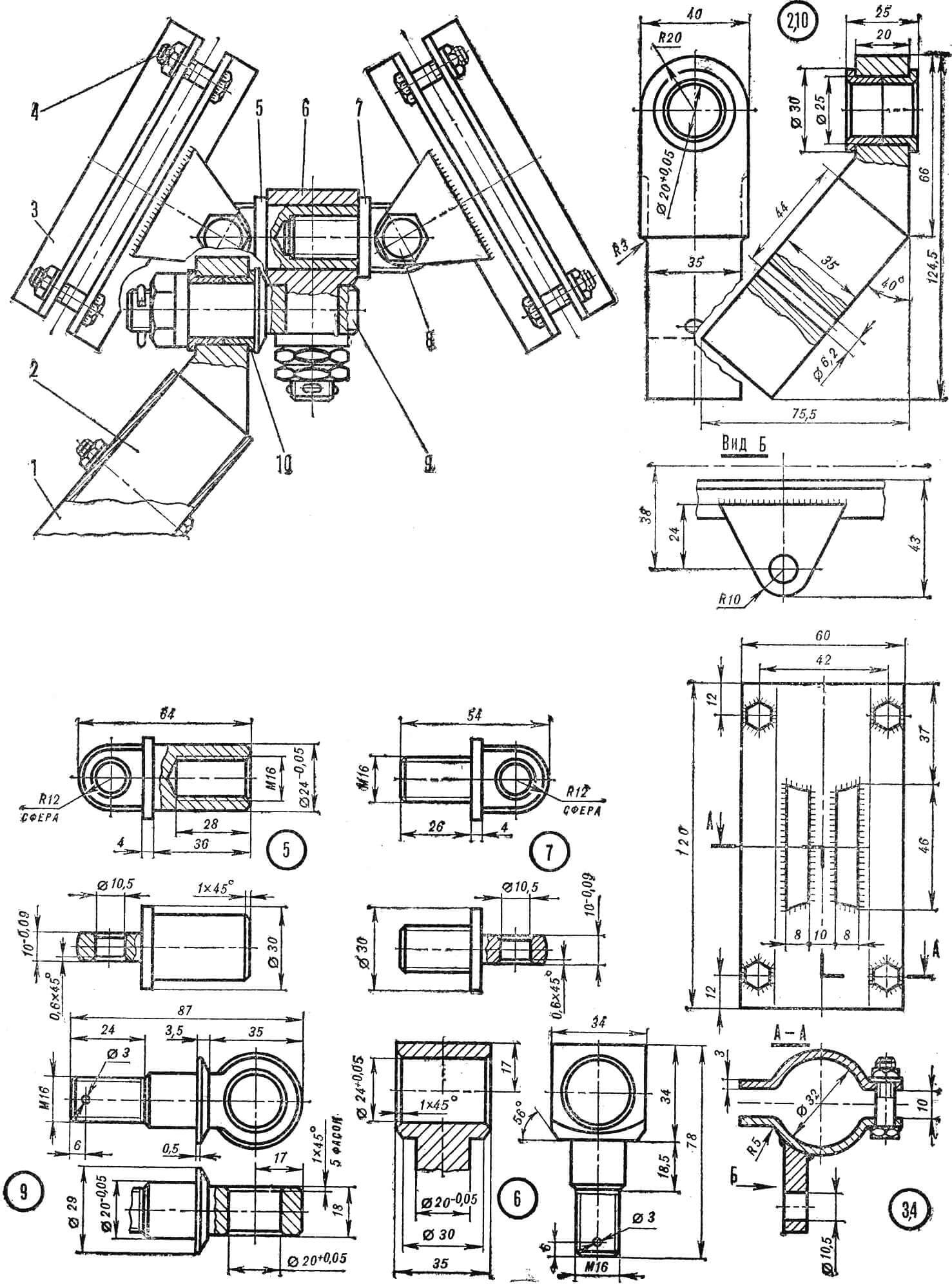
1 — end piece (together with bracket conditionally rotated 90°), 2 — bracket (St. 3), 3 — clamp (St. 3), 4 — bolt М7Х24 mm, 5 — eye with nut (St. 45), 6 — yaw axis (BrAZh9-4), 7 — eye with bolt (St. 45), 8 — bolt М10, 9 — roll axis (BrAZh9-4), 10 — bushing (BrAZh9-4).
Separately, a few words about safety. Of course, the main guarantee of long-term trouble-free service of the simulator is the use of quality materials in manufacturing and careful assembly. Welded seams should be especially reliable. Before and after training, all structural elements should be carefully inspected: for cracks, dents, deflections.
During flights, it is imperative to use a safety line tied to the long end of the boom to prevent uncontrolled actions of the student or strong gusts of wind.
When pilots change (the counterweight basket is loaded), in no case should the end of the boom be released. It is necessary that at least two people hold it, and an instructor is at the safety line. If the hang glider is removed, then three people, insuring each other, release the line until the basket lies on the ground. During the operation of the simulator, unauthorized persons are prohibited from entering the training area.
When leaving, the counterweight basket should be unloaded, the boom removed and attached to the mast so that children playing nearby cannot accidentally get hurt.
Recommend to read
 RAPID SNOW RAID
SNOWMOBILE RF-8-GAZ-98. Snowy and cold winter of 1941/42 created the conditions for widespread use we combat and transport equipment. "Hint" the Russian winter has been perceived by our... SUPPORT CLAY
Medical bubbles, and especially the opened vial is very fragile, and spill their contents sometimes very simple. To avoid this, use a "tortilla" of clay: recessed in her glass bottoms of...
