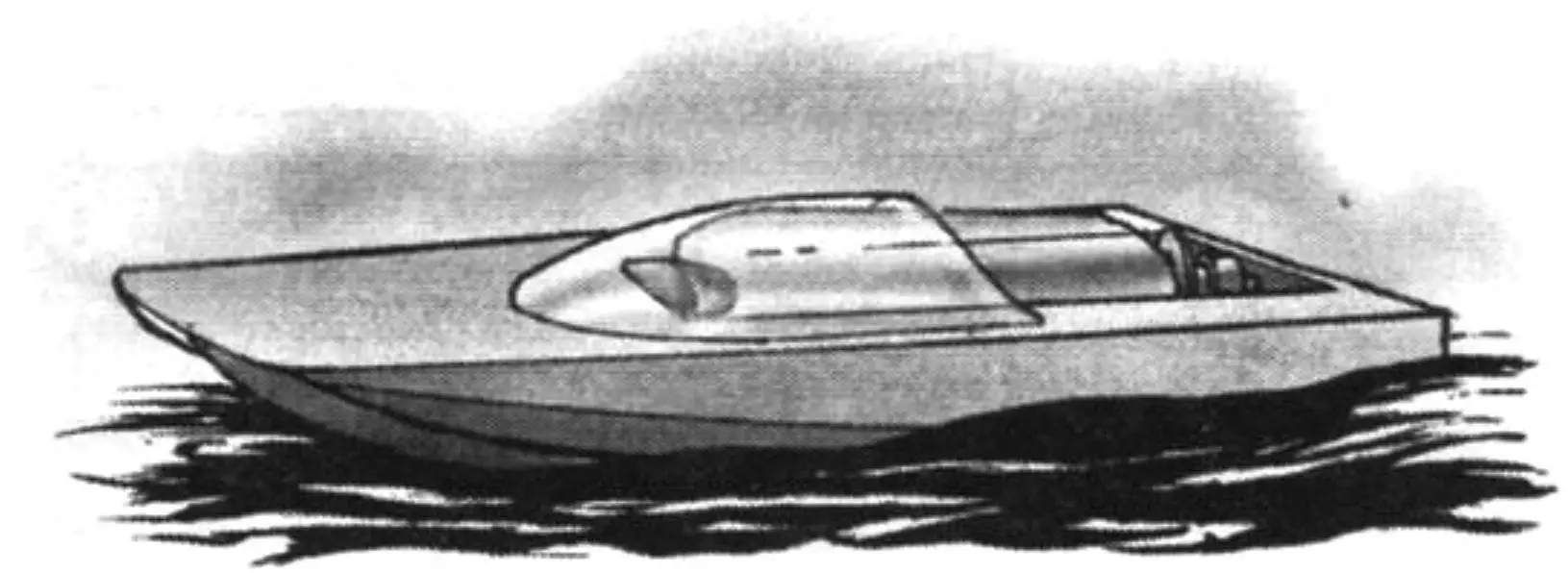
Another addition to our “bottle fleet” is a ship model fitted with a hydropneumatic water jet.
To turn a plastic soda bottle into an engine, it is enough to equip it with a fitting that will also serve as a reaction nozzle. Filled with water to about 2/3 of its volume, the bottle is placed in a socket on the model’s hull and charged with compressed air using a foot-operated car pump. The craft is then put on the water, the fitting is freed from the pump tip, and the reaction of the water jet from the nozzle accelerates it to a quite respectable speed.
For a small planing boat about 600 mm long, a 1 L bottle can serve as the basis of the hydropneumatic water jet (its length is usually about 325 mm and its diameter about 80 mm). A metal (duralumin) tube about 140 mm long with an outer diameter of 8 mm and a wall thickness of 1 mm will do for the fitting. An M8×0.5 thread is cut on one end of the tube. The fitting is sealed in the bottle cap using nuts, washers, and a self-hardening sealant. The part of the tube inside the bottle is bent — this makes it possible to use practically all of the so-called “working medium,” that is, the water poured into the cylinder.
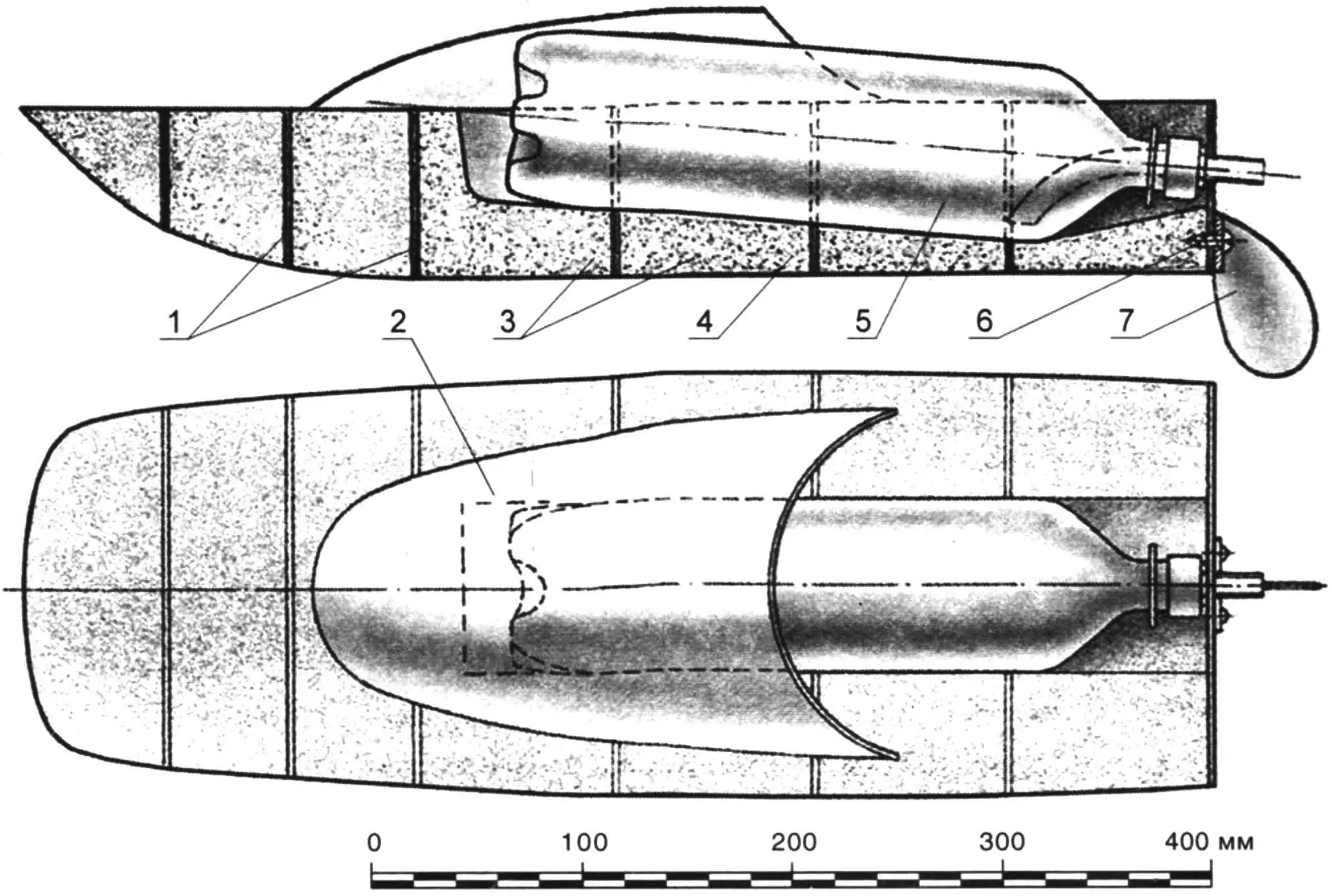
1 — frames (plywood s3 mm); 2 — fairing; 3 — filler (PS-type foam plastic); 4 — skin (fiberglass cloth and epoxy resin); 5 — hydropneumatic water jet; 6 — rudder-fin mounting (self-tapping screw); 7 — rudder blade
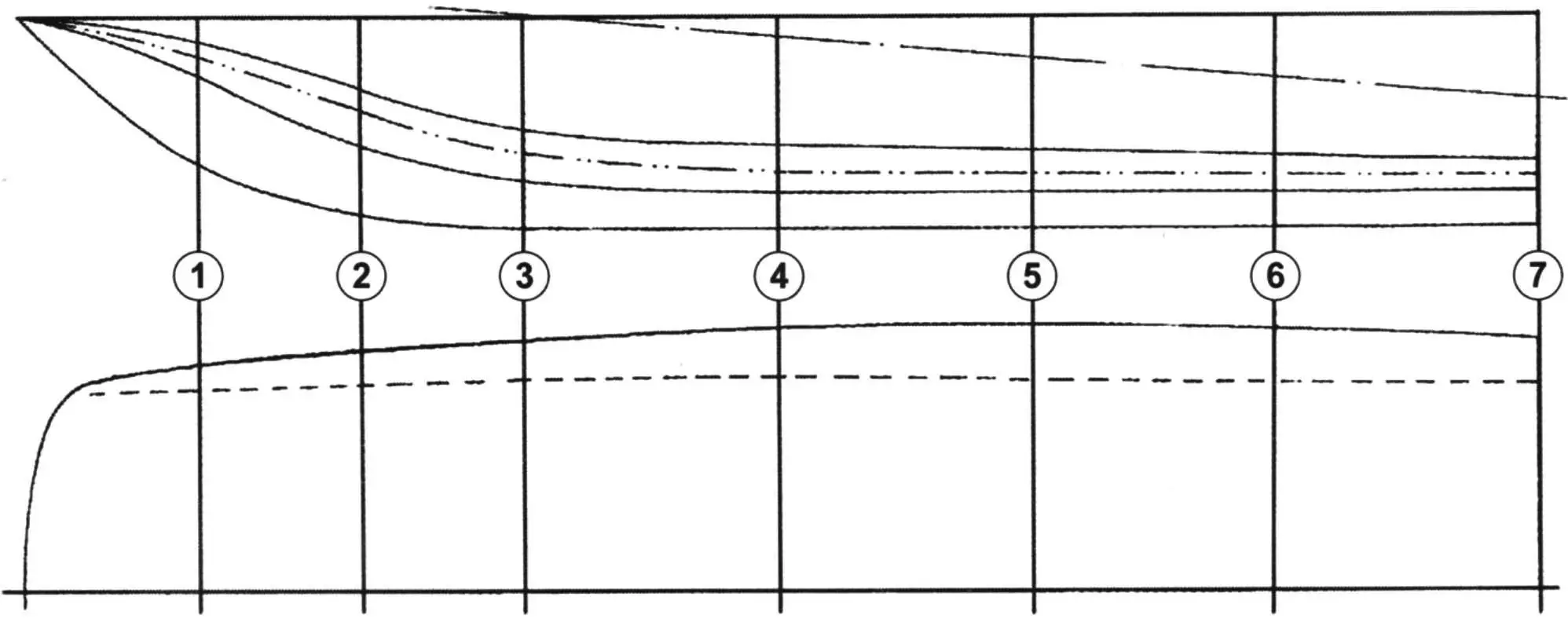
The model is a trimaran assembled by a simplified method from packing foam plastic and frames cut from plywood about 3 mm thick. Note that a 10 mm wide process allowance must be left on them on the deck side.
Assembly uses a building board measuring 200×700×30 mm, on which the frame axes and the hull centerline are marked. Along the frame axes, saw cuts 10 mm deep are made. The width of the cuts should allow a frame to be inserted easily and fixed there with miniature wooden wedges. In the same way, all frames are set up on the building board, and the spaces between them are filled with foam-plastic bars fixed in place with epoxy glue. After the resin polymerizes, excess foam is cut away with a sharp knife; the resulting hull is sanded with papers of various grit and covered with two layers of fiberglass cloth with an epoxy binder.
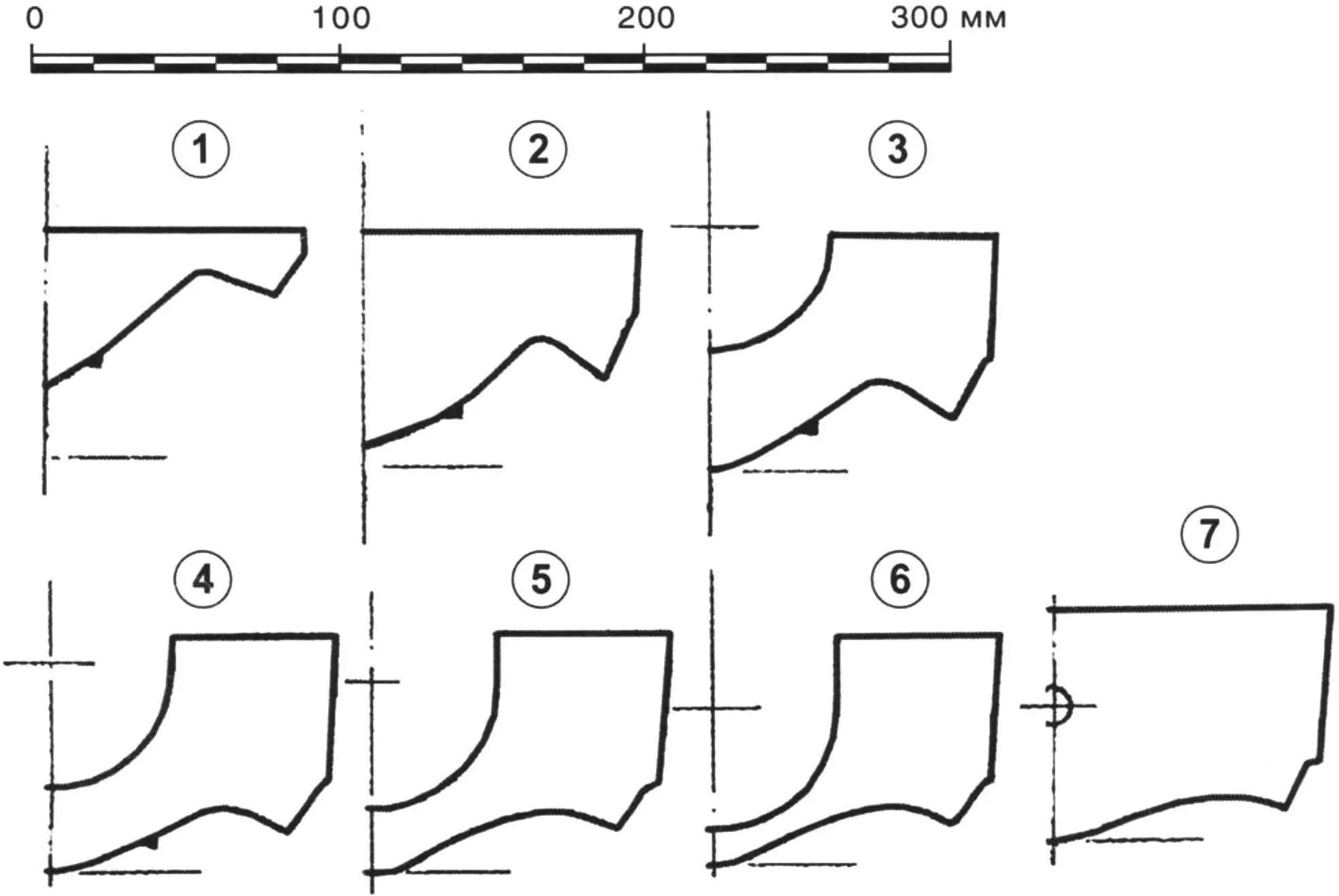
After the resin hardens, the hull is removed from the building board, a recess for the engine is cut in it, and the process allowance is trimmed from the frames. It remains to cover the deck with fiberglass cloth, prime the hull with epoxy, sand it, and paint it with enamel of a suitable color.
The model’s rudder is cut from a duralumin T-section or angle profile with flange thickness of 1–2 mm.
A canopy fairing can be fitted on the hull — a suitably shaped piece cut from a two-liter plastic bottle. After fitting the fairing to the deck plane, mark the joint line with a pencil, cut the foam with a knife to a depth of 3–5 mm, and fix the shell in the cut with the same epoxy glue. Such a canopy should be painted from the inside — then the outer surface will be glossy and uniform.
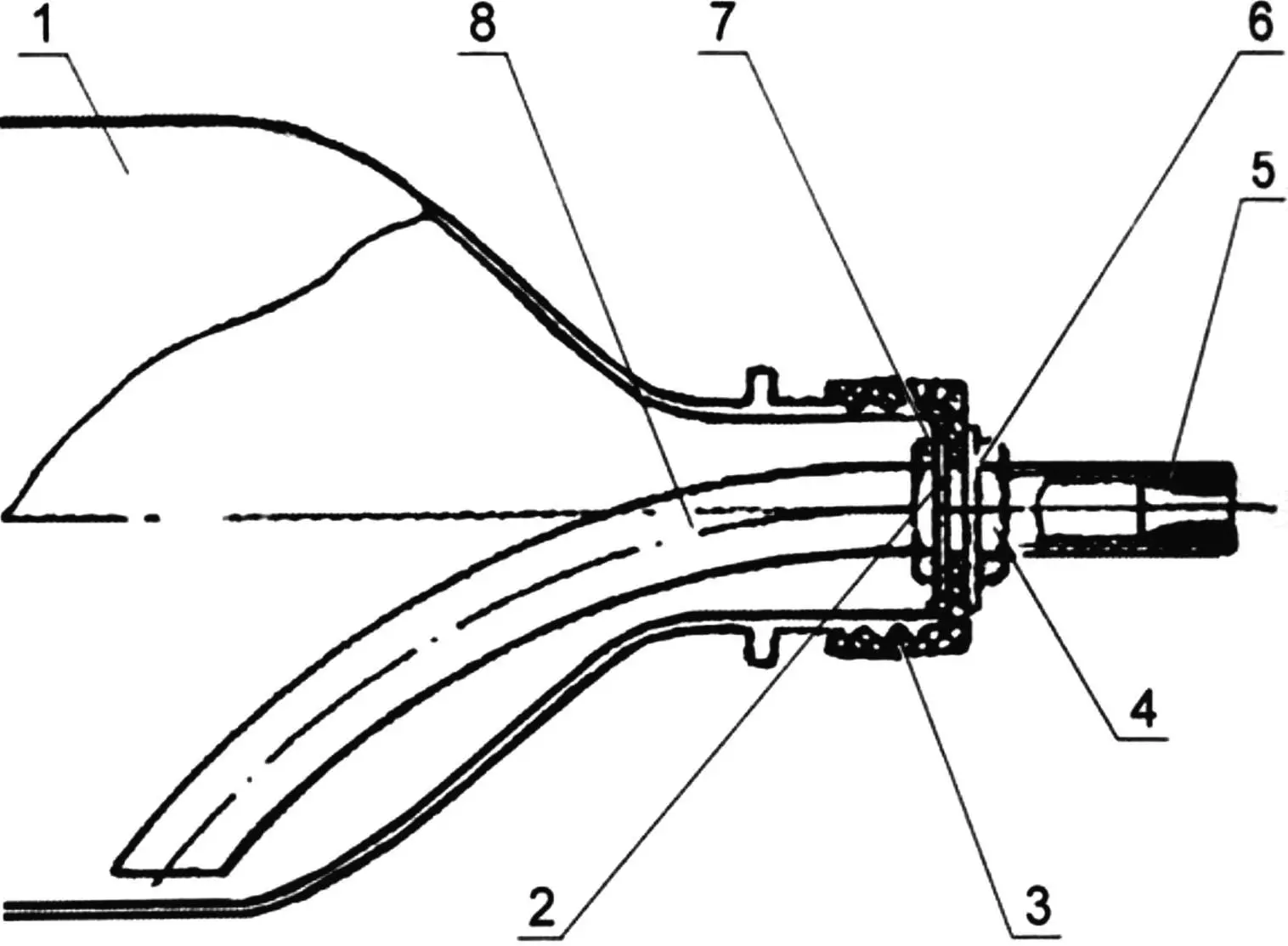
1 — cylinder for water and compressed air (1 L capacity); 2, 6 — washers; 3 — threaded plug; 4, 7 — nuts; 5 — nozzle (polystyrene); 8 — fitting (aluminum tube Ø8×1 mm)
The model’s speed and the running time of the hydropneumatic engine depend on the flow cross-section of the fitting. To find the optimum, it is most convenient to glue a plastic nozzle into the water jet and make a series of test launches, gradually enlarging the hole with drills of increasing diameter.
“Modelist-Konstruktor” No. 10’2025, Igor SLAVSKY
Recommend to read
 Sunken greenhouse
Everyone has a general idea of a greenhouse on a garden or homestead plot. Building one usually takes a lot of expensive, hard-to-get material: load-bearing metal or wooden posts, film... CONVENIENT SCREWDRIVER
The usual tip is a spatula she is hidden by a rubber tube. This sheath not only protects the working tip of a screwdriver, but pockets. Pulled the head of the screw, it will screw it in...
