Amateur boatbuilding is probably the most accessible and democratic form of hobbyist technical creativity. To build a small rowing/motor/sailing boat with your own hands, you need only the most common materials and simple tools. Registration of such a homemade craft with the supervisory authorities is either not required, or follows a logical scheme depending on the vessel’s purpose and parameters. In any case, it is far simpler than building and legalizing an aircraft or a car.
A dream that came true
In the modern world, where speed records and technological achievements grow ever more impressive, the voyage of French amateur seafarer Yann Quenet stands out for its special “atmosphere,” romance, and sincerity. The circumnavigation he completed in 2019–2022 on the homemade four-meter boat Baluchon is a story of love for the sea.
Yann Quenet lives in Saint-Brieuc (Brittany) on the coast of the English Channel. From childhood he was drawn to the boundless expanses of the sea, but the road to them turned out to be long. Only at the age of 50, having gathered his courage, did he begin to realize his cherished goal. “The first pancake came out a flop”… Having set out from Brittany, his 4.3-meter homemade boat Skrowl, after two months at sea and 450 miles from Madeira, was caught in a storm and sank. The yachtsman was rescued by sailors from a passing ship.
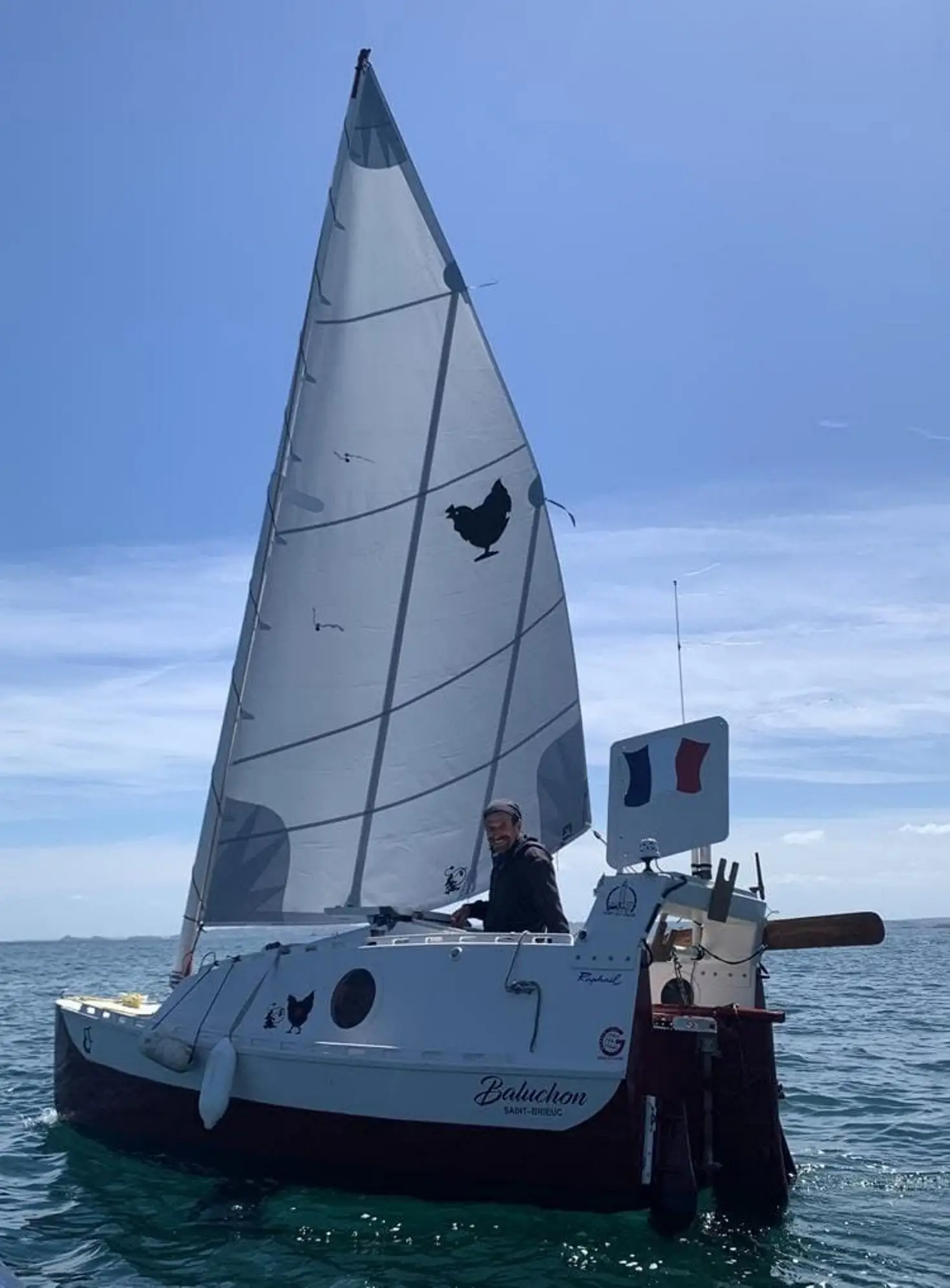
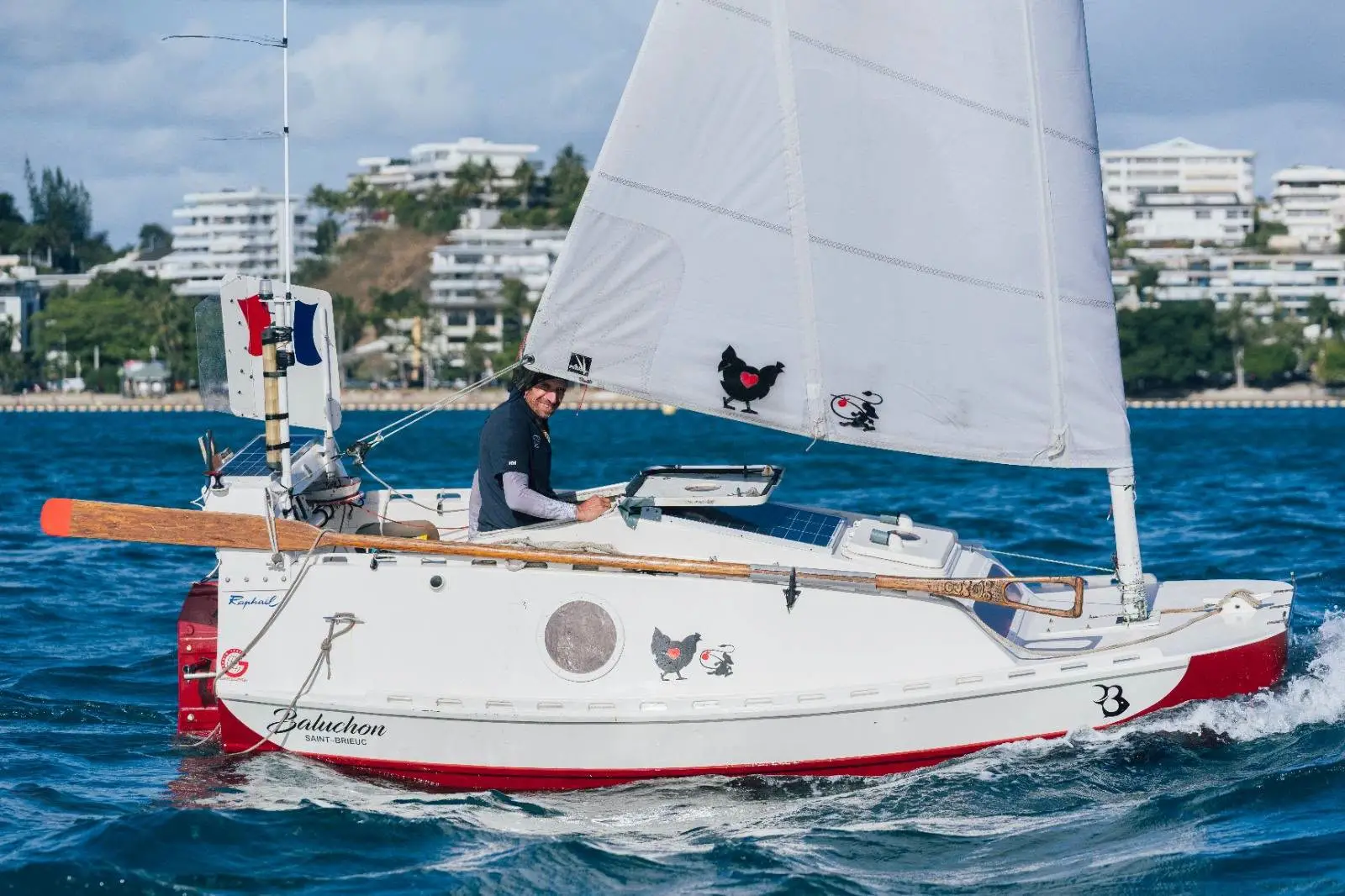
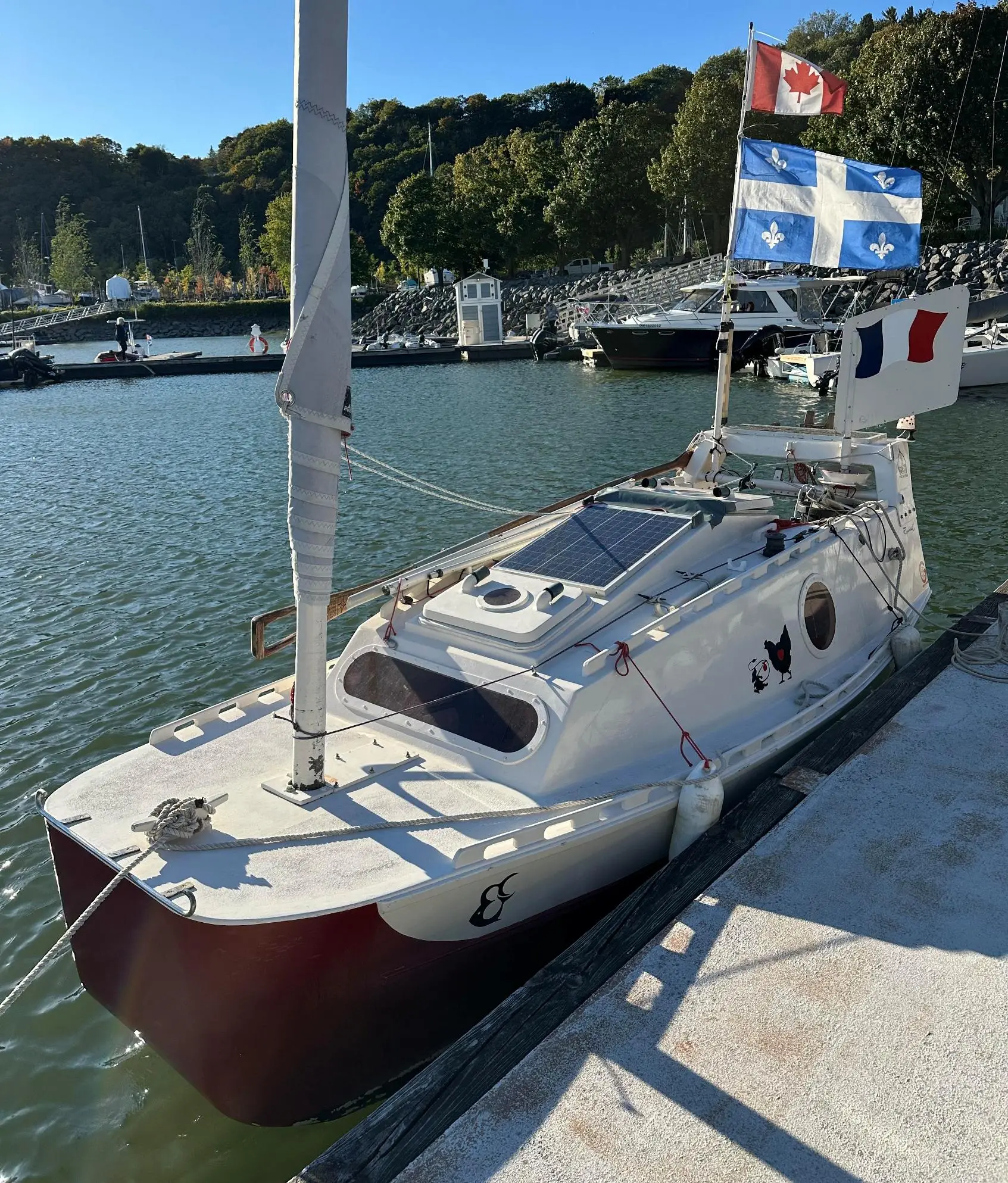
Returning home, Yann built a new yacht from laminated plywood. Its design is striking in its simplicity and thoughtfulness. At only 4 meters in length and 1.63 meters in beam, it is based on the lines of modern flat-bottomed Scow yachts (from Swedish for barge), which can glide over the water almost like surfboards. Craft of this type include children’s Optimists, dinghies, and Mini Transat 6.5 boats — participants in the well-known transatlantic race.
The yacht has no auxiliary engine: only a sail and oars as an additional means of propulsion. The interior of Baluchon is extremely compact and rational — here you find both a stores compartment and a cabin that Yann never left during the voyage, handling the sails through a hatch in its roof.
In several stages, stopping in ports for rest and repairs, the seafarer covered thousands of miles on his miniature vessel, spending three years in the open ocean. His diet on the passages consisted of the cheapest Chinese noodles. The motto “minimalism in everything” became his creed.
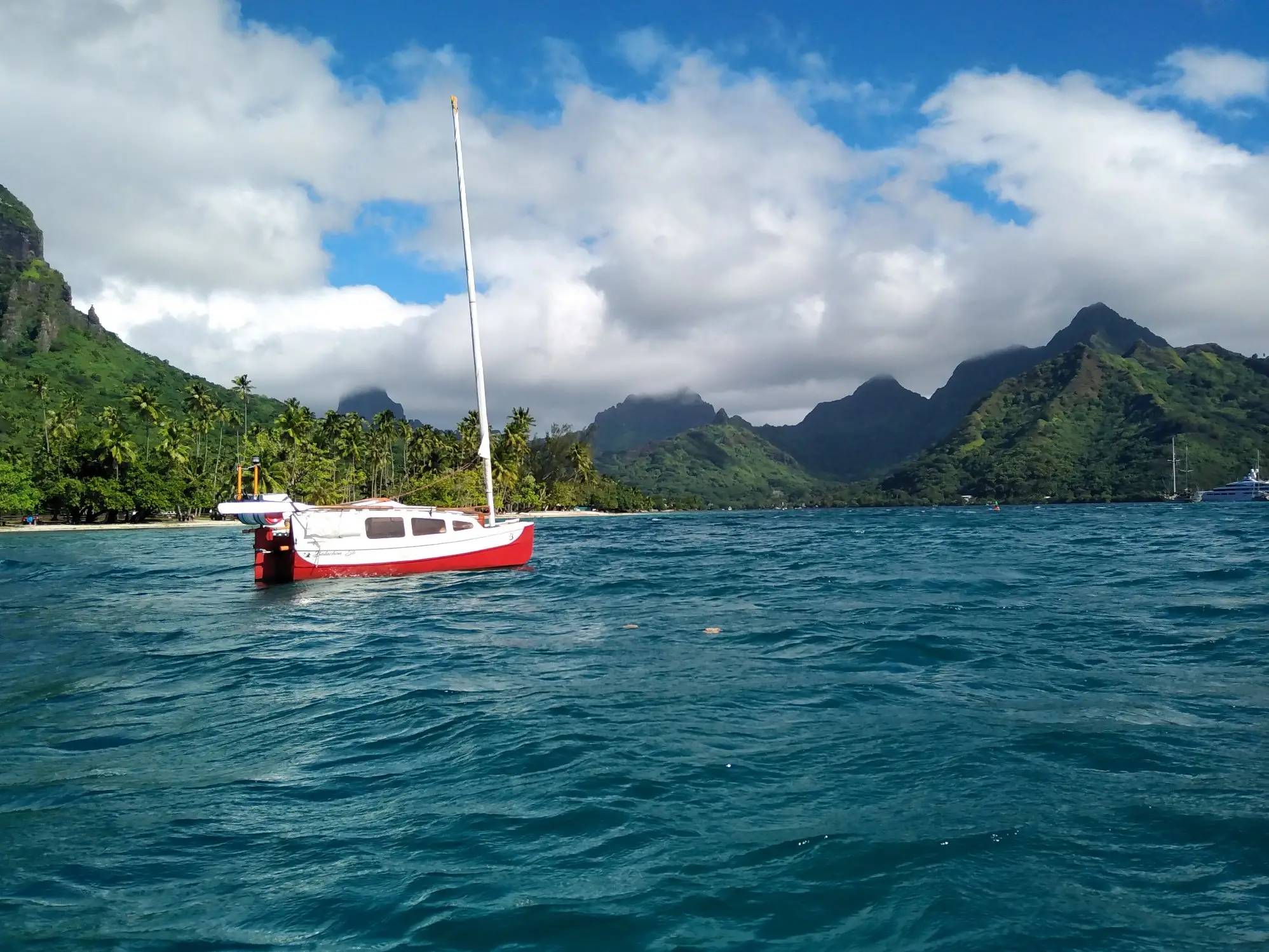
After successfully completing the circumnavigation, Yann Quenet immediately set about designing another mini-yacht and also published notes about his adventures. The book is free of heroic pathos; it is written with humor and even self-irony. Given the technical format of our magazine, we decided to publish some excerpts from it devoted to preparing for the voyage and to the boat’s design. Perhaps some readers of Modelist-Konstruktor also have a dream…
Yann Quenet. Around the world on Baluchon
…Back in Brittany, I took stock. I had failed badly with Skrowl, but I was by no means discouraged. Of course, there was no question of abandoning the idea of a circumnavigation. I simply needed to take a step back and try to analyze what had gone wrong…
A new boat
I had to look for money again and think carefully about replacing Skrowl. Dozens of sleepless nights and as many liters of tea, hundreds of sketches and new ideas took shape in the design of my new boat Baluchon (French baluchon — a traveler’s bundle). I decided that the name suited such a craft perfectly: small, light, quick to build, without fuss and with a sense of humor.
Baluchon, 4 meters long and 1.60 meters wide, differs slightly from Skrowl. It is narrower, but fitted with a deeper keel with a bulb — a kind of steel torpedo weighing 150 kg, located 90 centimeters below the waterline. This was meant to greatly increase the righting moment that Skrowl so badly lacked. Thanks to this improvement, the new little vessel should not remain upside down if capsized. Everyone makes mistakes, so let’s try not to repeat them.
From the day my son left the family nest, I felt pride in him and a sense of duty fulfilled for myself. From then on I intended to occupy myself only with interesting things. I had a long list of things that needed finishing before it was too late. Including my long-standing dream — a voyage around the world.
I quit my boring paperwork job in the Department of Equipment, which a certain weakness had forced me to keep far longer than necessary. At the same time, to top up my meager finances, I organized a micro-business designing and building small plywood boats. But apparently I lacked cunning and business acumen — the profits proved incompatible with my wish to return to the sea as soon as possible. Raising the funds took a little longer than I expected, but it could be called “the price of freedom.”
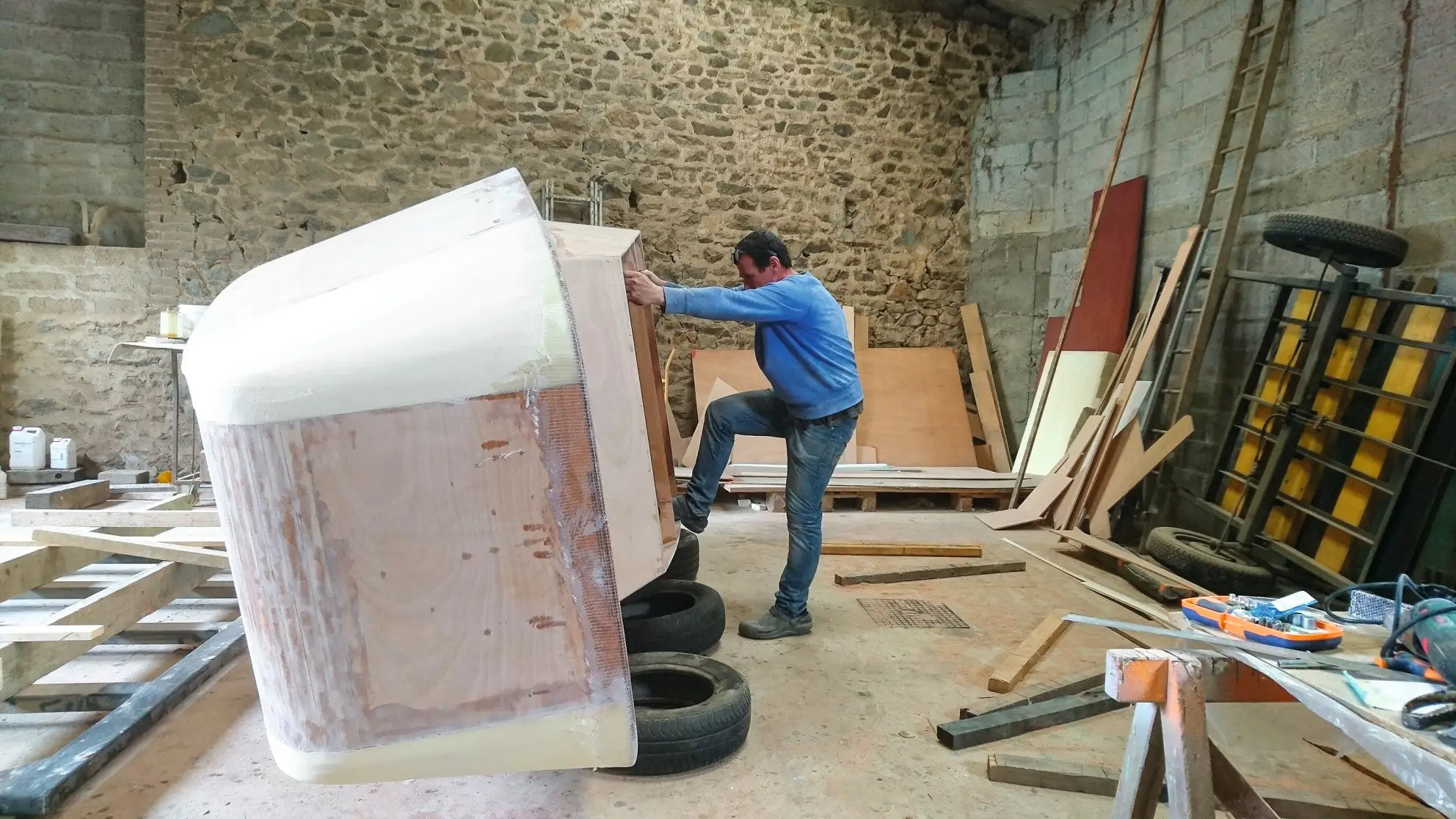
In the spring of 2016, eight months after the wreck of Skrowl, I began building Baluchon, alternating it with several commissioned jobs. The work was fully finished in the autumn of 2018, but the season had already passed, so I had to wait a little.
I decided to set out from Lisbon, roughly from the same latitude where Skrowl had been lost — a kind of logical continuation of my previous voyage. Moreover, since Baluchon was unregistered and I lacked the equipment required by the rules for sailing more than three miles from shore, this made it possible to avoid administrative hassles and a clash with zealous French marine officials who would have forced me to stay ashore.
Ever since I had returned with my tail between my legs after the Skrowl misadventures, I had become a target for jibes, cutting criticism, and lectures in the spirit of “I told you so!” I had to keep as low a profile as possible. Nevertheless, my new project was discussed on every quay. Some thought I was mad; others strongly doubted my abilities as a yachtsman. Still others said it was possible, but that a four-meter boat for going to sea was not very sensible and that it was, of course, a strange idea.
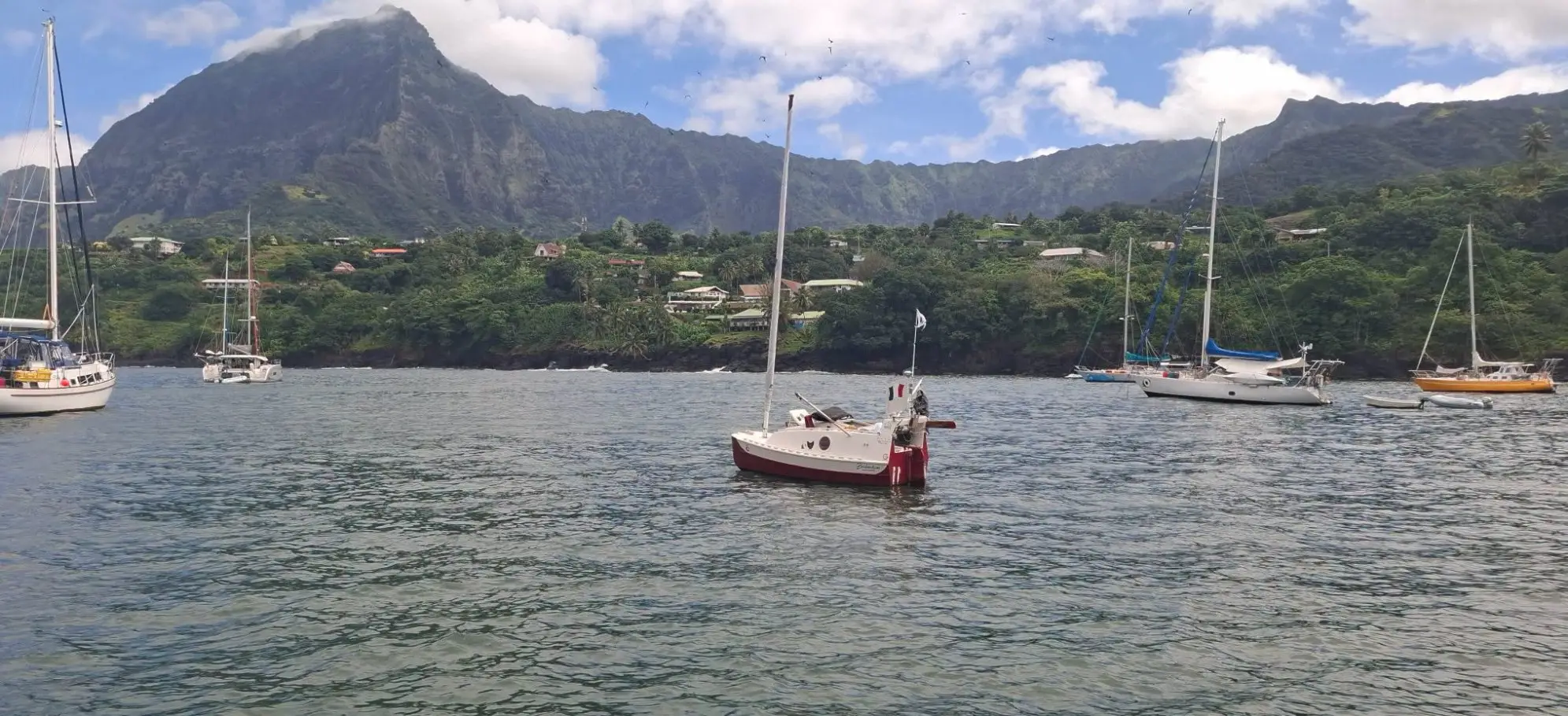
I carried out several sea trials to check how well the boat sat in the water and, most importantly, whether it could right itself if turned upside down. Then I modified a tiny trailer, cutting a hole in the middle for the keel, hitched it to my pickup, and one fine morning in the spring of 2019 left Brittany for Portugal.
Crossing France, Spain, and Portugal on small country roads was already an adventure in itself. My trailer did not fully comply with the highway code and was uninsured. Besides, the clutch was failing (I had missed the pickup’s inspection date), so I struggled over several rather steep Spanish passes. I do not much like driving and avoid motorways, so it took me almost three days to cover the 1,700 km to Lisbon.
Why is the yacht so small?
First of all, let me make clear that I chose to travel in a mini-boat not in order to get people talking about me. Such a thought would only have troubled me, and it was far from my outlook on life. Luckily for me, a record had already been set in an even smaller sailing boat: the Australian Serge Testa completed a circumnavigation in the 1980s in a yacht 3.60 meters long. I had absolutely no interest in chasing a place in the record books. Whose boat is the smallest is a rather absurd game that did not fit my project. I simply wanted to sail. It is worth noting, however, that Testa’s hull, at 3.60 m, had a bowsprit, which means that to within a few centimeters our craft were practically the same size.
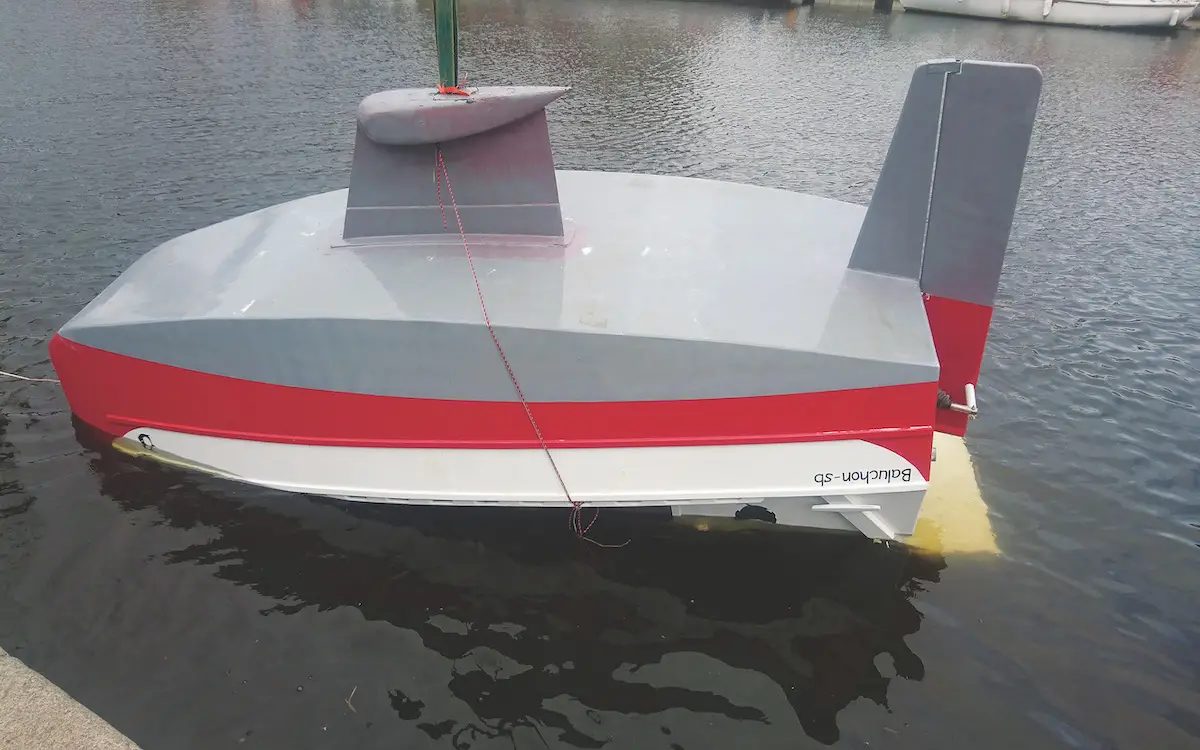
The idea of a small boat came to me gradually; it was the fruit of several years of reflection, building, and sailing other yachts of various sizes. It is not impossible, though, that the real reason I made this choice is that large yachts are built for “big” people with standing in society, for those who prefer a comfortable solid house rather than some kind of birdhouse. Deep down, even though I was already past 50, I still saw myself more as a boy than as a responsible adult. The pleasure I got from my “toy” boats was akin to that of a child assembling a model sailboat and delighting in the idea of trying it on a stream or a pond in a nearby park.
Virtually everyone, before becoming a yacht owner, has to work and save enough money to afford one. But as soon as you buy it, you constantly have to solve a host of technical and financial problems, which in the end can become very exhausting. By definition, everything on a sailboat eventually breaks, so you have to keep working again and again to keep the damn fragile thing seaworthy. I will not lecture anyone, but the time allotted to us on earth is, in my view, far better spent on travel than on financing the upkeep of a yacht. Some people like to pamper their boat and equip it with the latest technology. That choice deserves respect, but it is not for me. The less time you spend in a dock or at a desk in an office, the better!
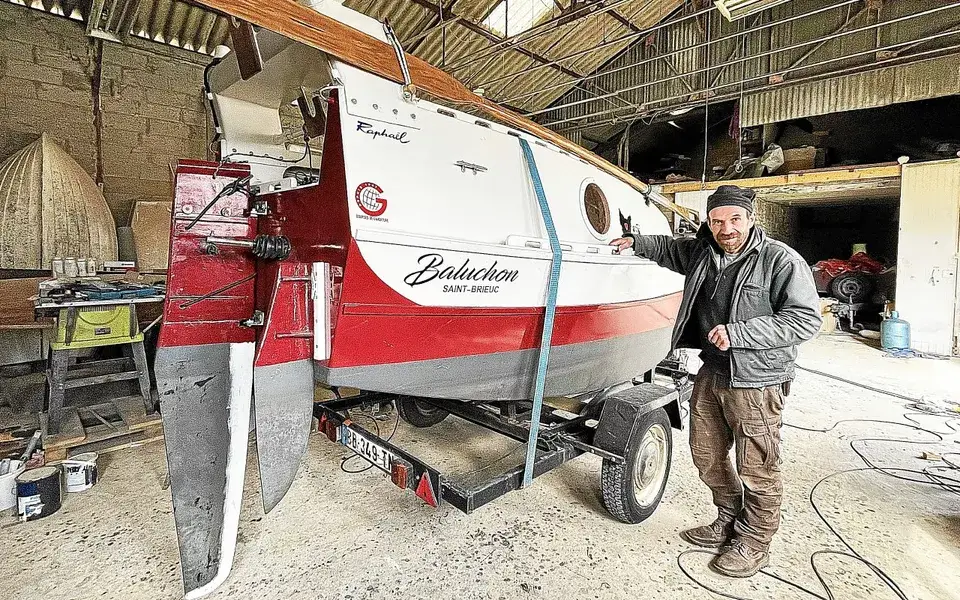
I wanted a boat that was simple to handle, cheap, and reliable (in other words — for a lazy person). After looking around many of the world’s yacht shows, finding such a craft proved impossible: those who build yachts, like the buyers, want boats that are complex, expensive, and unreliable. To these features one should add speed and comfort — qualities quite alien to me that immeasurably complicate and weaken the structure.
Unwilling to indulge anyone more than myself, I decided to build my own boat. Moreover, it had to be super-fast to build, since a “pleasure” stretched over many years did not appeal to me.
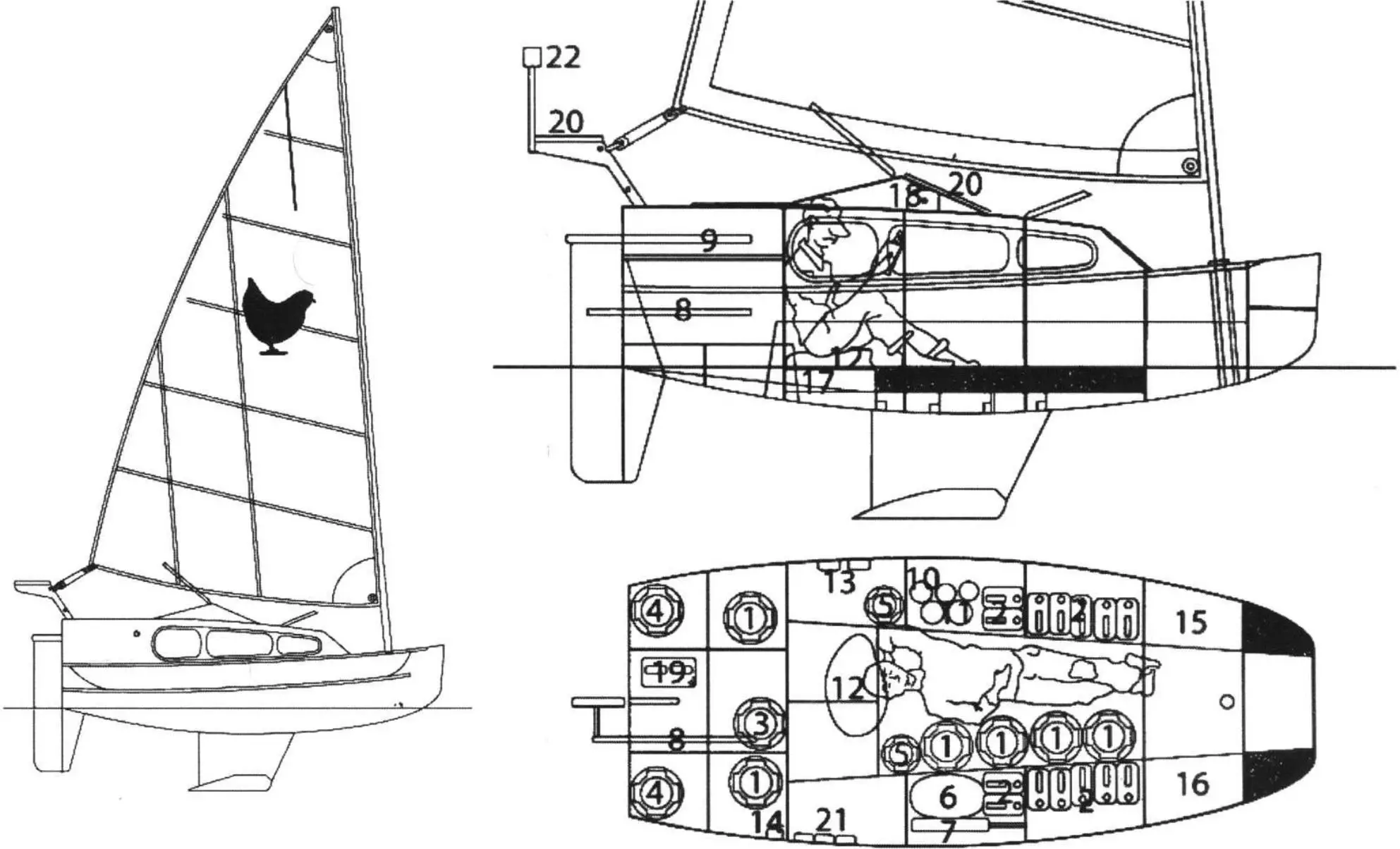
1 — food containers; 2 — fresh water in 5-liter jerry cans; 3 — first-aid kit; 4 — repair materials; 5 — gas stove and electronics (smartphone, tablet, camera, tracker); 6 — protective bag; 7 — electric autopilot; 8 — interior panel; 9 — exterior panel; 10 — tools; 11 — provisions
Another important advantage of a mini-boat is that it can easily be transported by road without a heavy truck. This makes it possible, if necessary, to cross a stretch of country by land, or to store the boat away from a marina or yard if it has to be left ashore for an indefinite time. That possibility gave more freedom and peace of mind.
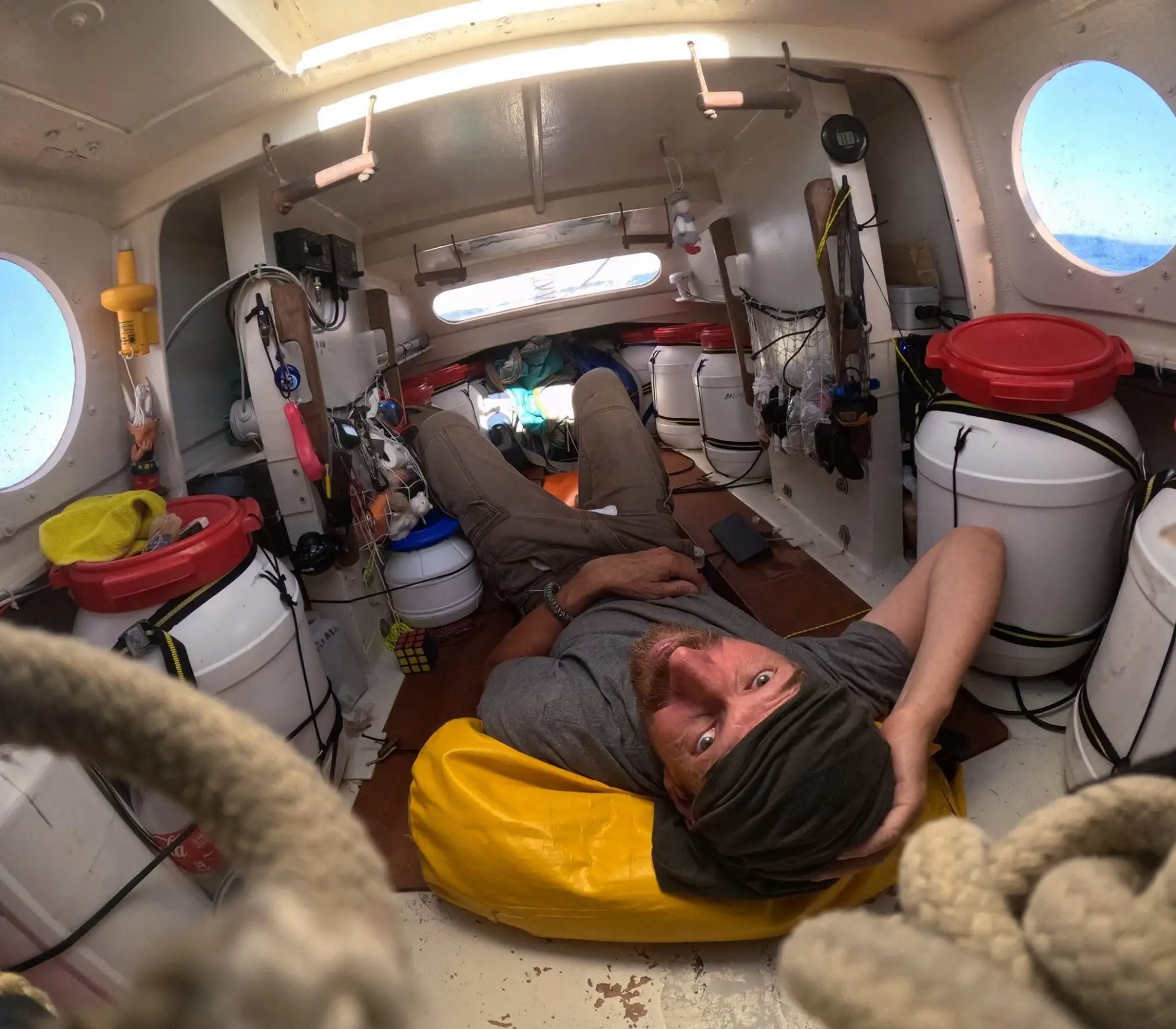
From a safety standpoint the adventure did not seem more dangerous to me than it turned out to be in reality. This time the boat was designed from the start to be unsinkable and self-righting. In very bad weather, small and light, it behaves like a cork, offering no resistance to the elements. Being in it in a storm is not very comfortable, but I have every chance of getting out of a scrape (provided, of course, I remember to close the hatch in time). It is also important that the yacht can be sailed from inside the cabin, which removed the need to work on deck — the main cause of accidents on sailing vessels.
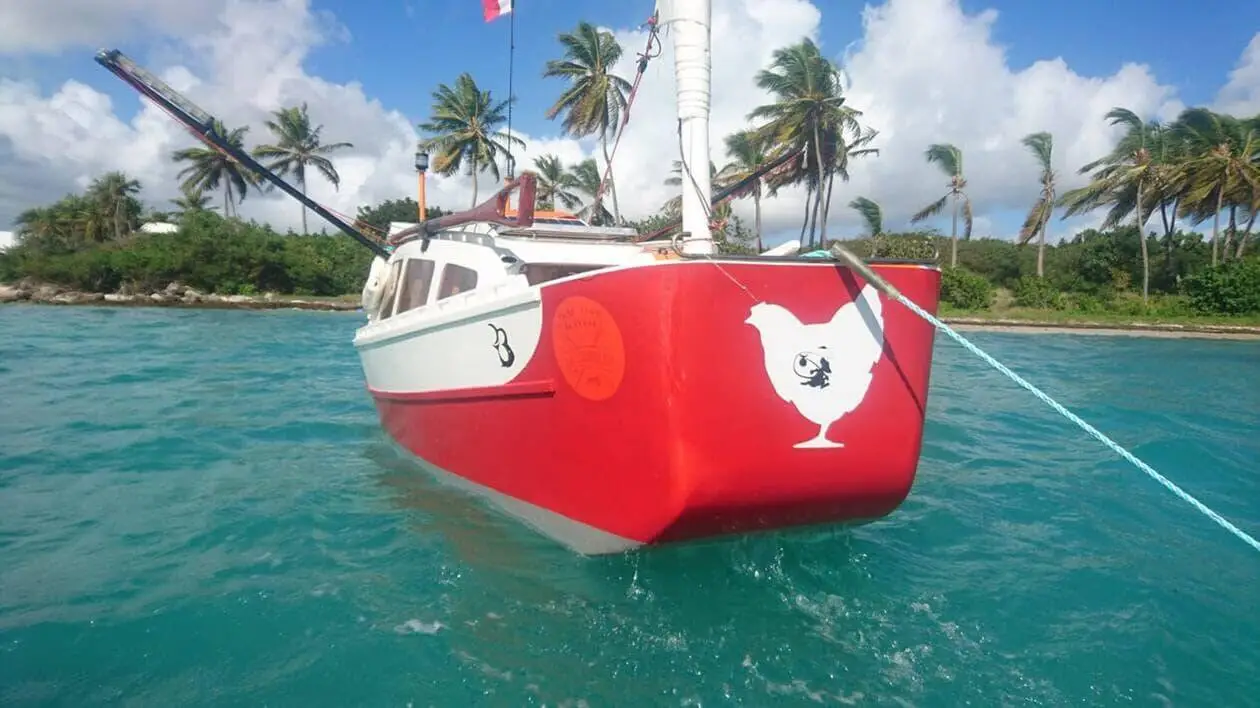
Baluchon: technical details
Combining all the factors listed above, after long hours of reflection I arrived at the concept of a very small ocean yacht. But to complicate my life a little more, I had to observe certain constraints: stay within a budget of 4,000 euros (the sum I had saved by the time work began) and build the boat in 400 hours. Such a brief, by the way, is a good way to see a plan through with the maximum chance of success.
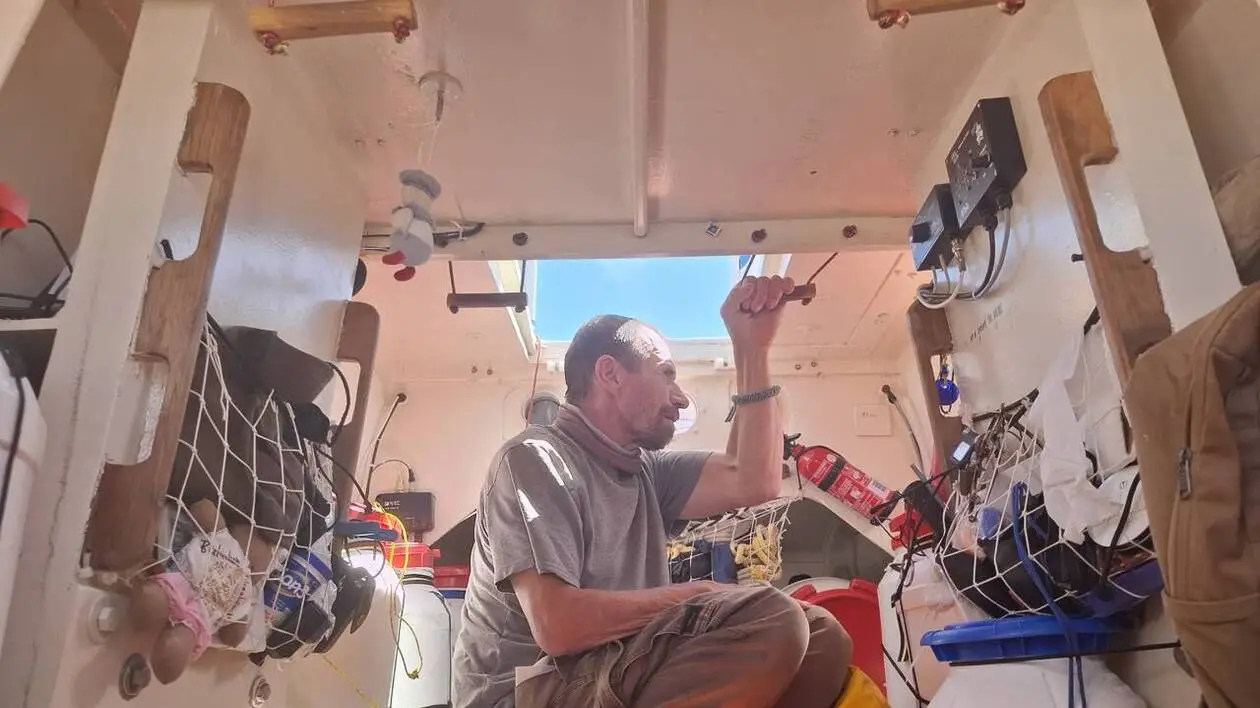
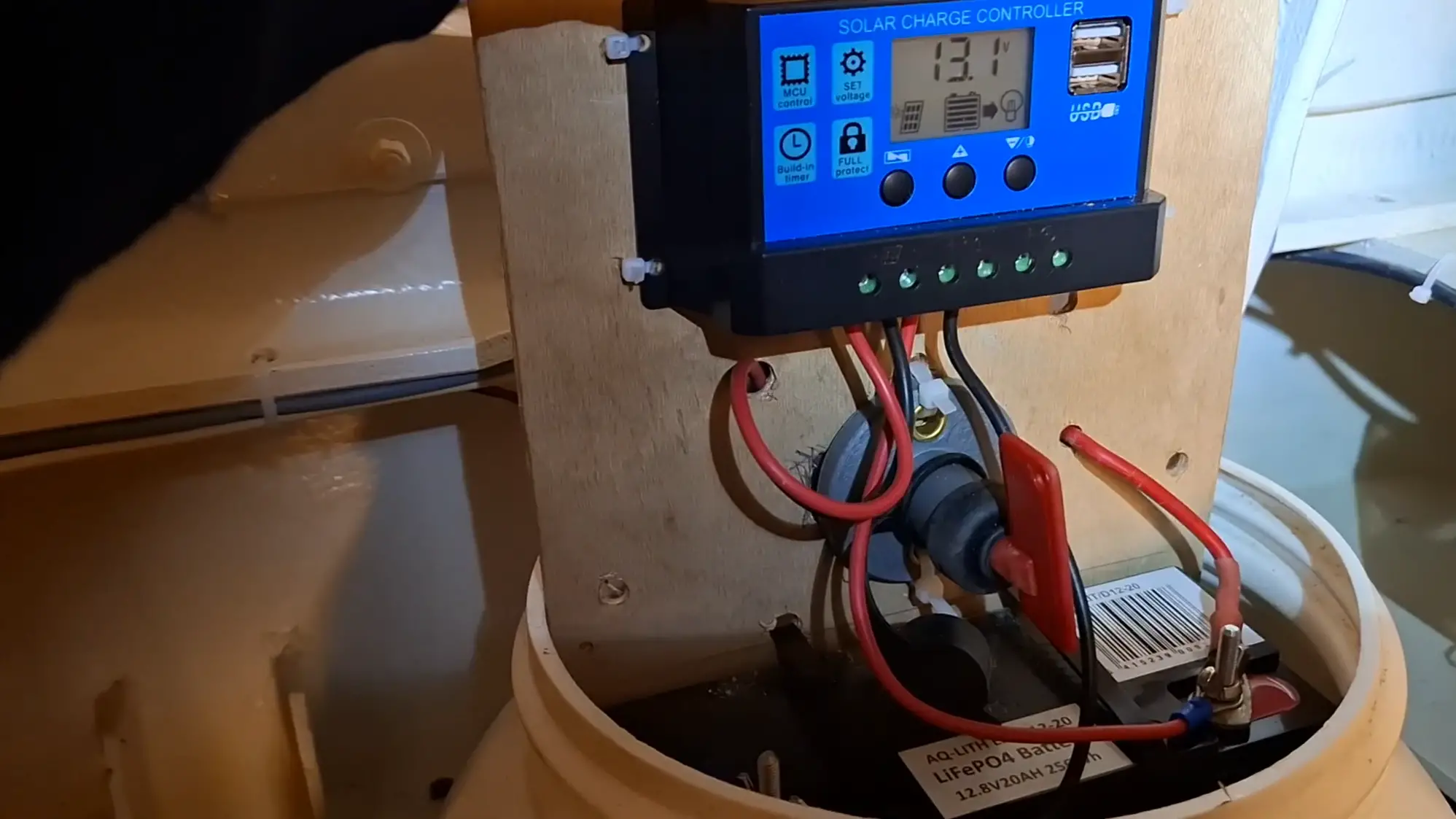
The 4,000 euros / 400 hours scheme almost worked. Already on the first trials the boat tacked well, but about another hundred hours were needed to increase the keel weight and make a few changes. Plus about 1,500 euros to buy an inexpensive autopilot, two batteries, a pair of small solar panels, an emergency signal detector, a used handheld VHF radio, and a personal locator beacon. Clearly, in such a financial situation there could be no question of an auxiliary engine, a navigation system, or means of communicating with shore.
And even that modest budget I managed to meet only thanks to a “hunter’s instinct.” For example, the keel cost me the price of the eight bolts that fasten it to the hull. The keel itself was made from two steel plates 1 cm thick that I had stockpiled several years earlier when a factory nearby was being demolished. Its weight was topped up with a few pieces of lead gathered “here and there.” The same can be said of the paint, nuts, and bolts left over from my previous work or found in boat yards. I replaced Plexiglas for the large portholes with plywood. Used hatches I bought at a sale for next to nothing. About forty percent of all the expenditure went on buying two carbon-fiber tubes for the mast and having the sail professionally made.
You do not need to be a genius of marine engineering to understand that designing a mini-boat is not a matter of copying a larger vessel and then shrinking it. Such “extrapolation” can produce results poorly adapted to reality. Whether you go alone in a 10-meter or a 4-meter boat, the amount of fresh water, food, and necessary gear is the same. In the second case it is even greater, because it is clear from the outset that the voyage will last longer. In light of that fact I had to look for hull lines capable of carrying a large load for their size without losing speed. And that, of course, strained the brain. The goal was not to create an especially fast boat, but a difficult equation had to be solved. The longer the passage, the more food and fresh water you need to take. At the same time, the more stores you have on board, the heavier the boat and the slower it goes — and so the passage becomes longer… As you can see, designing a hull for a very small ocean boat is not so simple!
I also wanted to put into practice a rather strange theory that had long been spinning in my head. In the hull design of racing and cruising monohulls over the past few decades there has been a serious evolution: yacht builders have gradually moved from narrow, heavy, deep hulls that cut the water like a knife to lighter, shallower, flatter forms that behave like a spoon sliding over the water or a skipping stone. These changes have partly caused the incredible growth in boat performance in recent years. The difficulty constructors face is combining the necessary hull volume with a sufficiently fine bow, so that the boat does not push water as it gathers way and does not slam its bow from side to side when pitching. In the case of a small boat the effect of pitching is practically zero (unlike heel, which is much stronger). A sharp bow is not justified here. The behavior of a mini-yacht on the water should resemble that of a sled on snow more than that of a fine-bowed yacht cutting through waves. In my view, an almost square bow is by no means heresy. It greatly increases load-carrying capacity and helps avoid burying in the waves during uncontrolled “surfing rides” (broaching). This type of bow is beginning to be widely used today in some ocean races, especially in the Mini class. Of course these arguments are greatly simplified and hydrodynamics is far more complex, but these ideas formed the basis of my decisions.
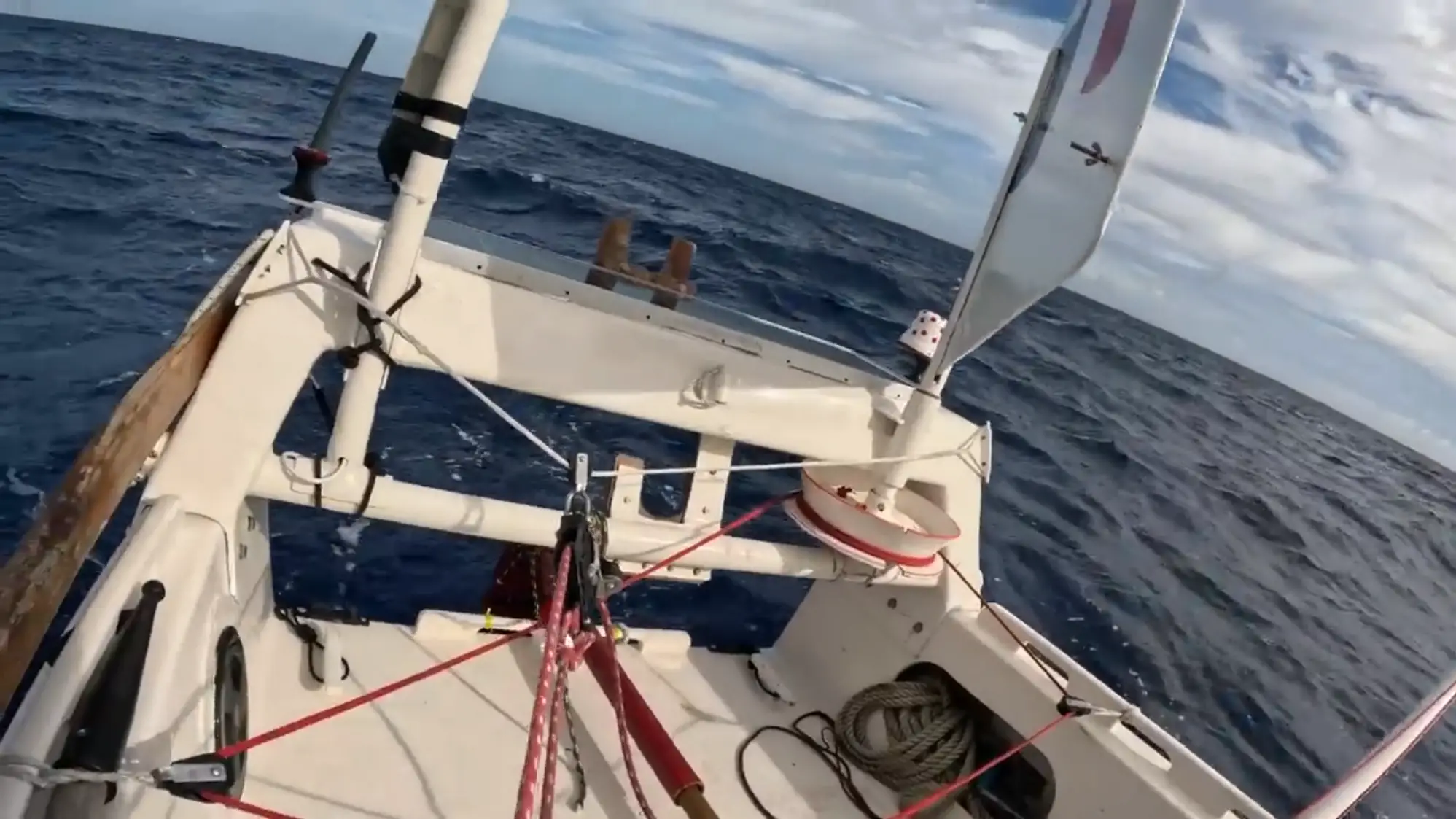
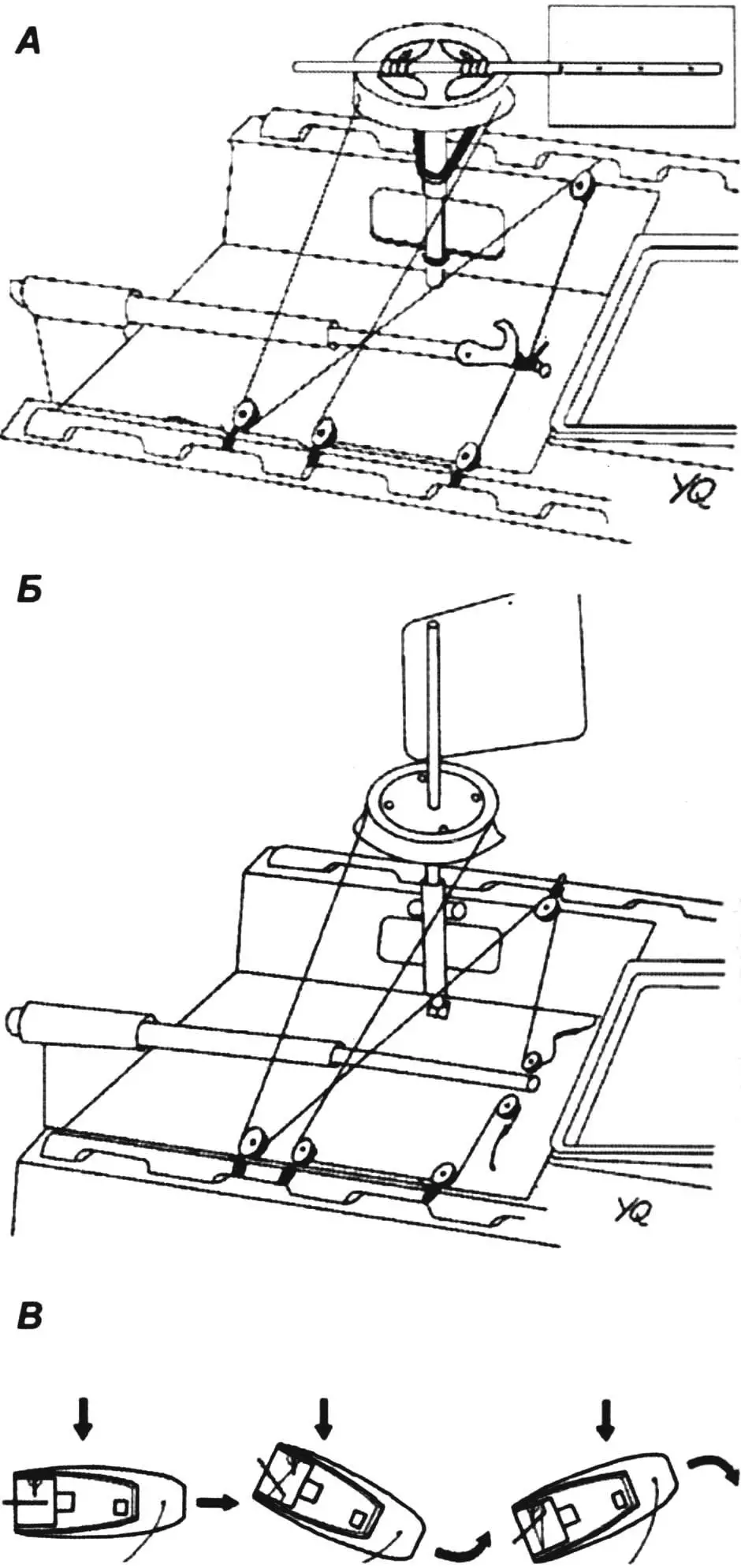
A — Biber-1; B — Biber-2; C — operating diagram
Now about the sails. At present most yachts are fitted with two more or less triangular sails: one forward of the mast and one aft of it. This type of rig, the result of a long evolution, is best suited to racing or fast cruising. But it is not very practical for unhurried single-handed voyages in a mini-yacht. Such a setup consists of kilometers of various ropes and a host of parts with complicated names: fairings, turnbuckles, jibs, spreaders, pins, clevis pins, sheaves, fittings, and so on. The mainsail roller-reefing alone contains several bearings and a pile of other parts not very suited to the marine environment. If something in this “composition” breaks, the mast has every chance of falling — which is rather unpleasant.
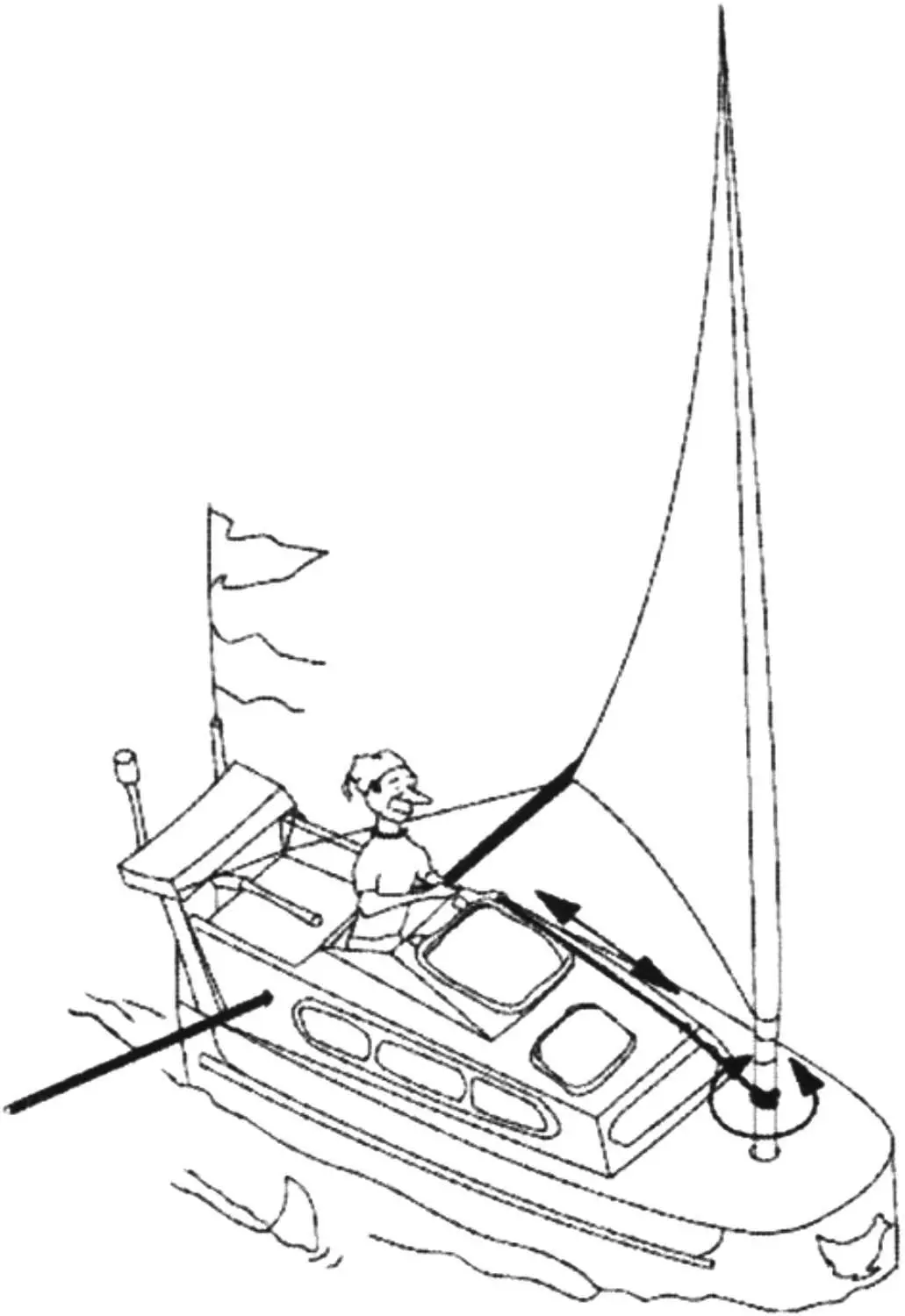
I wanted to simplify Baluchon’s sail plan to the extreme, so that it would be reliable and easy to use — and at the same time self-trimming, with the fastest possible system for reducing sail area. It consists of a carbon-fiber mast that rotates freely in a vertical well running right through the boat. At the bottom of the well is a small stainless-steel pin that serves as a pivot. On deck, for the mast to pass through, there is an epoxy ring that sometimes needs greasing. There is only one sail, which wraps around the mast. The absence of a jib, and thus of compression on the mast, eliminates the need for spreaders: the mast only bends, like a fishing rod, making the whole rig far more flexible and therefore stronger than a conventional one. Since there is no boom, during sailing outrigger poles are permanently set on each side to help spread the sail with the sheets.
Autopilot. This device, named Biber, I assembled in the Indian Ocean after leaving New Caledonia. The old batteries refused to hold a charge, and the bought electric autopilot became useless. Here the wind vane acts directly on the tiller. Naturally, the arrangement only works if the boat is not too heavily loaded, is on course, and is perfectly balanced. The steering lines must not be too tight or too slack. At first the setup was achieved by much trial and error. For it to work in light air, it is best if the vane area equals the wetted surface of the rudder. Mine was half that, which meant I had to reef earlier and lose speed. Many also advise fitting a counterweight on the vane (perhaps it is human nature to complicate simple things); in my case it was unnecessary. Biber-1 steered superbly for nearly 7,000 miles between New Caledonia and Réunion, and Biber-2 covered the rest of the way to Brittany — 9,500 miles in all.
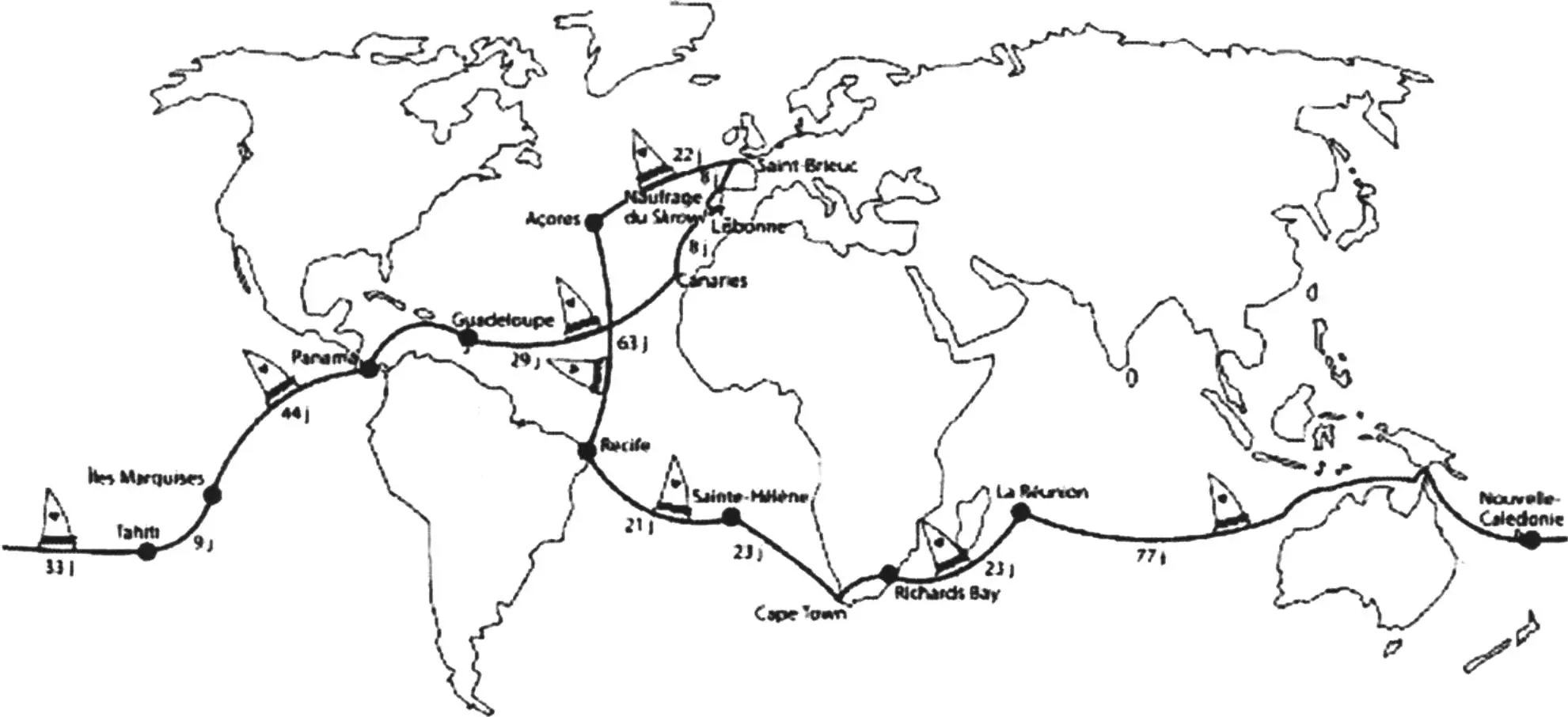
First stage: Lisbon — Canaries, May 2019; across the Atlantic — Arrecife (Lanzarote) — Guadeloupe, November 2019; Guadeloupe — Panama, February 2020.
Second stage: Pacific Ocean, Panama — Marquesas, March 2020; Marquesas — Tahiti, June 2020; Tahiti — Leeward Islands; Raiatea — New Caledonia, September 2020.
Third stage: Indian Ocean, New Caledonia — Réunion, May–July 2021; Réunion — South Africa, October–November 2021; South Africa, November 2021 – January 2022.
Fourth stage (return): Cape Town — St Helena, January–February 2022; St Helena — Brazil, March 2022; Brazil — Azores, April–June 2022; Azores — Brittany, July–August 2022.
Being entirely self-taught — designer, builder, and navigator in one person — I had a great advantage over professionals with long experience in their fields. I was influenced by neither tradition nor convention; I could use any simple solution without suffering the feeling of devaluing knowledge acquired by long hard work. I could afford not to hold endless meetings, not to get angry with myself over trifles, and not to face the perennial problems inherent in any team effort.
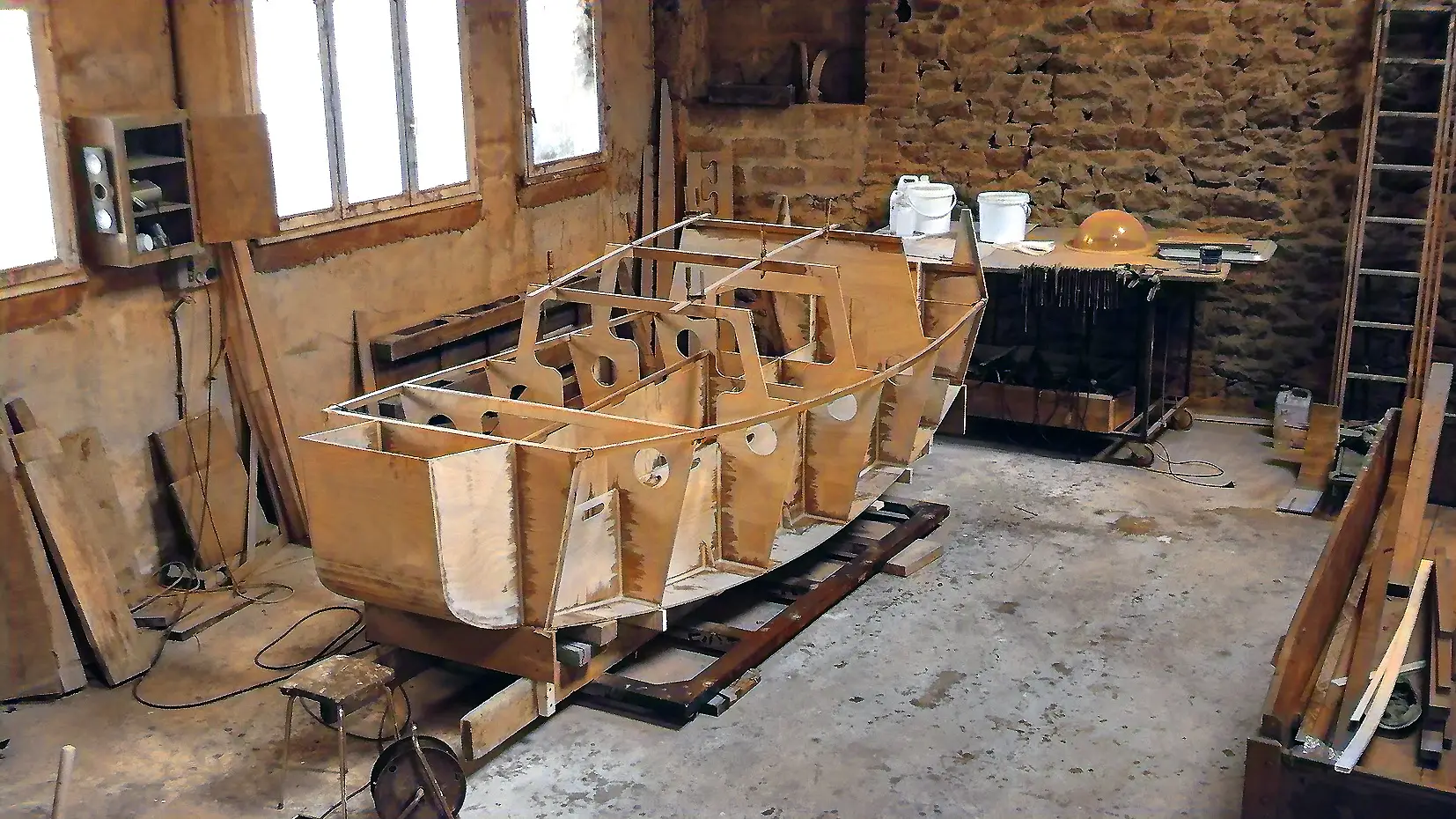
For building the boat I chose a technology I particularly like — plywood, fiberglass cloth, and epoxy resin.
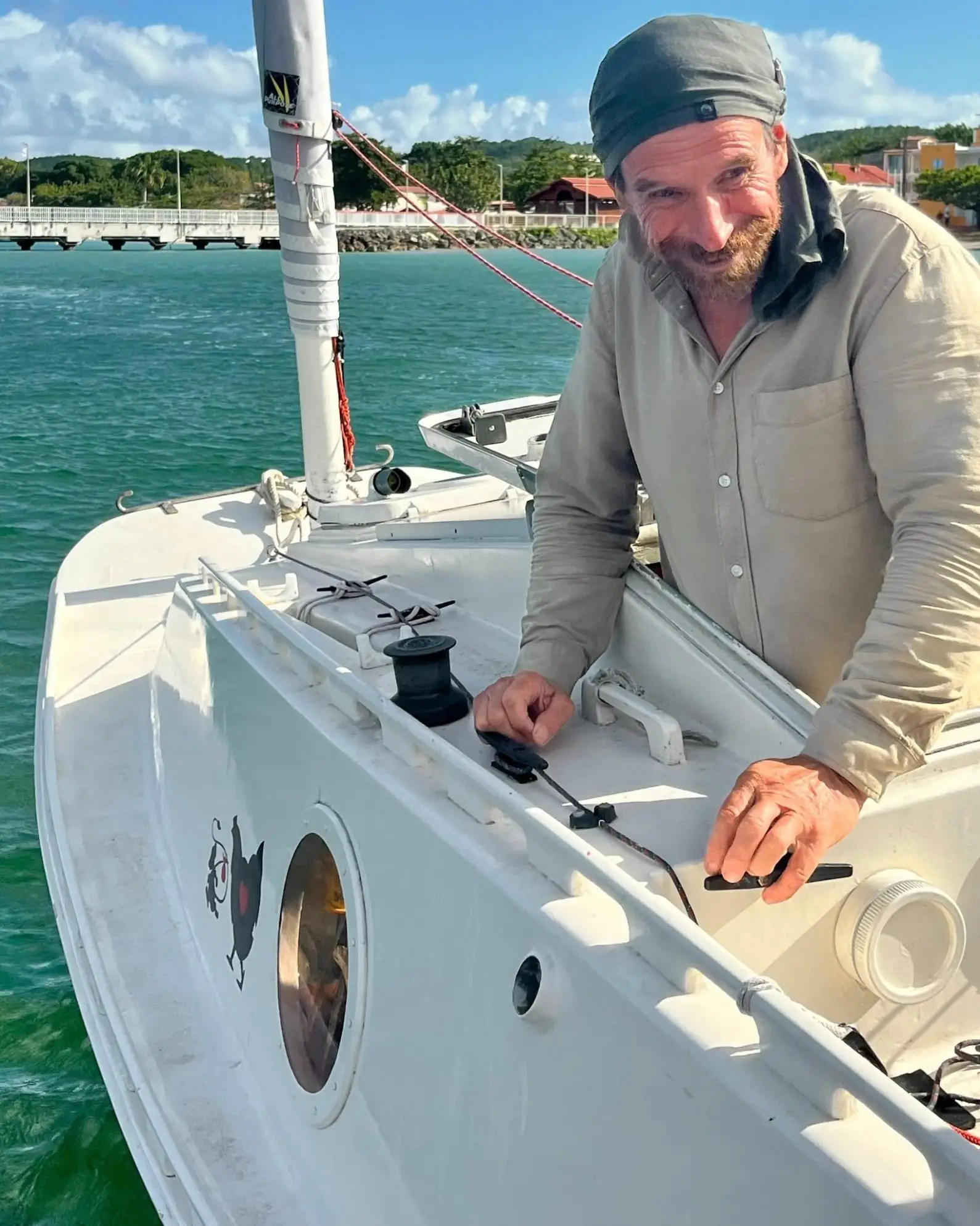
Epoxy can be used as a high-strength two-component adhesive or thickened to obtain a uniform putty for joining plywood panels and bonding fiberglass to wood. The only real limitation: you cannot work with epoxy resin below 18°C — you either have to heat the workshop in winter or build boats in summer.
And so, with only three basic materials, plus a jigsaw, a spatula, scissors for cutting fiberglass, kitchen scales for measuring the adhesive mix, a Swiss Army knife, and a little common sense — you can build a super-strong ocean yacht. You will get pleasure from it and experience real adventures!
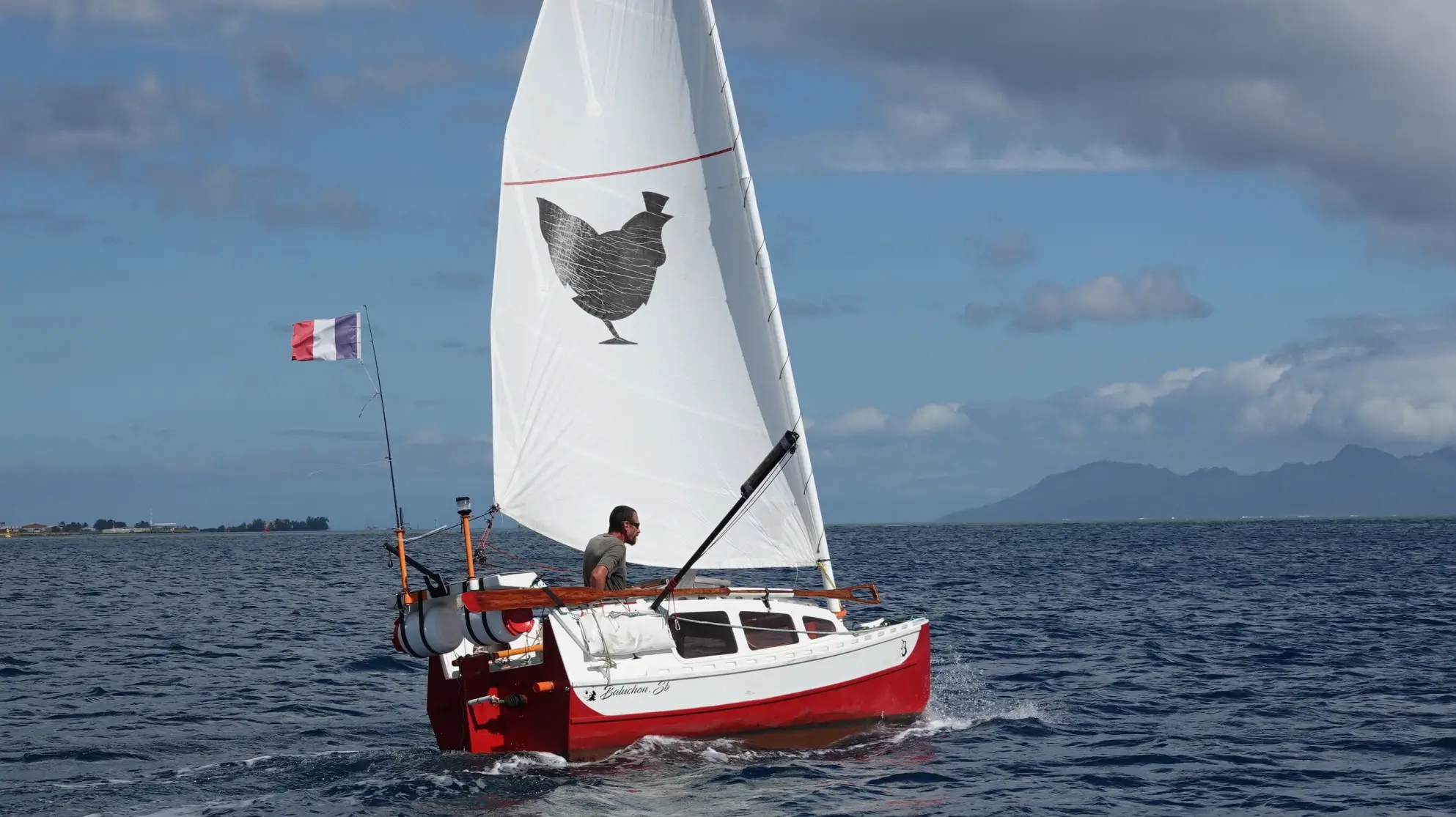
Technical specifications of the mini-yacht Baluchon
Hull length, m … 4.00
Waterline length, m … 3.77
Beam, m … 1.63
Draft, m … 0.90
Light displacement, kg … 550
Ballast (bulb/keel), kg … 150/50
Sail area, m2 … 11
Mast (length/weight), m/kg … 7.3/7
Hull material … 9 mm plywood
Modelist-Konstruktor No. 10’2025, prepared by Sergei ABASHKIN, illustrations from Yann QUENET’s book
Recommend to read
 Power plant in a backpack
It's getting dark. The sun is slowly setting towards the horizon. Dusk is coming. It’s still early to go to bed, I want to read and play chess. For motorists, energy for lighting is... DRYER WITH LIFT
How many ropes for drying clothes should be in the house? Where and how it is better to place in a small apartment? These and similar questions become particularly acute when the family...
