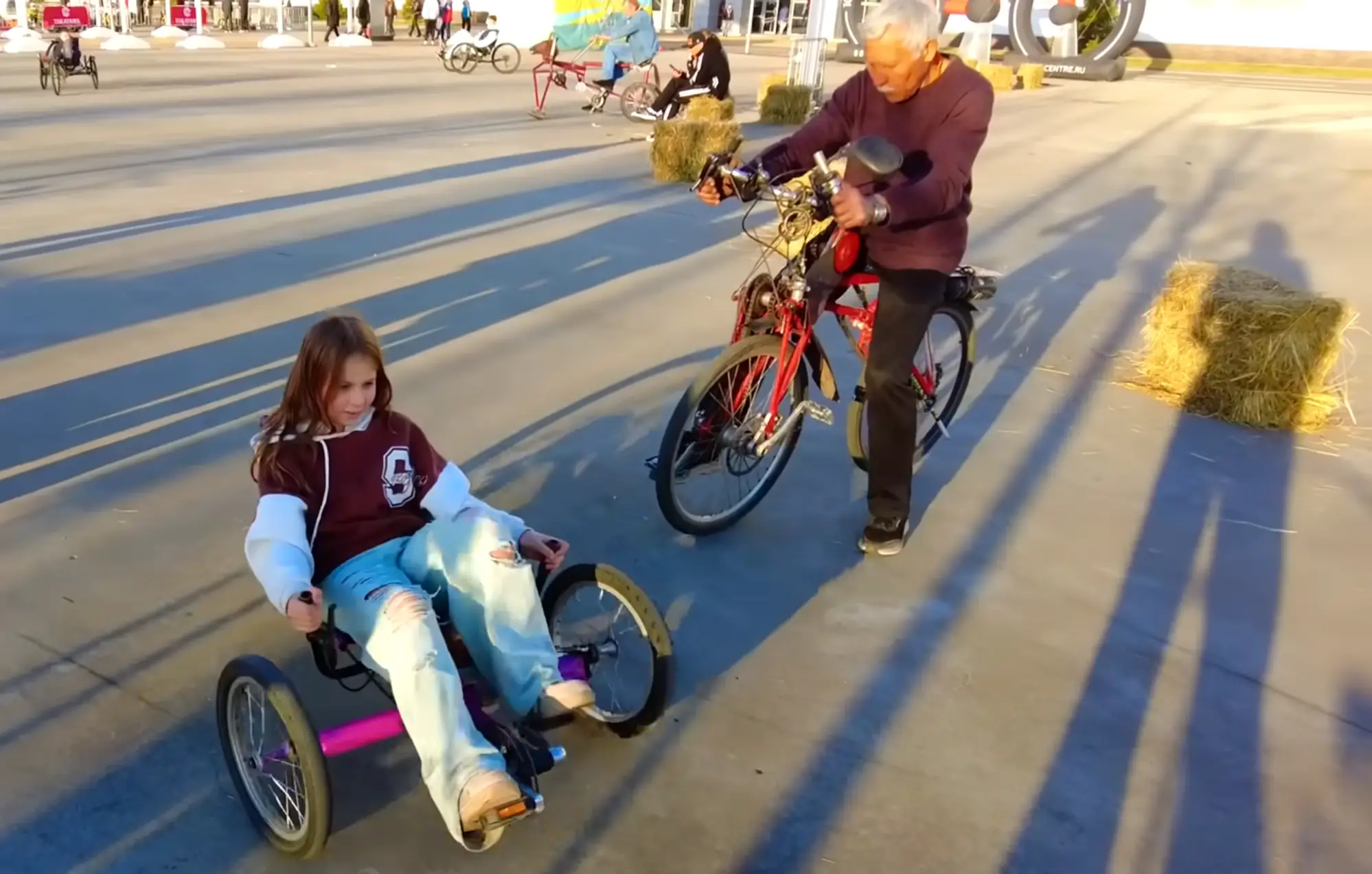
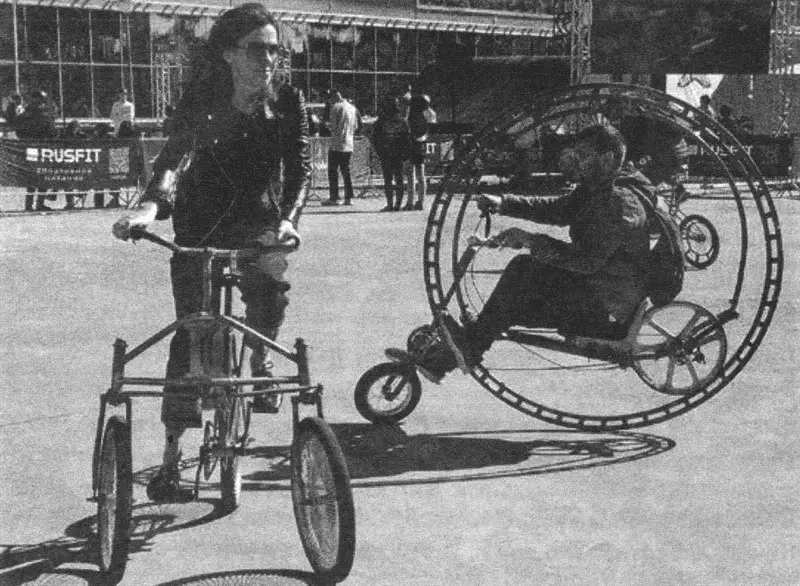
In April, the individual transport exhibition “Velokult-2025” took place. The most exotic exhibits greeted visitors on the open area at the pavilion entrance. They were demonstrated by enthusiasts from the “Velotsirk” group. Dozens of specimens—and not a single one like another! Moreover, anyone could take a ride on each of them, which delighted visitors. Some “steeds” proved so unruly that it took far more than one attempt to “tame” them.
“Pedal horse”
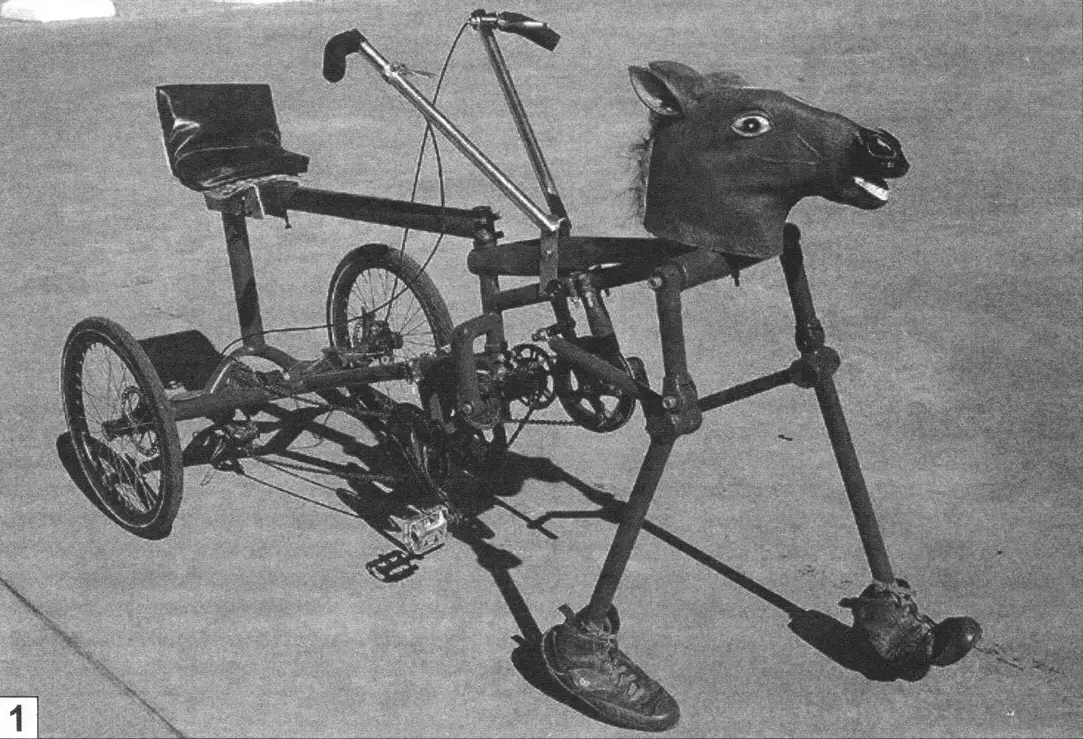
The magazine has already written about an original vehicle driven by a walking mechanism with pedal drive (see “M-K” No. 11-2020). At the exhibition, a machine of a similar concept was spotted (photo 1). However, it still moves thanks to the rotation of the rear wheels, while the “legs” serve only as supports. They step with the help of an additional chain drive. Interestingly, small rollers are attached to them, so the “horse” does not stop dead in its tracks but keeps moving by inertia for some time, like an ordinary bicycle. Convenient!
“Mr. Handy”
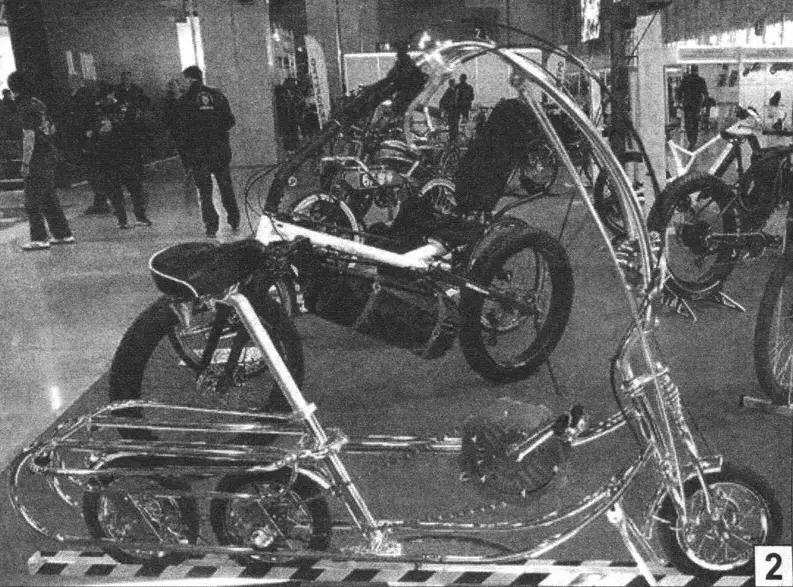
Well-known creators of unusual machines Ilya and Anastasia Nikonov from IN Studio presented four exhibits at once: “Mr. Handy,” “Barkhan,” “Red Rocket,” and “Green Rat.” Here, for example, is the three-wheeled “Mr. Handy” (photo 2). All its wheels are in one line. Drive from the pedal bottom bracket goes to the middle wheel, which in turn is connected by a chain to the rear wheel. The tooth counts of the driving and driven sprockets are 54 and 14, respectively. With such a layout, the bicycle would be expected to struggle in turns, but the close spacing of the rear wheels and their small size (12 inches) do not create noticeable resistance in corners. At the same time, paired wheels allow carrying up to 40 kg of cargo on the rack, and a double kickstand makes loading convenient. Despite compact dimensions, the stainless steel frame is designed for riders up to 210 cm tall.
The bicycle has a classic cruiser riding position: at stops, it is enough to put your feet on the ground without getting off the saddle.
“Neptune”
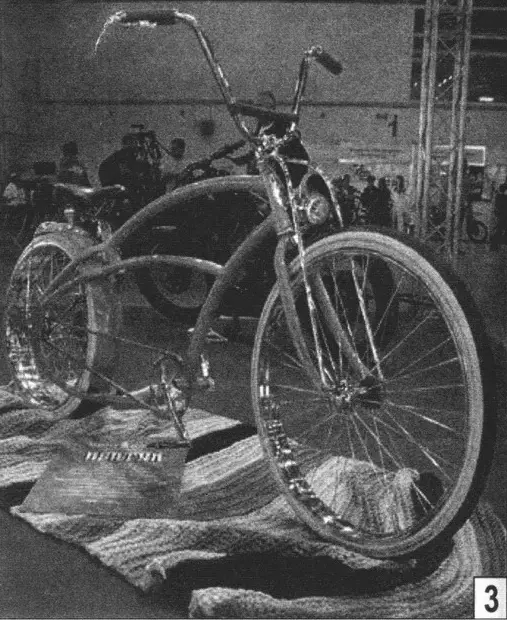
Inside the pavilion were creations from custom workshops and individual builders. This is the territory of design and aesthetics. Moreover, each bicycle here has its own name. What might the “Nevsky PetroBalt” workshop from Saint Petersburg build? Of course a “land cruiser”! Its authors drew inspiration from the power of the sea. “Neptune” (photo 3) has a homemade frame, fork, and handlebars. Master Ivan Zemlyanoy welded the structure.
“Barkhan”
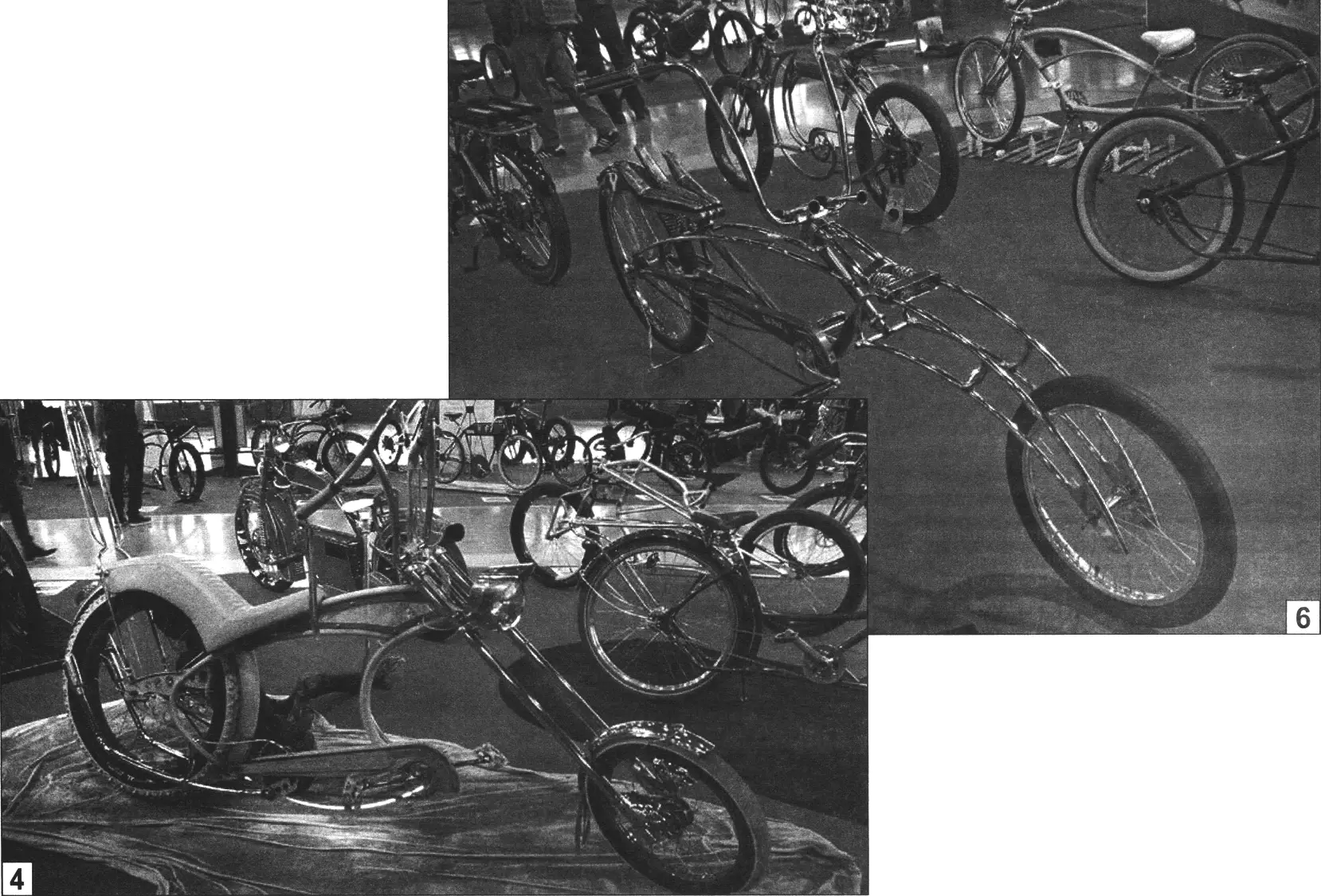
According to the designers’ intent, it is a winter chopper (photo 4). Winter daylight is short, so lighting received extra attention: a large central headlamp at the front and two small ones right at the wheel. A horn is built into the main lamp. The rear light is housed in the body of a marker lamp from a Volkswagen car. Additional lights are mounted in decorative “exhaust” pipes, and the lower frame tube has LED accent lighting. The system is powered by a power bank. The seat is made of fiberglass composite and upholstered in genuine leather. The “footwear” is seasonal too: an aggressive studded 26″×4.8″ tire paired with a 20″×2.35″ slick that performed well on winter roads. The chain clears the wide wheel using a transition bushing. The machine is equipped with a three-speed planetary hub; shifting is coaster-style and actuated by a steel rod.
“Red Rocket”
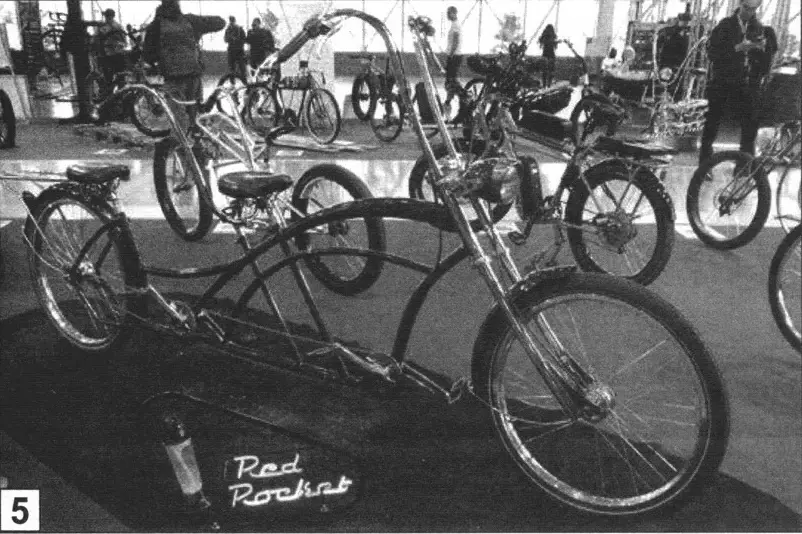
The bicycle is a classic cruiser (photo 5) based on a Micargi Royal frame, converted into a tandem. The frame is lengthened, reinforced, and supplemented with a bottom bracket shell, head tube, and seat tubes. It runs 29-inch wheels. Front and rear Sturmey Archer hubs with drum brakes. A classic “chopper” head tube angle provided good handling and straight-line stability at high speeds. A long wheelbase combined with large wheels gives excellent roll-on. Stainless steel handlebars were fabricated with each rider’s anatomy and preferences in mind, and the rack is set up to carry a passenger in a child bike seat. A stylish mechanical speedometer is installed in the front lamp.
“Green Rat”
Originally this machine (photo 6) was built for “Meluzgonka,” a competition for homemade bicycles whose rules require wheels no larger than 12 inches. Later, larger wheels were installed for everyday use. A mixed frame and polished stainless 16 mm tubes on a springer fork create a swift look. The bicycle turned out light and very fast. Its highlight is a saddle made from three… shoe lasts! It looks quirky but is comfortable.
“Chimera”
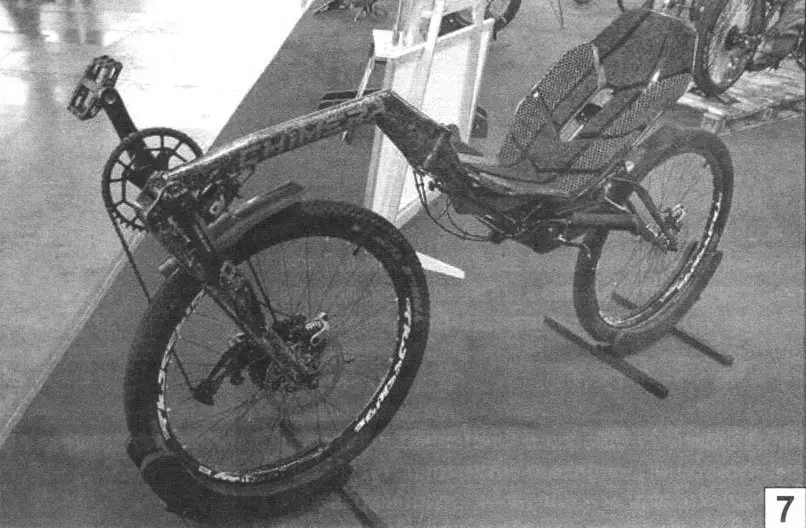
As Pavel Klok—author of this unusual recumbent design (photo 7)—says, he wanted comfortable pedaling with the body horizontal and a stable bicycle with acceptable aerodynamics. And to improve his welding and painting skills. The cruising speed is about 30 km/h, although on a flat stretch of highway it reaches 50 km/h. With narrow, well-inflated tires, it can go even faster. Parts from various bicycle frames were used to build the “Chimera”. There was no front suspension at first, but later full suspension appeared, giving a flying sensation while riding. Weight 18 kg. The drivetrain has 10 speeds, there are mechanical disc brakes, air shocks, and 26-inch wheels.
“Baronas Cargo”
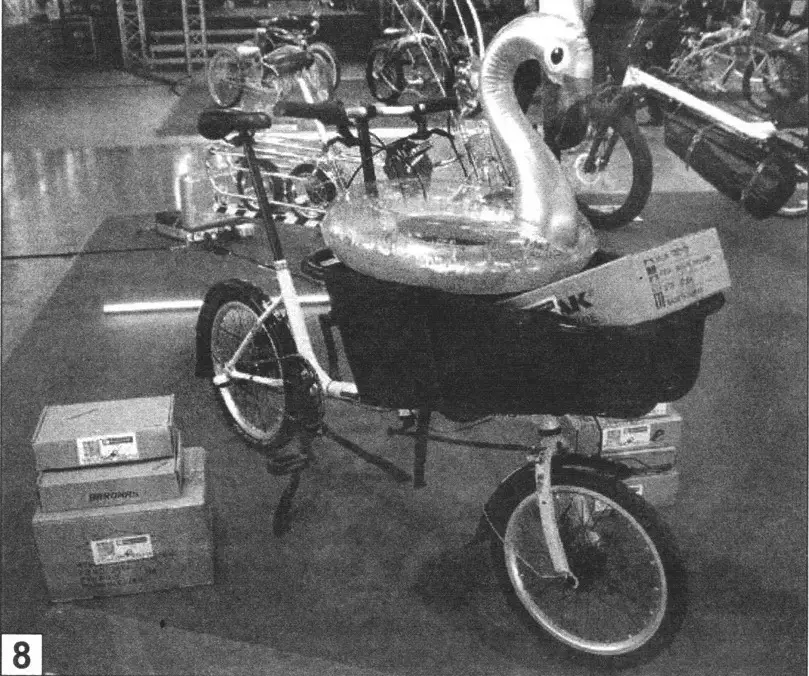
Vyacheslav Voronkov and Igor Baronas built a practical cargo bike (photo 8). It can carry up to 90 kg of load (not counting the rider), while a folding frame mechanism and quick-release front wheel mounting allow compact storage and transport in a car trunk. The basket detaches in 10 seconds. Thanks to compact dimensions and maneuverability, the cargo bike easily navigates narrow historic streets of Saint Petersburg. It was built in April 2023 and has been refined ever since. A reinforced head tube from double-wall reinforced steel tubing and wheels with double rims are already installed. Metal fenders were replaced with impact-resistant plastic ones with mud flaps.
Wooden racing bike
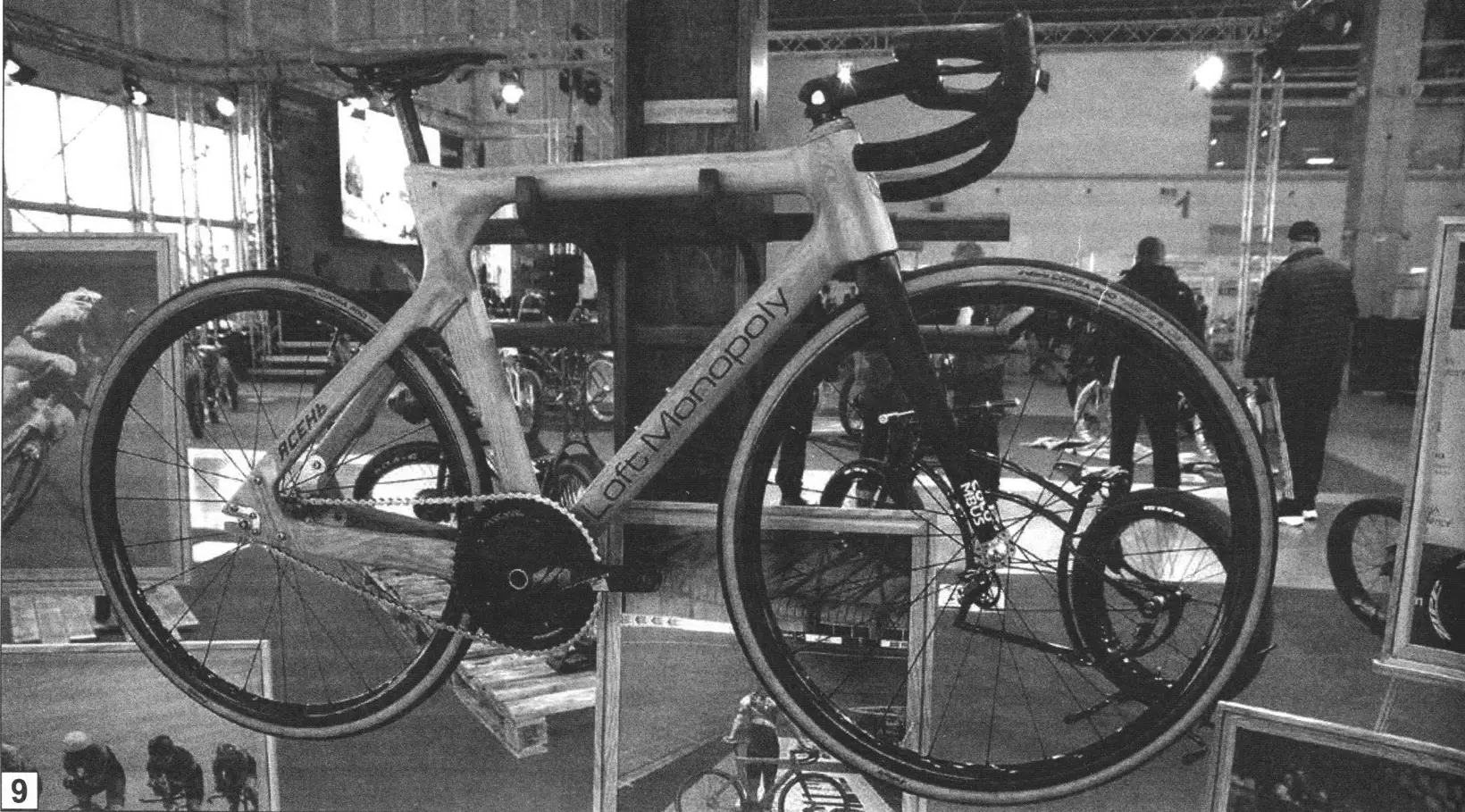
Dmitry Smirnov’s main work is interior design and crafting exclusive furniture. In his free time, he and partners build unusual bicycles. Here is what the designer said about his new creation (photo 9).
“We once had an idea to realize Russia’s first wooden bicycle project to compete in ‘Tour de Selishchi 2024.’ We started with a group discussion and rough sketches. Many nuances had to be considered—from visuals to painstaking selection of suitable parts. Many operations we had not faced before demanded precision and high quality. The bicycle weighs only 8 kilograms. Of that, 3.5 kg is the frame. It is made of ash, glued from thin laminates under a press, then primed to hide pores and keep moisture out. In this form it is not inferior in strength to steel samples and itself dampens vibrations well. The steering assembly is wooden too. In our opinion, it turned out gorgeous! And feedback from the racers confirms it. We even felt as if we had invented the bicycle!”
“Pheasant”
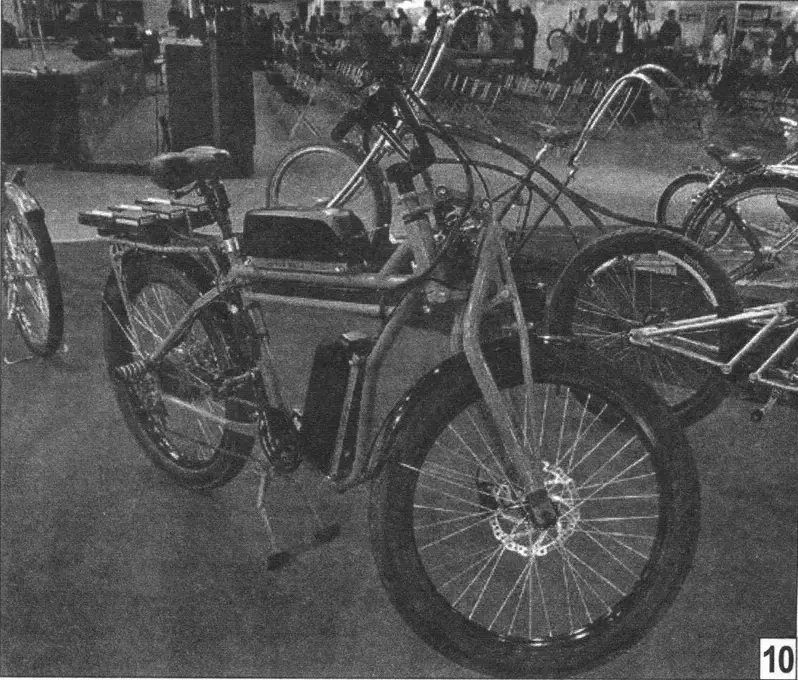
The exhibition also featured homemade machines with electric powertrains. Nikita Poddubnov from the “Dark Phase” workshop, for example, set out to build “the best electric moped in the world” (photo 10). The design is in the beloved retro style, and its specs would make many modern factory models envious. The frame was engineered with a large strength margin for an electric motor up to 4 kW. The front fork is unusual—such forks were fitted to early motorcycles. Top speed is 50 km/h. Range up to 50 km on one “fill-up.” Provision is also made for installing two batteries at once. The moped weighs 40 kg. Motor power in the version shown is 1500 W. A sturdy rack can carry a passenger, and a seatpost built as a shock absorber keeps the rider comfortable on rough roads. This is Nikita’s second moped; on the first he successfully crossed Mongolia, reaching Ulaanbaatar.
“Poltinnichek”
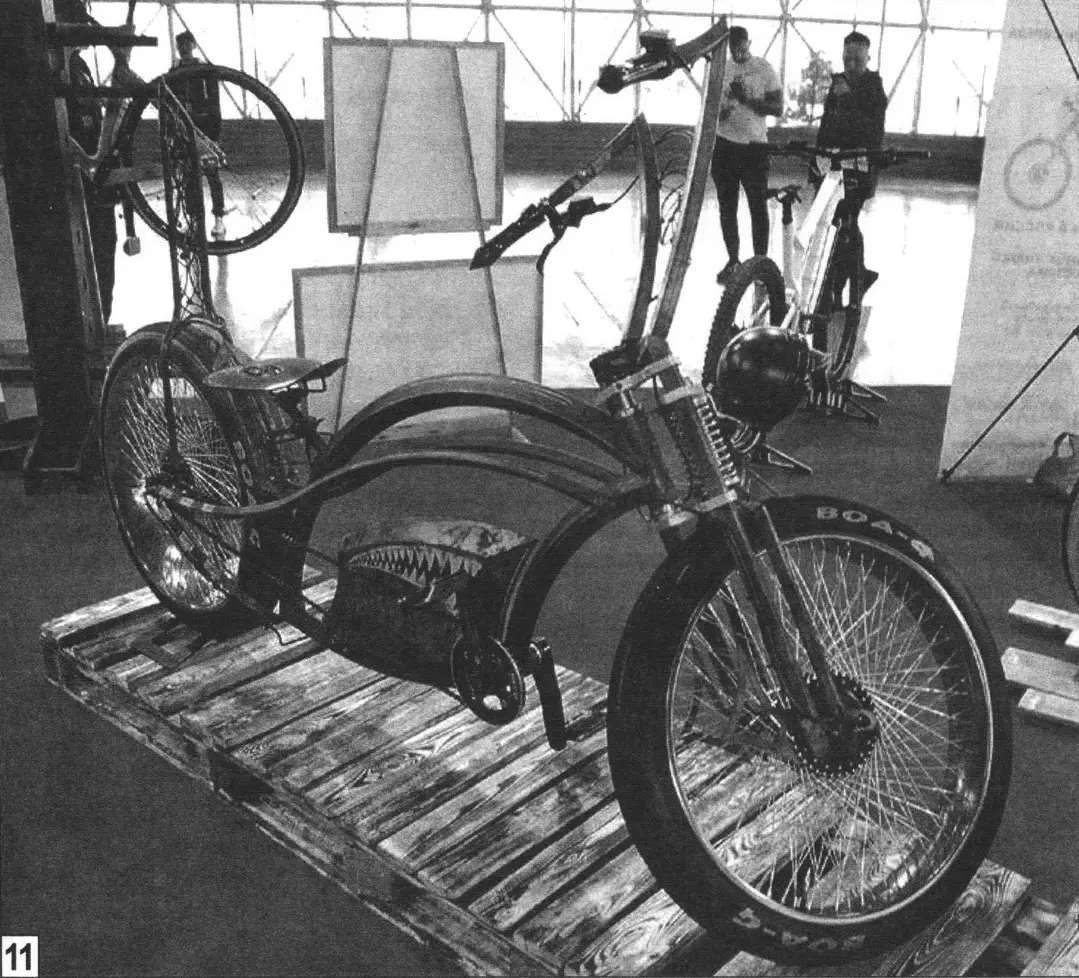
“Our electric bicycle is a unique blend of classic design, advanced technology, and exceptional craftsmanship. Built from scratch on a Firebikes Fluid frame, it recreates the spirit of the old school, combining heavy-metal elements with modern functionality. Its creation involved top craftsmen from Russia, the USA, and Germany.” That is how Alexander Valov—one of the authors of this work of technical art—presents his creation (photo 11).
The power unit consists of two geared motors working in tandem and connected through controllers to a large battery. The frame is made of unpainted steel with natural rust accents, giving the build a distinctive look. Graphics were done by artist Dmitry Grachev. The artistic patterns on the metal are Anton Korotkov’s work. The project aimed at a bicycle with bold design, strong technical specs, and excellent handling.
“Peaceful Sky”
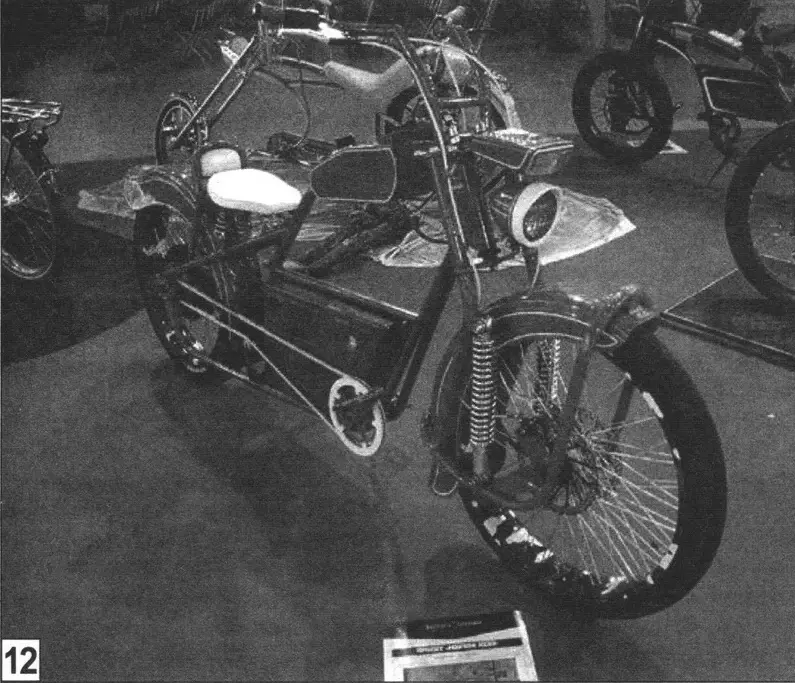
Frame, handlebars, leading-link fork, seat—all these parts of his moped (photo 12) Sergey Sverchkov made by hand. Shocks are from a Minsk motorcycle, fenders from an Izh Jupiter 3. The rear wheel is 24 inches with 36 spokes; the front is 26 inches with twice as many spokes. The battery outputs 72 V with a capacity of 56 Ah; motor power is 2 kW. Braking uses recuperation, but mechanical brakes are also fitted. Top speed is 75 km/h, range 80–90 km. A GPS speedometer is installed, plus a homemade case for an independent 12 V battery powering the lights and rear marker.
“Kolkhoznik”
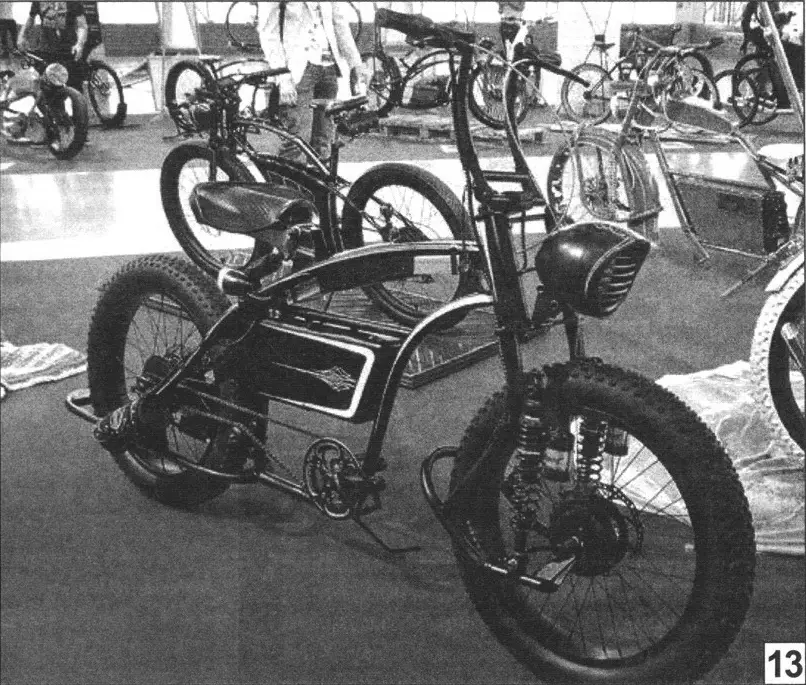
The second exhibit Sergey Sverchkov brought is meant for riding on light off-road in rural areas—hence the name (photo 13). The frame, handlebars, leading-link fork, and two battery boxes are homemade here as well. The machine is all-wheel drive! Its powertrain consists of two Mxus 500 W geared motors, two controllers, and a traction battery. It has a comfortable Ural motorcycle seat and moped shocks. “Kolkhoznik” can reach 45 km/h; range is 70–80 km.
At the same time as the “cyclists’ festival,” the neighboring venue hosted “Motovesna-2025,” where about a hundred homemade motorcycles were shown. The most interesting of them—in the next issue of the magazine.
“Modelist-Konstruktor” No. 6’2025, Andrey FAROBIN
