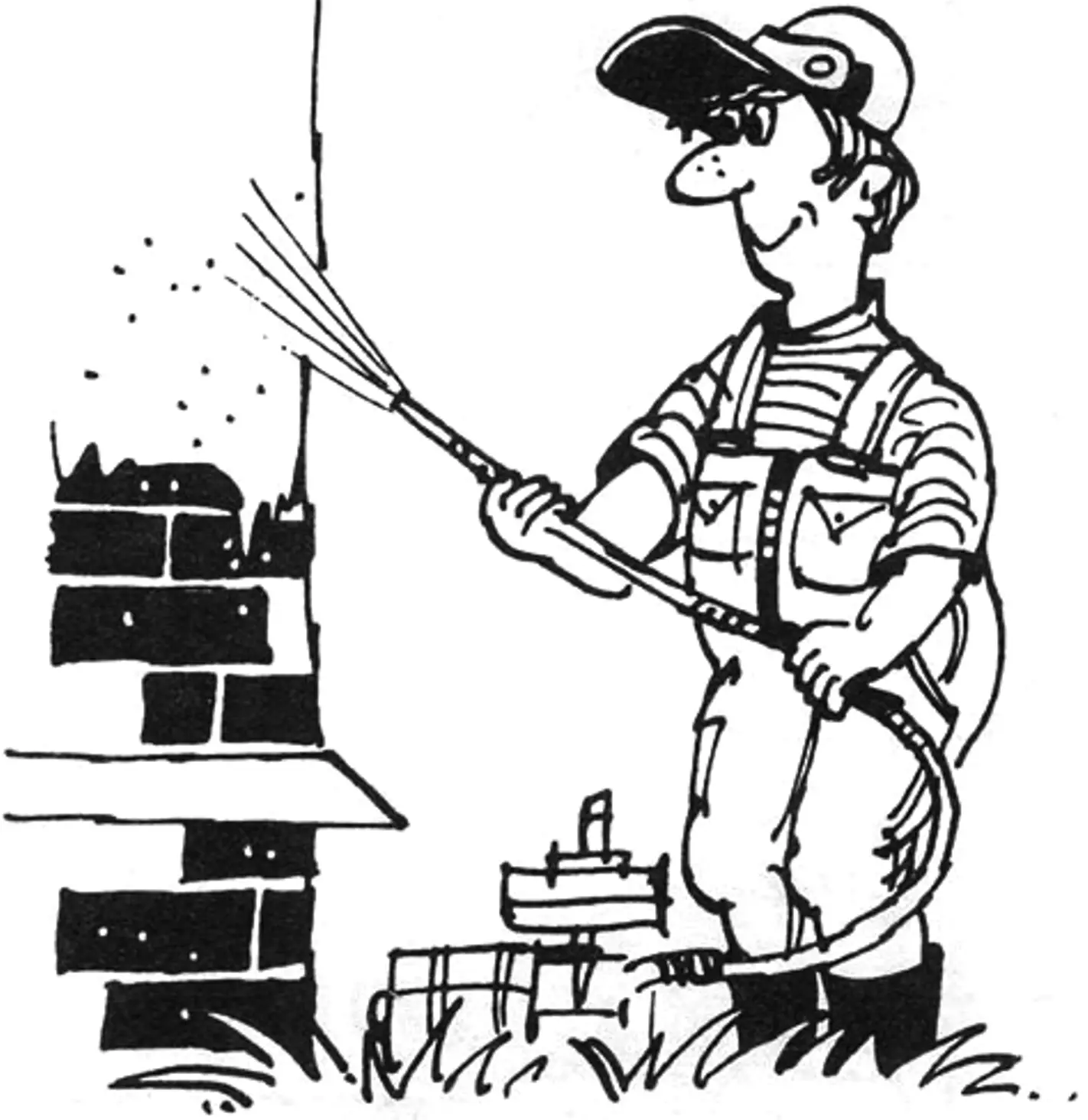
The proposed homemade compressor is intended for household use. With its help, you can quickly and efficiently carry out painting work or inflate a car tire. The compressor consists of an electric motor and a pump attachment driven by it.
The attachment is mounted on a fastening plate and installed on three studs. The pump is of the diaphragm type. It consists of an aluminum head, to which the inlet and outlet valve seats are attached on studs, and a diaphragm made of rubberized fabric clamped between the head and a steel ring. Using a clamping plate, the diaphragm is connected to the piston and connecting rod.
The rotational movement of the motor shaft is converted by an eccentric into the reciprocating motion of the connecting rod and, consequently, the diaphragm. When it moves from the upper position to the lower one, air is drawn into the internal cavity of the head. During the reverse movement, the spring-loaded intake valve closes, compressed air opens the outlet valve and exits through the fitting.
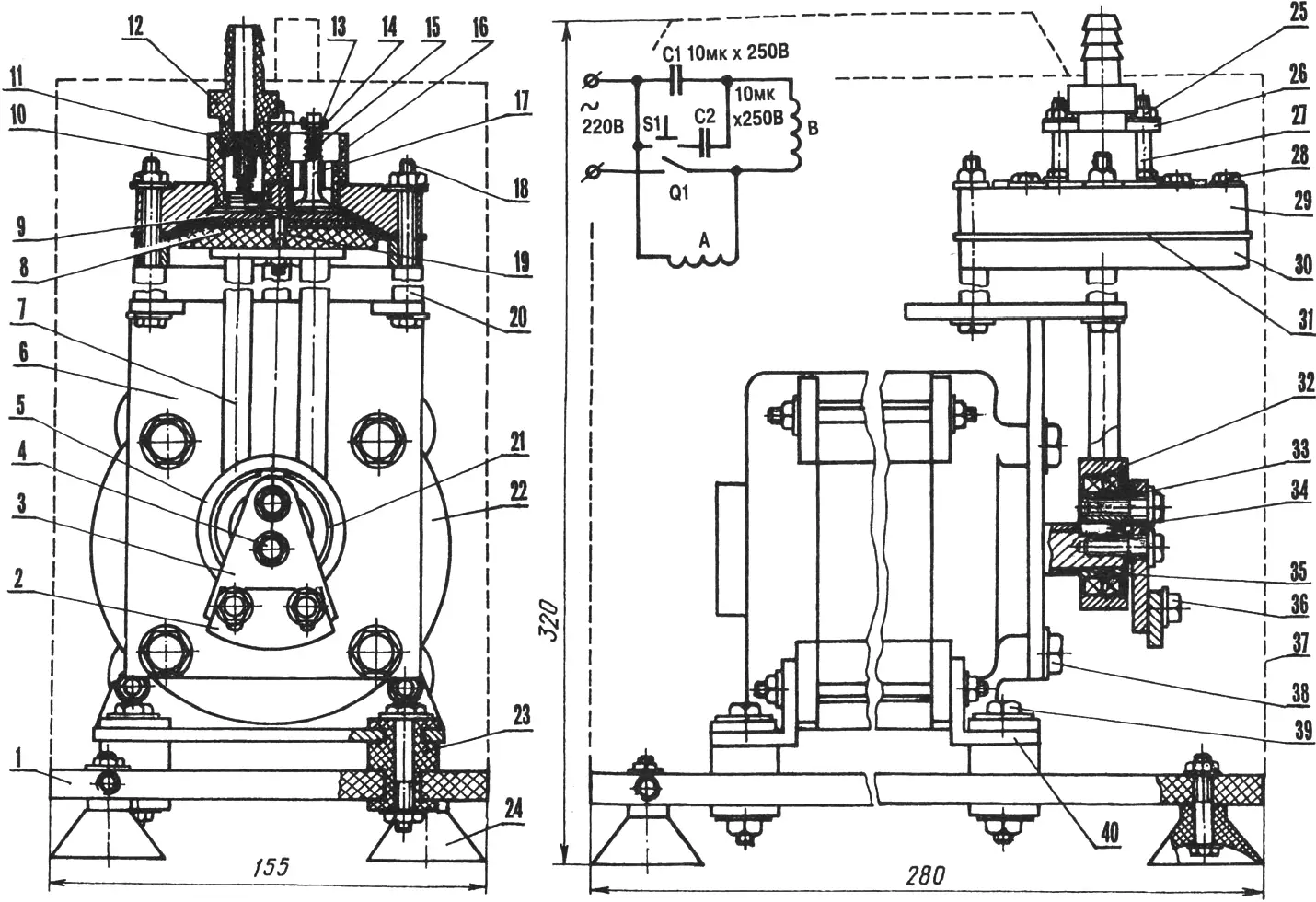
Two bearings are press-fitted into the connecting rod with a slight interference fit and retained by a ring. The eccentric is installed on the motor shaft with a key. To reduce vibrations generated by the connecting rod, the main and additional counterweights are attached to the eccentric and shaft. Precise adjustment of the latter’s position is performed while operating the compressor.
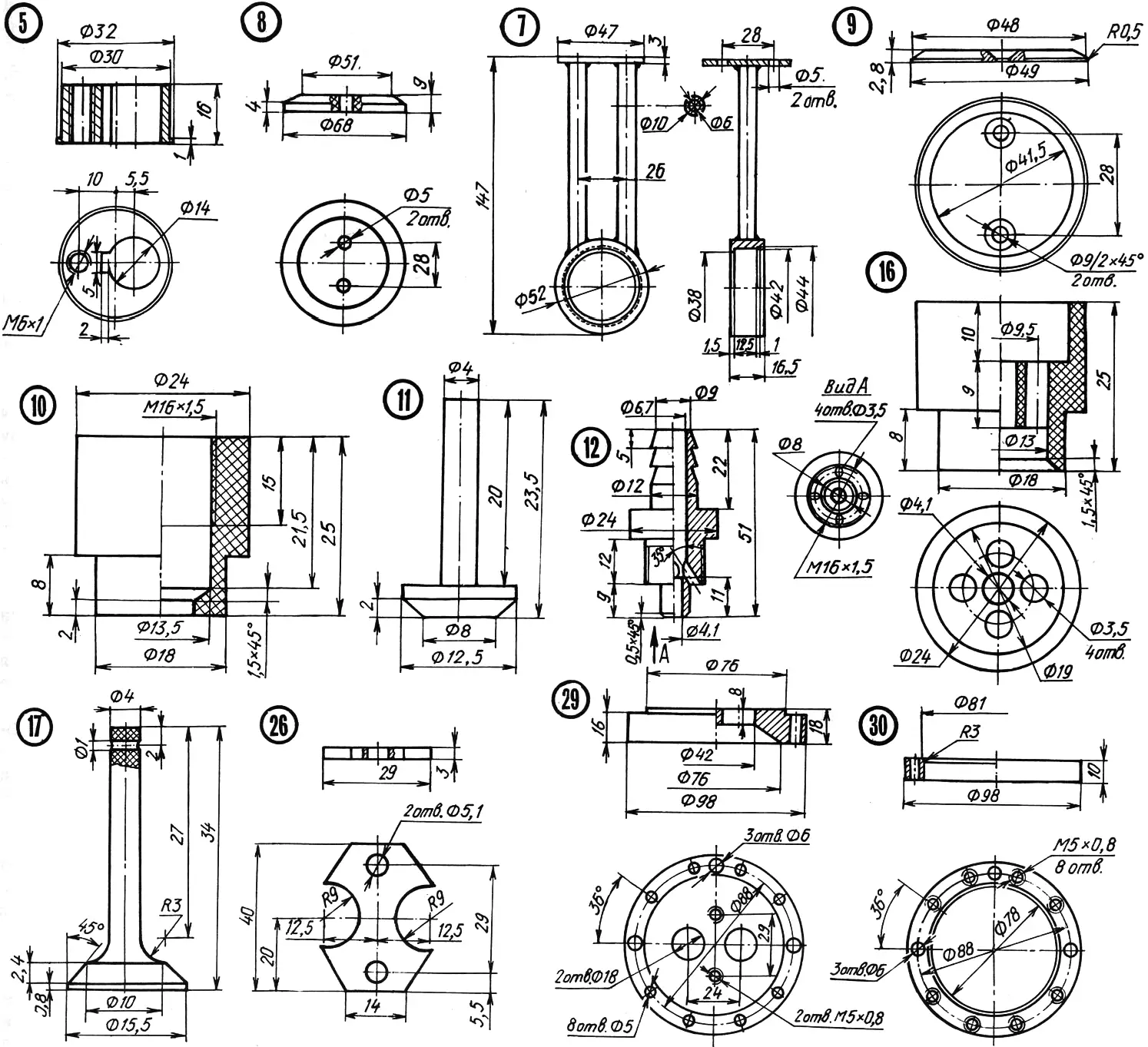
The base is made of thick textolite. The seats, valves, fitting, and piston are made of caprolon (polyamide P-AK7). The compressor housing is assembled from 2.5 mm sheet textolite.
1 — base (textolite); 2 — additional counterweight (St1); 3 — main counterweight (St1); 4,18,36,39 — M6 bolts; 5 — eccentric (St4); 6 — fastening plate (St1); 7 — connecting rod (St4); 8 — piston (polyamide); 9 — clamping washer (AL-5); 10 — outlet seat (polyamide); 11 — outlet valve (polyamide); 12 — guide fitting (polyamide); 13 — cotter pin; 14, 33 — washers; 15 — spring; 16 — intake seat (polyamide); 17 — intake valve (polyamide); 19 — M5 piston bolt; 20 — spacer bushing (3 pcs.); 21 — retaining ring; 22 — electric motor AVE-071-4; 23 — damping bushing (rubber, 4 pcs.); 24 — support (rubber, 4 pcs.); 25 — M5 nut (8 pcs.); 26 — clamping plate; 27 — M5 stud (2 pcs.); 28 — M5 head bolt (12 pcs.); 29 — head (AL-5); 30 — ring (St1); 31 — diaphragm (rubberized fabric); 32 — bearing 7000806 (2 pcs.); 34 — key; 35 — spacer sleeve (St1); 37 — compressor housing (textolite); 38 — M8 bolt (4 pcs.); 40 — support foot (2 pcs.).
The electric motor used is an AVE-071-4 from a washing machine. By rewinding its windings, the shaft speed was increased from 1350 to 2800 rpm. For better startup at reduced mains voltage, an additional 10 uF x 250 V starting capacitor is installed, which can be connected to the circuit by a button when needed. Buttons and switches must be rated for 220 V and current of at least 2 A.
It is possible to use motors of other brands in the compressor, but with suitable power ratings. A washing machine motor does not necessarily need modification, but in that case the pressure produced by the compressor will be almost two times lower; performance will also decrease.
Long-term operation has confirmed the high reliability of the manufactured compressor
Brief technical data of the compressor
Maximum generated pressure, kg/cm2 … 6
Capacity (at 3 kg/cm2, l/min) … not less than 25
Supply voltage, V … 220
Power consumption, W … 400
Operating mode … intermittent-duty (30 min operation — 10 min pause)
Weight, kg … 10.5
“Modelist-Konstruktor” No. 12’99, A. SHMIK
Recommend to read
 CORROSION THREADED CONNECTIONS
During repair works of structures with steel threaded connections of the work items that have to deal with the complexity of their separation due to corrosion of the thread. These... UNIVERSAL BRUSH
Regular floor brush is equipped with a handle, can turn into a handy tool for smoothing and pasting the Wallpaper or coating them with glue.
