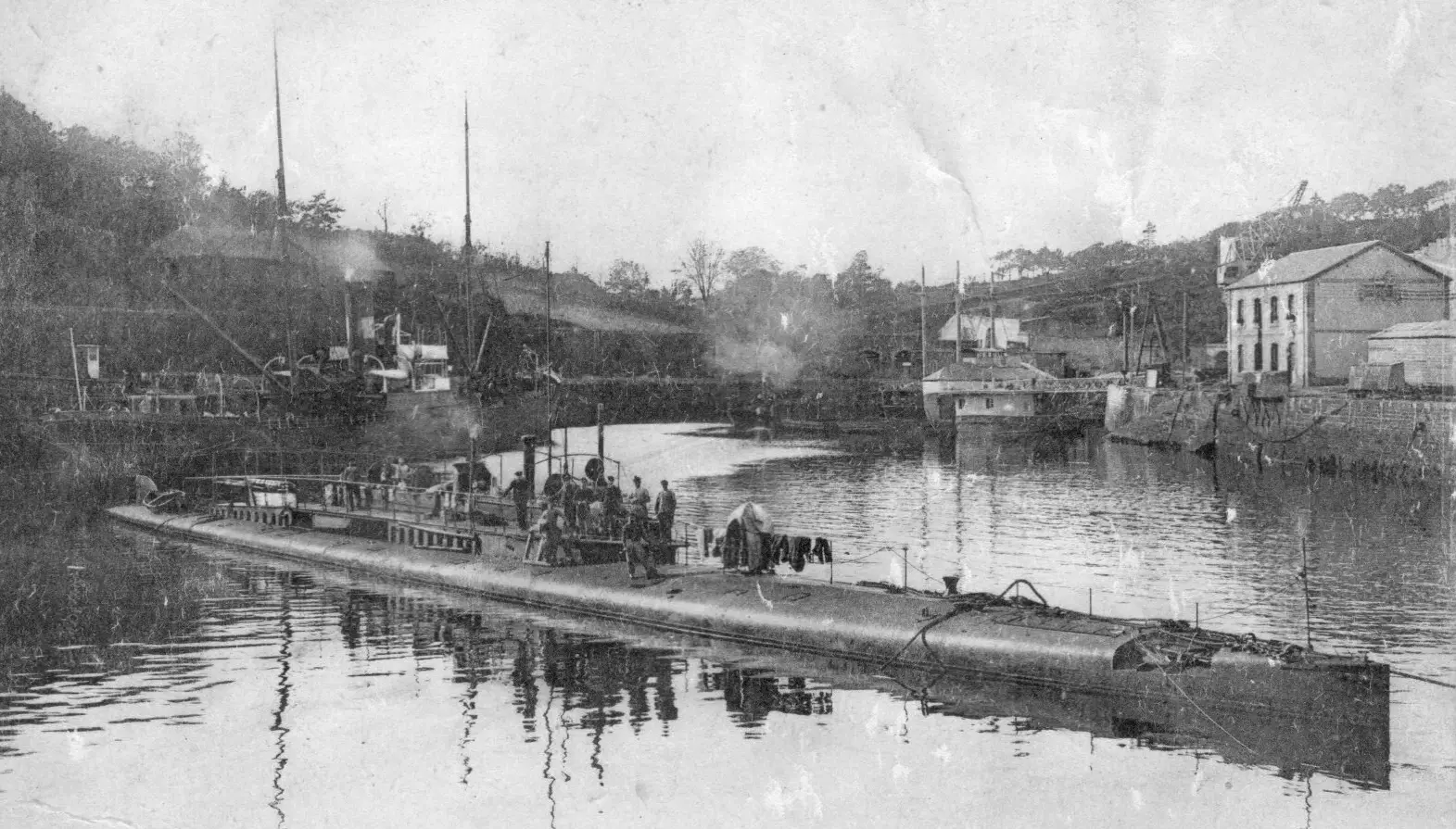
Steam-powered submarines are regarded today as something of a design curiosity, although the motives for their creation were entirely rational. The French set the fashion here. Despite the concept’s rapid failure, these boats took a very active part in the First World War. And one of the most successful steam submarines of the Third Republic’s fleet was the experimental submarine “Archimede”.
By 1906, French submarine construction was in a situation of financial abundance and of fading disagreements within the engineering corps and naval officers over what a combat submarine should look like. The naval establishment and even political circles had previously split into two factions: supporters of “true submarines” and “diving submarines”. The first concept envisaged vessels mainly of single-hull design with a small reserve of buoyancy, minimal silhouette, quick diving time, good underwater maneuverability, and high submerged speed. Proponents of the “diving boat” believed it should be a kind of “submarine destroyer” (the official term) of two- or one-and-a-half-hull architecture with good seakeeping in the surface condition, range, and habitability. The disputes between “submariners” and “divers” ended largely in favor of the latter, since the technology of the time simply did not allow a single engine for surface and submerged running. The era of “true submarines” would come only with the harnessing of nuclear energy.
The situation with diesel engines in French submarine construction became a stumbling block. The engines installed in the “true submarines” of the “Emeraude” class proved extremely capricious and unreliable. Diesels had to be purchased from the bitterest enemies — the Germans. Moreover, to solve various problems specialists from the MAN firm in Augsburg were sometimes even invited and allowed aboard France’s newest ships. For the French this was intolerable!
The solution was proposed by the already well-known engineer Maxime Lobé — creator of the first experimental French steam submarine “Narval”. He understood and acknowledged the superiority of the diesel and its great future on submarines, yet there was simply no other way to achieve the ambitious goal of building a numerous submarine fleet capable of operating on the open sea.
In 1906 two classes of boats were ordered to Lobé’s design: 18 steam “Pluviose” type and 16 diesel equivalents of the “Brumaire” class. The French bought a license to build German diesel engines and hoped quickly to master them, after which they might convert the “steamers” into diesel ships. Lobé provided for that possibility.
The laying down of such unprecedented classes seemed to offer a solid foundation for unifying submarine forces, but French admirals, relying on the parliament’s unheard-of generosity, decided to demonstrate foresight. At the same time as construction of the new ships began, they announced a competition for designs with even higher characteristics. If the steam “Pluviose” answered the wish to quickly obtain an “open sea” boat of 500 tons displacement with a six-torpedo bow salvo, command now wanted a large “squadron submarine” with an average speed of 15 knots and a maximum of 20 knots, able to escort a battleship squadron without hindering it. This chimera would overtake the British in ten years, embodied in the famous disaster-prone class of British steam-turbine “K”-type submarines.
The revised tactical and technical requirements of the competition were very strict: maximum surface speed — 15 knots (for 435 miles); economical speed — 10 knots (2,500 miles with extra fuel, up to 4,280 miles at 5 knots); maximum submerged speed — 10 knots (range at 5 knots 100 miles, later revised to 40 miles); maximum diving depth — 40 meters; maximum time to submerge — 4 minutes; provisions for 12 days; at least two strong bulkheads; eight torpedoes ready to fire and one spare.
Engineers admitted to the competition (Lobé retired because of intrigues by “submariners” who never forgave him his success) faced the same rather poor choice of main propulsion: either bulky steam machinery or extremely unreliable diesel motors.
From a large number of designs the commission selected four absolutely different ones that seemed promising to the admirals. The breadth of spirit and wallet of the naval ministry was astonishing: they decided to build and test all four experimental boats! All these submarines — “Charles Bré”, “Amiral Bourgeois”, “Mariotte”, and “Archimede” — remained one-offs, becoming symbols of inquisitive minds and a taste for experiment. Time showed that the most successful and fortunate of this “1906 collection” was “Archimede”, designed by 32-year-old first-class engineer Julien Jutte.
“Archimede”: technical description
On 6 February 1906 a directive from the Naval Ministry instructed Engineer Jutte to prepare design documentation for his project.
On 2 January 1908 “Archimede” (“Archimede”) was laid down at the shipyard in Cherbourg, receiving fleet registration number Q-73.
On 4 August 1909 the newest submarine was launched — it became the first French submarine honored with a ceremonial launching.
Manning and fitting out of the submarine was completed in January 1910, after which she was commissioned for comprehensive trials.
In essence, “Archimede” is a qualitative development of Lobé’s “Pluviose” design, which Jutte reworked creatively to meet the competition’s tactical and technical requirements as fully as possible.
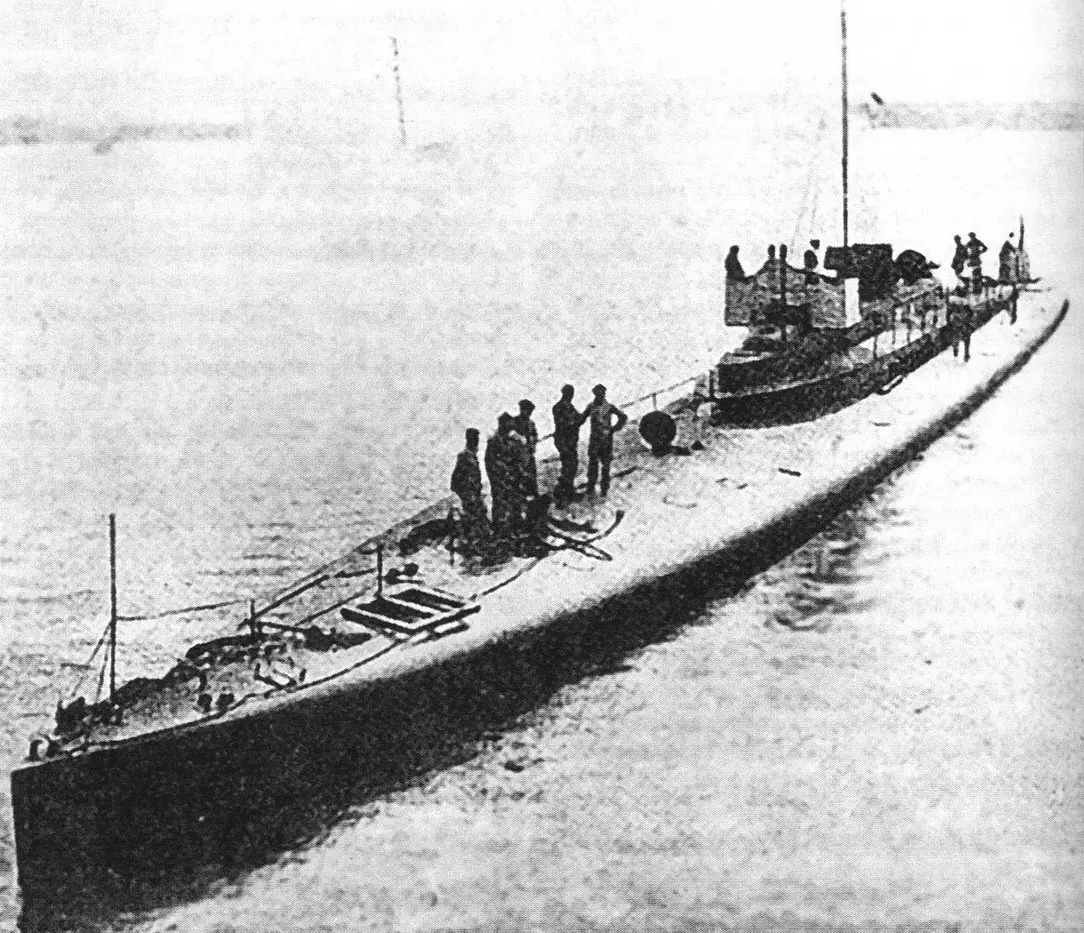
Jutte’s boat was twin-screw and double-hull. The outer light hull, containing the ballast tanks, fully enclosed the ends and most of the pressure hull without reaching the keel. Strictly speaking, such architecture is considered one-and-a-half-hull, but the French classified it as double-hull.
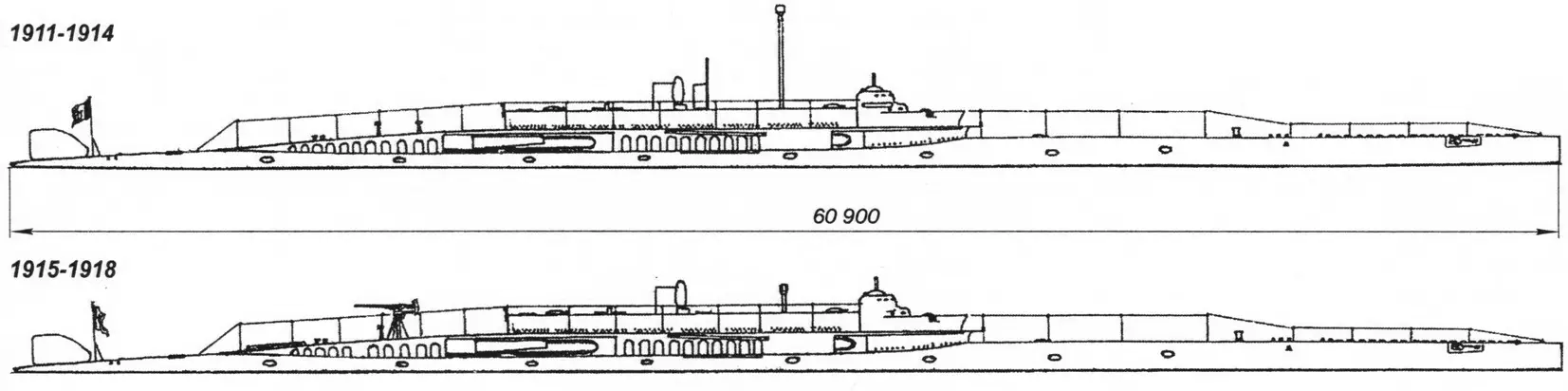
With an overall length of 60.9 meters and maximum beam of 5.63 meters, “Archimede” had a displacement of 580 tons surfaced and 808 tons submerged. Thanks to a finer hull form than “Pluviose”, fairly advanced section-forming technology, and lightened structural connections, Jutte avoided excessive growth in displacement compared with the prototype. Rapid progress in electrical engineering and steam machinery made it possible to achieve high performance in speed qualities. The boat’s buoyancy coefficient was 28.3%, ensuring good seakeeping surfaced.
Unfortunately, the original drawings of “Archimede” have not survived in the archives, so the boat’s layout can be judged only from the technical data sheet and description compiled by fleet engineers at Cherbourg in 1911.
From bow to stern “Archimede” was divided into compartments and spaces.
In the bow torpedo compartment were a bow tube torpedo launcher (in the stem), controls for external torpedo tubes, and the torpedomen’s quarters. It was separated from the next compartment by a 9 mm steel watertight bulkhead of increased strength. Jutte’s solution was a far-sighted innovation at the time of design — it was precisely the absence of such a bulkhead that caused the “Pluviose”-type boat “Fresnel” to sink on 6 October 1908 after colliding with a mole and flooding through the bow torpedo tube.
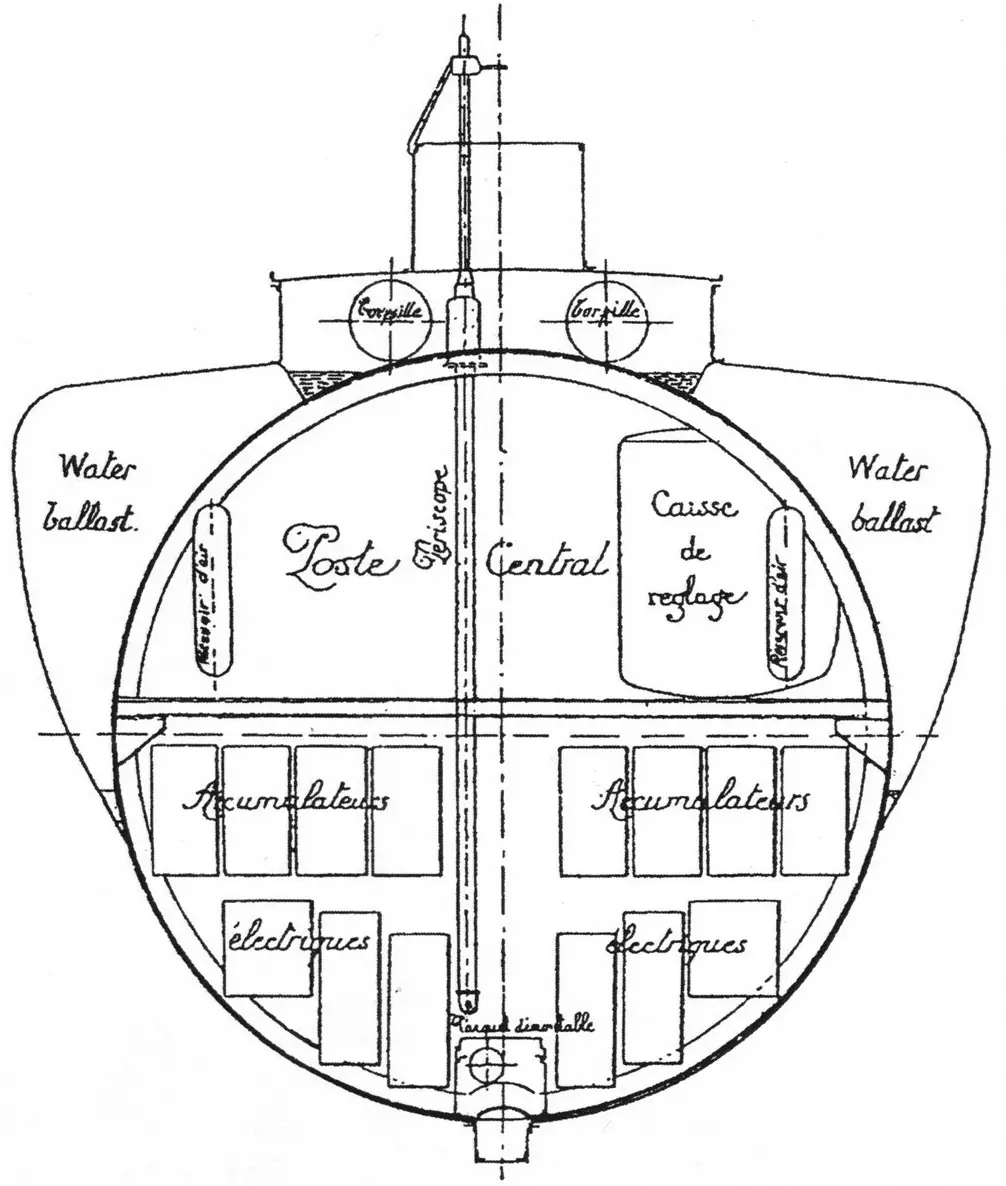
Control and battery compartment. For the first time in the French submarine fleet, storage batteries were placed in a fully watertight space under the main deck of 5 mm steel. On the main deck there was also, for the first time, a fully designed central control station, three cabins for the commander and officers (separated by 1 mm bulkheads), the commander’s study, which also served as the wardroom, the galley, the sailors’ quarters, and two heads — one for officers and one for ratings.
Forward fuel compartment consisted of six oil tanks with a total capacity of 12,780 liters. The tank walls served as watertight bulkheads; between them, slightly to starboard of the ship’s centerline, was a narrow passage to the next compartment.
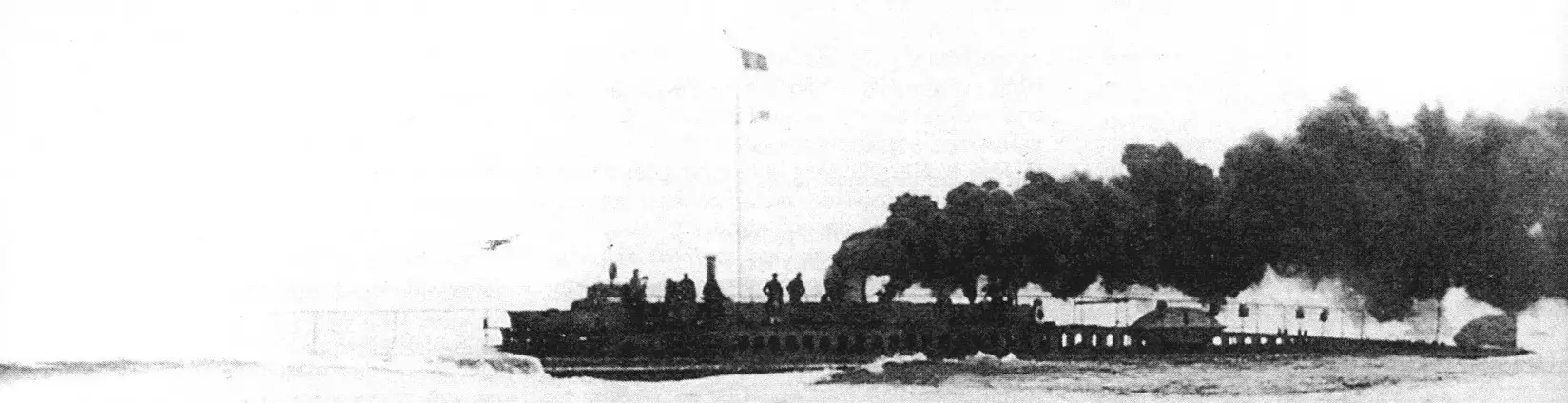
In the engine and boiler compartment were two oil-fired twin-furnace “Du Temple” boilers whose funnels joined in a single smokestack. Unlike the “Pluviose” boats, the boilers were isolated from the operating crew; all controls were on the outer walls of the boiler spaces. This compartment also held a 1,500-liter service fuel tank. Oil reached the boiler burners through a pump and filter and passed through a heater, warming to 110°C.
Two vertical triple-expansion steam engines with forced lubrication were arranged symmetrically, each driving its own propeller shaft. Maximum power of one engine was 844 hp.
In the propulsion motor compartment under the free-flooding deck were two “Bréguet” propulsion motors of 610 hp each. On the deck were the motor control stations.
Aft fuel compartment of nine tanks with a total of 13,840 liters of oil was similar in layout to the forward one.
In the aftermost stern compartment were compressors, the petty officers’ quarters with head, and motors for the aft vertical and horizontal rudders.
The armament of “Archimede” consisted of seven torpedo tubes: one bow tube in the stem; four external tubes arranged symmetrically in pairs amidships under the upper deck; and two Dziewiecki rack launchers under the upper deck aft. All tubes were oriented for firing forward. The first pair of external tubes had 6° deflection from the ship’s axis, the second 10°. The outfit comprised eight 450 mm torpedoes of the 1906 pattern — seven in the tubes and one spare in the bow torpedo compartment.
No gun armament was provided, but the submariners were generously armed with carbines and revolvers with a large allowance of ammunition: 690 rounds for seven carbines and 882 rounds for nine service revolvers.
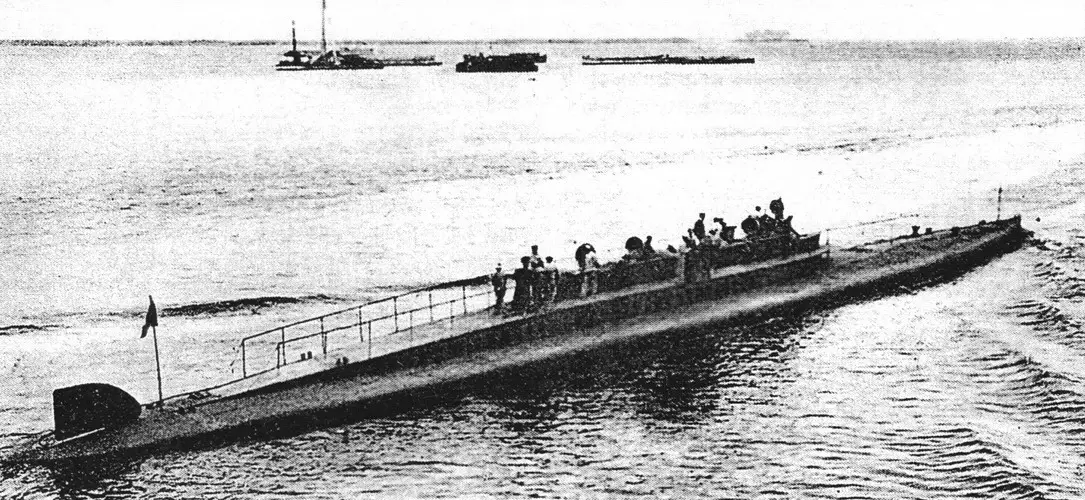
“Archimede” had all the characteristic design features of French submarines of the time, including a very low conning tower surrounded by a large breakwater superstructure. The breakwater housed access hatches, ventilation and periscope trunks; a fixed smokestack and an additional retractable one were installed in a watertight casing. The upper watch was to be stationed on the breakwater, and conditions for the crew did not improve much compared with earlier boats, as there was no real protection from waves and wind.
Another characteristic feature was the presence of three pairs of horizontal rudders — bow, midship, and stern. They had electric and duplicated manual control. Yet, by an inexplicable tradition of French shipbuilders, they were fixed and had no structural protection, although foreign designers had long used “folding” rudders that did not interfere with maneuvering and mooring.
The vertical rudder was double, on one pintle — conventional in the submerged part and with an upper blade in the surfaced stern — considered necessary for better control underwater. Jutte also provided a bow vertical rudder, but after trials it was removed — the ship maneuvered excellently without it.
The complement comprised the commander, a lieutenant commander, senior lieutenants, five petty officers, and 19 sailors.
Overall, the trials completed in September 1911 fully satisfied the acceptance commission — the fleet received a well-armed submarine capable of covering 800 miles at 15 knots or up to 3,000 miles at 10 knots with the planned extra fuel stowage in ballast tanks. Submerged, “Archimede” also confidently met the assigned 40 miles, maintaining maximum speed of 9–10 knots for 4.5 hours; at economical speed of 4 knots the boat could remain underwater for 30 hours and cover 120 miles.
The only substantial shortcomings noted by the commission were the presence of only one watertight torpedo tube and the absence of a stern torpedo tube.
Concern for the crew
The first commander of “Archimede”, Lieutenant Commander Joseph Frochot, proved a highly competent officer wholly devoted to his ship. His reports shed light on practices in the French navy and reflect the commander’s wish to break the attitude toward submarines as second-class ships. First of all Frochot demanded two additional billets: a cook and a steward. His explanations showed that by established practice cooking aboard submarines was done in rotation by ratings, with no regard for their culinary skills or education. Given the sharply increased range, such a state of affairs was, in his view, unacceptable.
The commander’s second wish was that the crew should live permanently aboard while “Archimede” was based separately, to teach submariners to value and economize the ship’s modest resources. A quote from Frochot’s report conveys the problem well: “Living the crew in barracks is absolutely unnatural and should be resorted to only in extremis. The men then come to see the ship as a means of transport on which they spend a few hours each day and which they are eager to leave as soon as they step ashore. The crew’s sense of responsibility toward the ship rapidly weakens. Crew members cease to be servicemen and begin to feel like national guardsmen.”
These and several other sound proposals by the commander of “Archimede” were fully approved by command, substantially raising the boat’s combat effectiveness and improving conditions for the crew.
By the outbreak of the First World War “Archimede” was fully combat-ready. In overall fighting qualities and technical complexity she was considered a true pride of the French submarine fleet. Yet the hardest test for the “submarine steamers” and their flagship still lay ahead…
Routine instead of heroics
At the outbreak of the First World War only two units of the 1906 experimental series remained in service: “Mariotte” and “Archimede”. “Amiral Bourgeois” was temporarily non-combat-ready because of diesel problems, and “Charles Bourgeois” after trials was never placed in the fleet’s battle order: even members of the acceptance commission who admired its original technical solutions had to admit that approving the design had been a mistake. By August 1914 the laurel wreath of “pride of the submarine fleet” around “Archimede” was about to be taken by a new steam “leviathan” — the 850-ton boat “Gustave Zédé” was to commission any day, on which fleet command placed great hopes.
On 29 July 1914, with mobilization of the French fleet, “Archimede” under Lieutenant Commander Émile Deville joined the 3rd Flotilla at Cherbourg.
From the evening of 1 August, even before war was declared, French boats began daytime patrols off their bases.
On 3 August at 01:45 the order to begin hostilities and implement the corresponding operational plan was received, under which all boats under destroyer cover deployed to the center of the English Channel. The atmosphere was one of incredible tension: the British still delayed entering the war, and the French expected the imminent appearance of a huge German dreadnought fleet against which they had nothing to oppose. Only on 4 August, after Britain entered the war, boats of the 3rd and 1st flotillas were assigned under the operational plan to patrol the strait between the Cotentin peninsula and the English coast.
As early as 6 August, after a week of real strenuous war service, command received a surprise — commanders of the steam boats reported that “the boilers are showing signs of fatigue,” and no one would vouch for the reliability of torpedoes that had been exposed to seawater for a week. Because of technical problems flotilla and division compositions began to be reshuffled, and it was reluctantly agreed to keep one flotilla on patrol while another repaired and rested.
As the land front stabilized, the naval ministry grew increasingly nervous about the routine patrol duty of submarines in home waters. Huge sums had been invested in this weapon, advertising campaigns run, great hopes placed on it — yet it was relegated to sitting in the British rear and consuming resources.
On 18 September 1914 Naval Minister Jean-Victor Augagneur sent a telegram to First Lord of the Admiralty Winston Churchill stating that France had three excellently prepared submarine flotillas in the English Channel, some units with outstanding fighting characteristics able to operate directly off enemy coasts. Augagneur proposed cooperation in offensive operations off Heligoland under British direction, for which he was ready immediately to place at the Admiralty’s disposal a flotilla of six or seven of the best boats led by the newest “Gustave Zédé”.
Churchill raised no objection. Moreover, the French had already done him a favor by providing a submarine flotilla for the defense of Portsmouth. On 22 September he replied to Paris that the Admiralty gladly accepted the proposal to form a flotilla of several large submarines for joint operations. The British proposed to concentrate this flotilla at Dunkirk and for its commander to appear in London for instructions.
Augagneur did not delay a second, and that same evening Rear Admiral Albert Rouyer, commander of the 2nd Light Squadron in whose command were the Channel submarine flotillas, received orders to submit to the minister his views on the flotilla’s composition and the appointment of its commander. Rouyer immediately replied proposing the steam boats “Vertuel” and “Prairial” with cruiser speed of 9.5 knots at Portsmouth, and “Archimede” and “Mariotte” with cruiser speed of 13 knots. Captain Henri de Casabianca was proposed as flotilla commander.
The minister approved the special flotilla and its commander but personally added “Gustave Zédé”, which in his view the admiral had omitted through misunderstanding. However, when on 24 September “Archimede” and “Mariotte” weighed anchor at Cherbourg and headed for Calais, Augagneur learned to his great displeasure that “Gustave Zédé” was still not ready for action. Instead the diesel boat “Newton” based at Calais with the 2nd “Brumaire”-class flotilla was added to the flotilla.
On 25 September the special flotilla commander Henri de Casabianca arrived in London for a conference with British command. It seemed French pride would soon be satisfied and the Germans would learn of French submariners’ courage in their lair. But events took an unexpected turn…
That same day the French naval attaché in London, Captain Jean Le Guis de Saint-Sévin, after the conference sent a telegram to the ministry, and the next day Augagneur received a dismayed report from de Casabianca, returned to Calais. The general sense of these extremely interesting documents was as follows: having studied the tactical and technical characteristics of the French boats, Commodore Roger Keyes, commanding British submarine forces, and his officers considered them unsuitable for operations off Heligoland. Given the complexity of conditions in the Germans’ lair, constant destroyer and patrol craft sweeps, the British stated that off Heligoland one must be able to submerge in at least 2 minutes, run submerged or lie on the bottom at 40 meters for 36 hours. On that basis they considered only “Mariotte” (single-hull, diesel, with four internal torpedo tubes) and possibly “Gustave Zédé” suitable, though that boat’s characteristics were vague. As an alternative Keyes proposed reducing the number of boats at Portsmouth to three and establishing a picket line off the Belgian coast to cover the British rear.
In the subsequent exchange of telegrams it became clear the situation was even worse…
The attaché fully agreed with the British proposals and threw himself into vigorous activity along their lines. De Casabianca additionally telegraphed that the British, as they confidentially told him, did not need help off Heligoland and were ready to take a French boat on the operation solely out of “generous courtesy” to an ally. The special flotilla commander himself also admitted that French steam boats took 4–5 minutes to submerge and their exposed torpedoes would not withstand long stay at depth. Only “Mariotte” met the requirements, but she too needed fitting with air regeneration and at least three weeks’ training of the crew at Harwich under British direction.
All this together provoked a real outpouring of bile in the ministry and command. An enraged Rear Admiral Rouyer urgently demanded that the attaché in London be put in his place and forbidden to interfere in planning combat operations.
Following consultations with the admiral, Minister Augagneur replied dryly and with dignity to the Admiralty that the proposal was rejected, the French would act according to previously approved operational plans, and would reduce the number of boats at Portsmouth to three. That same day the special flotilla was also disbanded. Yet the story of the French expedition to Heligoland did not end on that minor note.
The funnel won’t lower!
At the beginning of November that year the British Admiralty, apparently realizing the degree of allies’ offense, sent Paris a request proposing to send “Gustave Zédé” to Harwich for unconditional participation in operations off Heligoland. Delighted, Victor Augagneur immediately ordered the new commander of the 2nd Squadron, Vice Admiral Charles Favre, to prepare the boat for a three-month combat deployment in England. It turned out, however, that the newest submarine due to commission in July 1914 was still non-combat-ready because of defects in the funnel-lowering mechanism. The minister ordered an official inquiry, clearly stating that he wanted specific persons responsible for such a state of affairs.
As a substitute for “Gustave Zédé” the commander of the 2nd Light Squadron proposed “Archimede”, and Augagneur agreed without hesitation.
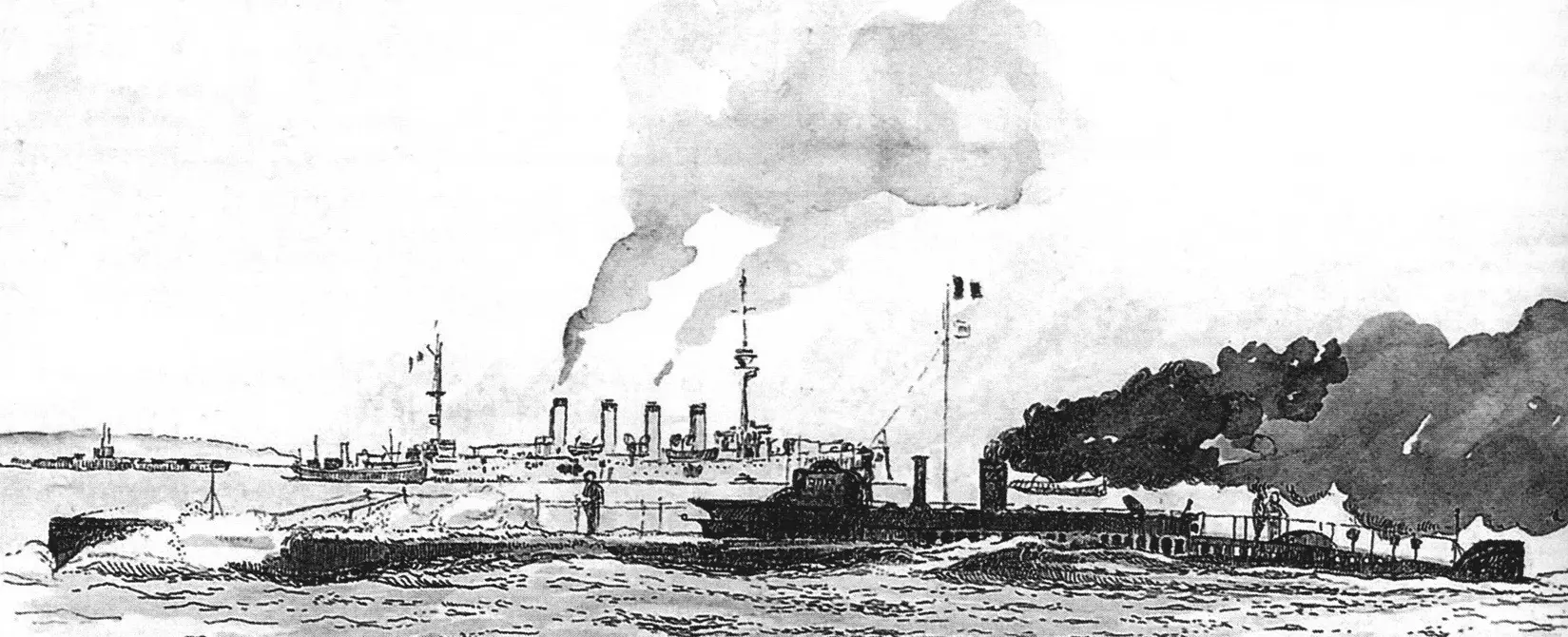
On the evening of 1 December 1914 “Archimede”, escorted by a destroyer, weighed anchor at Cherbourg and headed for Dover, then Harwich, where she arrived after noon on 3 December. Senior French representative aboard was Henri de Casabianca. After discussing all details with Commodore Keyes he departed on 9 December for Cherbourg on the steamer “Newhaven”, which brought spare parts, supplies, and torpedoes for “Archimede”.
Under Admiral Favre’s instructions, Commander Deville was ordered to attack large German ships in the first instance, but if this did not conflict with British orders, “small fry” such as destroyers might also be sunk.
The arrival of “Archimede” at Harwich aroused great interest among British submariners, impressed by her complex technical layout. Her fighting characteristics, low for so large a boat, were somewhat disappointing.
On 15 December Commodore Keyes issued orders to the commander of “Archimede” for the upcoming operation. The task was serious: British intelligence had established that the German fleet was to put to sea on 16 December to bombard the Yorkshire coast, and Keyes planned to try to intercept the enemy off his bases. Seven British “E”-class boats and “Archimede” were to form a screen in the German Bight. The French were assigned a position 5–6 miles northeast of Heligoland and to cruise there until the night of 18 December.
Boats left Harwich in pairs. “Archimede” weighed anchor on 15 December at 15:30, following submarine E 15. As a precaution Keyes attached to Deville a consultant, an experienced British submarine lieutenant.
From Commander Deville’s detailed report, misfortunes began to pursue the French from the very start of the sortie. The port boiler feed pump, which worked perfectly in harbor, began to falter under light load at sea. Speed had to be reduced and “Archimede” fell behind schedule.
On 16 December at 15:30 near the Dutch coast “Archimede” and two British boats met the destroyers “Firedrake” and “Lurcher”. Keyes was aboard the latter; he confirmed previous orders and the submarines continued toward their positions. Three hours later the French found problems with the starboard boiler and active salting of boiler water. At the same time the first attempt to lower the funnel failed. Eventually it was managed and boiler pressure raised. Alarmed but resolute, Deville stubbornly held course for Heligoland.
On 17 December at 08:05 the lookouts sighted the coast of Heligoland; the French reached their assigned square and began cruising on station, observing through the periscope. No enemy ships were detected, only distant smoke once to the southeast.
After 17:30 Deville began withdrawing north to charge batteries. The starboard engine and boiler functioned ever worse, so the starboard shaft was disconnected, to be used when high speed was needed to evade German patrols.
At 21:00 the barometer fell sharply, the sea worsened, and it became clear a storm was approaching from the west, as Keyes had warned. The commodore allowed leaving station with the storm’s arrival, so the commander of “Archimede” decided to return to base.
On the morning of 18 December wave impacts jammed the funnel solid. “Archimede”, smoking heavily, with the starboard condenser also out of action, completely lost the ability to submerge. Periodically avoiding unidentified trawlers and fighting the storm, on the afternoon of 19 December the French at last safely reached Yarmouth, where boiler water was changed (engine cylinders were fully coated with salt) and at noon on 20 December they moored at Harwich.
The list of damage to the ship was impressive. Condenser replacement and feed pump valve repairs were required; the steering quadrant sector was broken and the funnel hatch bent. Wave impacts bent the upper protective covers of two deck torpedo tubes and the breakwater shield of the stem tube. In effect after the storm only the four aft tubes could be used, and their reliability was also in question. Deville characterized the crew’s actions on the sortie as excellent.
After reading the commander’s report the naval minister saw clearly that French steam boats had no business off Heligoland. Despite Admiral Favre’s protests, “Archimede” was ordered to prepare for transfer to the Mediterranean, where she had long been awaited.
“Archimede”‘s finest hour
Commander of the French fleet in the Mediterranean Admiral Boué de Lapeyrère as early as 6 December 1914 had requested “Gustave Zédé” and “Archimede” from the ministry. He needed large boats with great range for reconnaissance and blockade of Pola — main base of the Austro-Hungarian fleet.
On 29 March 1915 “Archimede” left Cherbourg for Brest, whence on 31 March she sailed with “Gustave Zédé” for the Mediterranean.
To describe all further vicissitudes of the submarine’s service in full is impossible and hardly worthwhile — there were too many routine tasks and fruitless sorties. We shall note only the most interesting episodes.
Italy’s entry into the war, taking responsibility for the Adriatic theater, made French sorties toward Pola irrelevant, so until August 1915 “Archimede” operated in the Ionian Sea hoping to intercept Austrian submarines bound to aid the Turkish ally.
From August to December 1915 “Archimede” underwent major repair and modernization at Toulon — a 47 mm deck gun was installed.
The Italians agreed to French submarine flotilla participation in Adriatic operations, and on 13 December “Archimede” arrived at Brindisi. On 29 December 1915, during her second war patrol, off Cape Planka Deville claimed a successful torpedo attack on an escorted enemy merchant ship; Austrian destroyers then pursued the boat for three hours and damaged her. The Austrians did not confirm the attack, but modern sources show Deville did torpedo the steamer “Kupa” (790 GRT), which ran ashore and was not salvaged.
After repair at Taranto, in February 1916 “Archimede” made several more sorties to the Dalmatian coast, unsuccessfully attacking a transport and the destroyer “Warasdiner”.
In March and April Deville claimed two more successful torpedoings of enemy transports, but the Austrians did not confirm them.
On 9 May 1916 “Archimede” scored a victory the enemy at once confirmed and accused the French of senseless cruelty. Off the island of Lussino (modern Croatian Lošinj) Deville ambushed the steamer “Dubrovnik”, assessed as a “heavily laden steamer of 2,000–3,000 tons”. The first torpedo hit amidships but the ship did not sink. Deville then fired a second torpedo. It hit the stern and destroyed the boat into which passengers and crew were boarding — 19 people died. The Austrians publicized the loss in the press and lodged an official protest — according to them “Dubrovnik” had been returned to civilian owners immediately after requisition in 1914 and carried purely peaceful traffic between islands of the archipelago.

It is interesting that according to Austrian sources the tonnage of the steamer for which the French expended two torpedoes was 481 GRT. Meanwhile another “Dubrovnik” of 4,232 GRT, sunk by the Russian submarine “Tyulen” in 1915 in the Black Sea, is sometimes taken as “Archimede”‘s victim.
The flotilla commander at Brindisi, our acquaintance Henri de Casabianca, dismissed all Austrian protests and awarded Deville special thanks for careful navigation reconnaissance in the Dalmatian archipelago, difficult for submarine operations.
The next success was long in coming and was achieved under a new commander. On 8 October 1916 Lieutenant Commander Élie Mercier du Paty de Clam was appointed — son of one of the main figures in the famous Dreyfus Affair.
Having sailed on 13 January 1917, early the next morning off Cape Planka “Archimede” torpedoed the steamer “Zagreb” (537 GRT), which sank within ninety seconds. Joy was short-lived. By evening a storm broke, waves reached 3–4 meters, and at about 22:30 a wave threw Lieutenant du Paty de Clam over the breakwater lifeline onto the deck; the next wave washed him into the sea, where he disappeared without trace.
By cruel irony, shortly before this Émile Deville had taken part in a conference on possible modernization of steam boat superstructures for better protection of the upper watch from seas. Deville spoke against it, noting that he personally had always stood watch on “Archimede”‘s breakwater without difficulty. It was from that breakwater that his less fortunate successor was washed away.
The senior officer, Lieutenant Georges Auben, brought the ship into port and was appointed her new commander. Du Paty de Clam received a posthumous mention in fleet orders praising his gallantry in dangerous operations.
On 2 April 1917 the last episode of “Archimede”‘s service worth mention occurred. The French encountered the Austrian submarine U-27 and in pursuit unsuccessfully fired their entire ammunition allowance at the enemy.
That same month “Archimede”, her machinery and hull heavily worn, went to Toulon for major repair.
After emerging from repair in January 1918 the steam veteran was already considered obsolete and was sent to the rear echelon of the submarine war. She joined the Moroccan submarine flotilla hunting German ocean raiders. No successes or notable incidents were recorded for “Archimede” or the whole flotilla in this last period of the war.
After the armistice the boat was immediately placed in reserve and disarmed, and on 12 November 1919 stricken from the navy list. In 1921 the former pride of the French submarine fleet was sold for scrap at Toulon for 47,000 francs.
With three reliably confirmed victories “Archimede” became the most successful French submarine of the First World War. The geography of her war service is also impressive: the English Channel, North Sea, Mediterranean, Atlantic Ocean.
Despite faults and the hopelessness of the design that became obvious during the war, French sailors remained grateful to their steam submarines and to Lobé’s foresight. For almost the entire war the “submarine steamers” proved more reliable than their diesel sisters, which constantly had engine problems. Without the steam boats, in the first half of the war French admirals might have been left entirely without “eyes” off enemy ports and bases. Analysis of time out of service for technical reasons shows the “steamers” beat diesel boats with 31.2% against 42%. Thus they fulfilled their mission: they bought time for French diesel engineering to “cure its teething troubles” and materially affected the combat readiness of French submarine forces in the First World War.
“Modelist-Konstruktor” No. 8’2025, Maxim DIANOV
Recommend to read
 Kayak on wheels
Long-distance kayak trips have become one of the most popular types of tourism in our country, and not by chance. It is hard to name another sport that combines so much that is both... MORE ABOUT THE LAMPS
The era of universal shortage has prompted us to create the things in the shops it was impossible to find. However, the era of abundance has not stopped this process. Apparently, a...
