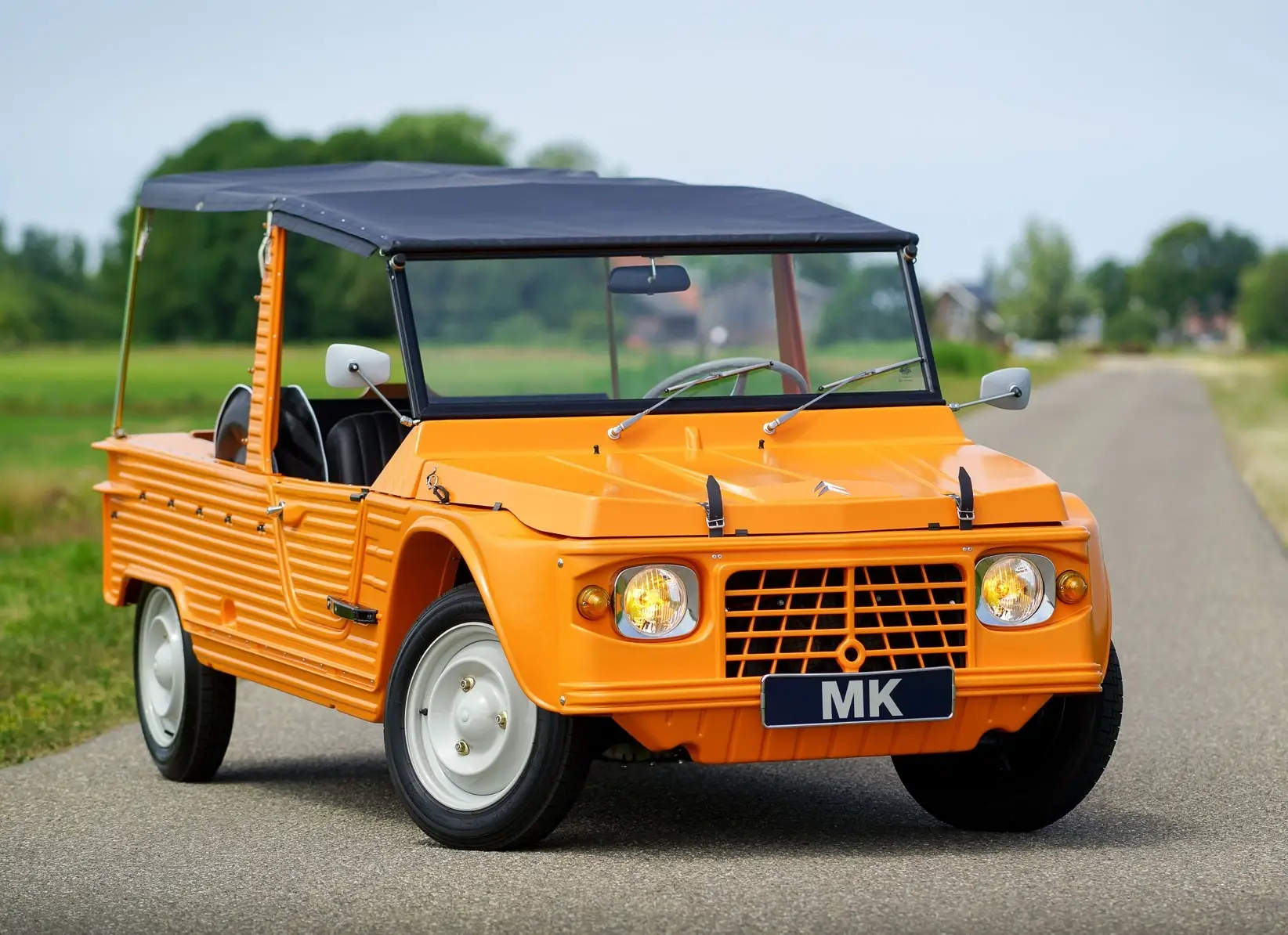
Many famous French automobiles were created by aviators. The cars of the Voisin brothers and Farman are well known, for example. A worthy place in automotive history is also held by the light off-roader Citroen Mehari. It was designed by a pilot as well — Hero of the Soviet Union, Count Roland de la Poype.
The Citroen Mehari became one of Roland de la Poype’s finest creations. The idea of building such a car was born in the early 1960s. At that time, his company supplied Citroen factories with instrument panels and plastic fenders for some models. The count then wondered: why not build a car entirely from ABS plastic using the running gear of the Citroen 2CV. It would be inexpensive to produce, light, and durable. At first, the designer planned to sell the cars as kits for home assembly, but the project appealed to Citroen management. In the end, they decided to produce series cars on the platform of the Dyane model — a modernized version of the Citroen 2CV — and sell them through the official dealer network.

The car was named Citroen Dyane 6 Mehari. As is known, Mehari is a breed of camel developed by the Tuareg for racing and riding. In late November 1942, pilots of the Normandie squadron traveled to the USSR from Iran aboard Li-2 passenger aircraft. One of the intermediate stops was in Astrakhan. Winter came early in 1942, and the pilot forever remembered the scene: snowdrifts, mechanics in valenki boots and sheepskin coats, and… camels used as transport for airfield service. The designer sought to make his car as undemanding and hardy as a camel. Later the car’s name was shortened to Citroen Mehari.
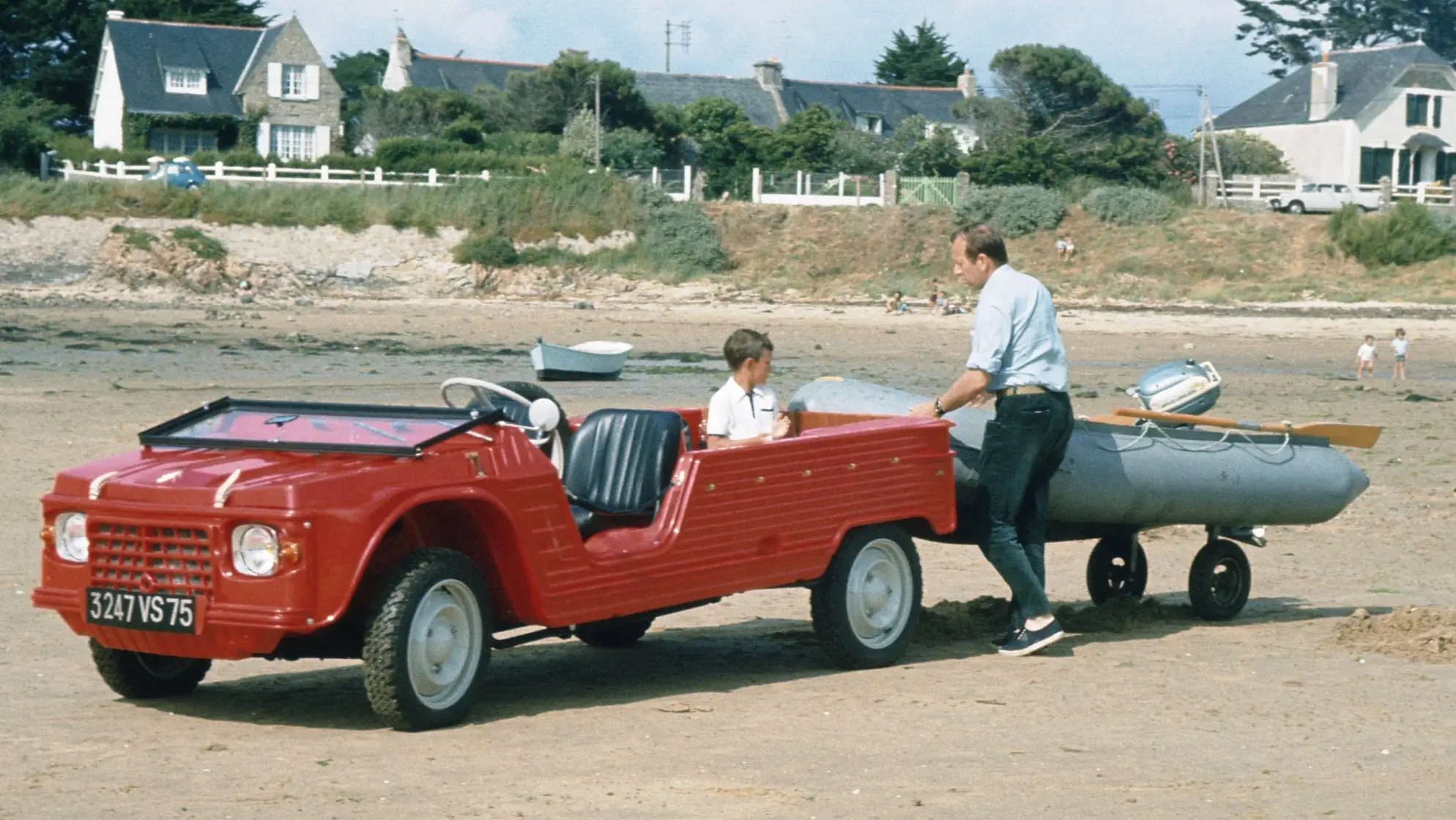
Citroen Mehari went into series production in 1968. At first it was offered in two trim levels. The simplest and cheapest had a fully open body. The top version had an additional vertical body pillar and a removable transparent plastic top. This version was developed for the gendarmerie, but such cars were also sold to anyone who wanted one. Two side and a rear door, plus additional metal bumpers, were offered as options. There was also an amphibious version, but it did not go into series production. The Mehari cost slightly more than the Dyane 6 (9,680 and 8,980 francs respectively).
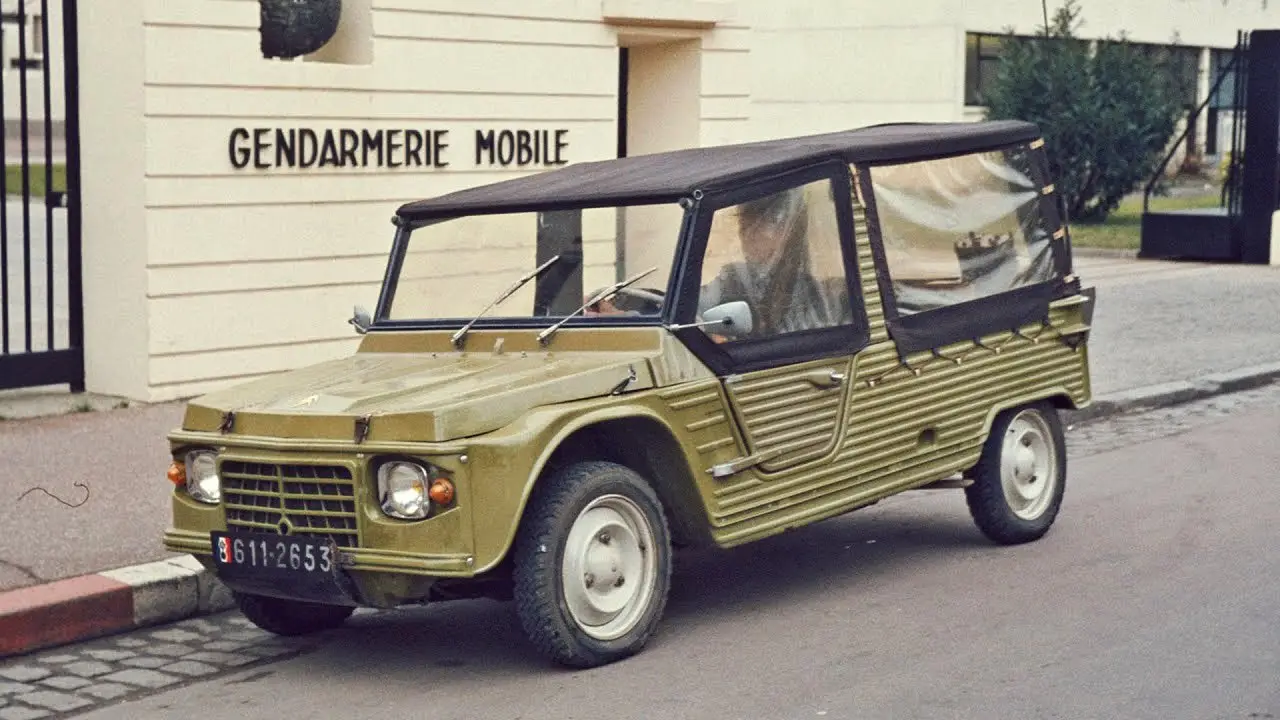
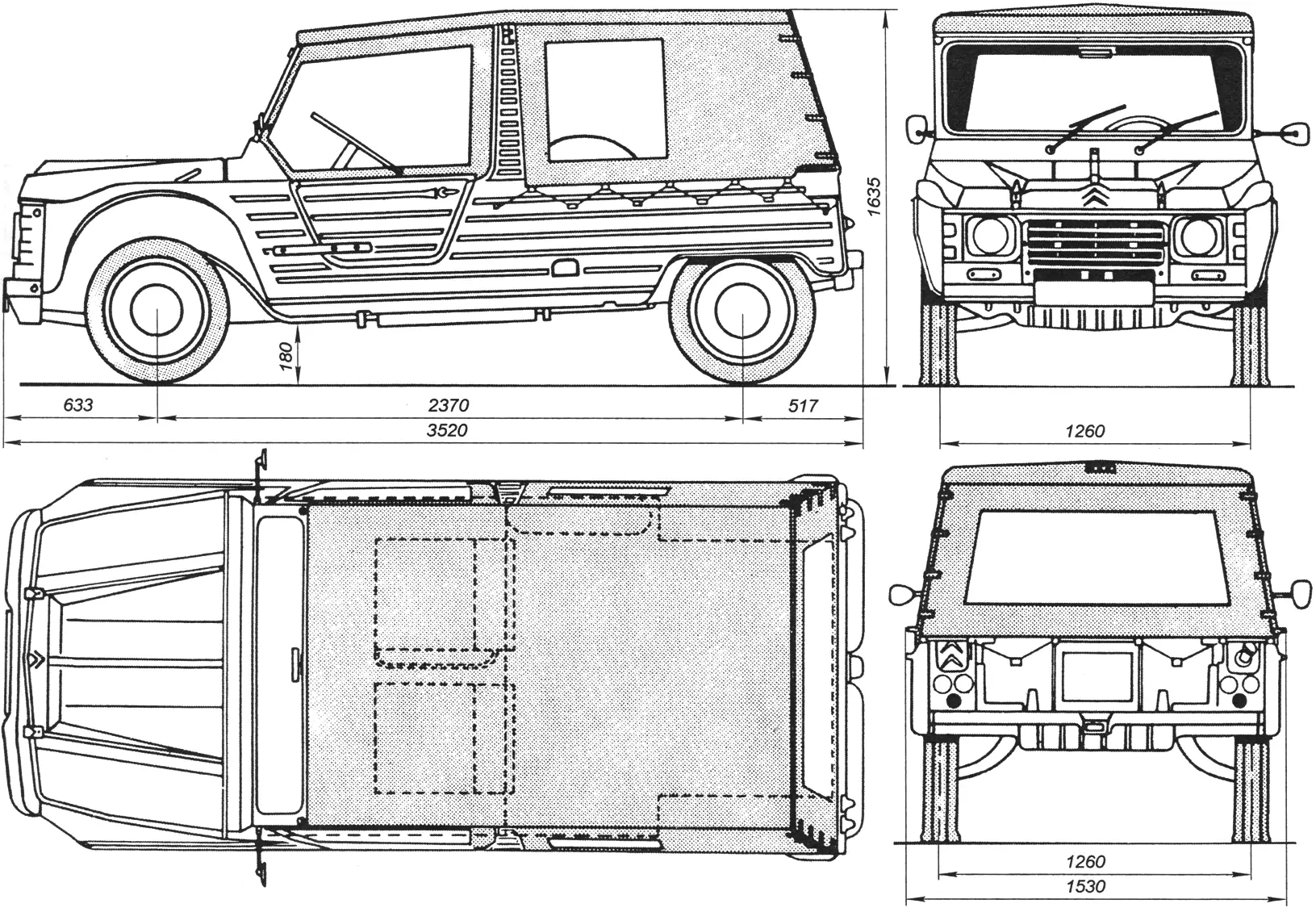
The Citroen Mehari had front-wheel drive only. The engine came from the Citroen Dyane 6 — an air-cooled, horizontally opposed two-cylinder unit of 602 cc developing 29 hp. The gearbox was a four-speed unit. To increase pulling power, fourth gear had a ratio of 1.42, so top speed did not exceed 100 km/h. If desired, the standard gearbox from the Citroen Dyane 6 could be installed, raising the maximum speed to 120 km/h. Thanks to its low weight (570 kg), the Mehari had excellent off-road ability for a front-wheel-drive car. And if it got stuck, the crew could easily push it out on their own.
The car was extremely spartan. Up front were two separate seats upholstered in leatherette, at the rear a single bench, and a spare wheel mounted vertically along the right side. Formally it seated 2+2 (two adults up front and two children in the rear). Yet payload capacity was an impressive 400 kg, which is why in the famous gendarme films up to six law enforcement officers could cram into the little car.
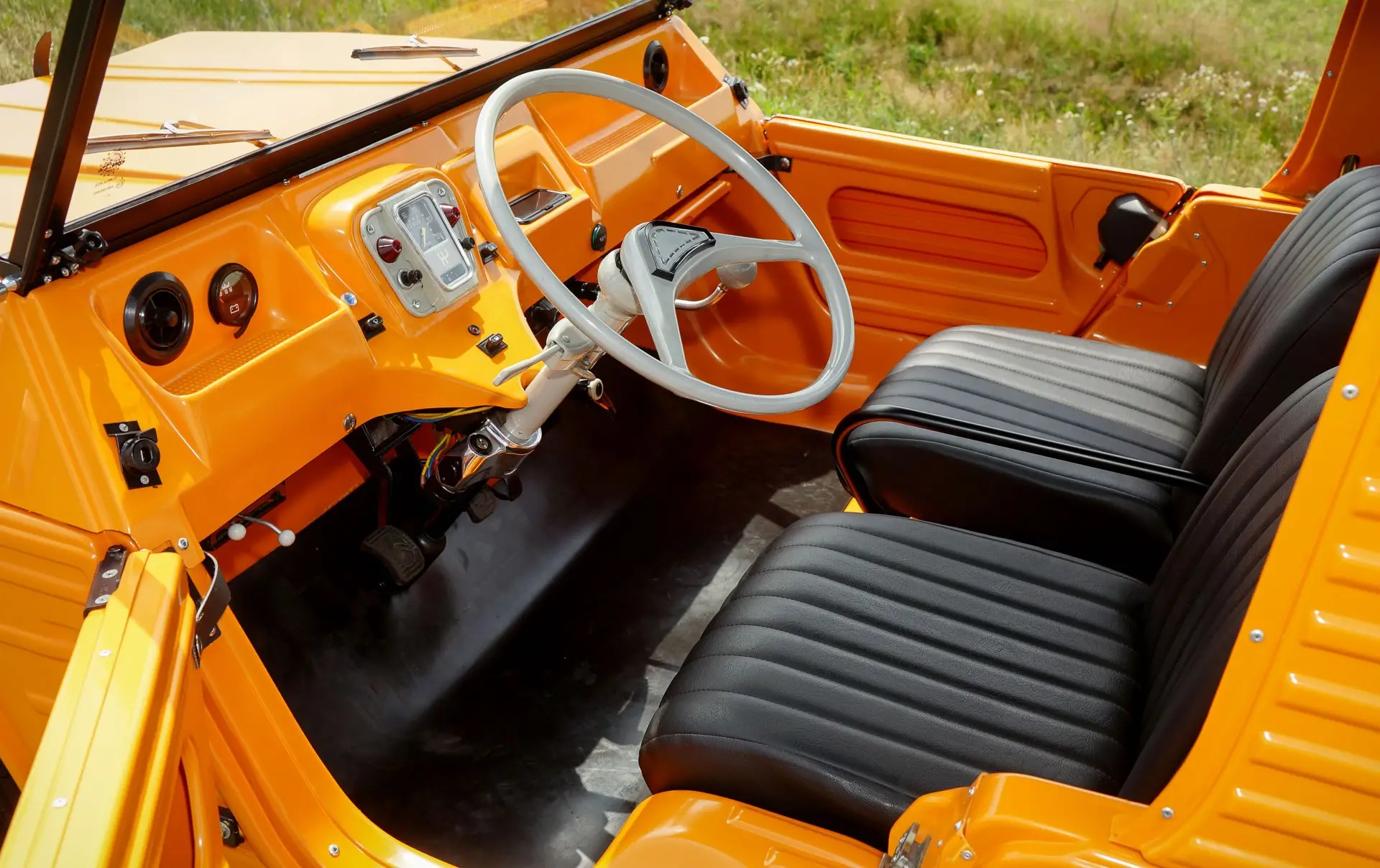
The Citroen Mehari was offered with both left-hand and right-hand drive for export markets. The factory palette consisted of seven colors: red “Gobi”, yellow “Atacama”, two greens “Montana” and “Tibesti”, two beiges “Kalahari” and “Hoggar”, and “Kyrgyz Orange”. There was also the luxury Mehari Azur trim with a white body; the doors, center pillar, and top with radiator grille were painted blue. It came with more comfortable seats with fabric upholstery.
From 1969 to 1970, a special Mehari version certified as a light truck was produced for export to the USA, since passenger cars could no longer be sold there without seat belts. The cars were fitted with lighting to American standards and had a number of minor differences. Mostly they were sold in California and on the Hawaiian Islands.
In 1978 the Citroen Mehari body was updated. The lighting, radiator grille, and front bumper were changed.
Immediately after its debut, the “Camel” attracted interest from the French military. As early as 1959, the four-wheel-drive Citroen 2CV-AZ 4×4 Sahara with two Citroen 2CV engines had been adopted. That car proved expensive, complex in design, and heavy. Later the military began purchasing the Citroen Mehari instead. They were mainly used in rear units and signal troops. Some cars were supplied in “front-line transporter” trim for evacuating wounded from the battlefield. A total of 8,807 (according to other sources, 7,064) Citroen Meharis of various versions were delivered to the French armed forces. Another 12 cars went to the Irish armed forces.
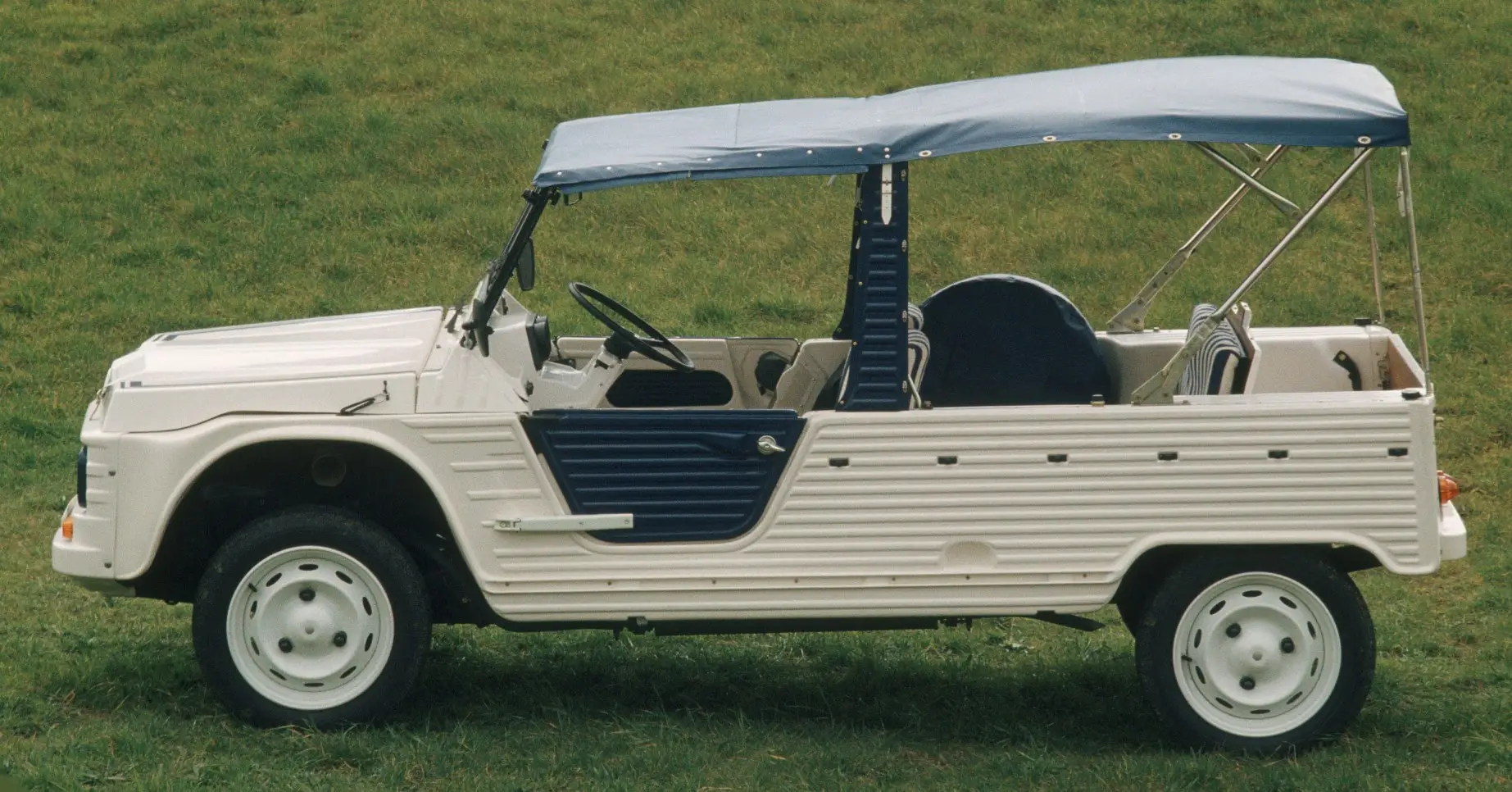
At the military’s request, a four-wheel-drive version also appeared. It was equipped with a transfer case and a locking rear differential. The civilian Citroen Mehari 4×4 went on sale in 1979. It had widened wheel arches, larger tires, and additional metal bumpers. The rear lights came from the Citroen Acadiane. The spare wheel was moved to the engine compartment. It did not fit entirely, so a cutout was made in the hood. Seating capacity increased to five. Citroen had to buy four-wheel-drive transmission components from outside suppliers, so the price of the Mehari 4×4 nearly doubled compared with the front-wheel-drive version (more expensive than our Niva), which kept demand low. Production ended in 1983 after only about 1,300 units were sold.
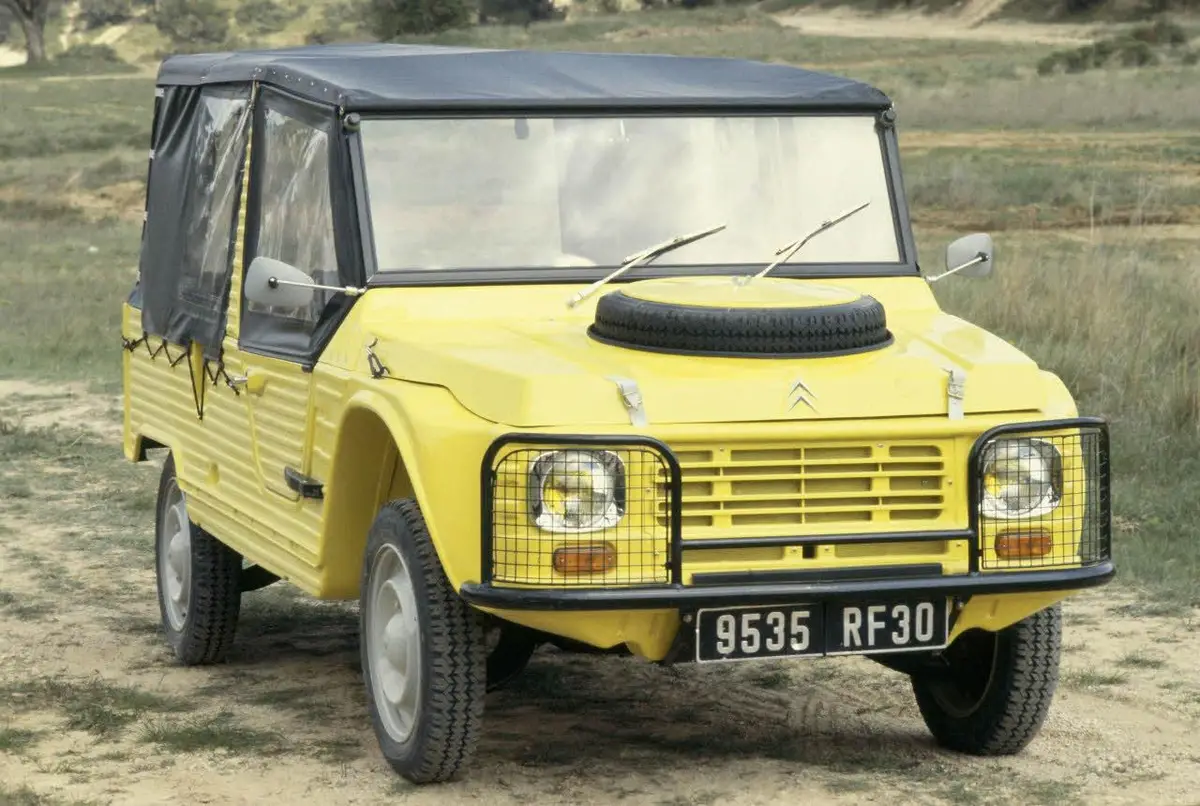
Production of the base model in France continued until 1988; a total of 144,953 such little cars were built. Another 17,500 were assembled in Portugal, 12,480 in Spain, and 3,997 in Argentina. But that is only the tip of the iceberg. Meharis were assembled by many Citroen branches in other countries and by numerous independent companies. Moreover, in some cases they differed substantially from the original version.
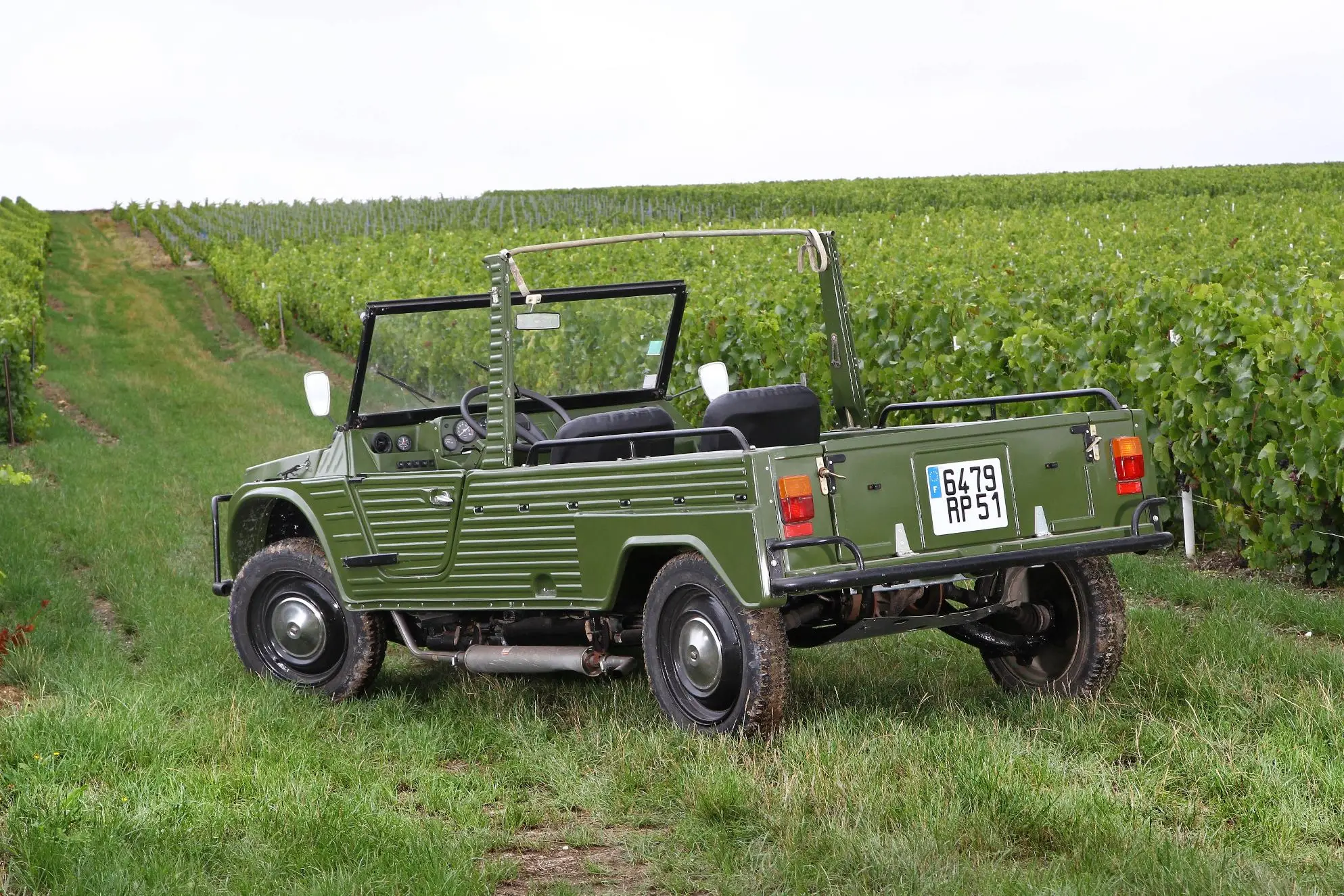
In South America, for example, there was a local version of the Citroen Mehari. Outwardly it resembled the French prototype but had structural differences. This modification used running gear from the Citroen Ami, a more powerful engine, and drum brakes rather than the discs of the “original”. Because ABS plastic processing technology was unavailable, the body was made of fiberglass. Late-production cars had the same design as the Mehari 4×4, but drive was to the front wheels only. About 14,000 such cars were assembled in Argentina and Uruguay.
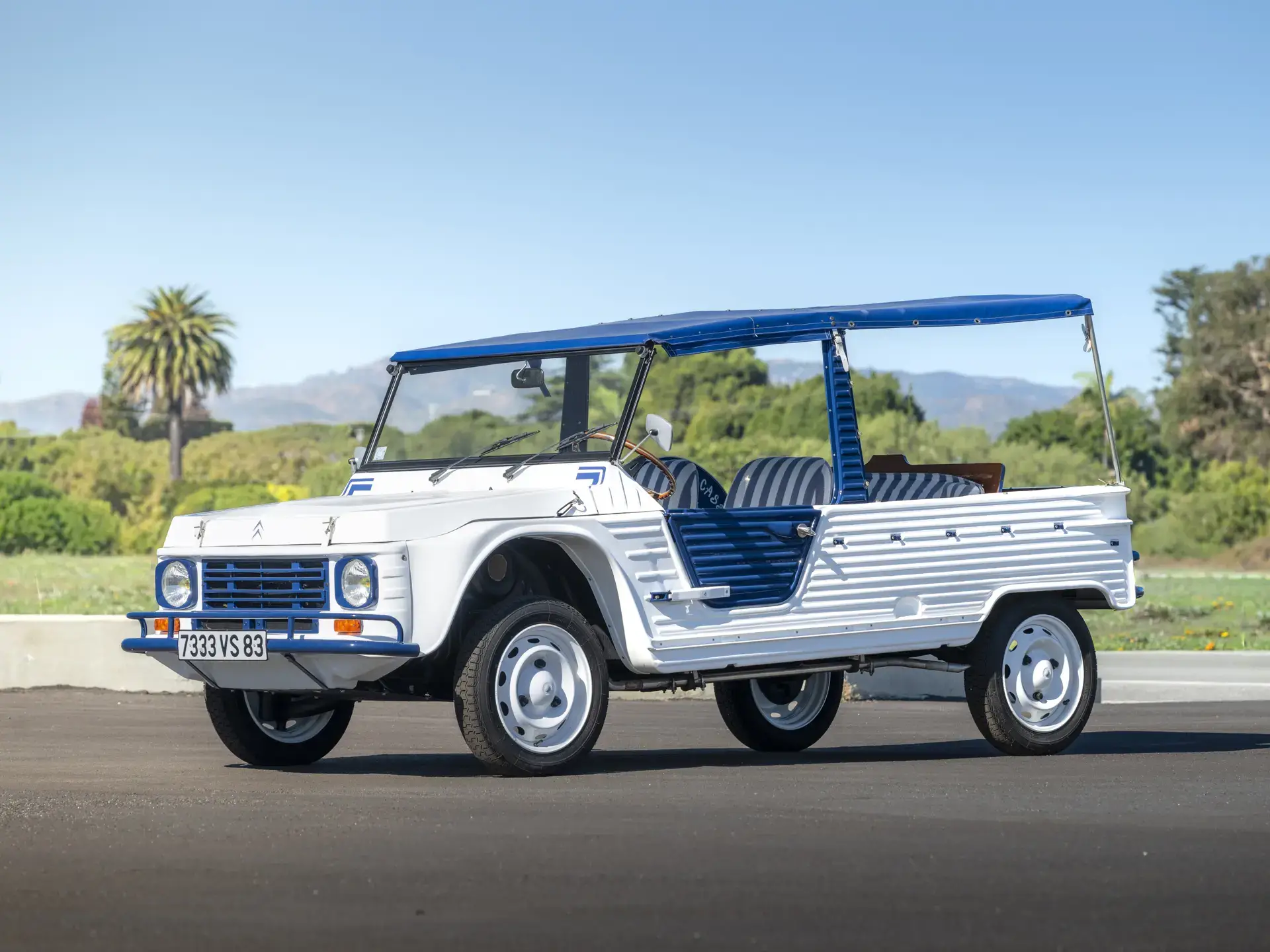
Uruguay also produced the Mehari Ranger version with a closed plastic body. And in Chile from 1972 to 1974, open Citroen Yagan cars were crudely assembled — inspired by the Mehari but with 2CV running gear.
From 1974 to 1983, NAMCO Pony-Citroen cars were produced in Greece. They used French running gear but had bodies of original design. In addition to complete cars, NAMCO supplied kits for assembly in other countries. About 30,000 Pony-Citroens were built in all, 17,000 of them in Greece itself.
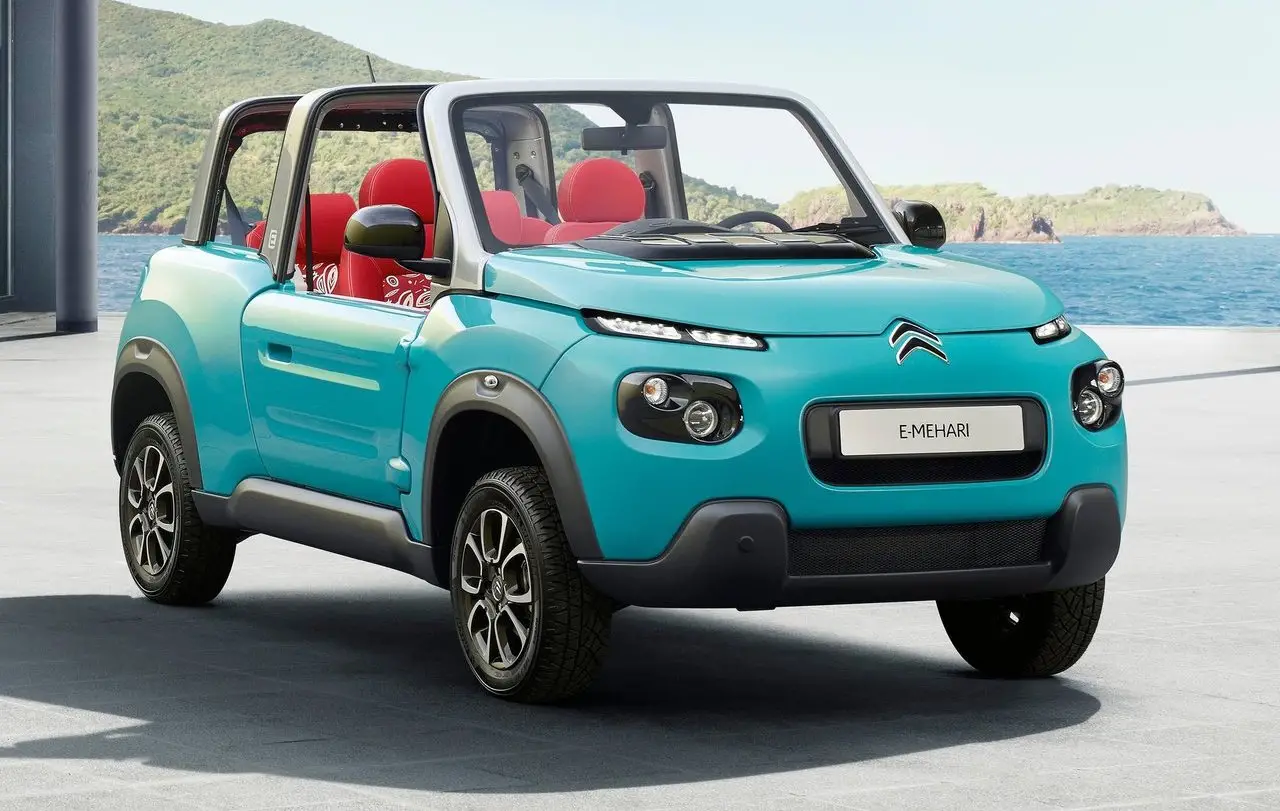
Although the Citroen Mehari has long been out of production, a significant number are still on the road. The plastic body is virtually eternal, and all necessary spare parts are made by Mehari Club. The same company restores the cars. A Citroen Mehari assembled from new parts costs about 10,000 euros; the four-wheel-drive version is twice as expensive. At the customer’s request, the car can be fitted with an electric powertrain.
In 2016 Citroen decided to release a remake of the cult car. The new generation is powered exclusively by electric motors and is called the Citroen E-Mehari.
Technical specifications of Citroen Mehari family cars
| Model | Mehari | Mehari 4×4 |
|---|---|---|
| Curb weight, kg | 570 | 735 |
| Gross weight, kg | 955 | 1145 |
| Engine displacement, cc | 602 | 602 |
| Power, hp | 29 | 29 |
| Compression ratio | 8.5:1 | 8.5:1 |
| Maximum speed, km/h | 100 | 99 |
| Average fuel consumption, l/100 km | 6.9-7.5 | 8-9 |
MINIATURE TECHNOLOGY
The most accurate model of the 1978 Citroen Mehari in 1:24 scale is made by WhiteBox. It has a well-detailed interior and lighting, and a decal on the instrument panel. There are few shortcomings: the chassis is rather simple, and there is no sidewall marking on the tires. On the same molds Altaya made a magazine version of the early 1970 Citroen Mehari; it differs in lighting, radiator grille, and paintwork.
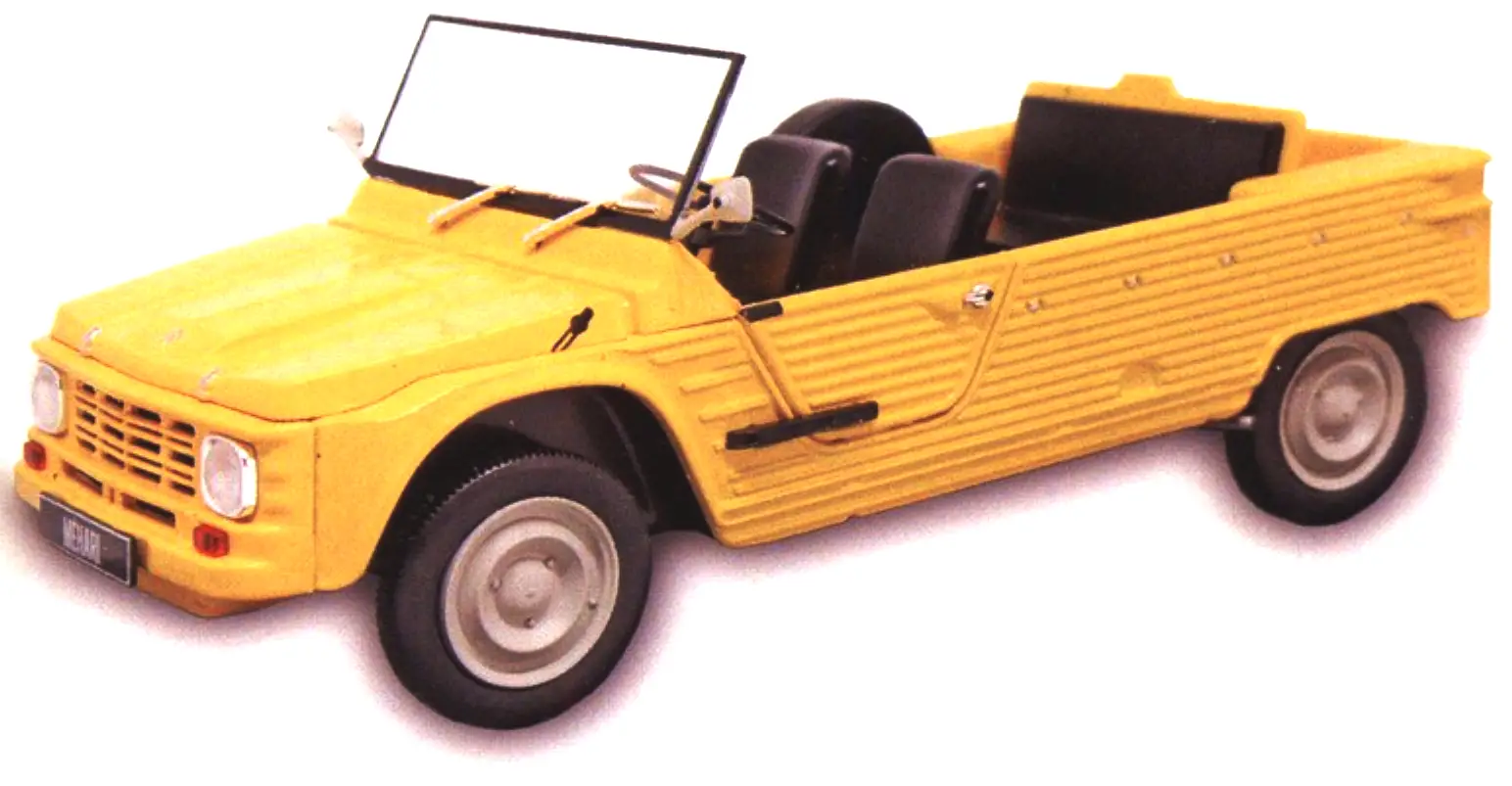
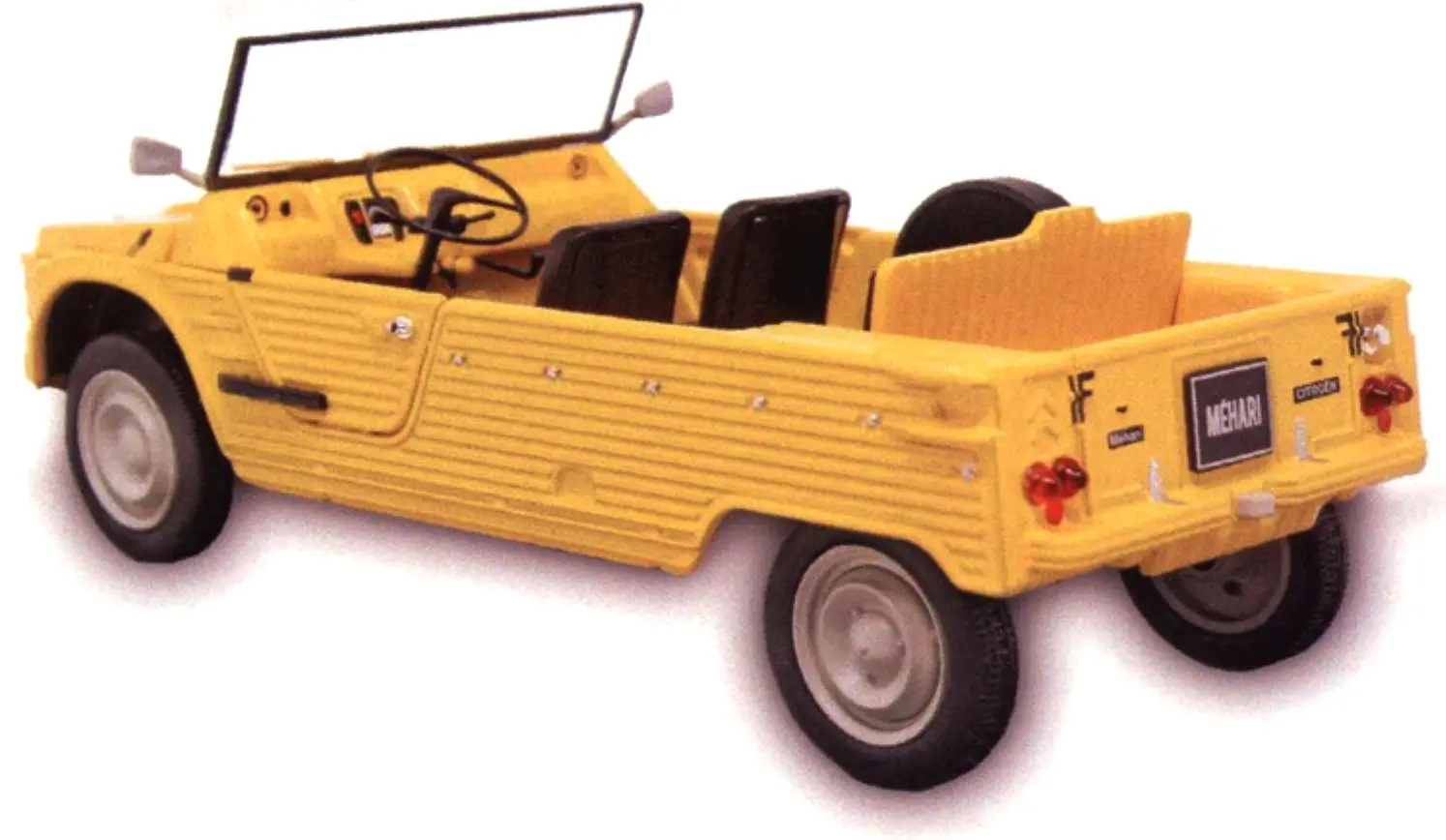
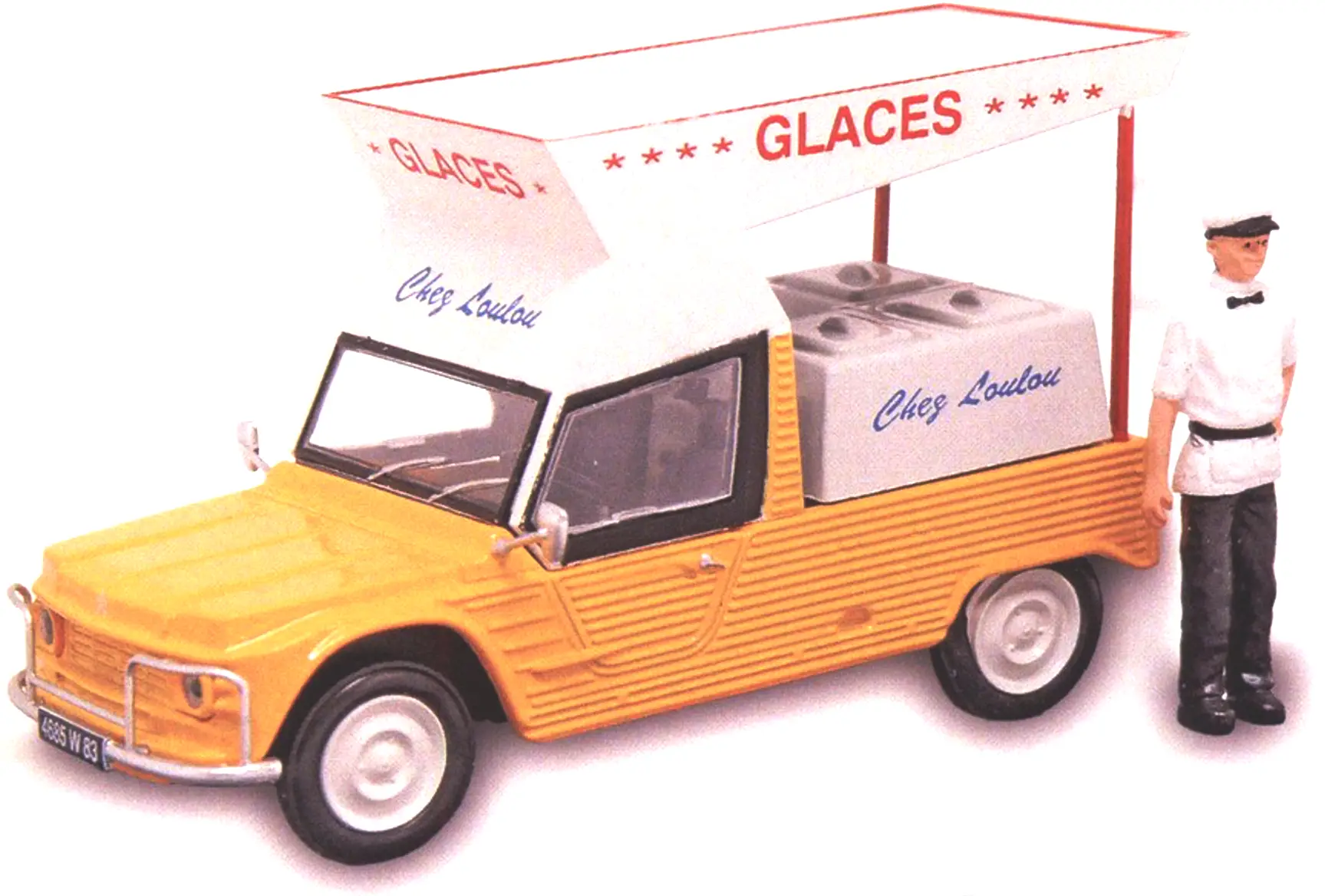
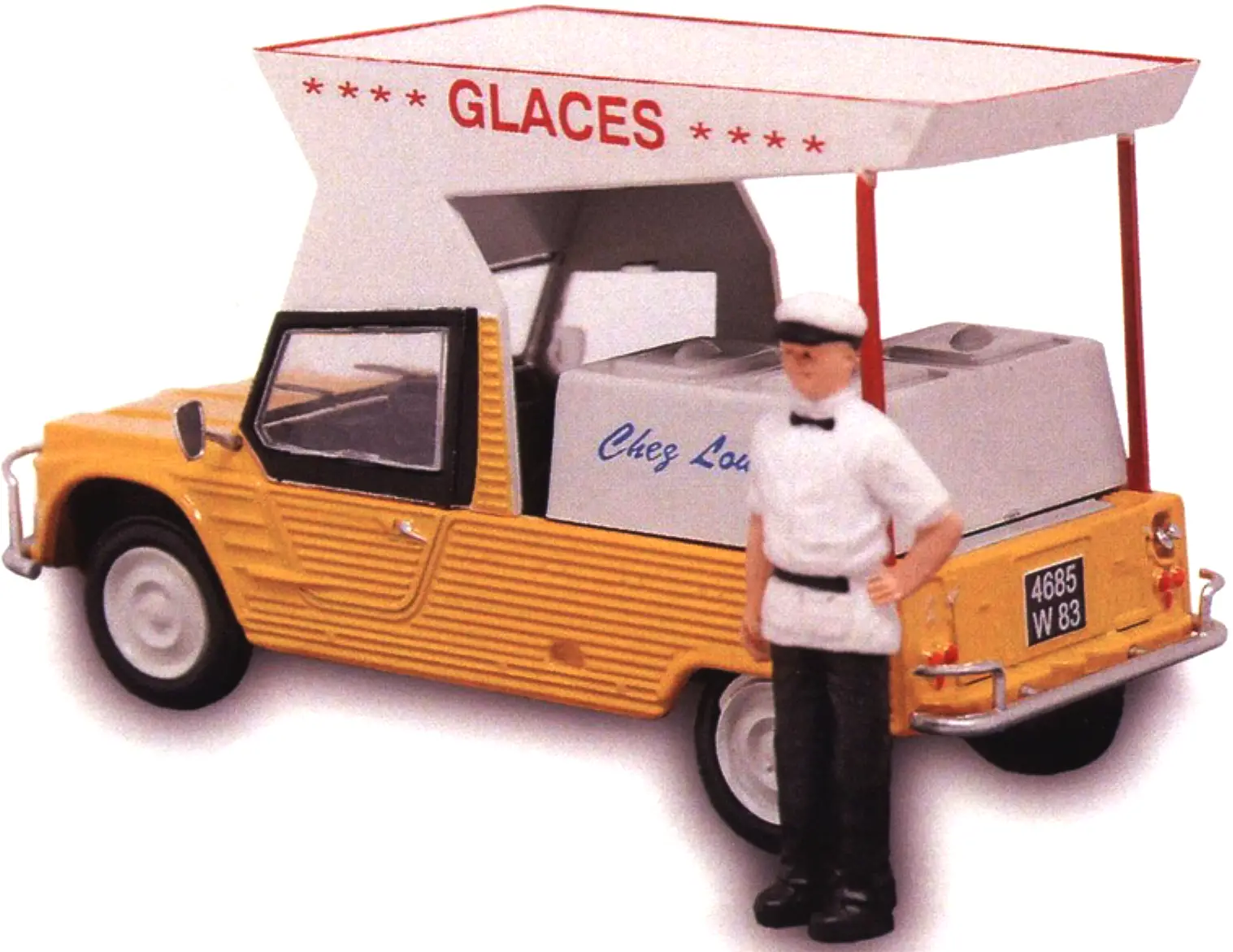
In Atlas’s magazine series Petits utilitauies (“Light commercial vehicles”) there was an interesting 1:43 Citroen Mehari modification — a mobile ice-cream cart. Such vehicles really did operate in French resort towns. The model includes an insert with a registration certificate and a figure of a cheerful ice-cream vendor. It has an extra bumper, but the hood is reproduced incorrectly and there are no front turn signals, although mounting points for them are provided.
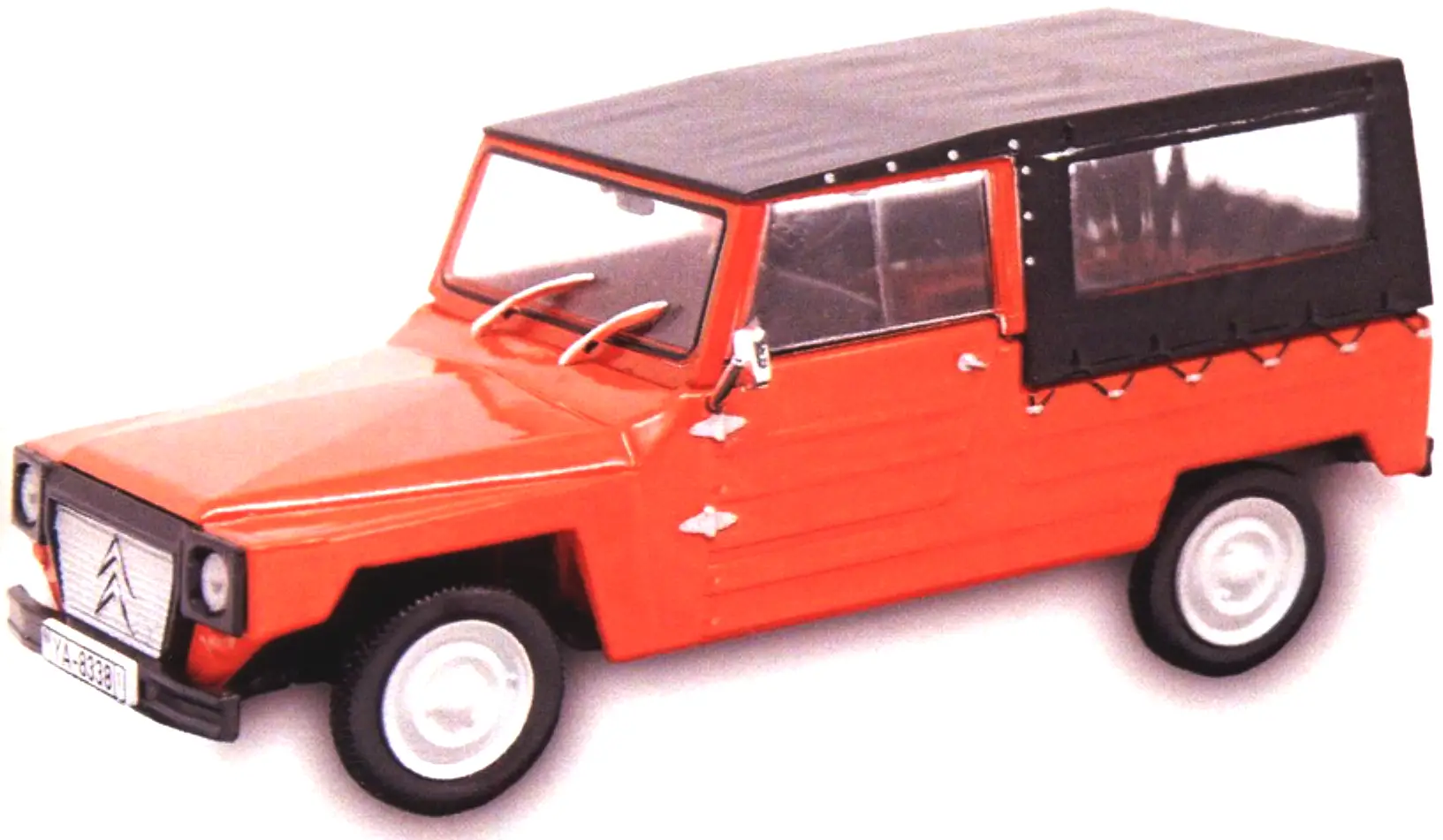
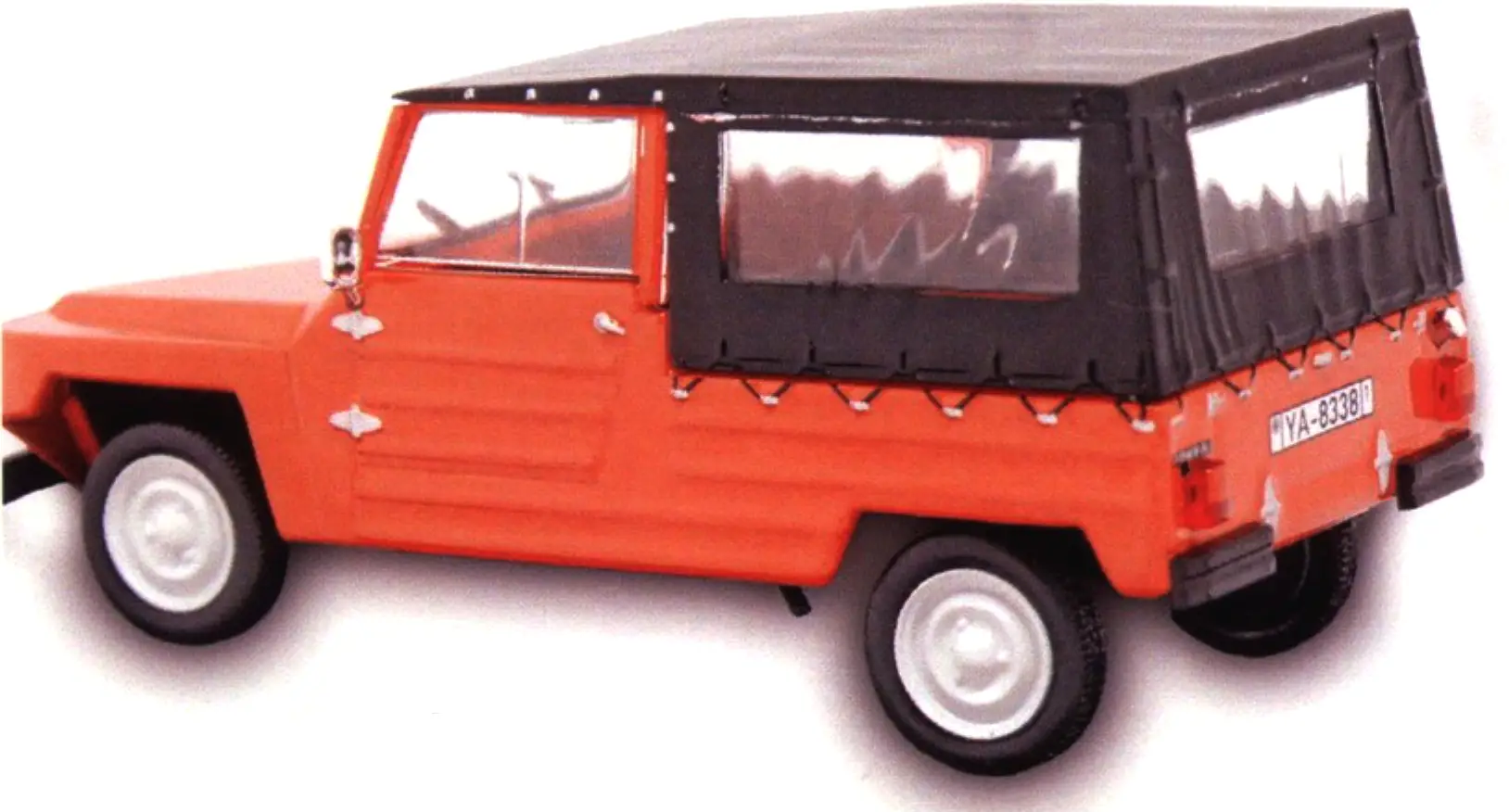
The Greek NAMCO Pony-Citroen model in 1:43 scale is offered by ixo. On the same molds it appeared in various European magazine series. The copy looks striking; the top with simulated sagging came out well. However, the chassis is not detailed at all, and the front turn signals are simply picked out in paint.
“Modelist-Konstruktor” No. 8’2025, Sergey DYAKONOV, photos by the author and Citroen
Recommend to read
 Apples instead of… laundry
For apple juice lovers I can suggest a homemade juicer that is simple to make and does not require large investments. It is built from an old washing machine. Factory juicers have low... THE INSTRUMENTAL IN THE FRIDGE
Not in a hurry to dump an old refrigerator (even if it was only on the door). He still will serve as a closet pantry and door stamped inner wall can be adapted for storage for tools....
