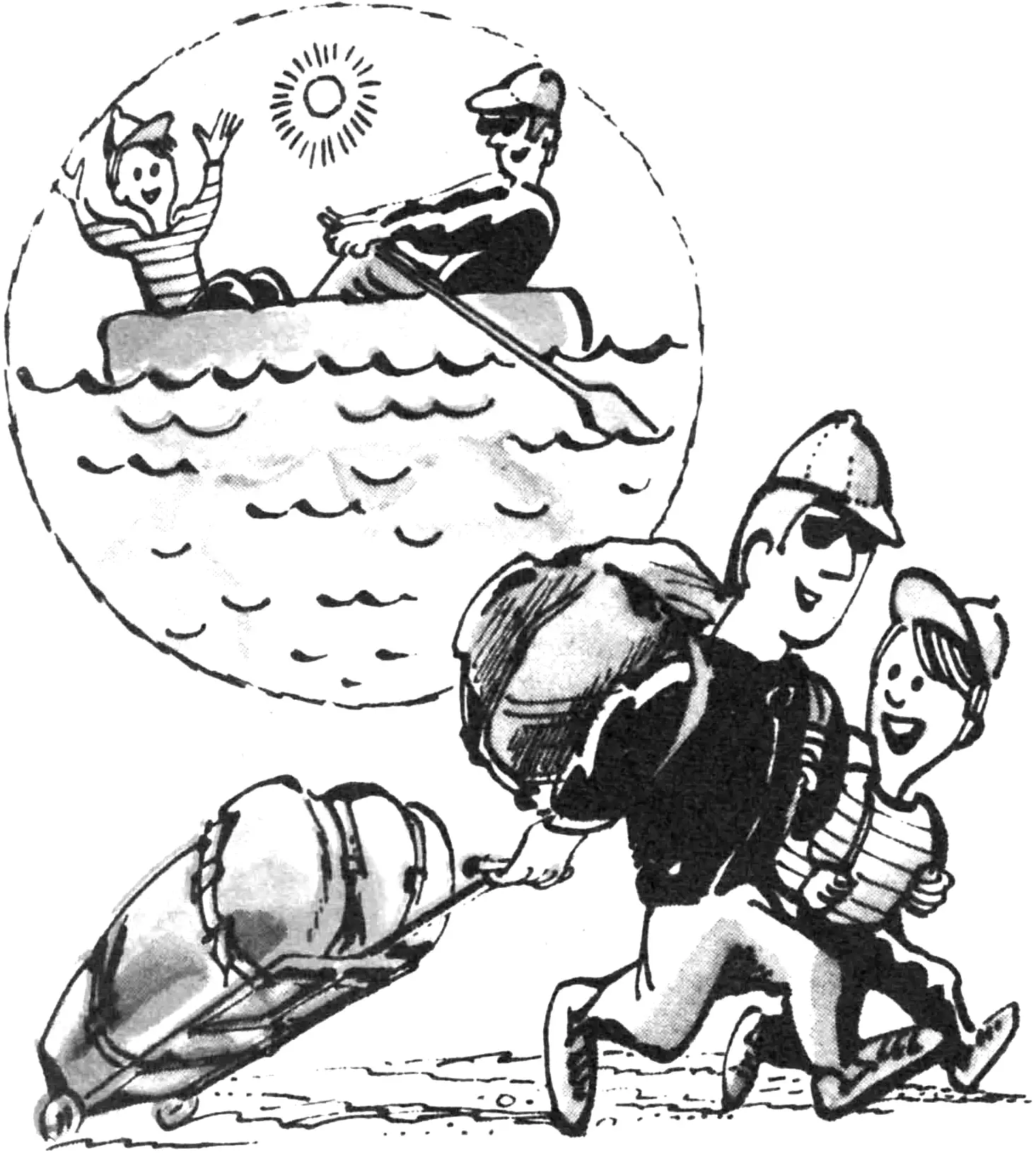
I needed such a complex trolley to carry an inflatable boat. The one sold in stores takes up quite a lot of space, and keeping it in a rubber boat is not very convenient: the wheels stick out, as do the cargo platform and its stop. On my trolley everything folds, which made it quite compact. Now it fits well in the inflatable-boat cover; and in the boat itself there is always a place for it. Storage is convenient too: it simply hangs on the wall. Several variants of folding and sliding units, locking in the working and folded positions, were made in metal. The last one proved the most reliable, as shown by its successful three-year service. True, a load of more than 32 kg never had to be hauled.
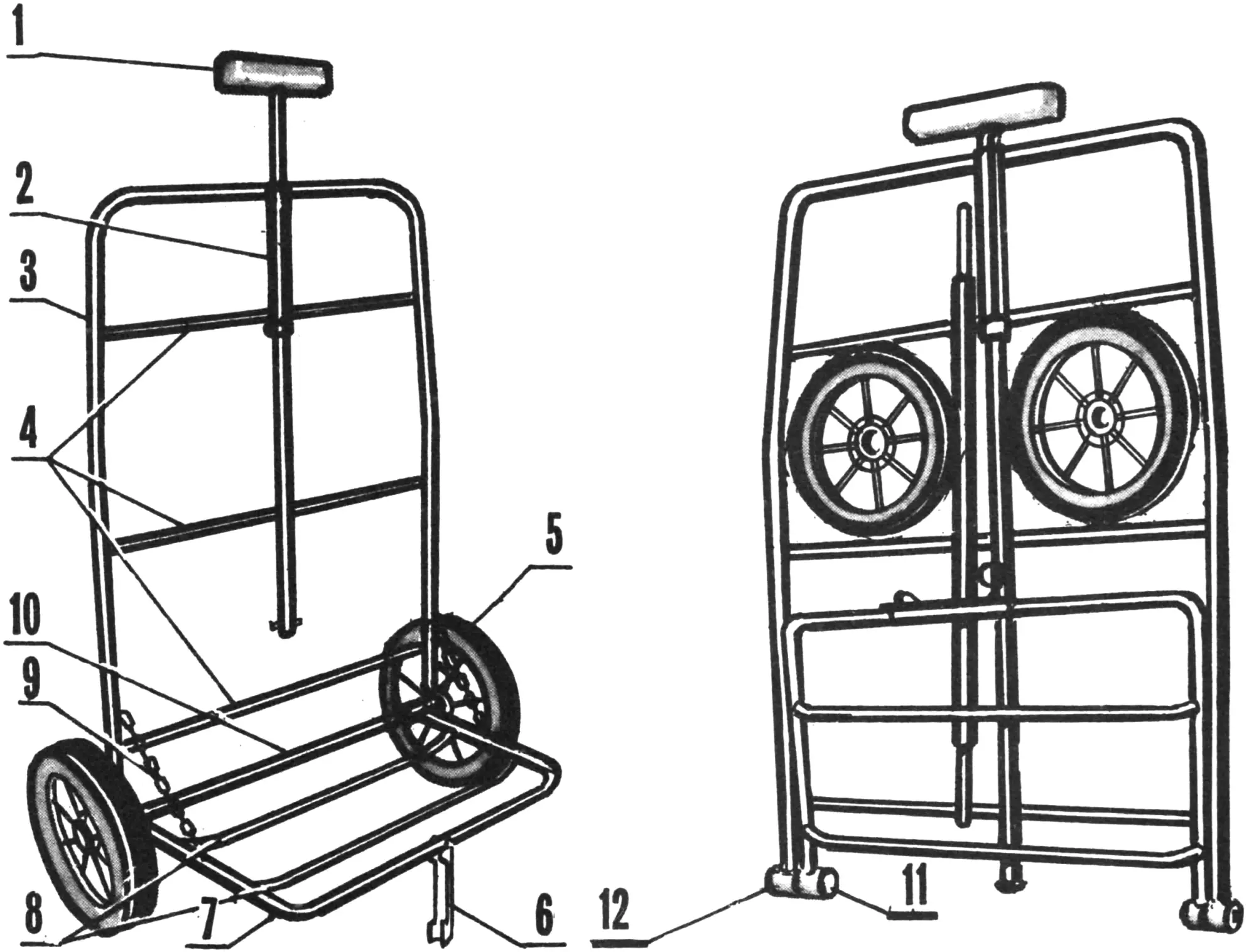
1 — telescopic handle (shown in the retracted position), 2 — telescopic-handle bushing, 3 — trolley frame, 4 — frame crossmembers, 5 — wheel, 6 — folding stop, 7 — cargo platform, 8 — platform crossmembers. 9 — chain lock, 10 — axle, 11 — cargo-platform bushing, 12 — frame bushing.
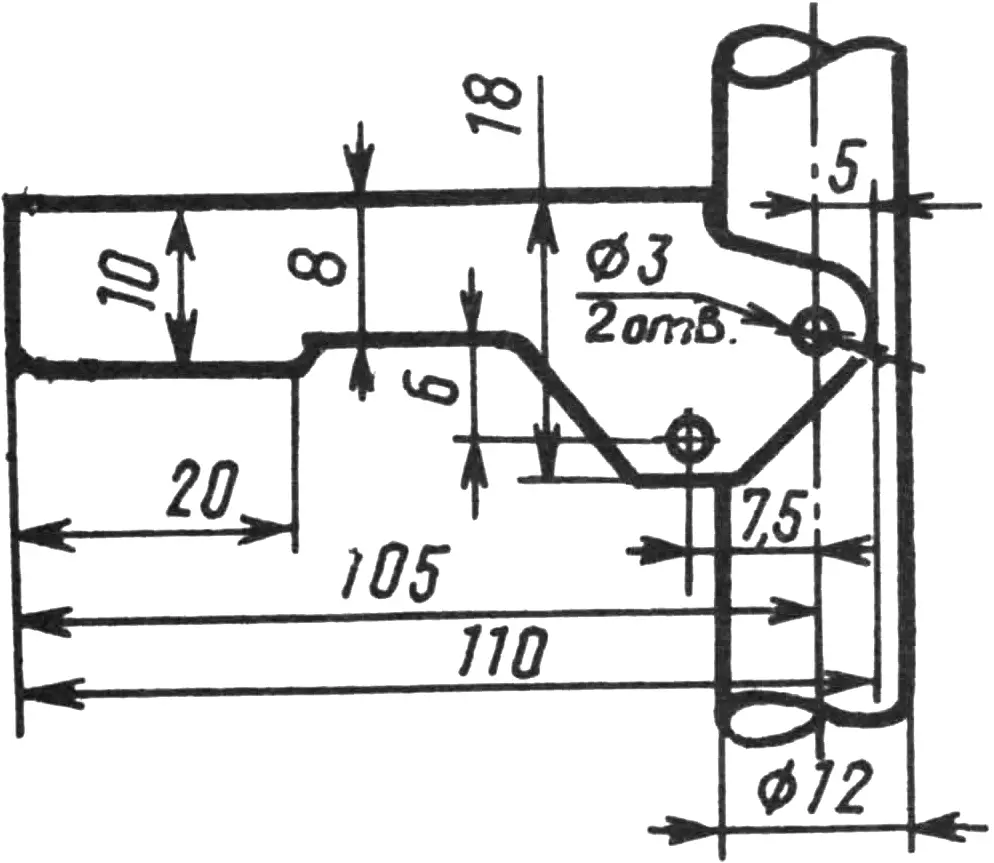
When making the stop, I do not recommend using a tube with a wall thickness of less than 2 mm, because on a bus ride, on sharp turns, it is simply twisted by the side load.
To make the frames, first draw a full-size template on paper and use it as a jig when bending the tubes. When joining the trolley parts, tack the pieces to each other with two or three spots first, then weld them fully; otherwise the frame will warp, and straightening can substantially spoil its appearance.
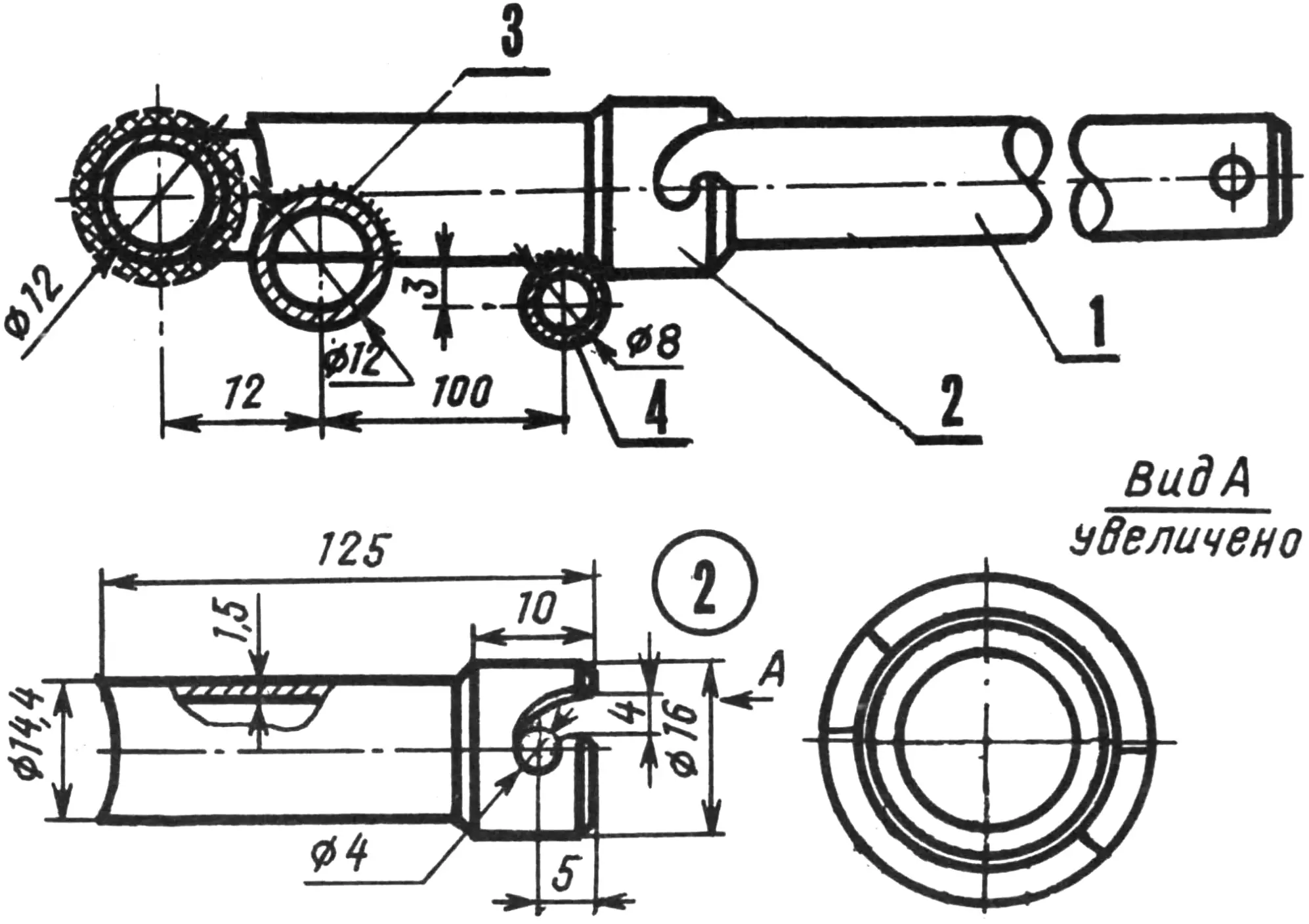
The folding cargo platform is welded in the following order: the hinge bushings are slipped onto a mandrel — a Ø 15 mm rod, tack-welded to the platform frame, and then fully welded. After that, the trolley-frame bushings, using a mandrel — a metal rod of the same length and diameter as the axle — are tacked to the main trolley frame, the joints are checked for ease of rotation, and the final welding is done. All welds and burrs are carefully cleaned and polished. It should be noted that the folding trolley was designed for Ø 160 mm wheels. Accordingly, if they turn out larger or smaller than this size, the half-axles will have to be modified.
When bending the blanks for the frame, a hand pipe bender with 30 mm roller diameters was used.
“M-K” 7’89, A. RYBAKOV
Recommend to read
 Siberian All-Rounder
I invite the magazine’s readers to get acquainted with an original design of a universal self-propelled vehicle built by my brother Alexander. As he claims (jokingly, of course), the idea... WITHOUT A BRUSH AND IS CONVENIENTLY
Offer an easy and convenient option of using paper glue sold in plastic bottles without a brush. On the lid of the bottle make a hole with a diameter under the core-tube of a ballpoint...
