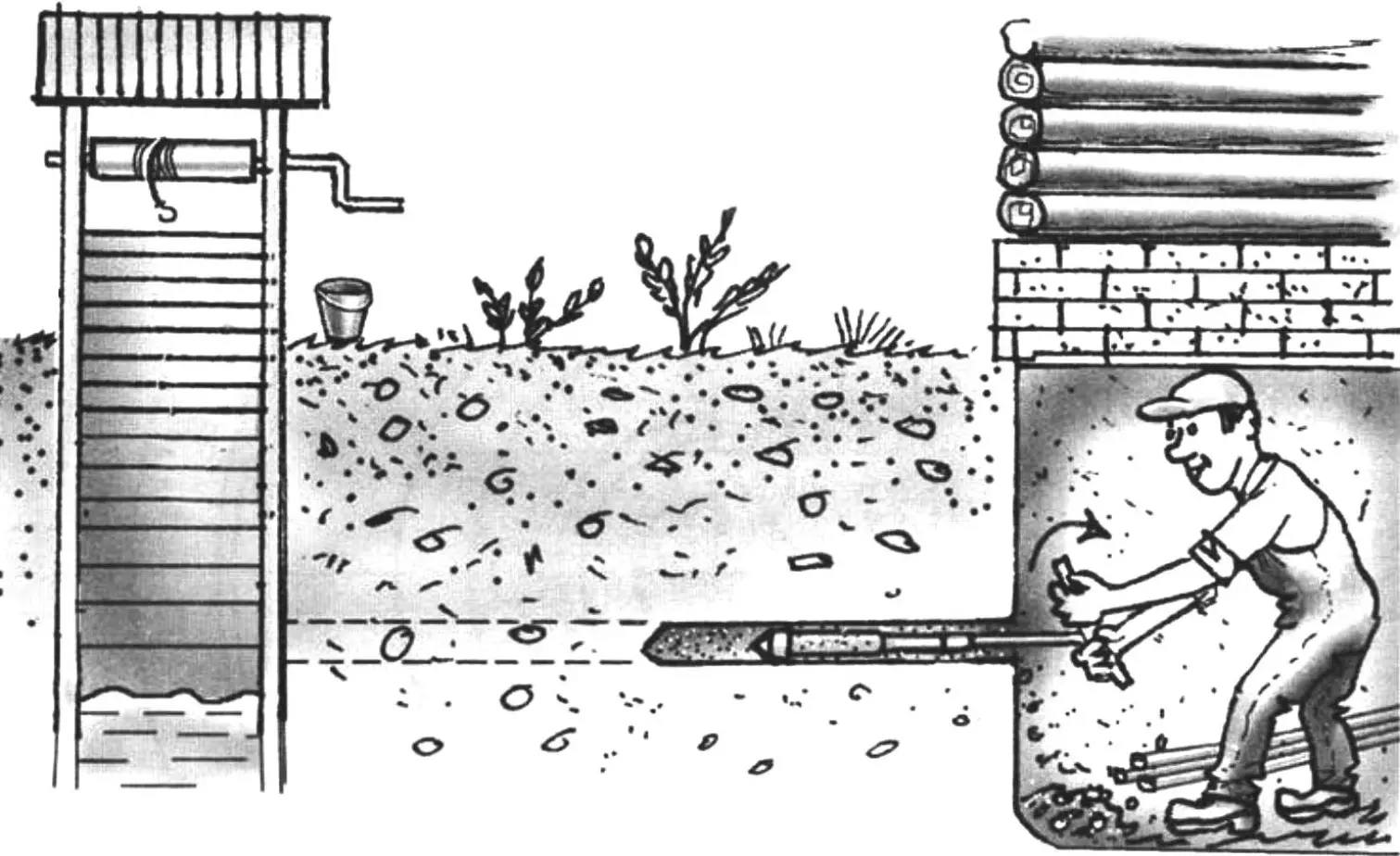
The idea to make the drill offered to readers came to me in the following everyday situation: after moving into a homestead house, I did not manage to run a water supply from the well before winter began. Digging a trench that was not long (about 5 m) but rather deep (about 2 m) in frozen ground seemed a difficult job. So as not to wait until the next summer, I decided to drill a horizontal borehole (a relatively small-diameter hole) a little below the frost line to lay a 3/4″ steel pipe for bringing water from the well through the crawl space into the house.
The drill design is simple. It consists of a pair of cutters, a guiding ring of the body, a rod, and a sleeve. All these parts are welded into a single assembly. But the drill also has a detachable part, which in turn consists of several pieces. The first is the tommy bar. It is a T-shaped welded part consisting of a stem and a handle. Not far from the free end of the stem a 4.2 mm hole is drilled — through it, using a nail pin, the tommy bar is connected to the sleeve. For convenience, handles made from a suitable rubber hose can be put on the ends of the tommy bar handle.
The cutters are made of good spring steel (an old wood circular saw blade can also be used) and are welded to the ring symmetrically relative to its center. The cutters can be sharpened and accordingly welded either for clockwise rotation of the drill or for counterclockwise — whichever is more convenient.
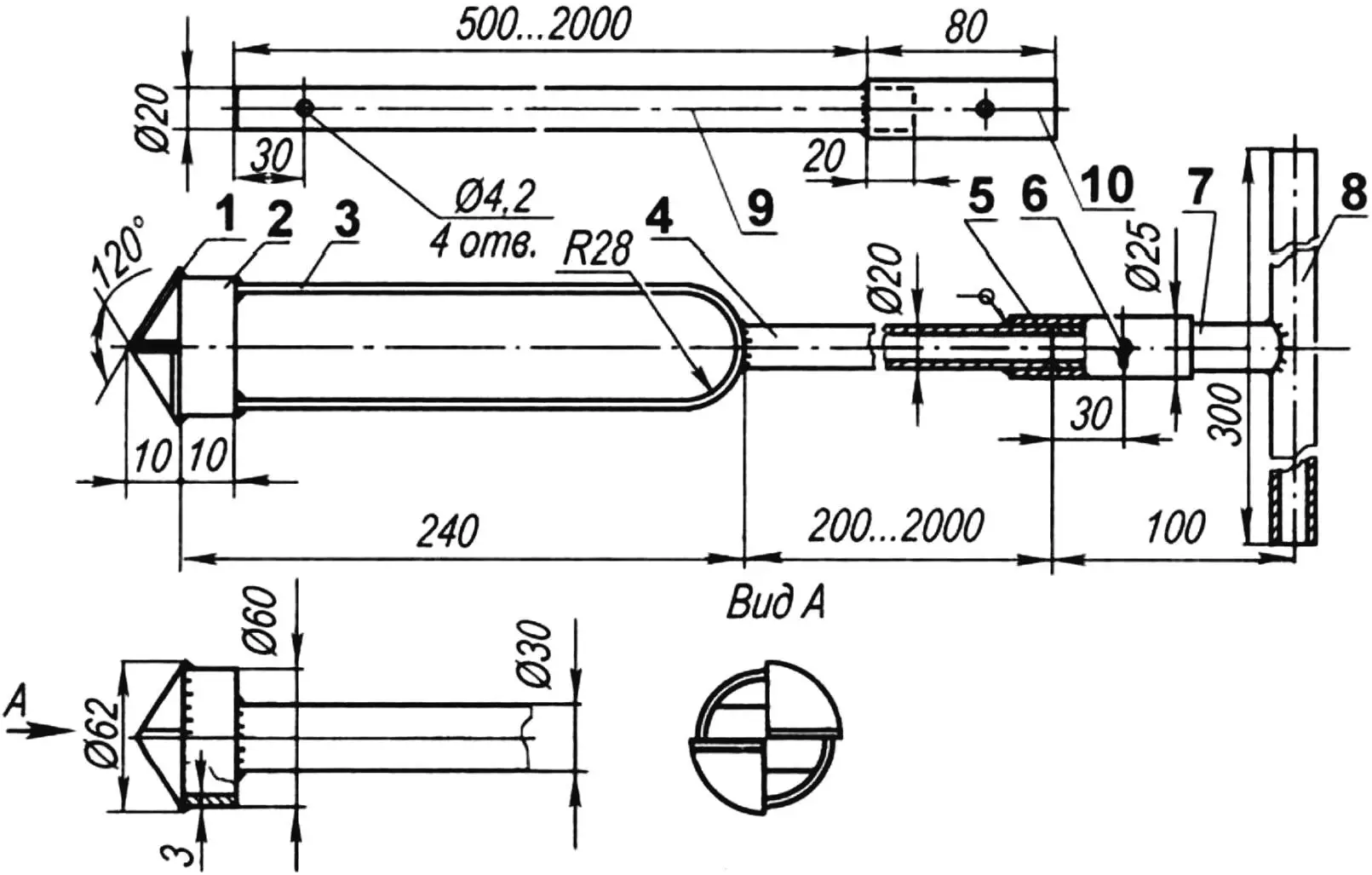
1 — cutter (spring steel, 2 pcs.); 2 — ring (steel, sheet s3); 3 — body (steel, strip 30×3); 4 — rod (1/2″ pipe); 5 — sleeve (3/4″ pipe); 6 — pin (nail Ø4); 7 — tommy bar stem (1/2″ pipe); 8 — tommy bar handle (1/2″ pipe); 9 — extension rod; 10 — extension rod sleeve (3/4″ pipe)
On the other side, the ends of an arc-shaped body, bent like the ring from a 3 mm thick steel strip, are welded to the ring. A rod — a length of 1/2″ steel water pipe — is welded to the bend of the body arc. The rod length can be up to two meters, but for convenient storage of the drill it is not worth making it longer than one meter.
A sleeve made from 3/4″ water pipe is fitted onto and welded to the free end of the rod. Also, near the free end of the sleeve a diametral hole is drilled (the same as in the tommy bar stem) for the pin that connects the tommy bar.
The drill also has other attachable parts — extension rods (one or several), made like the main rod. The length of the extension rods can reach two meters.
Before starting drilling, I determined more precisely the direction from the crawl space to the well. I marked the borehole at a height of about 250 mm from the crawl-space floor and with a slope of about 10° toward the well. The drilling method is simple: after setting the drill in the required direction, turn the handle 10–15 times while pressing. Then the drill must be pulled out and the packed soil shaken out of the body and the ring. The procedure is repeated many times, lengthening the drill with extension rods. I would note that with a helper the work goes about one and a half times faster.
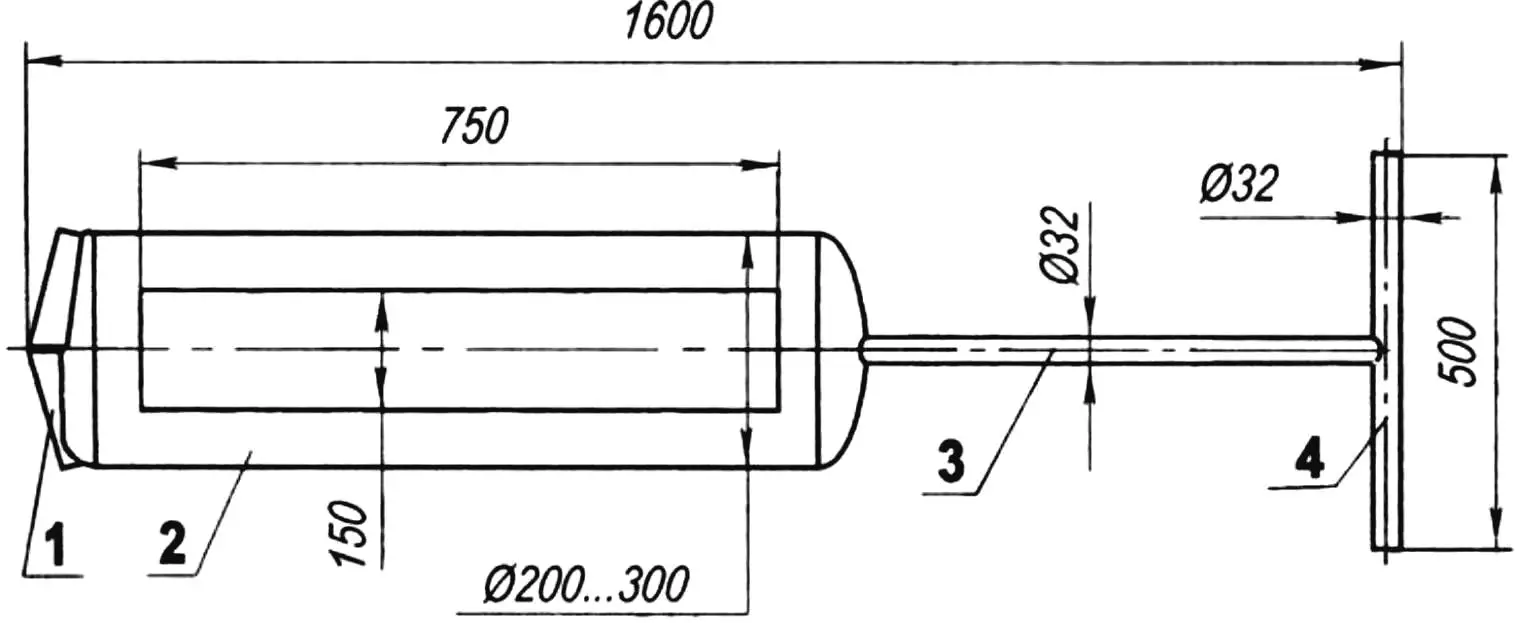
1 — cutter (spring steel, 2 pcs.); 2 — body (KamAZ truck air receiver, modified); 3 — tommy bar stem (1″ pipe); 4 — tommy bar handle (1″ pipe)
Having drilled through to the well wall, I punched a hole in it. Into the borehole I first inserted a casing pipe with an outside diameter a little under 60 mm, and through it I pulled a hose into the well, which I connected to a pump.
My drill does not sit idle. I have also used it to set fence posts and to drill boreholes up to 10 m deep for Abyssinian (driven) wells. But more often relatives, neighbors, and acquaintances use this tool. There is even experience of drilling a horizontal borehole under a road without blocking it at all. When laying a water line under that road, the owner saved 15 thousand rubles that the municipal water utility had asked for the service.
In rural areas or cottage construction a larger-diameter drill is often needed. It is not hard to make one on the model of the one described, from an air brake system receiver of a KamAZ truck. One end of the receiver must be cut off and cutters welded in its place. In the shell, on opposite sides, two elongated windows should be cut — for emptying the accumulated soil. To the other end, along the receiver axis, weld a rod or the tommy bar directly.
“Modelist-Konstruktor” No. 11’2007, A. MATVEYCHUK
Recommend to read
 BEDSIDE WITH TWO FLOORS
Nightstand for bedding is usually a narrow box with a lid or flap in half of the front panel. We offer Hungarian magazine "Thermastar" option bedside tables apparently also almost... ENGINE-PUMP
Motorcyclists know what a tire puncture on the road. What should I do if I didn't have the pump? With me this often happened. Here's what the replacement pump I would suggest. Make type...
