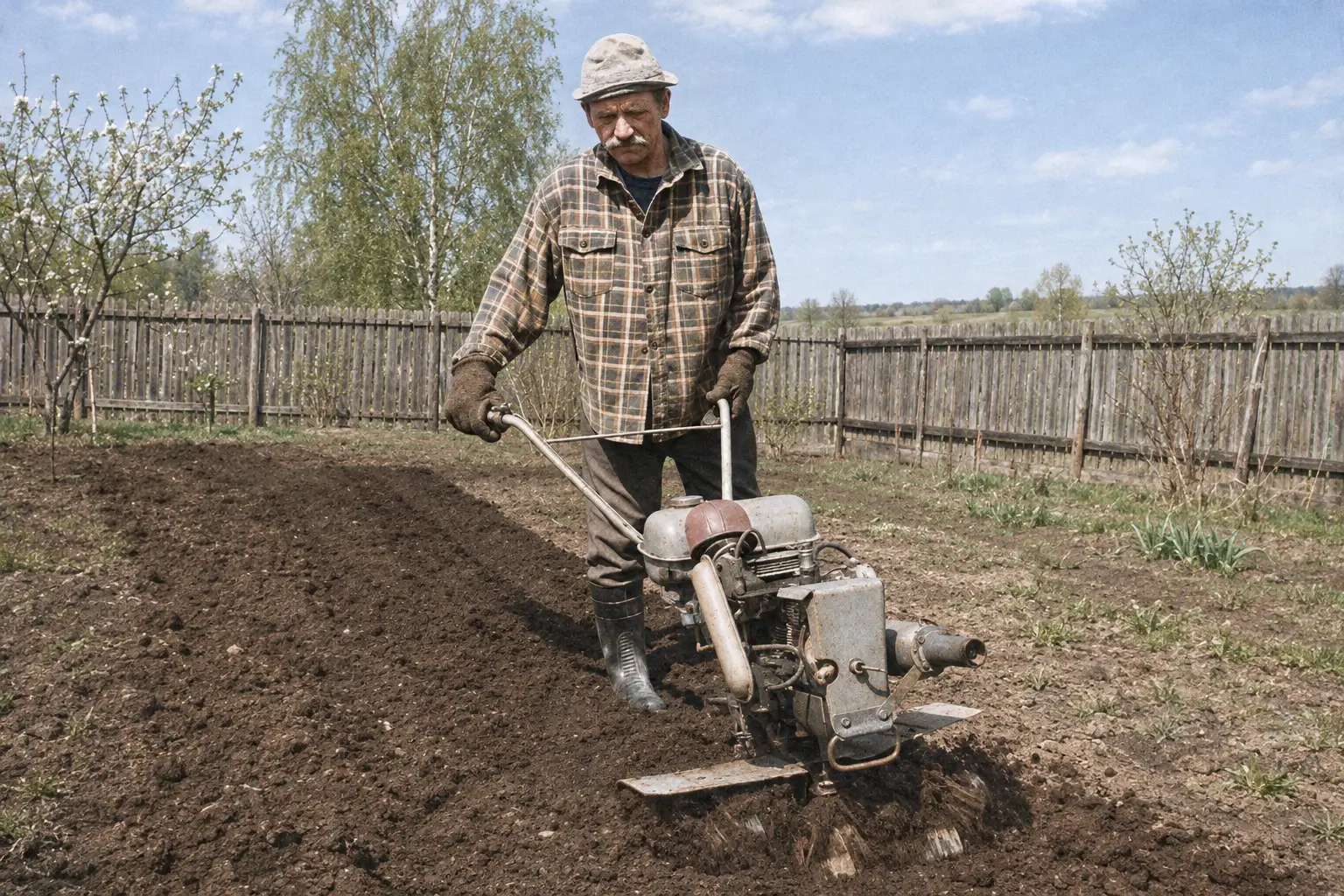
Of course, most men who have a homestead or a garden plot own a walk-behind tractor or a motor cultivator — often still of the Soviet type, such as “Krot”, “Pchelka”, or “Ural”. These are what this article is about.
Usually, in the second year of using such garden equipment, after winter storage, a problem with starting the engine appears. And in the following plowing seasons it often happens that a motor cultivator that stalled during spring work cannot be started at all!
As in all other life situations, there are certain “internal” reasons for this.
So — the procedure for starting a two-stroke engine after a long winter standstill is as follows:
1. Top up the fuel tank with at least half a tank of fresh fuel mixture and tilt the cultivator well from side to side to mix the engine oil that has settled on the bottom. Even better — completely drain the old mixture and pour in a new one. The reason is simple: after several months of idle time, the light fractions evaporate from the gasoline, and it ignites poorly. Polymerization of fuel molecules into a new substance resembling diesel oil also occurs, fouling the spark plug and even the combustion chamber.
2. Drain last year’s fuel mixture from the carburetor float chamber. If there is a special bolt — simply unscrew it and wait until the oily liquid has completely drained. Then open the fuel cock and fill the carburetor with fresh fuel mixture. After finishing the procedure — close the fuel cock and tighten the bolt.
In designs that have no special drain hole in the lower part of the float chamber, you will have to remove the carburetor and flush it.
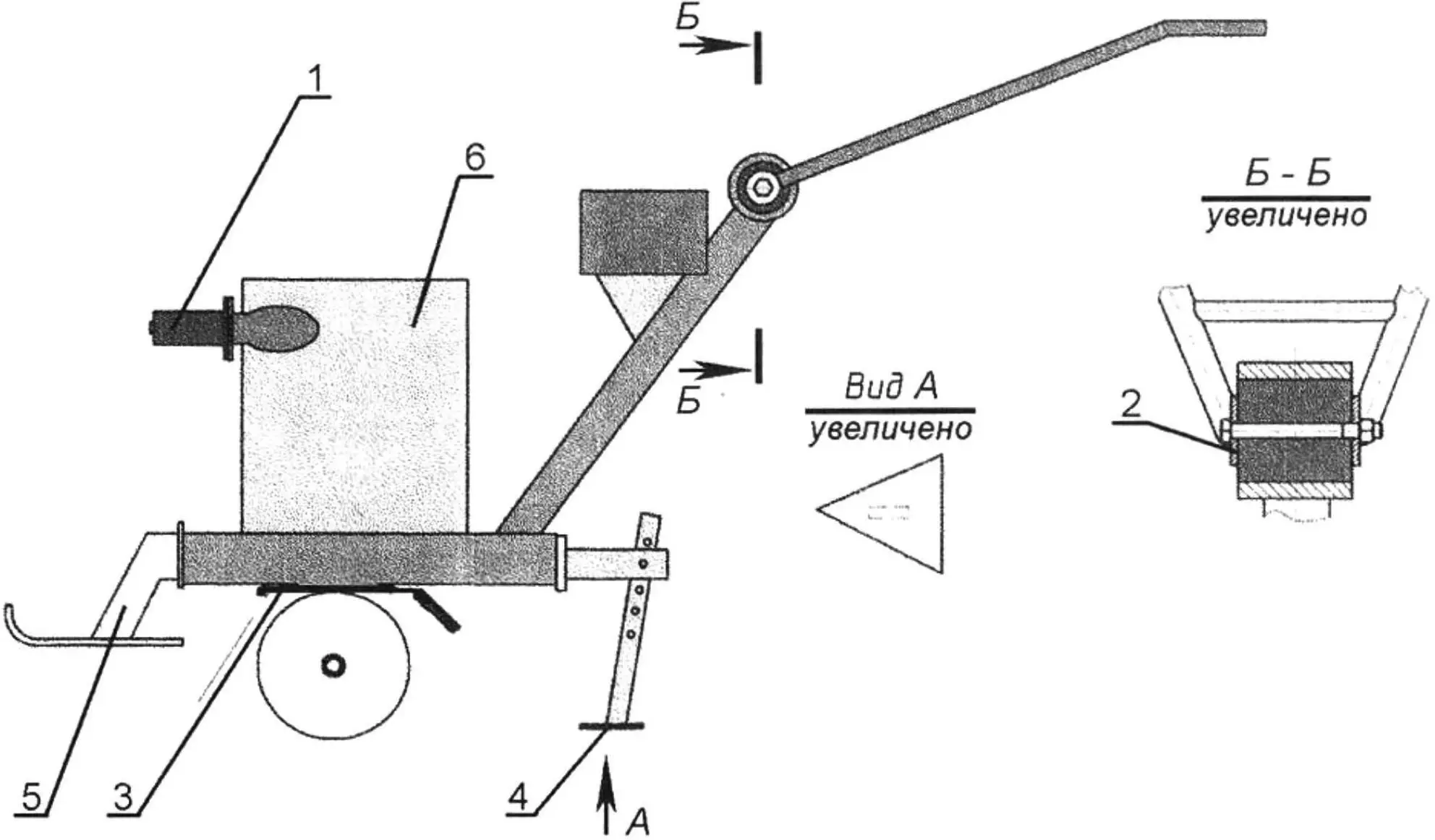
1 — muffler attachment; 2 — rubber damper; 3 — fender; 4 — support-and-adjusting skid; 5 — support-and-guide ski (or wheel); 6 — motor cultivator
After these simple procedures, your motor unit will start easily and remain responsive during further work.
After several seasons of operation, deeper maintenance also becomes necessary. The reasons will be poor hot starting, increased fuel consumption, and unexpected engine misfires. So, the most essential maintenance jobs are as follows:
1. Remove the cylinder head, bring the piston to top dead center, and clean the surface of carbon deposits. Cleaning can be done with a sharp knife, taking care not to scratch, and then finish with fine sandpaper. Wipe away the remaining carbon and abrasive dust thoroughly with a clean oiled rag, gradually moving the piston toward bottom dead center. During reassembly, if necessary, replace the head gasket and tighten the fastening nuts evenly, without distortion.
I recommend using a cylinder-head gasket made of soft sheet aluminum instead of a paronite one. This will improve heat transfer from the cylinder to the cooling fins of the head and improve the engine’s cooling regime.
2. Inspect the ignition contacts, true up the contact surfaces, and clean them with fine sandpaper. Be sure to adjust the gap and ignition timing according to the engine operating instructions! As a rule, the ignition contact break should occur 2 — 3 mm before the piston reaches top dead center. After finishing the work, be sure to install the ignition cover on a sealant gasket. Neither dust, nor water, nor oil should get into this zone of the engine.
3. I strongly advise removing the spark-plug cap. Many causes of engine misfiring lie precisely in it. Simply strip the end of the high-tension wire for 20 mm and twist the copper conductor into a loop sized for the threaded tip of the spark plug. It is convenient to secure the wire on the plug with an ordinary nut and matching washer. By the way, choose a better spark plug! It is best to buy several different spark-plug models and select the most suitable one already during operation. With a well-matched plug, the motor cultivator’s engine will start both cold and hot and will not stall when overheated.
4. Remove and inspect the air filter. It is usually of the paper type. As a result, already in the second season of farm work the piston rings wear out, and the engine loses its easy-starting ability. Take note: the air filter must be oiled with special oil or at least with ordinary motor oil! Otherwise it lets through the finest dust… Servicing the air filter is extremely simple — put it into a double polyethylene bag and pour in ordinary gasoline-oil fuel mixture. After rocking and shaking it for about five minutes, drain the dirty wash and pour in a fresh one. For a heavily soiled filter, the procedure can be done three times. Then dry the filter naturally or, better still, blow it out with a compressor hose.
5. Another ailment that Soviet ICEs suffer from is poor seating of the carburetor mounting face against the cylinder. Using a file or an abrasive lap, eliminate the factory unevenness and bring it closer to a true plane. By removing this defect, you will eliminate harmful “air leakage” and improve the operation of the internal combustion engine.
There is also a creative side to today’s topic — the necessary modernization of a purchased motor unit. There are not that many modifications, or rather improvements, but I consider them important because they make work with a motor cultivator easier:
1. Adding fenders over the rotary tillers if there were none. Fender material — sheet: galvanized steel about 1 mm thick, aluminum alloy (1 — 2 mm), or even plastic. The height of the fenders is determined during trial plowing. They must not rest on the ground at full tilling depth and must protect the operator from flying clods of earth. Factory mountings may be reinforced.
2. To improve the controllability of the motor cultivator during plowing, you can weld a support plate in the form of an equilateral triangle measuring 80x80x80 mm made of 3-mm steel sheet to the brake claw. For heavy walk-behind tractors it is useful to fit a front support ski that will prevent the machine from digging into soft soil.
3. To damp vibration loads on the joints of the hands, it is highly desirable to connect the control levers to the cultivator frame through a rubber vibration isolator in the form of a silent block. A simpler approach is to use mittens with vibration-damping palms made of foam rubber. Vibration mittens are easy to make yourself or buy in a workwear store (though they cost as much as dress leather ones). Using both means will not be superfluous.
The loud exhaust of two-stroke engines may not be the main drawback of Soviet motor equipment. But it has a negative effect on hearing and, as a consequence, on the owner’s nervous system. Neighbors also dislike the crackle of a running engine.
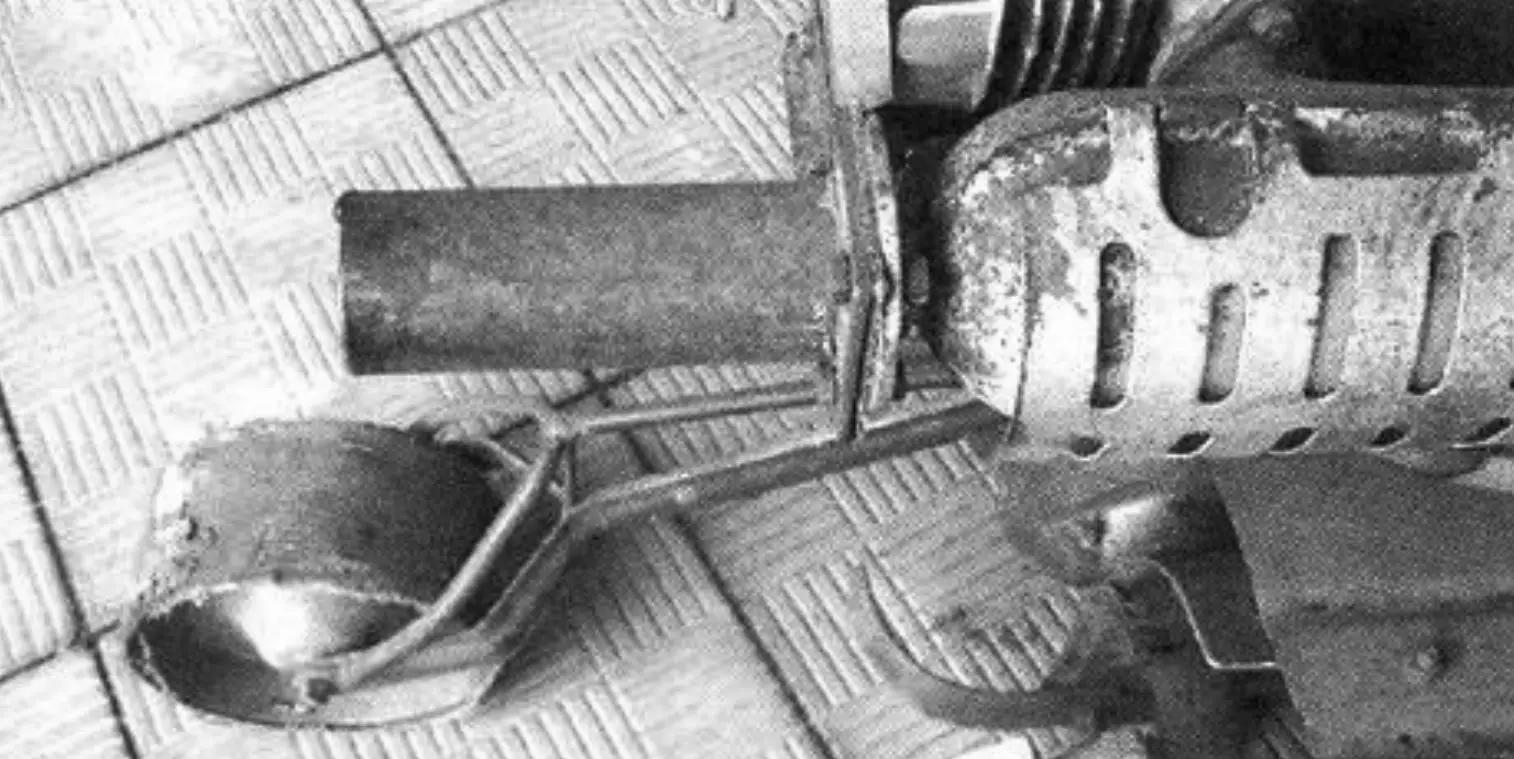
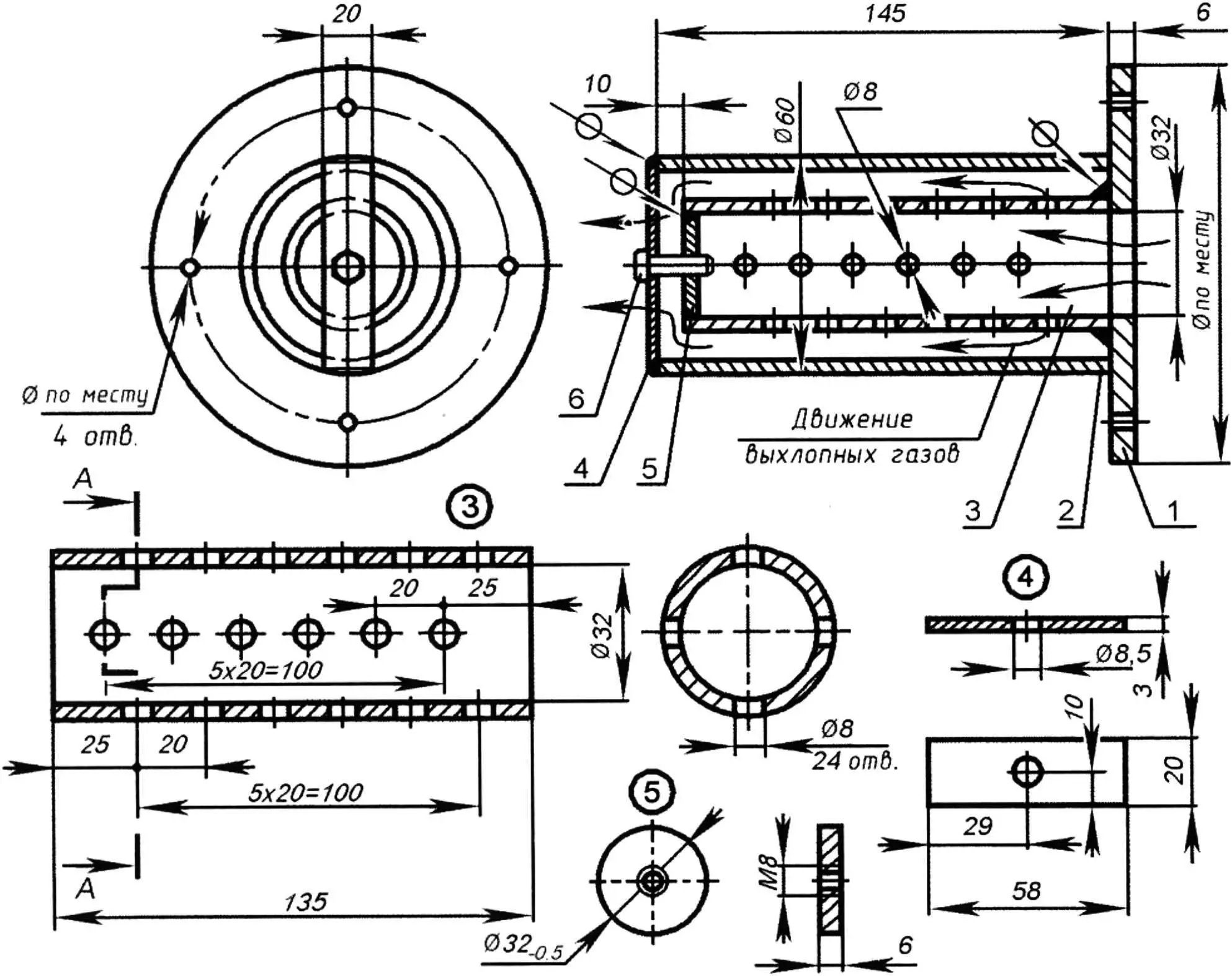
1— flange for mounting the attachment to the muffler; 2 — outer casing; 3 — silencing element; 4 — clamping plate; 5 — baffle disc; 6 — fastening of the casing to the silencing element (screw M8x25)
Therefore such a “loudspeaker” unit must definitely be fitted with an additional silencing attachment. In each specific case you will have to apply ingenuity and practical skills together with metalworking tools and a welding set. A skilled owner can invent the design himself, but the key principle is important — the additional muffler must not excessively restrict the exhaust-gas flow, yet it must reduce the noise by 20 — 30%. Otherwise starting problems will appear and power will be lost. The main thing to think about here is to roughly calculate and ensure minimal exhaust-gas resistance from the additional muffler. From personal experience I recommend using a single-chamber muffler attachment made according to the accompanying drawing. Here everything is simple — the diameters of the through tubes must be larger than the outlet of the stock muffler, and the sum of the cross-sectional areas of the openings from chamber to chamber must be twice as large.
The design is generally simple both to make and to use, consisting of only a few parts: an inner silencing tube with a baffle disc, and an outer removable casing tube with a clamping plate.
The attachment is fastened with four M6 bolts to a matching flange on the stock muffler (a version for the “Pchelka” motor cultivator) through a paronite gasket.
Manufacture and assembly are done in the following order:
— cut with a hacksaw a piece of water pipe with an outside diameter of 42 mm and a length of 140 mm. Then drill 24 holes Ø8 mm in its side walls, trying to arrange them in a staggered pattern;
— make a mounting flange, which may also be square, and, after fitting it to the mating plate of the cultivator muffler, mark the holes. Then drill them with a positive allowance, and bring the center hole to the required diameter with a round file;
— cut out a blanking disc with a chisel and weld everything together: the mounting flange, the inner silencing tube, and the baffle disc;
— cut with a hacksaw a 145-mm length from a water pipe with an outside diameter of 60 mm;
— cut out a strip measuring 20×58 mm from 3-mm steel sheet, drill a Ø8.5 mm hole in it, and weld it to the outer tube;
— last of all, a Ø7.2 mm hole is drilled in the baffle disc, and an M8 thread is cut in it with a tap;
— then the attachment is assembled and installed on the motor cultivator.
Since I mentioned homemade “vibration mittens” a little earlier, I will give their pattern. Note that if the material from which the mittens are made has clearly defined face and reverse sides, the patterns of parts 1 and 3 should be made as mirror images for the right and left hands. The vibration-damping pads of foam rubber are cut according to part 2, only reduced by the seam allowance, and sewn by hand with a darning needle and thick thread using a large-pitch stitch.
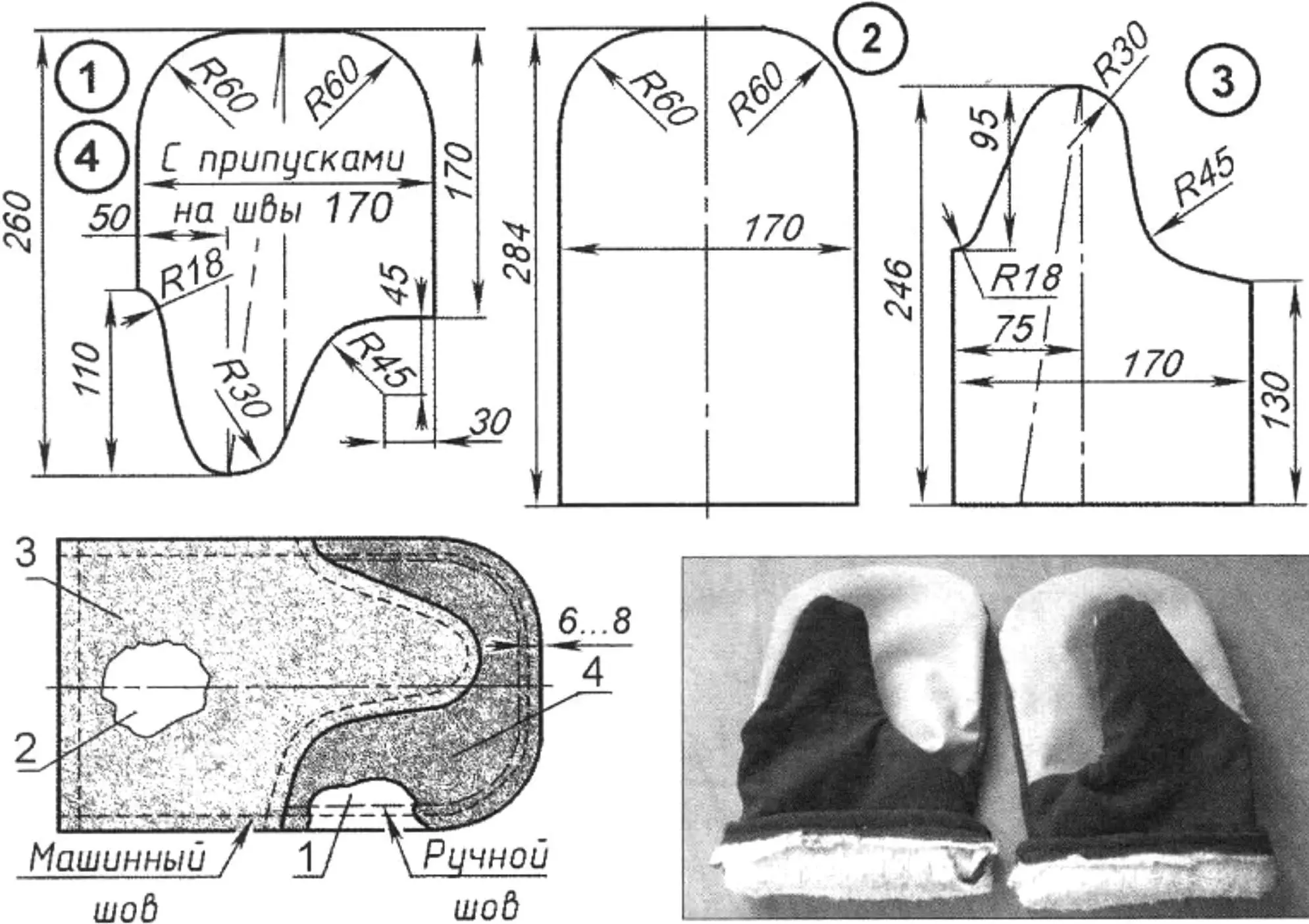
1 — inner part (“palm”); 2 — outer part; 3 — inner part (“thumb”); 4 — vibration-damping pad (foam rubber s5)
Using the same pattern, you can also make warm mittens (from an old flannel blanket, heavy cloth, or thick wool fabric) for winter household work, or ordinary mittens (from canvas or denim) for summer. By making the inner part (“palm”) from the synthetic nonwoven material “teza”, you will get “puncture-resistant” mittens for picking berries from thorny bushes.
It is desirable to get all this done before the active plowing of garden plots begins.
That, I suppose, is all the advice for users of motor cultivators with gasoline carburetor two-stroke engines.
I wish you, hard-working men, soft plowing and further trouble-free operation of your motor unit!
“Modelist-Konstruktor” No. 5’2011, A. MATVEYCHUK
Recommend to read
 A SMALL RECUMBENT FOR LARGE ROADS
Mini-recumbent, about which speech will go, was born in the Kazan Studio of Edward Stovbunenko — designer of velomobiles and a lover of travel to them. Edward party festivals, parades... Cut metal? Easy!
Every DIY enthusiast regularly faces cutting sheet metal and non-metallic materials. Using hand shears is inefficient (especially for large sheets): with high labor costs, the cutting...
