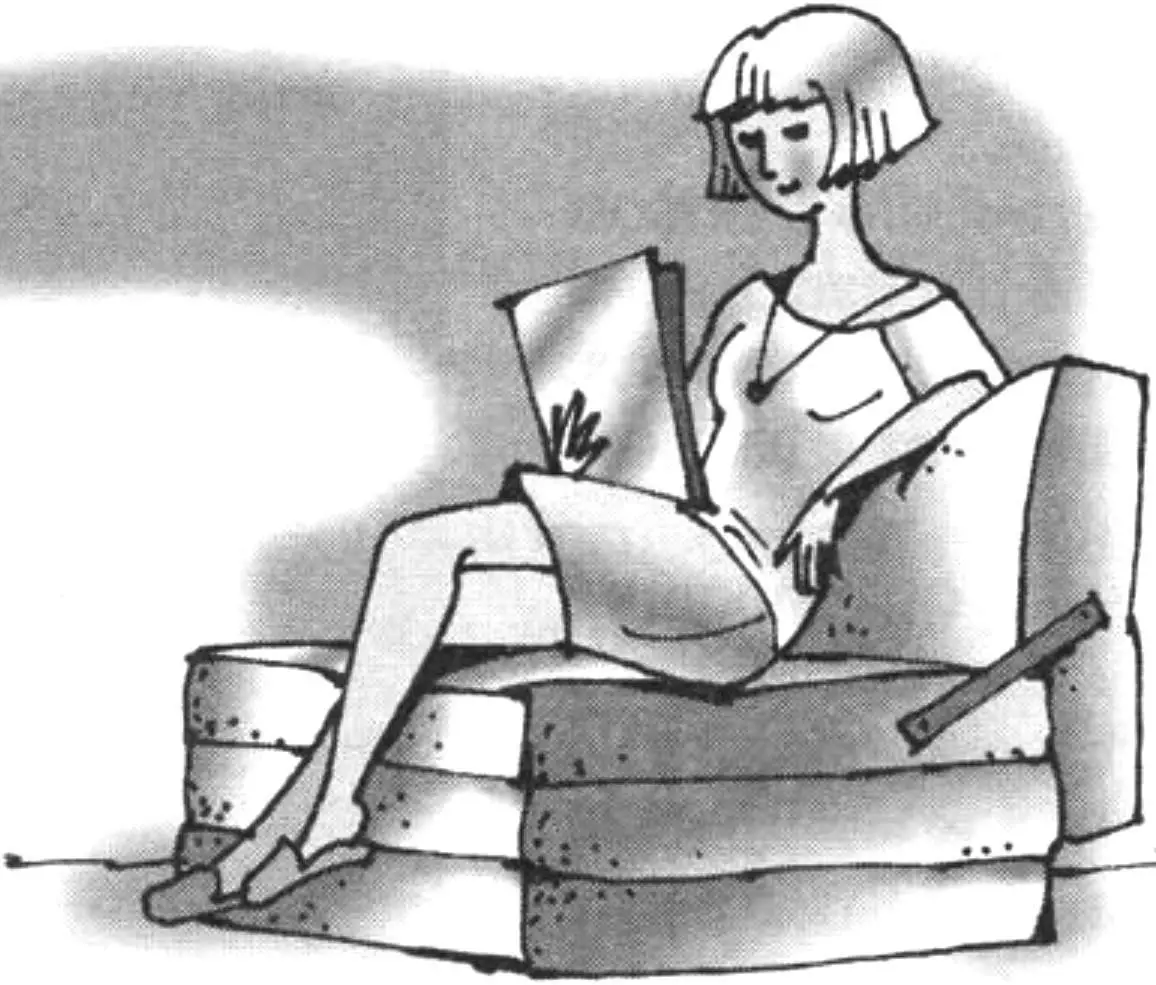
When a child outgrows a crib, its mattress can be used to make an original frameless floor armchair without legs that fits well with a teenage interior.
The mattress armchair is placed directly on the floor and rests with its back against the wall, so it can be formed from cushions alone, without a rigid base. Its dimensions will be as follows: width — 600 mm, depth (to the back) — 400 mm, overall thickness of the folded three-layer seat — 300 mm, back height (from the seat) — 300 mm.
The seat itself consists of three identical cushions made from the mattress, each 400×600 mm. The back is also a cushion measuring 500×600 mm. The thickness of all soft elements of the armchair is about 100 mm.
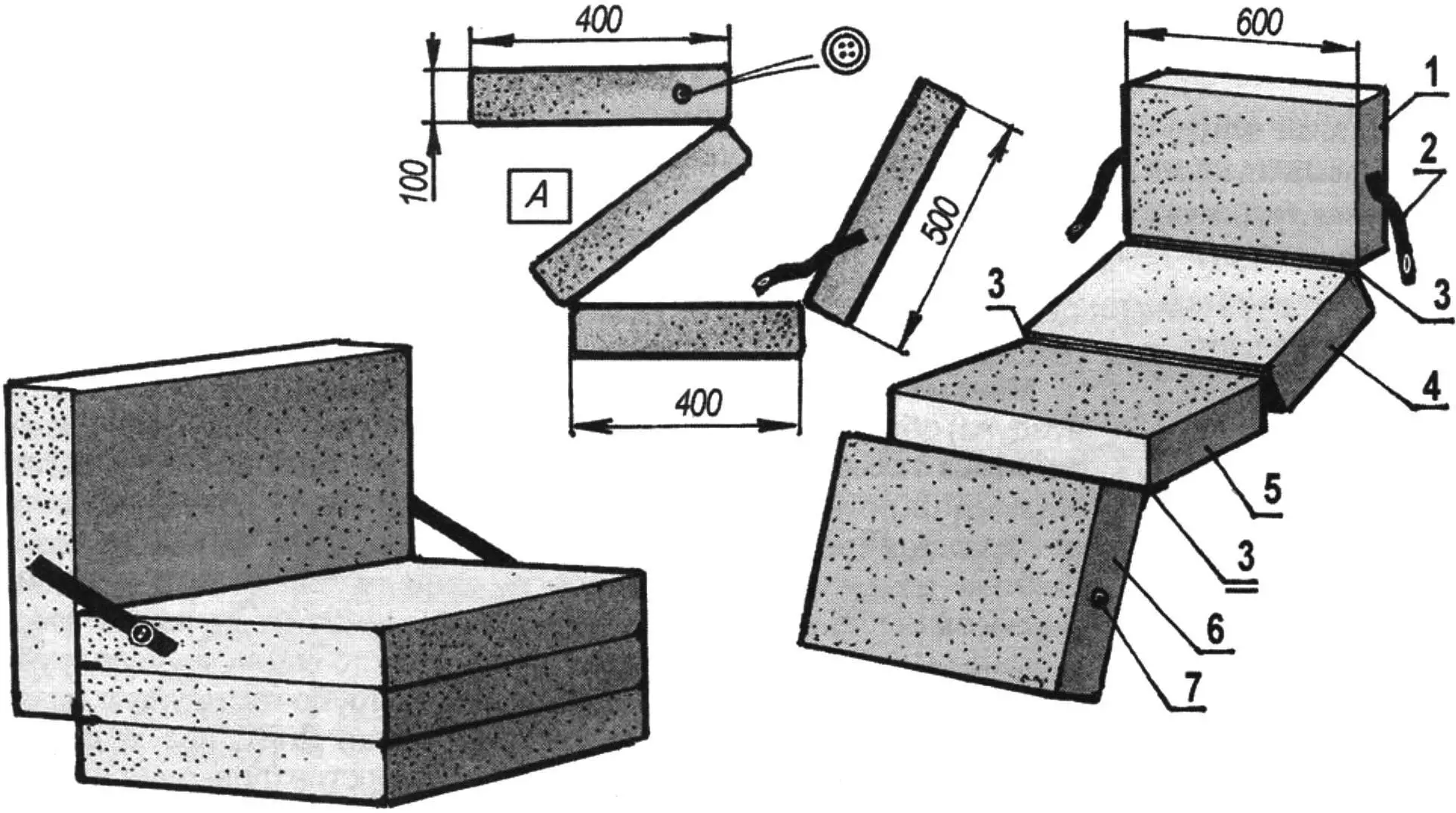
1 — back; 2 — strap; 3 — fabric strip “loops” for joining the cushions; 4 — lower cushion (when folded into an “armchair”); 5 — middle cushion; 6 — upper seat cushion; 7 — button (or Velcro fastener).
A — diagram of folding the mattress cushions into the “armchair” position
When the mattress is converted into an armchair, the back cushion, in addition to resting against the wall, can also be held in a vertical or inclined position by straps sewn to its side edges. The straps fasten onto buttons attached to the sides of the upper seat cushion, or are held by Velcro fasteners sewn in the same place.
In the unfolded position, the mattress is 1700 mm long. To turn the armchair folded from it back into a sleeping place, simply unfasten both straps and, gripping the upper cushion from the front, pull it toward you — the rest will follow like an accordion. The seat then unfolds into a single plane, and the back cushion falls backward toward the wall. Folding the armchair is done in the reverse order.
Cushions for such an armchair can also be made separately from foam of suitable thickness (or layered from several thinner sheets), as well as from latex (the latter option will be firmer and therefore more stable in the “armchair” position).
“Modelist-Konstruktor” No. 9’2008, I. STAN, Prajila, Moldova
Recommend to read
 SEED BED
Seed bed in your garden in the spring will be cooked quickly and easily, if the grooves in the beds for sowing to do by a gifted Reiki. The advantages of this method are obvious and the... KAMELEK IN THE AREA
Individual suburban area I have a small 5 acres, therefore, the brick house I built corresponding: 4,5x4 m Room razgorodit decorative wall to bedroom and living room. And to make it...
