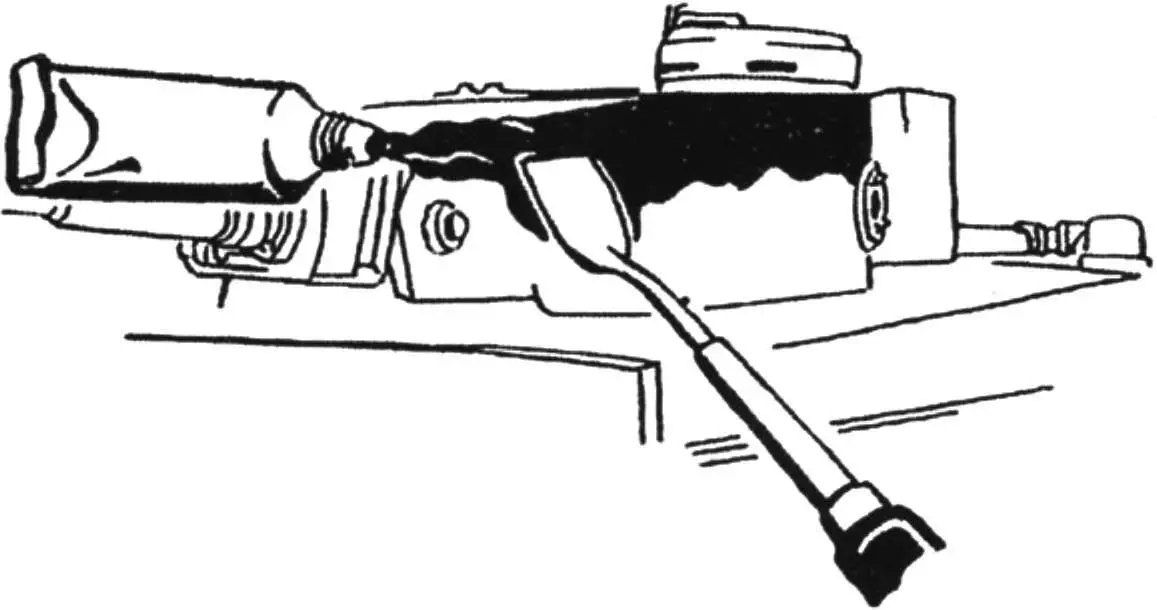
It is known that starting in 1943, a characteristic feature of the appearance of German tanks was an anti-magnetic armor coating — the so-called “Zimmerit”, which had a rather complex chemical composition. In simplified form, it can be imagined as a mixture of latex and cement. The idea itself is rather debatable, since magnetic mines were used only by partisans, and the tank still had “clean” areas left (road wheels, tracks, and so on). Moreover, a mine could also be “magnetically attached” to a railway flatcar — trains with tanks both with and without “Zimmerit” were equally good at flying down the embankment.
Nevertheless, the Germans used this protection. “Zimmerit” was applied mainly under the conditions of front-line workshops. The layer thickness was 0.5–1.5 mm. Depending on the tool, the coating could take different forms: squares, diamonds, vertical and horizontal stripes with a smooth or “waffle” surface. Camouflage paint was applied on top. Overall, a combat vehicle with such a coating acquired a rather colorful look. This last circumstance cannot fail to interest scale modelers who want to make their model more attractive.
There are several ways to imitate “Zimmerit” on models.

Method 1. The most accessible. It consists of applying a plastic mass to the model’s surface (from modeling clay to putty) and impressing the required “pattern” into its soft surface. The best tool for this is a screwdriver, whose width depends on the model’s scale. The method works for models made of any material — from paper to tinplate.

Method 2. Suitable only for polystyrene models. Layers of glue or acetone that dissolve polystyrene are applied to sections of the model “armor”. After the surface softens, patterns imitating “Zimmerit” are made on it.

Method 3. Also only for polystyrene models. The pattern is applied with a soldering iron. This requires special care and caution so as not to damage the model.

Method 4. The most labor-intensive option, but quite effective and suitable for models made of any material. Squares (or diamonds) measuring 3×3 or 4×4 mm are cut from drawing paper or thin cardboard and glued onto the model.
“Modelist-Konstruktor” No. 10’2025, Ya. VLADIS
Recommend to read
 PLATE WITH TEETH
In the journal "modelist-Konstruktor" was published an article by a teacher from the city of Severodvinsk Vladimir Arkhipov, dedicated to the manufacture of plastic fine-grained... WHEEL SECRET
For those doing long trips on a Bicycle puncture of the camera wheel is a waste of time and effort. And if there is no spare wheel, very bad: stuck now with the patch and glue... For...
