After the 1990s, the flood of all kinds of previously scarce goods onto store shelves by no means cooled the imagination and enthusiasm of DIY makers. Proof of that is the “Russkiy Masterovoy” club, founded in 1992 in Chelyabinsk and uniting proactive and creative craftsmen.
Over the years, the club has accumulated considerable experience in creating original household devices and preparing technical documentation for making them. Many DIY makers familiar with the work of “Russkiy Masterovoy” gladly use its designs; the feedback is most favorable. The highlight of the club’s constructions is the maximum use in products of ready-made, preferably inexpensive, parts and assemblies. When the author’s imagination is brought in, combining seemingly ordinary things into one whole sometimes produces a rather unexpected and useful effect. For example, the case of an old battery can become the base for an electrolysis welding machine, and on the basis of a medical inhaler clever craftsmen will make a device for cleaning automobile injectors and spark plugs, and so on.
In the arsenal of “Russkiy Masterovoy” there are designs that are the club’s special pride (some of them are patented): an electronic smokehouse, a device for flushing automobile injection systems, a shovel-plow, and a whole range of welding machines: from a microplasma and electrolysis unit with a capacity of 1000 l/h to a semiautomatic and a resistance welding machine. It should be emphasized that the designs developed in the club are manufacturable, made from readily available materials, their fabrication is quite within the capabilities of an amateur craftsman, and — very importantly — in cost they are an order of magnitude lower than industrial counterparts.
The author of most of the developments is Sergey Igorevich Molotkov (not without reason he holds the honorary title of “chief designer of the Russkiy Masterovoy club”), who made his first DIY project (a demonstration compass) back in the 1st grade.
With a story about a miniature winch we begin a series of publications about the club’s developments.
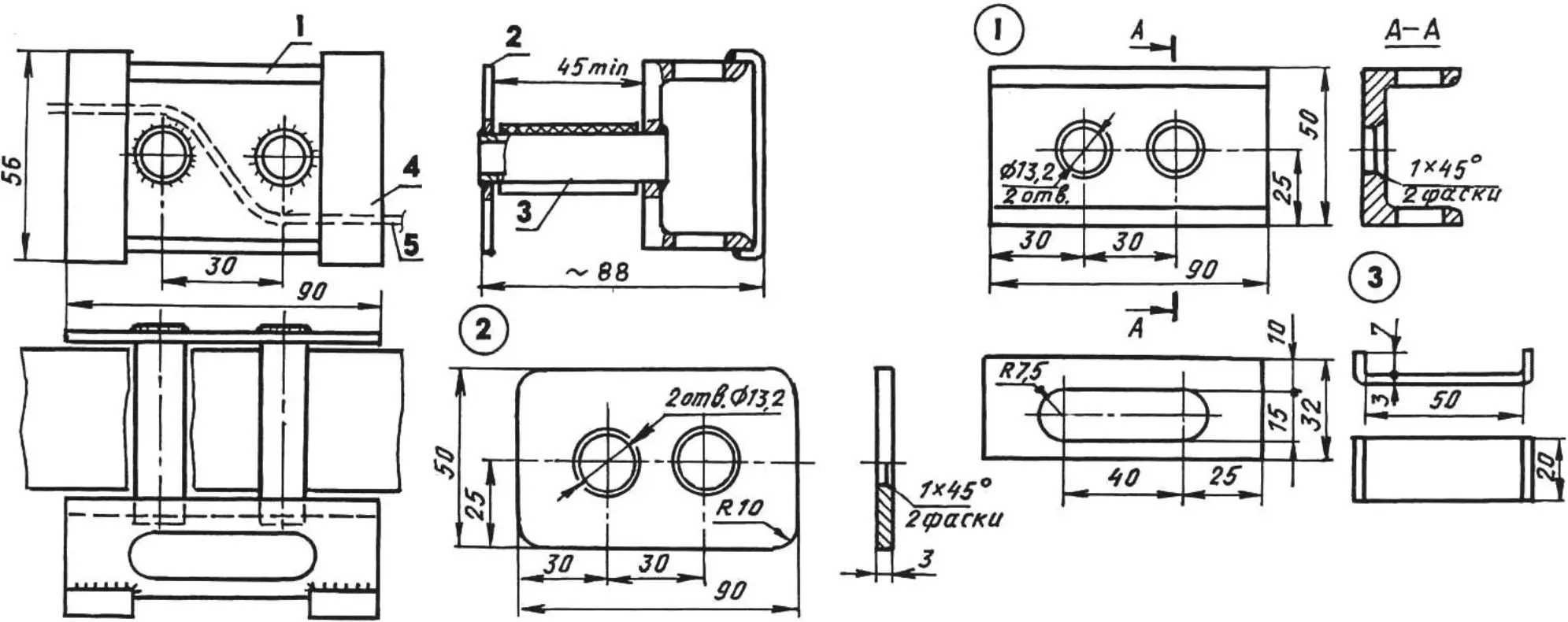
1 — body (steel, channel No. 5, L90); 2 — cheek plate (steel, sheet s3); 3 — crosspiece (steel, tube 13×2.5, L60, 2 pcs.); 4 — strip (steel, strip 20×3, L68, 2 pcs.); 5 — tape (nylon 45×3, L10 000)
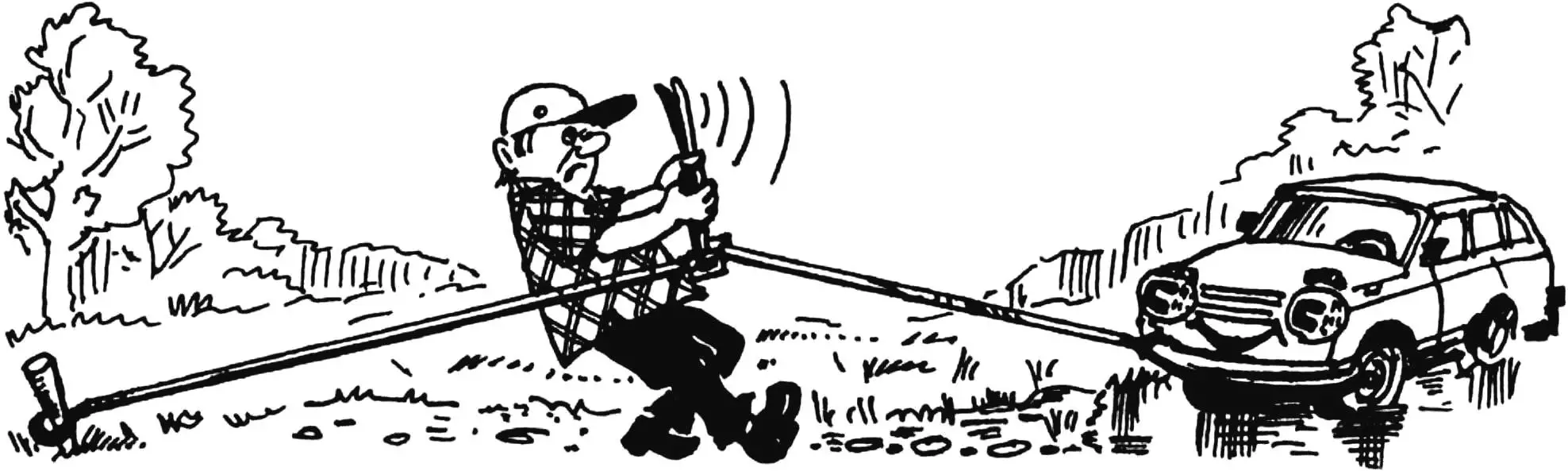
In a homestead or country household, a compact hand winch with a lifting capacity of up to a ton will always find a use: loading and unloading heavy items, straightening leaning fence posts, pulling out a stuck car, and so on. And if you start construction work, you simply cannot do without a winch. Of course, you can buy such a winch in a store, but why not make one yourself, especially since it is not difficult at all?
We offer for your attention a miniature winch (MW) whose action is based on the principle of a lever and a windlass. The latter consists of a body, crosspieces, and a cheek plate. As a lever, a car mounting pry bar extended with a tube, a crowbar, or simply a metal tube 20—25 mm in diameter and 750—800 mm long will do.
The MW body is made from channel No. 5. Holes 13.2 mm in diameter for the tubular crosspieces are drilled in the vertical wall, and slots for installing the lever are milled in the flanges (if milling is not possible, the slots can be made by drilling a series of holes followed by filing). To provide the necessary rigidity of the body, strips of steel strip 20×3 mm are welded along the edges of the channel on the side opposite the wall.
The cheek plate is a steel rectangular plate 3 mm thick with two holes the same as in the body.
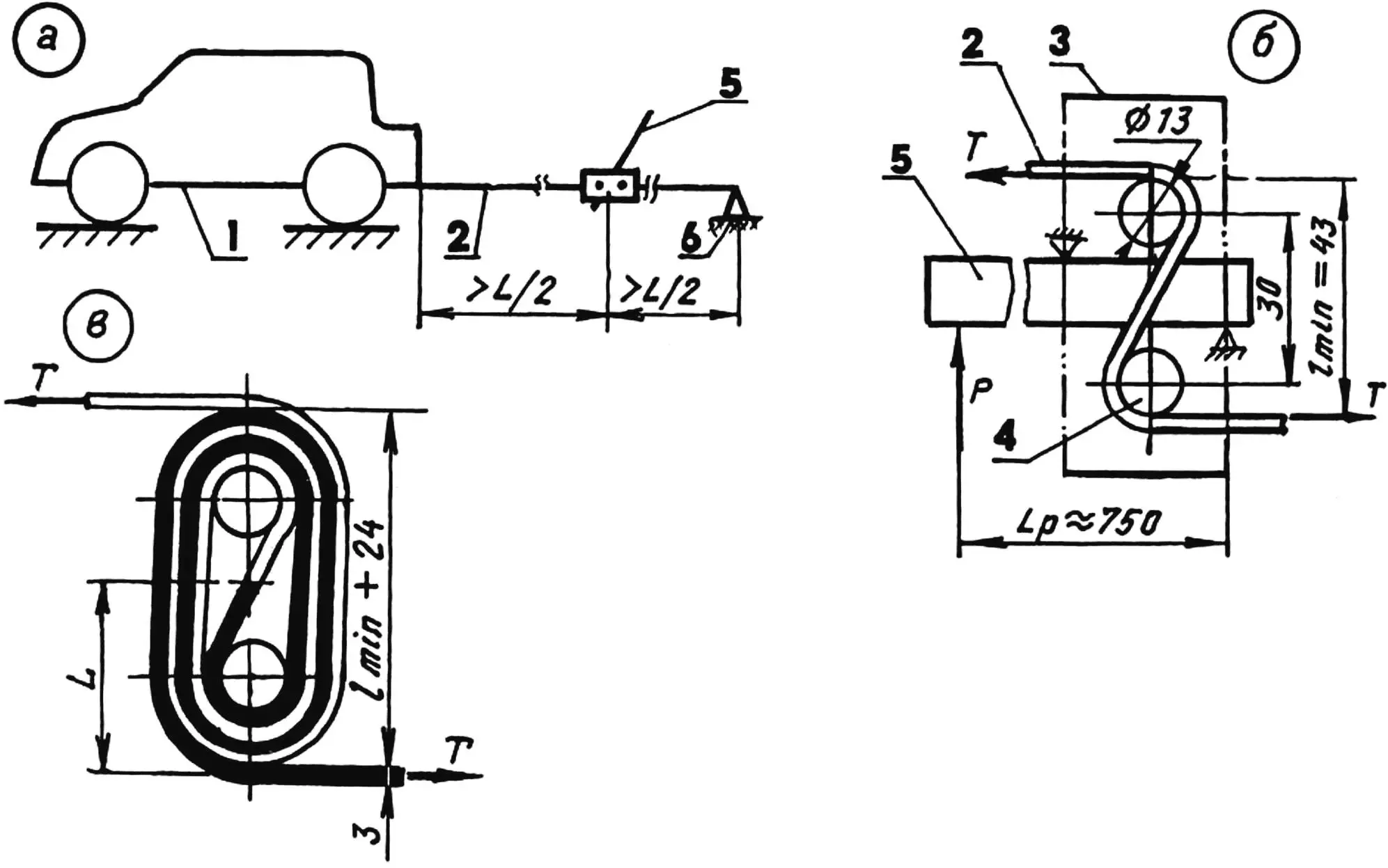
1 — load; 2 — tape; 3 — winch body; 4 — crosspiece; 5 — lever; 6 — anchorage;
a — location of the winch between the load and a fixed anchorage; b—start of operation; c — laying of tape layers after the second turn of the winch
When assembling the winch, the crosspieces are first inserted into the holes of the body and cheek plate and tack-welded, ensuring that they are mutually perpendicular. Then final welding is done from the chamfer side. The strips are welded last. The welds are cleaned, and the winch is painted with nitro paint in two coats (if possible, it is better to use a galvanic coating instead of paint, for example zinc plating or phosphating).
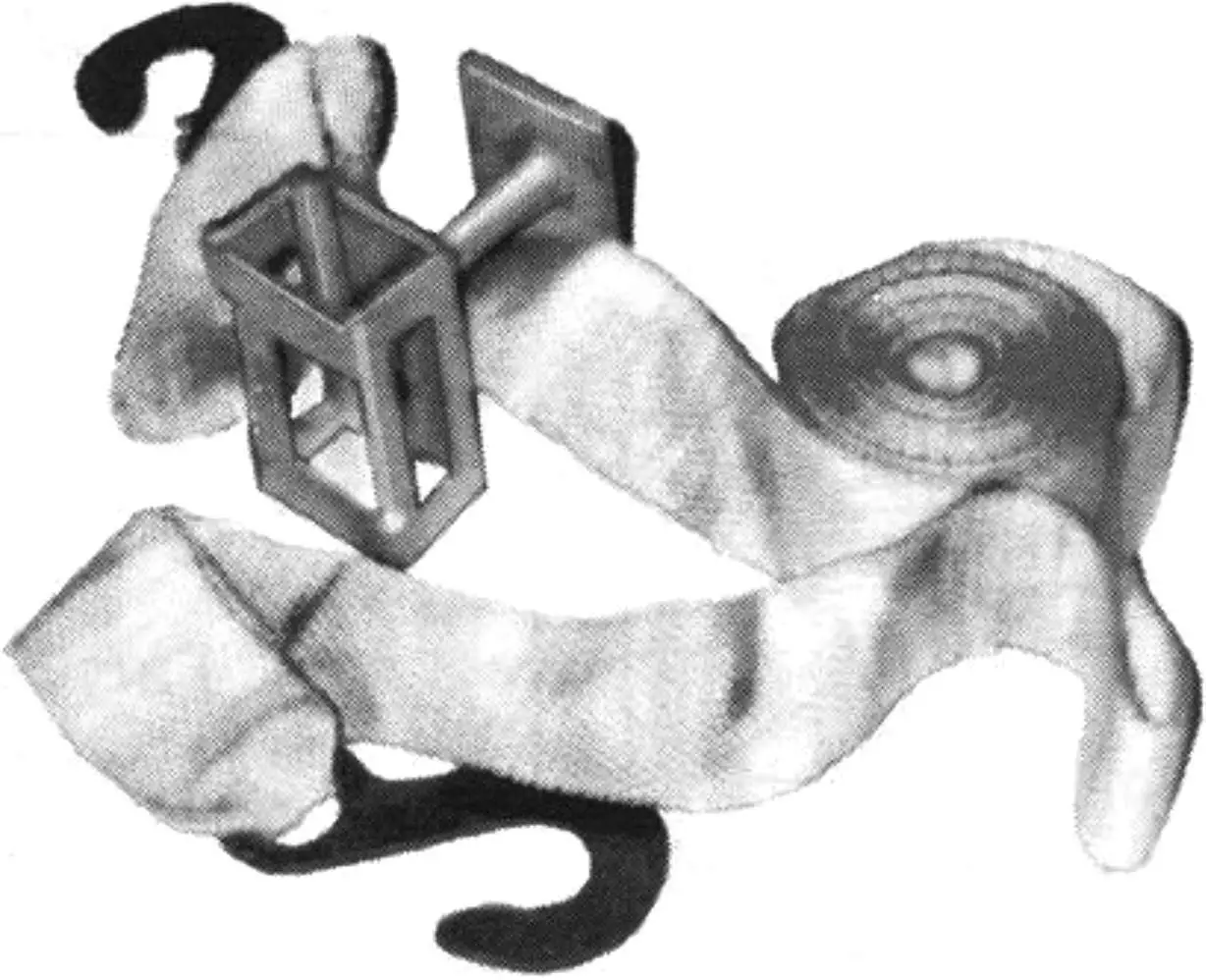
The operating principle of the MW is illustrated in Fig. 2. A nylon tape is introduced between the two crosspieces, for example a car tow strap (width 45 mm, thickness 3 mm). One end of the tape is secured to the load being moved, for example a car; the other is fastened under tension to a rigid fixed anchorage. A lever is inserted into the body slots and used to rotate the body; the tape winds onto the crosspieces, and as a result the load moves toward the anchorage.
The maximum distance the load can be moved in one go is limited by two factors. First is the pulling force T of the tape. At T = 600 kg (enough, for example, to pull out a car stuck in mud or snow) and a lever length Lp = 750 mm (a greater length creates inconvenience in work), a force P of about 35 kg must be applied at its end on the first turn of the winch. With each subsequent turn the arm L of force T will increase by 12 mm, and accordingly the force P on the lever will need to increase by 9 kg. Thus, a person of average physical ability will most likely be able to turn the winch no more than twice in one cycle. In that case the load will be moved approximately 0.5 m.
The second limiting factor is that the tape wound on the crosspiece must stay within at least one overall dimension of the cheek plate and the wall of the winch body. Otherwise the tape may slip off and an emergency situation may arise. With a tape thickness of 3 mm and the winch dimensions adopted in this design, eight layers of pull can be wound onto the crosspieces and the load moved 1.7 m.
When installing the winch between the anchorage and the load, the MW must be no closer to them than L/2 — half the distance the load moves in one go.
To lock the load being moved and prevent the winch from unwinding on its own, a metal ring with an inside diameter of 60—70 mm is put on the tape (it can be welded from 8-mm steel rod). When the load needs to be locked, the ring is slid onto the winch lever.
When working with the MW, all safety measures prescribed for work with lifting mechanisms must be observed.
“Modelist-Konstruktor” No. 8’2004, S. MOLOTKOV, (Chelyabinsk, “Russkiy Masterovoy” club)
Recommend to read
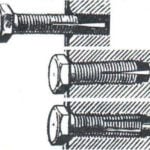 THE BOLT WITH THE WEDGE?
Yes, this method will provide a "dead" mount them in the parts exposed to vibrations, which he can gradually get out by itself. To avoid this, enough in the shank of the bolt to make a... WALK UNDER SAIL
When in your "arsenal" there is a rowing boat and you have developed a taste for water trips, undoubtedly the thought has crossed your mind more than once to equip it with light and...
