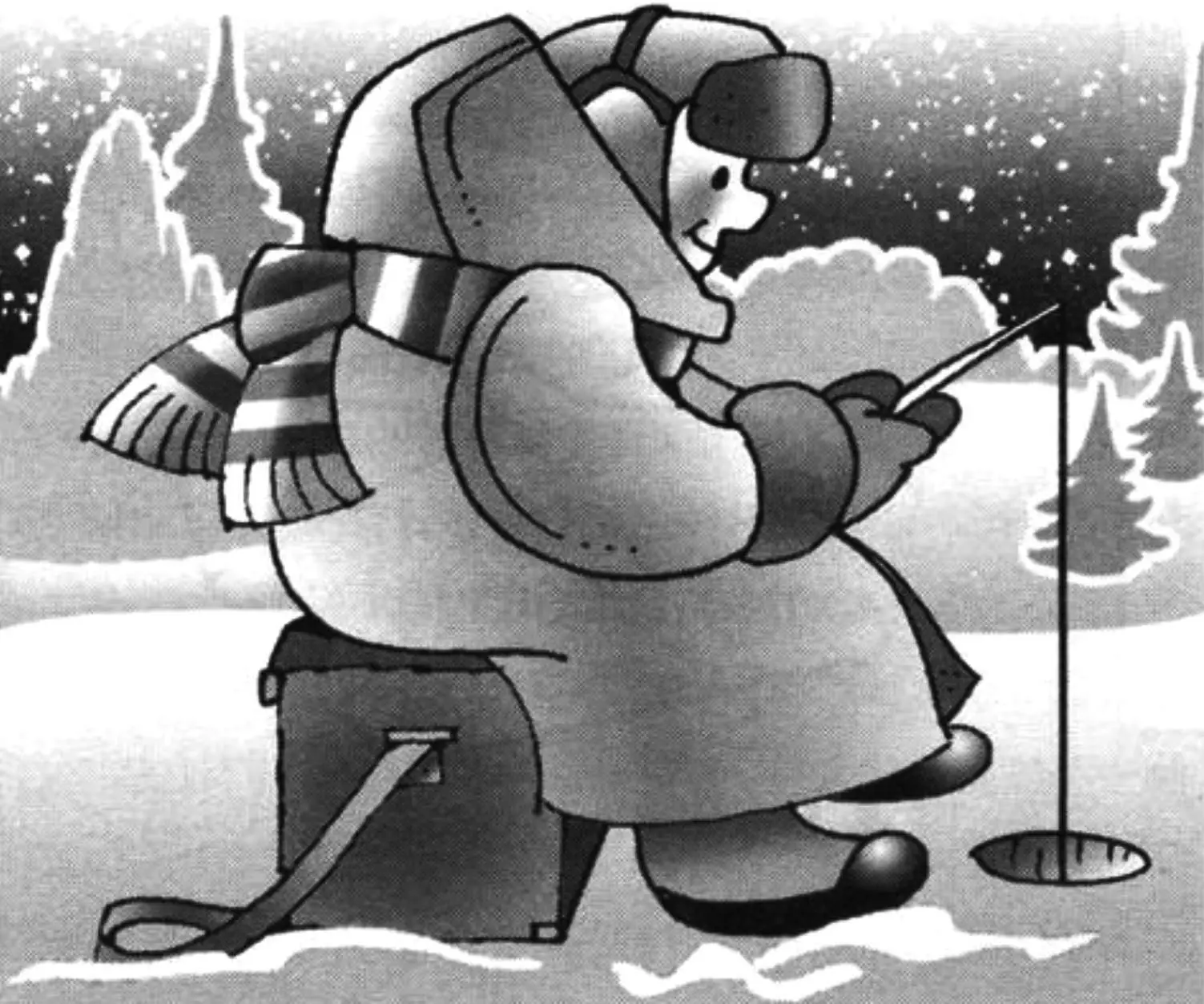
An equipped ice-fishing enthusiast is easy to spot among other people by a special seat-box, which many nowadays call a “kofr” (tackle seat chest). After all, an ice fisherman without a kofr is like a tourist without a backpack, a mushroom picker without a basket, or a hunter without a game bag. That is why every one of them strives to get such gear.
Of course, specialized equipment of this kind is sold in a wide assortment. But far from everyone can afford to set aside money from the family budget for a kofr — money spent, essentially, for personal pleasure rather than for urgent needs. Besides, recreational anglers, like professional fishermen, are mostly a superstitious folk. They believe that “luck can live” only in a homemade kofr — if not all of it, then at least a little bit of it.
Meanwhile, making this necessary but simple piece of gear yourself is within the power of even a novice teenage angler.
The main material for the kofr is a 1 mm thick duralumin sheet. The entire body — walls and bottom — is made from it. In my version, the bottom and side walls are made as one piece (but you can also cut them separately; just leave allowances for subsequent joining). Marking is done according to the drawing, and the parts are cut out with hand metal shears. The blanks and allowances can be bent in a vise by placing steel angles on the jaws, with a length matching the bend line. The next and most difficult operation in making the box (at least for beginning DIY makers) is joining its parts with rivets.
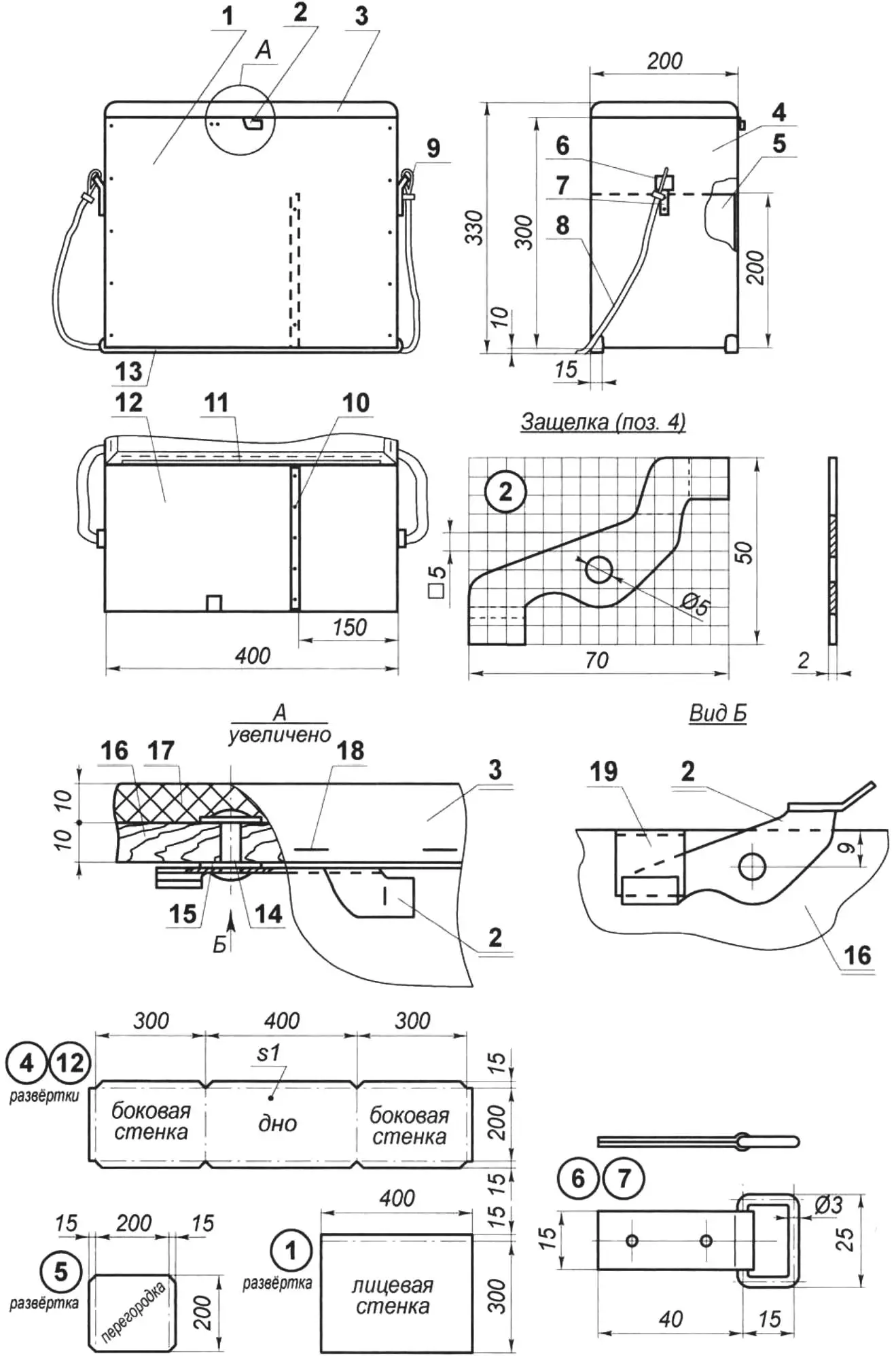
1 — face (front or rear) wall (duralumin, sheet s1, 2 pcs.); 2 — latch catch (stainless steel, sheet s2); 3 — seat covering (leatherette); 4 — side wall (duralumin, sheet s1, 2 pcs.); 5 — partition (duralumin sheet s1); 6 — lug ring (steel wire Ø3, 2 pcs.); 7 — lug clamp (duralumin sheet s1, 2 pcs.); 8 — strap (flat nylon cord); 9 — carabiner (from a bag); 10 — aluminum rivet Ø2.5 (as needed); 11 — hinge (piano hinge); 12 — bottom (duralumin sheet s1); 13 — runner (polyethylene, sheet s10, 2 pcs.); 14 — boss (steel rivet Ø8); 15 — backing washer (steel, 2 pcs.); 16 — seat-lid base (plywood, sheet s10); 17 — soft pad (foam rubber, sheet s10); 18 — covering fasteners (steel staple from Ø0.5 wire, as needed); 19 — tongue (steel angle 10x5x3)
Then, along the edges of the box bottom, duralumin runners are attached with rivets (with countersunk heads on the outside), and lugs (locally called “antapki”) for the strap are attached to the side walls. The lugs consist of a ring and a clamp. The ring is made of 3 mm diameter steel wire, and the clamp is made of the same duralumin sheet as the walls.
Inside the box, at the maker’s discretion, a partition cut from the same 1 mm duralumin sheet is installed and riveted to the face (front and rear) walls and the bottom (this part largely provides the rigidity of the product). After that, it is advisable to dull all sharp edges and corners of the parts.
The box lid (which also serves as the seat) is first made separately. Its base is a 10 mm thick plywood sheet. A boss made from a 3 mm diameter steel rivet with backing washers is attached to the base, and a polyethylene foam pad is glued on and covered with a leatherette cover. The edges of the cover are pulled over the edges (ends) of the base and fastened to it with wire staples. Next, one leaf of a piano hinge is screwed to the long edge of the lid on the side opposite the boss. The other leaf is riveted to the upper edge of one of the face walls from inside the box. A latch is hinged (so that it can rotate freely) in the middle of the edge of the opposite face wall.
The latch catch is cut from a 2 mm thick stainless-steel sheet according to the drawing provided and bent in a vise along the bend lines. It engages an angle attached to the face wall.
The strap for the box is made of flat nylon cord. One end is passed through a lug and fastened to the strap webbing with a rivet. A small carabiner is hung on the other end in the same way. It is desirable that the carabiner have a swivel — then you will not have to straighten the strap every time.
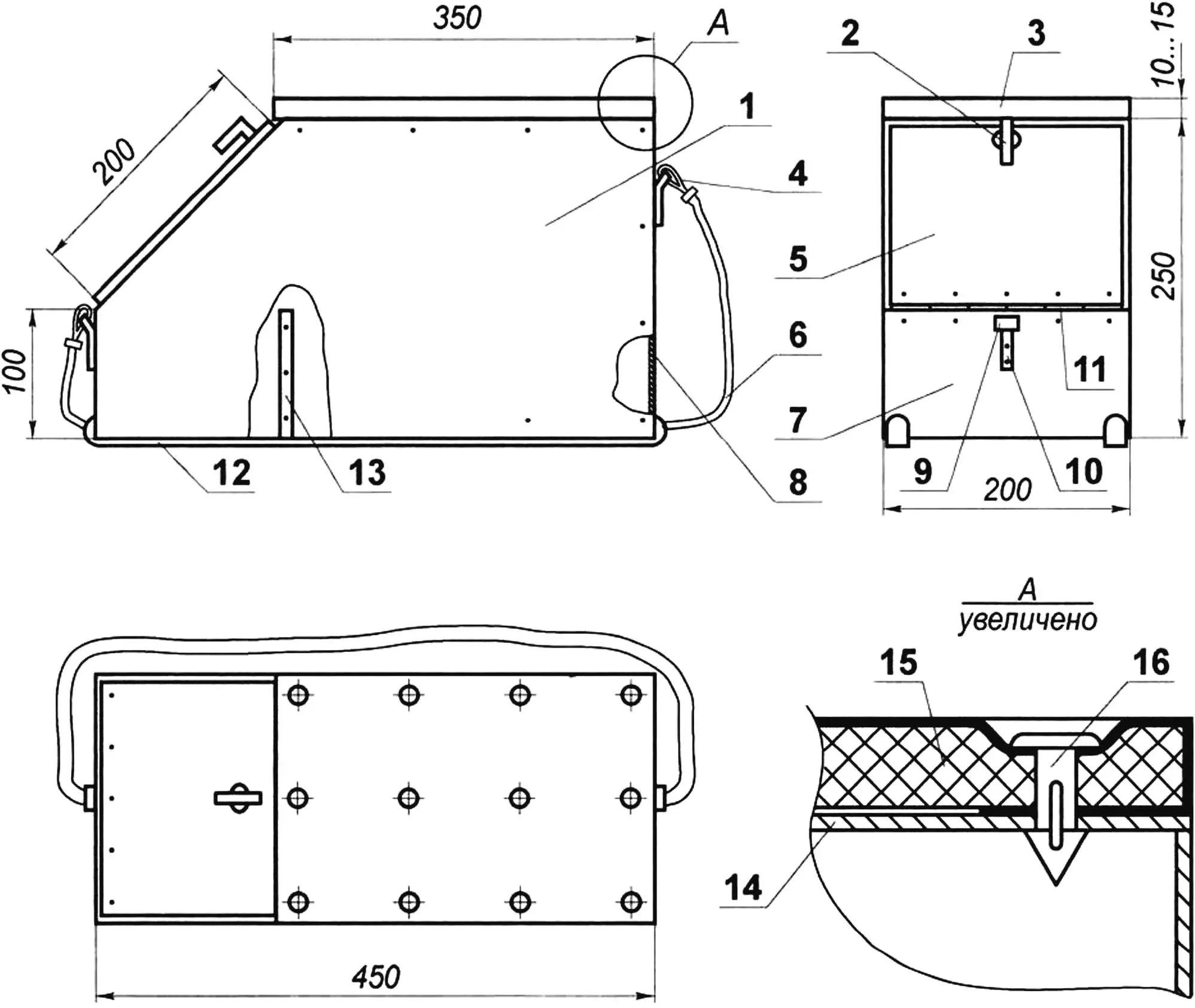
1 — face (front and rear) wall (duralumin sheet s1, 2 pcs.); 2 — handle-latch (furniture type); 3 — covering (leatherette); 4 — carabiner (from a bag); 5 — lid (duralumin sheet s1); 6 — strap (flat nylon cord); 7 — short side wall (duralumin sheet s1); 8 — tall side wall (duralumin sheet s1); 9 — lug ring (steel wire Ø3.5, 2 pcs.); 10 — lug clamp (duralumin sheet s1, 2 pcs.); 11 — hinge (piano hinge); 12 — runner (polyethylene, sheet s10, 2 pcs.); 13 — partition (duralumin sheet s1); 14 — seat base (duralumin sheet s1); 15 — soft pad (foam rubber, sheet s10); 16 — nylon fastening snap (as needed)
Finally, you can also paint the box — just do not choose a color that is too bright, so as not to scare the fish away.
Of course, other box designs are also possible, as are the materials used to make it — much depends on the DIY maker’s taste and capabilities. But one mandatory condition must still be met: ensuring a low mass and sufficient rigidity of the box (sufficiency here depends directly on the angler’s own weight).
I will also describe another box version — with slanted face walls and one shortened side wall. And if the first version is the simplest and most common, then the second, in my view, is the strongest and can be recommended for heavyweight anglers. In it, the seat is rigidly attached to three walls (both face walls and one side wall), while the lid is separate and covers the slanted part of the box.
The manufacturing technology of the second box version is practically no different from that described above. Only, angles bent from a strip of the same 1 mm aluminum sheet need to be riveted from below to the edges of the seat base, and the other flanges of the angles — to the face walls of the box. Alternatively, the base can also be made from a 1 mm duralumin sheet, with the pad and covering fastened to the base with nylon snaps through matching holes drilled beforehand.
“Modelist-Konstruktor” No. 1’2009, A. MATVEYCHUK
Recommend to read
 ON THE BICYCLE FROM THE CAR
Automotive pump, of course, performance bike, but they (if the pump is to the old bike) unequal valves, which eliminates the possibility of replacement. Small adapter to motor valve will... THE MOST ELEGANT
Flying boat MDR-6 (Che-2). So say the historians of aviation, Soviet flying boat MDR-6 design Igor V. Chetverikova was one of the most elegant production of the Soviet seaplanes. Its...
