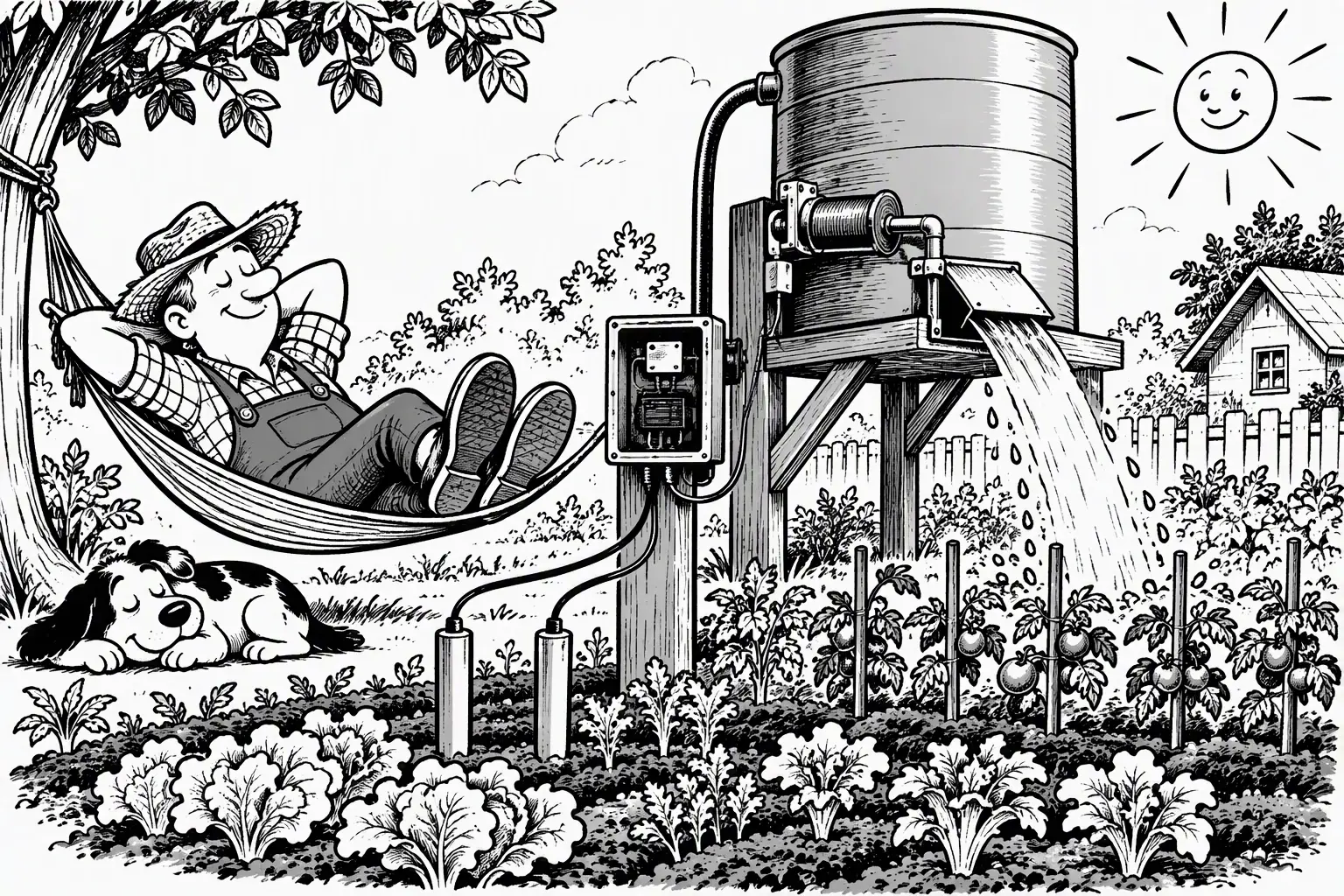
Summer heat. Not a cloud in the sky. Without watering, the garden cannot be saved. In this case, it is good to use a unit that waters by itself.
The device is an electronic relay based on transistor VT1, whose base and emitter are connected to plates of conductive material stuck into the soil 3 — 3.5 cm apart. Since damp earth has low resistance, the transistor base can be considered directly connected to its emitter (the transistor is cut off). But as soon as the soil begins to dry out, the semiconductor device turns on, electromagnetic relay K1 operates — and its contact pairs close the circuit of the actuator — an electromagnet that lifts the flap of the watering water tank.
The electromagnet is a pull-in solenoid. The coil frame is made of textolite or ebonite, 100 mm long, with an outer diameter of 30 mm and an inner diameter of 20 mm. The “cheeks” 70 mm in diameter and 5 mm thick are made of the same material as the frame and glued to it with BF-2 or “Moment” adhesive.
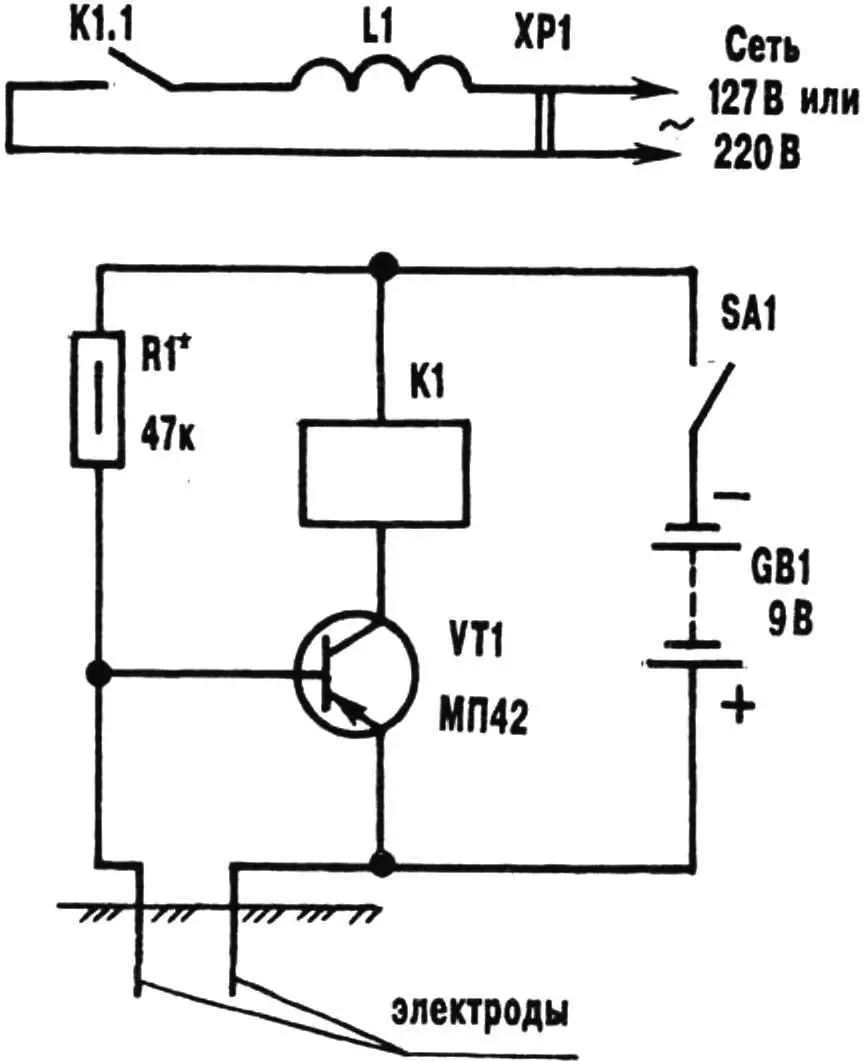
The solenoid coil contains 4300 turns of PEV 0.4 wire (for a 127 V mains supply) or 5500 turns of PEV 0.35 (for 220 V). The core is made of soft steel (steel 10 or 20), 20 mm in diameter and 100 mm long. A pin is attached to the core; its length depends on the distance between the solenoid and the tank flap. The spring is a push type; its purpose is to return the flap to the initial position after watering ends.
A fixed core 20 mm in diameter and 18 mm long is inserted into the opposite end of the coil to increase the solenoid’s pull-in force. The fixed core is made of the same material as the moving one.
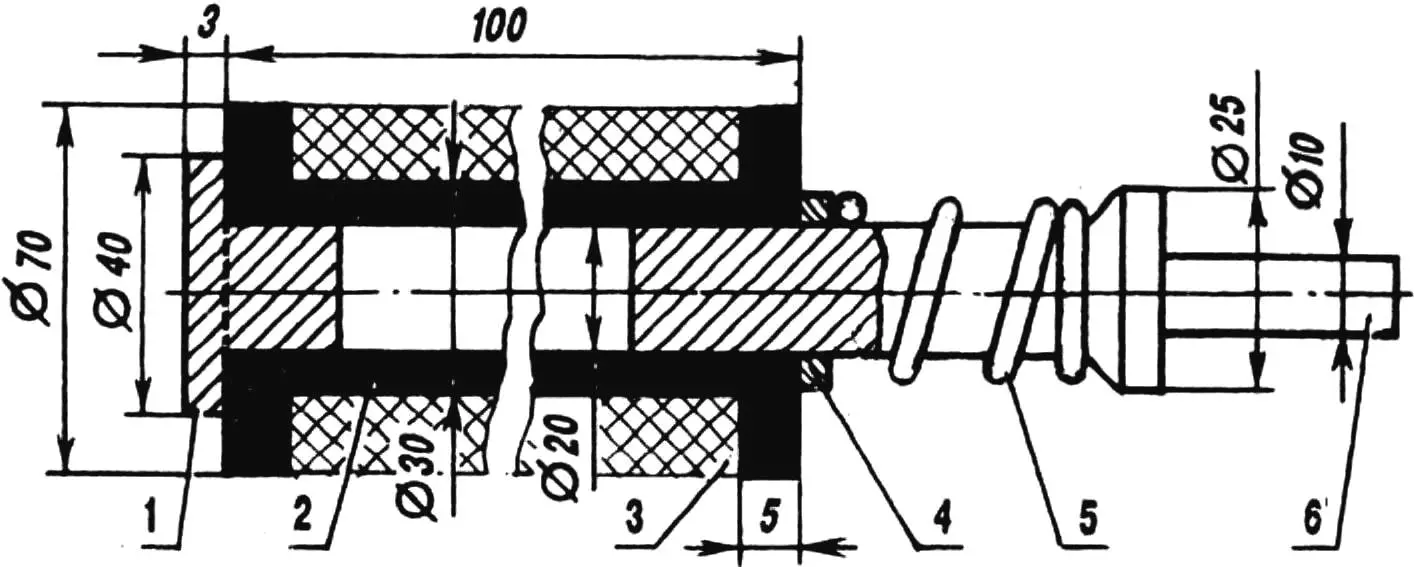
1 — fixed core; 2 — coil frame; 3 — winding; 4 — washer; 5 — spring; 6 — moving core.
The design and dimensions of the flap are not given, because they depend on the tank and pipes. The main thing is that the flap mass must not exceed 300 — 350 g.
Any electromagnetic relay can be used in the watering unit (for example, RSM-1, RES-10) that operates at 7 — 9 V. The transistor is of the MP39 — MP42 type. Power is supplied from one “Korund” battery or two series-connected 336L cells.
“Modelist-Konstruktor” No. 8’98, D. KRYAZHEV, Krasnoyarsk
Recommend to read
 “TIGER” PAID OFF “AT A TROT”
The modern concept of development in army units provides the transition to a combined arms brigade of several types: - heavy brigade with armored tank divisions; - medium and... Steamer from childhood
What is usually associated the term "straight-through"? Of course, with aircraft jet engines to achieve the highest supersonic speeds. And how can become a propulsive ship ...? This is...
