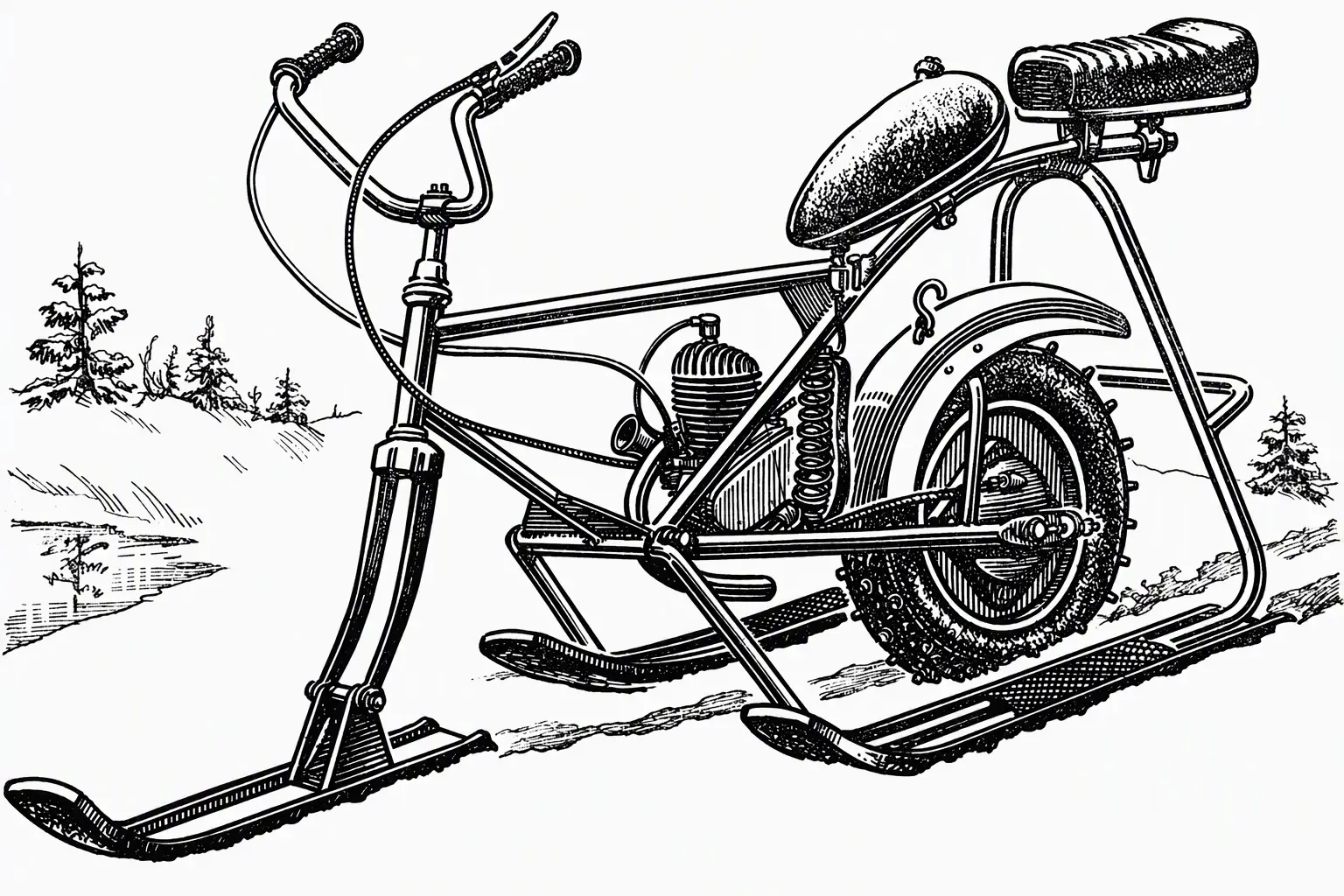
What ice-fishing enthusiast doesn’t dream of a convenient, lightweight vehicle to get quickly to those prized perch holes? In one of the issues of Modelist-Konstruktor I read about N. Ibragimov’s motor iceboat design and decided to build a similar machine. I fitted an engine and a wheel from a Tourist motor scooter. During tests the motor iceboat reached speeds of up to 70 km/h on ice and hard crust, but it spun on loose snow. Besides, it turned out rather heavy: about 140 kg.
I had to redesign it. Instead of the wheel I fitted a track. The weight rose to 160 kg, and the speed dropped noticeably — both on firm ground and on loose snow. The question inevitably arose: do I even need such a machine? To go fishing twice a month? And what if the motor iceboat breaks down somewhere in the woods — haul 160 kg of iron on my back? In the end I dismantled my creation.
Last autumn I decided to build a more portable machine suitable for a city dweller. And so the Snezhinka (Snowflake) snowmobile with a D-5 bicycle engine was born. Snezhinka is easy to control, uses little gasoline, and does not require highly skilled maintenance. For aerosleds of the same weight one would need an engine of at least 10 hp, consuming 8 times more gasoline! Of course, for use in the steppe belt or on large bodies of water aerosleds are indispensable, but for anglers Snezhinka is more convenient. It is also much more compact in size.

1 — front (steering) ski, 2 — front ski mounting bracket, 3 — axle, 4 — fork (from a bicycle), 5 — right side ski, 6 — side-ski crossmember. 7 — reinforcing gusset of the central joint, 8 — D-6 or D-5 engine, 9 — throttle grip, 10 — clutch lever, 11 — swingarm, 12 — swingarm spring, 13 — fuel tank, 14 — seat, 15 — rear arc of the side skis, 16 — cross-link, 17 — drive wheel with studs, size 4×10 (Vyatka motor scooter), 18 — rubber footrest on the left side ski.
The Snezhinka engine is started with a cord (with the clutch disengaged), wound onto a Ø 60 mm pulley mounted on the right side of the crankshaft together with a Z-20 gear, or it can be push-started. The rear fork is a swingarm with a spring damper and a travel limiter of ± 10 mm; it provides good wheel traction. A cone-shaped air intake with a screen is fitted to the carburetor to keep out water and snow. The muffler is homemade.
The drive wheel has 60 steel studs riveted to the tire, as shown in the drawing. The brake drum and axle are from a Tourist motor scooter. The homemade engine drive sprocket has 8 teeth; the driven sprocket has 47. The chain is a bicycle chain with a 12.7 mm pitch. The engine is mounted directly on the swingarm, so the chain is not subjected to alternating loads and lasts longer.

A — engine mounting on the swingarm, B — swingarm, C — the same from above, D — three-view drawing.
Currently, instead of the Tourist wheel, I am testing a homemade metal wheel with 12 paddles that allows travel on loose snow as well. I made it from ST-3 steel 3 mm thick. In November and March — that is, when traveling on first and last ice — a studded wheel can be used, while in midwinter, when the snow cover thickens, a paddle wheel is preferable.
The all-terrain vehicle frame is welded from half-inch steel tubes. The fork, handlebars, and front section are taken from a bicycle. The seat is wooden, with a foam cushion covered in artificial leather. The skis are made of 4 mm sheet duralumin with longitudinal profiling (beading). The swingarm is welded from 3/4″ steel tube.
In case of a serious engine failure, it is enough to pull the wheel up by the swingarm and fasten it to the frame with an emergency hook: Snezhinka turns into ordinary sleds that are very convenient and easy to tow by a rope tied to the front ski.
“M-K” 3’78, V. STANOTIN
Recommend to read
 It will go out, but not immediately
One of the inconveniences in the design of many cars is that the interior light immediately turns off when the doors are closed. There are, of course, special devices that delay switching... FIAT STILO — LEADER OF THE FUTURE FIVE YEARS
The history of FIAT, now numbering more than a hundred years goes back to minor at first glance, the events in 1898. It was then that the engineer Giovanni Battista Ceirano, who at that...
