WHAT IS BIOGAS?
Recently, more and more attention has been drawn to unconventional — from a technical point of view — energy sources: solar radiation, sea tides and waves, and much more. Some of them — such as wind — found wide application in the past, and today are experiencing a renaissance. One of the “forgotten” types of raw materials is biogas, which was used back in Ancient China and has been “rediscovered” in our time.
So what is biogas? This term refers to a gaseous product obtained as a result of anaerobic, that is, occurring without access to air, fermentation (decomposition) of organic substances of the most diverse origins. In any farm, a significant amount of manure, plant tops, and various waste accumulates during the year. Usually, after decomposition, they are used as organic fertilizer. However, few people know how much biogas and heat is released during fermentation. And this energy can also serve rural residents well.
Biogas is a mixture of gases. Its main components are: methane (CH4) — 55—70% and carbon dioxide (CO2) — 28—43%, as well as very small amounts of other gases, for example — hydrogen sulfide (H2S).
On average, 1 kg of organic matter, 70% biologically decomposable, produces 0.18 kg of methane, 0.32 kg of carbon dioxide, 0.2 kg of water, and 0.3 kg of non-decomposable residue.
FACTORS AFFECTING BIOGAS PRODUCTION
Since the decomposition of organic waste occurs due to the activity of certain types of bacteria, the environment has a significant impact on it. Thus, the amount of gas produced largely depends on temperature: the warmer it is, the higher the rate and degree of fermentation of organic raw materials. This is probably why the first installations for obtaining biogas appeared in countries with warm climates. However, the use of reliable thermal insulation, and sometimes heated water, makes it possible to master the construction of biogas generators in areas where the temperature drops to —20° in winter. There are certain requirements for the raw materials as well: it must be suitable for the development of bacteria, contain biologically decomposable organic matter and a large amount of water (90—94%). It is desirable that the environment be neutral and without substances that interfere with the action of bacteria: for example, soap, detergents, antibiotics.
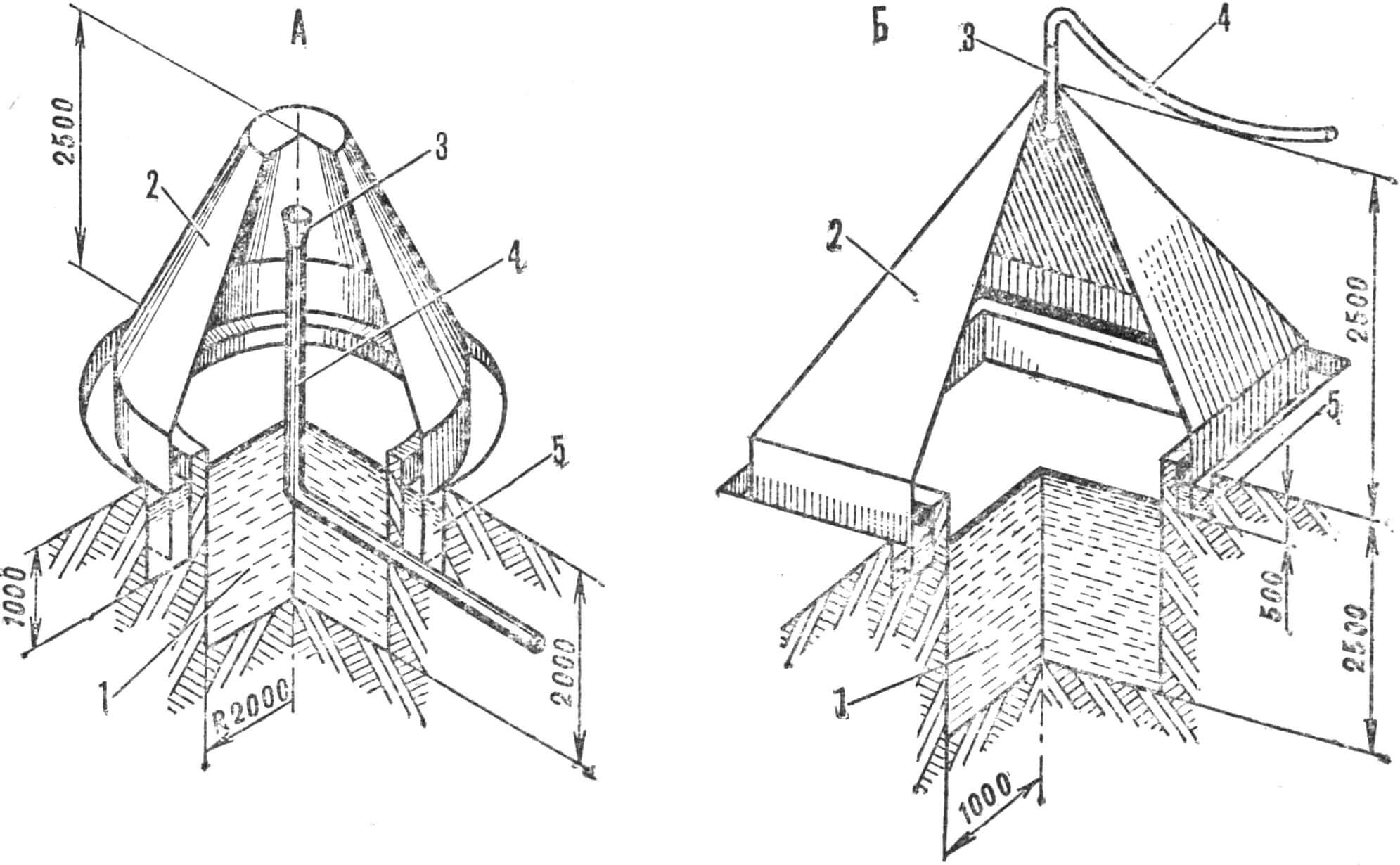
A — with conical bell, B — with pyramidal:
1 — fermenter pit with raw materials, 2 — bell, 3 — outlet pipe, 4 — biogas supply pipeline (hose), 5 — water seal groove with water.
Plant and household waste, manure, wastewater, etc. can be used to produce biogas. During fermentation, the liquid in the tank tends to separate into three fractions. The upper one — a crust formed from large particles carried by rising gas bubbles — can become quite hard after some time and will interfere with the release of biogas. The middle part of the fermenter accumulates liquid, and the lower, mud-like fraction settles.
Bacteria are most active in the middle zone. Therefore, the contents of the tank must be periodically stirred — at least once a day, and preferably — up to six times. Stirring can be carried out using mechanical devices, hydraulic means (recirculation under the action of a pump), under the pressure of a pneumatic system (partial recirculation of biogas), or using various self-stirring methods.
BIOGAS PRODUCTION INSTALLATIONS
In Romania, biogas generators have become widespread. One of the first individual installations (Fig. 1A) was put into operation back in December 1982. Since then, it has successfully supplied gas to three neighboring families, each having a regular gas stove with three burners and an oven.
The fermenter is located in a pit about 4 m in diameter and 2 m deep (volume approximately 25 m3), lined inside with roofing iron, welded twice: first by electric welding, and then, for reliability, by gas welding. For anti-corrosion protection, the inner surface of the tank is coated with tar. Outside the upper edge of the fermenter, a concrete ring groove about 1 m deep is made, which serves as a water seal; in this groove, filled with water, the vertical part of the bell that closes the tank slides. The bell, about 2.5 m high, is made of 2 mm thick sheet steel. Gas collects in its upper part.
The author of this project chose a gas collection option using a pipe located inside the fermenter and having three underground branches — to three households, unlike other installations. In addition, the water in the water seal groove is flowing, which prevents freezing in winter.
The fermenter is loaded with approximately 12 m3 of fresh manure, on top of which cow urine is poured (without adding water). The generator starts working 7 days after filling.
Another installation has a similar layout (Fig. 1B). Its fermenter is made in a pit with a square cross-section measuring 2×2 and about 2.5 m deep. The pit is lined with reinforced concrete slabs 10—12 cm thick, plastered with cement, and coated with tar for tightness. The water seal groove, about 50 cm deep, is also concrete; the bell is welded from roofing iron and can slide freely on four “ears” along four vertical guides installed on the concrete tank. The bell height is approximately 3 m, of which 0.5 m is immersed in the groove.
During the first filling, 8 m3 of fresh cow manure was loaded into the fermenter, and about 400 liters of cow urine was poured on top. After 7—8 days, the installation was already fully supplying the owners with gas.
A biogas generator designed to receive 6 m3 of mixed manure (from cows, sheep, and pigs) has a similar design. This turned out to be sufficient to ensure normal operation of a gas stove with three burners and an oven.
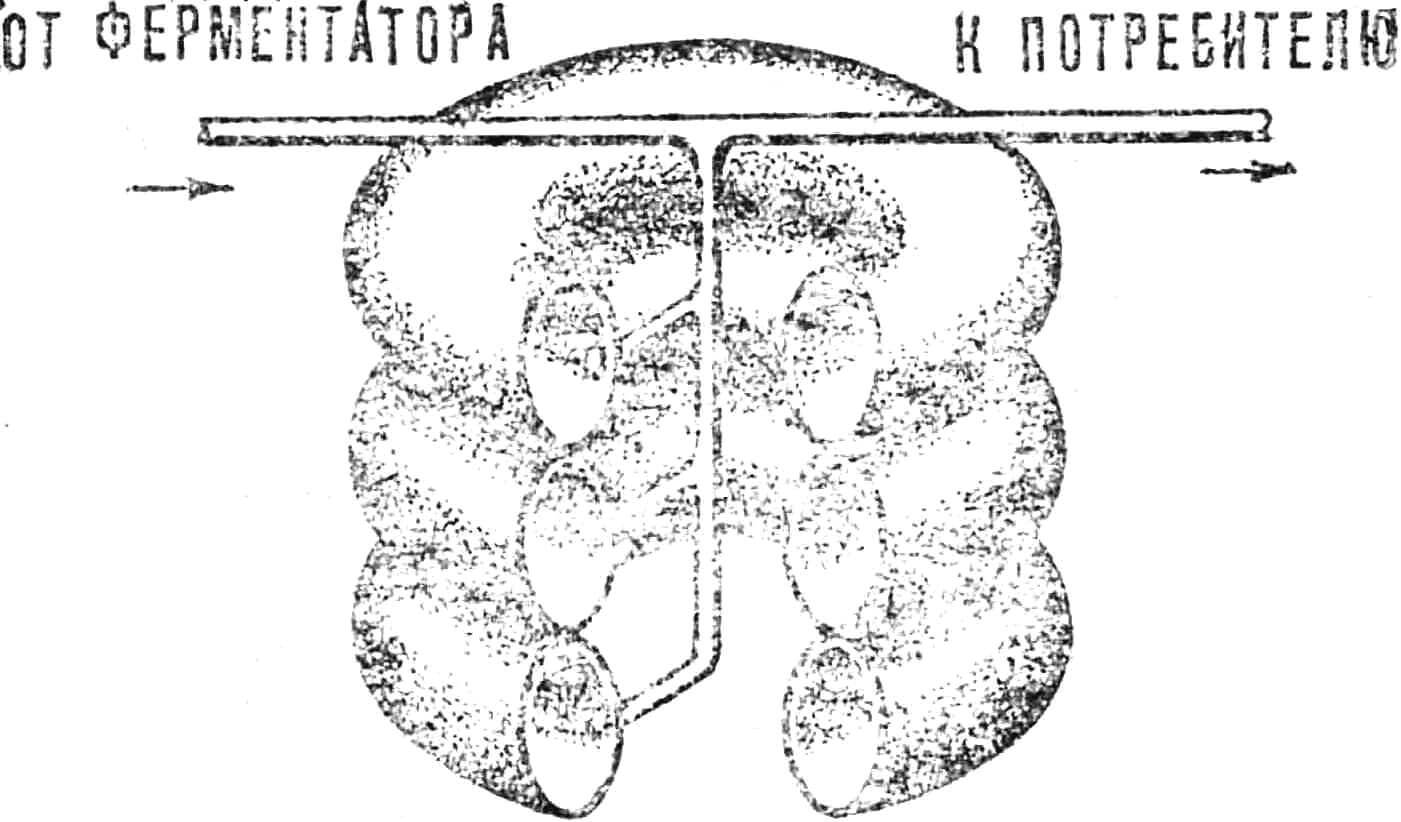
Another installation features an interesting structural detail: next to the fermenter, three large tractor chambers connected to it using a T-shaped hose and connected to each other are laid (Fig. 2). At night, when biogas is not used and accumulates under the bell, there is a danger that the latter will tip over due to excess pressure. The rubber reservoir serves as an additional container. A fermenter measuring 2X2X1.5 m is quite sufficient for the operation of two burners, and when the useful volume of the installation is increased to 1 m3, an amount of biogas sufficient for heating the home can be obtained. A feature of this installation variant is a bell device Ø 138 cm and 150 cm high made of rubberized fabric used for making inflatable boats. The fermenter is a metal tank Ø 140X300 cm and has a volume of 4.7 m3. The bell is inserted into the manure in the fermenter to a depth of at least 30 cm to ensure a hydraulic barrier to the exit of biogas into the atmosphere. A tap connected to a hose is provided in the upper part of the expanding reservoir; gas flows through it to a gas stove with three burners and a water heating column. To ensure optimal conditions for the fermenter operation, manure is mixed with hot water. The installation showed the best results at a raw material moisture content of 90% and a temperature of 30—35°.
The greenhouse effect is also used to heat the fermenter. A metal frame is built over the tank, which is covered with polyethylene film: under unfavorable weather conditions, it retains heat and allows to noticeably accelerate the process of raw material decomposition.
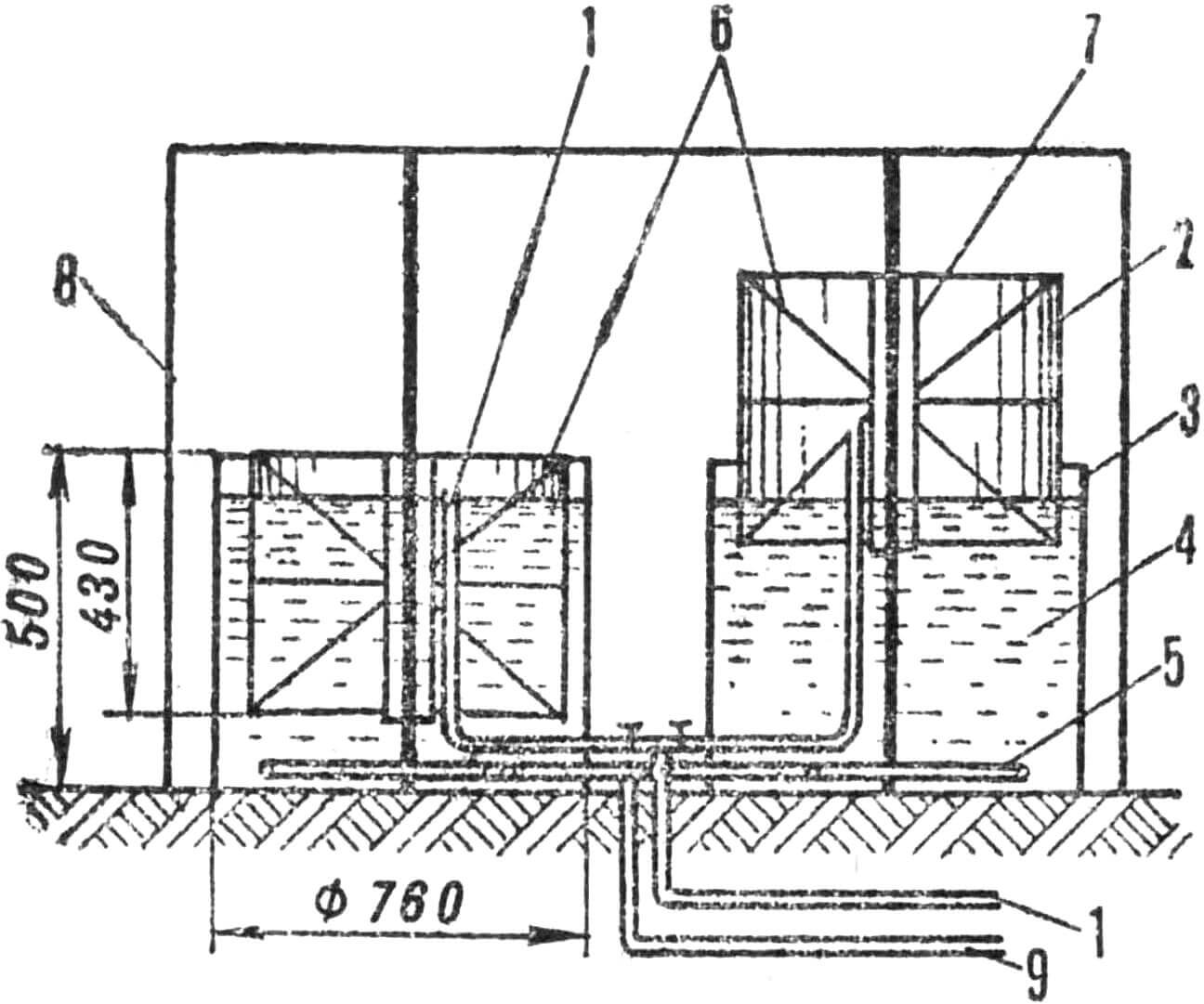
1 — biogas outlet pipeline, 2 — bell, 3 — fermenter body, 4 — raw materials, 5 — raw material heating system, 6 — bell metal structure braces, 7 — bell guide pipe, 8 — greenhouse metal frame, 9 — hot water supply pipeline.
In Romania, biogas generators are also used in state or cooperative farms. Here is one of them. It has two fermenters with a capacity of 200 m3 each, covered with a frame with polyethylene film (Fig. 3). In winter, manure is heated with hot water. The installation capacity is 300—480 m3 of gas per day. This amount is quite sufficient to meet all the needs of the local agro-industrial complex.
PRACTICAL TIPS
As already noted, temperature plays a decisive role in the development of the fermentation process: heating the raw material from 15 to 20 can double the production of energy carrier. Therefore, some generators have a special raw material heating system, but most installations are not equipped with it; they use only the heat released during the decomposition of organic substances themselves. One of the most important conditions for normal fermenter operation is the presence of reliable thermal insulation. In addition, it is necessary to minimize heat losses during cleaning and filling of the fermenter hopper.
It is also necessary to remember the need to ensure biochemical balance. Sometimes the rate of acid production by bacteria is higher than the rate of their consumption by the second group of bacteria. In this case, the acidity of the mass increases, and biogas production decreases. The situation can be corrected either by reducing the daily portion of raw materials, or by increasing its solubility (if possible, with hot water), or, finally, by adding a neutralizing substance — for example, lime milk, washing or baking soda.
Biogas production may decrease due to a violation of the ratio between carbon and nitrogen. In this case, nitrogen-containing substances are introduced into the fermenter — urine or, in small quantities, ammonium salts, usually used as chemical fertilizers (50 — 100 g per 1 m3 of raw materials).
It should be remembered that high humidity and the presence of hydrogen sulfide (the content of which in biogas can reach 0.5%) stimulate increased corrosion of the metal parts of the installation. Therefore, the condition of all other elements of the fermenter should be regularly monitored and carefully protected at damage sites: best with red lead — in one or two layers, and then with two more layers of any oil paint.
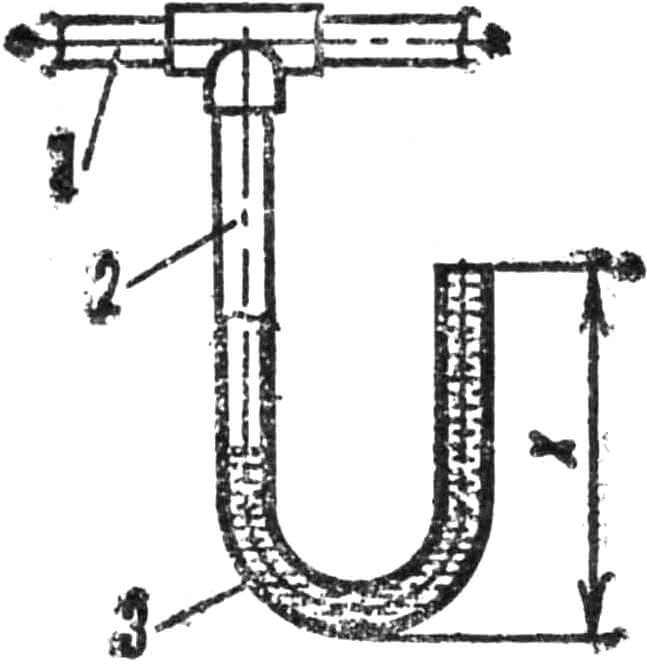
1 — biogas supply hose, 2 — U-shaped tube, 3 — condensed water.
Both pipes (metal or plastic) and rubber hoses can be used as a pipeline for transporting biogas from the outlet pipe in the upper part of the installation bell to the consumer. It is advisable to lay them in a deep trench to prevent ruptures due to freezing of condensed water in winter. If gas transportation using a hose is carried out through the air, then a special device is needed to drain the condensate. The simplest scheme of such a device is a U-shaped tube connected to the hose at its lowest point (Fig. 4). The length of the free branch of the tube (x) must be greater than the biogas pressure expressed in millimeters of water column. As condensate flows from the pipeline into the tube, water pours out through its free end without gas leakage.
It is also advisable to provide a pipe in the upper part of the bell for installing a pressure gauge to judge the amount of accumulated biogas by the pressure value.
Operating experience has shown that using a mixture of different organic substances as raw materials produces more biogas than loading the fermenter with one of the components. The moisture content of the raw material is recommended to be slightly reduced in winter (to 88 — 90%) and increased in summer (92-94%). The water used for dilution should be warm (preferably 35—40°). Raw materials are fed in portions, at least once a day. After the first loading of the fermenter, biogas is often initially produced, which contains more than 60% carbon dioxide and therefore does not burn. This gas is released into the atmosphere, and after 1—3 days the installation will begin to function normally.
Based on materials from the magazine “Technium”, CPP
Recommend to read
 HOW MANY TIMES IN THE TANK?
This question, unfortunately, was the last in the life of a motorcyclist attempting a match to light the dark failure of the fuel... This, of course, a joke but in every joke... ARCH TO ARCH – GREENHOUSE READY
The arched structure, under all other equal conditions, will always be stronger, more reliable, and cheaper than structures of other types—especially when the arch itself consists of rods...
