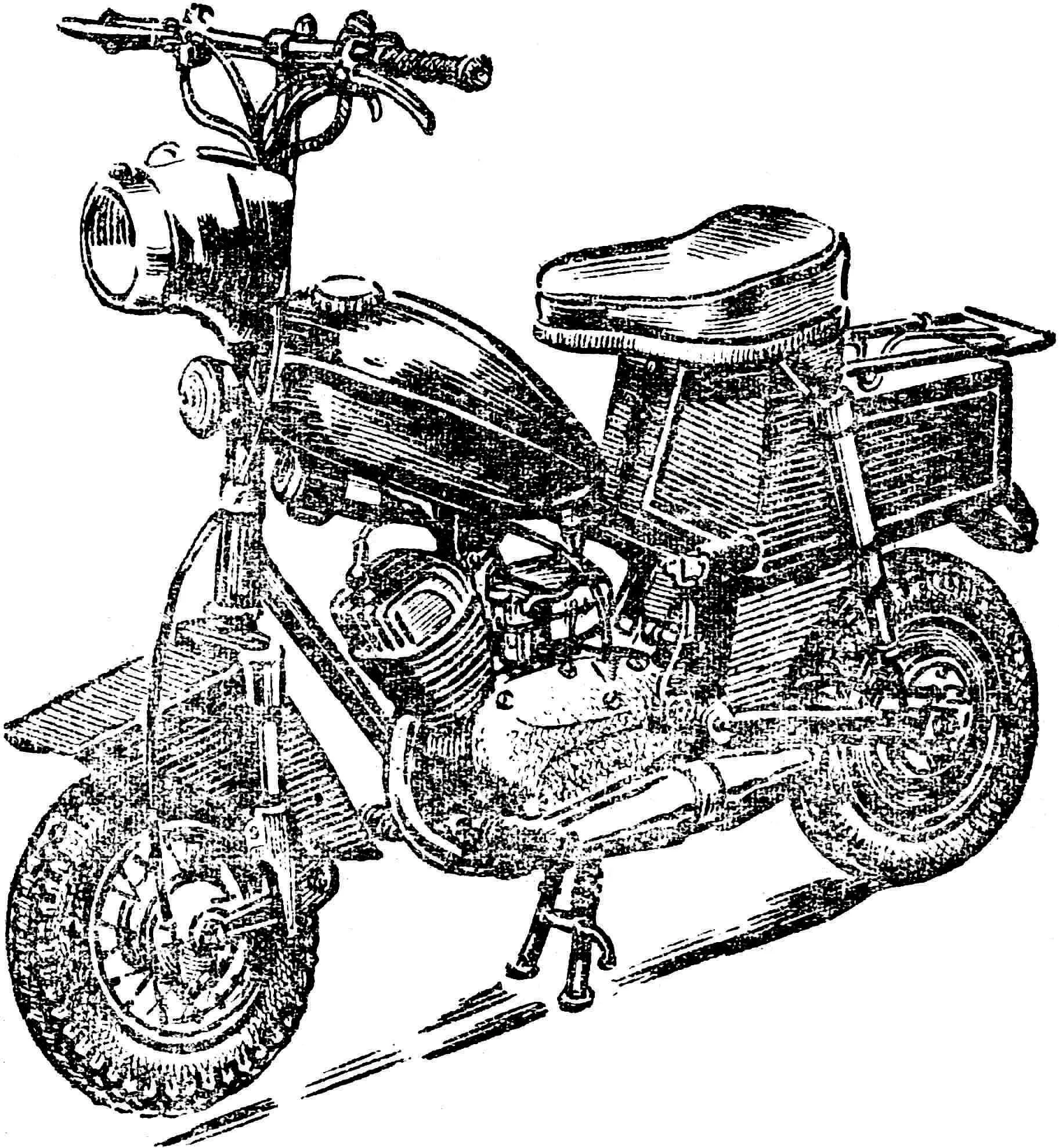
In Bashkortostan, we call the Belaya River “Agidel” — a favorite recreation spot for Ufa residents. I named my micromotorcycle “Agidel” as well, because it was conceived primarily as a standard design for fishermen, mushroom pickers, and lovers of long journeys. The purpose determined the main qualities of the machine — high reliability, ease of operation, maintenance, and repair. The micromotorcycle uses many serial parts, which will facilitate its mass production.
When designing the machine, I tried to provide maximum convenience. In particular, I had to attach even a strap with carabiners to carry “Agidel” over obstacles.
The motorcycle is equipped with a large luggage rack and a spacious tool box. Shock absorbers on both wheels significantly reduce fatigue on long trips. This was confirmed, by the way, during test runs along the route Moscow — Smolensk — Minsk — Vilnius — Riga — Tallinn — Leningrad and during everyday operation. The machine demonstrated good stability, high responsiveness, and reliably coped with all the difficulties of the road.
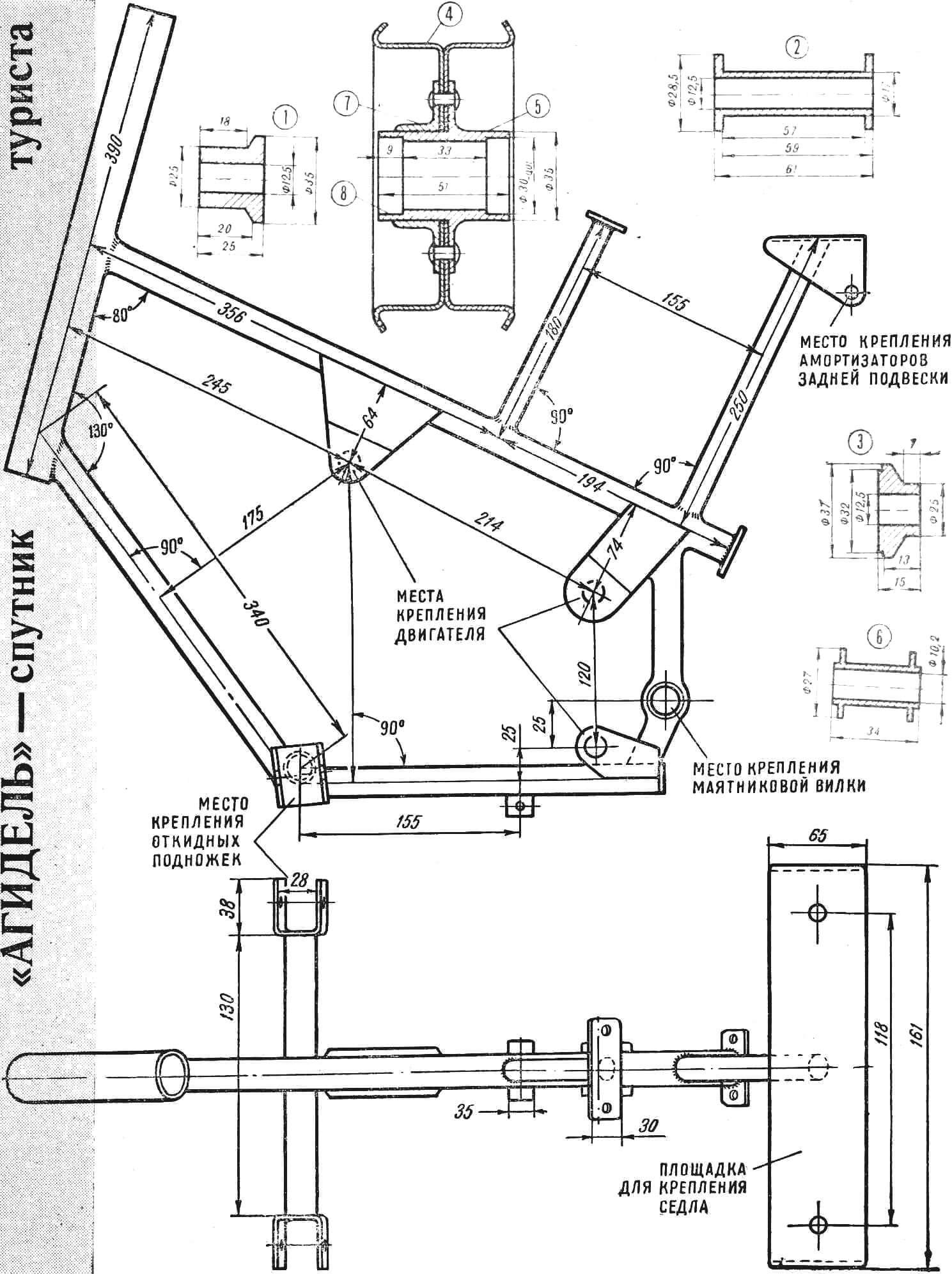
1 and 3 — rear wheel spacer bushings made of D16 duralumin, 2 — spacer bushing made of St. 3, 4 — standard bicycle brake drum, 5 — standard moped front wheel hub, 6 — spacer bushing made of St. 3, 7 — flange, 8 — bearing location.
FRAME is made of thin-walled tubes Ø 27X1 mm (Fig. 1). Suitable parts from a bicycle frame, welded as shown in the drawing.
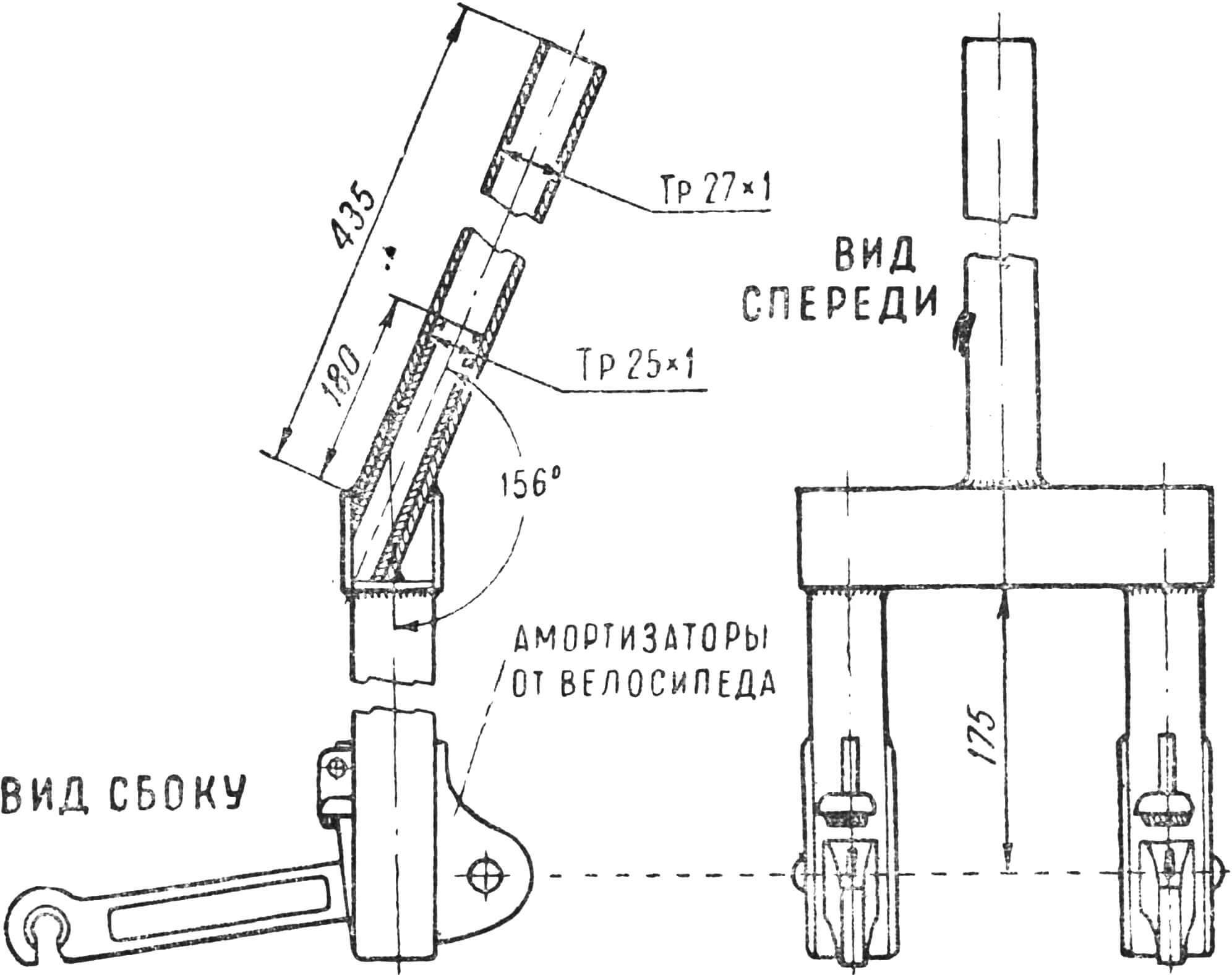
FRONT FORK with shock absorbers (Fig. 2) — from bicycle 16-V. The following changes were made. The left and right halves are cut to the dimensions specified in the drawing, then the pendulum levers are installed on the wheel and secured with nuts. A strip is cut from steel 40 mm wide and 3 mm thick, and the fork ends are crimped with it. After this, the fork ends are welded to the base strip. The shock absorbers do not need to be removed during modification.
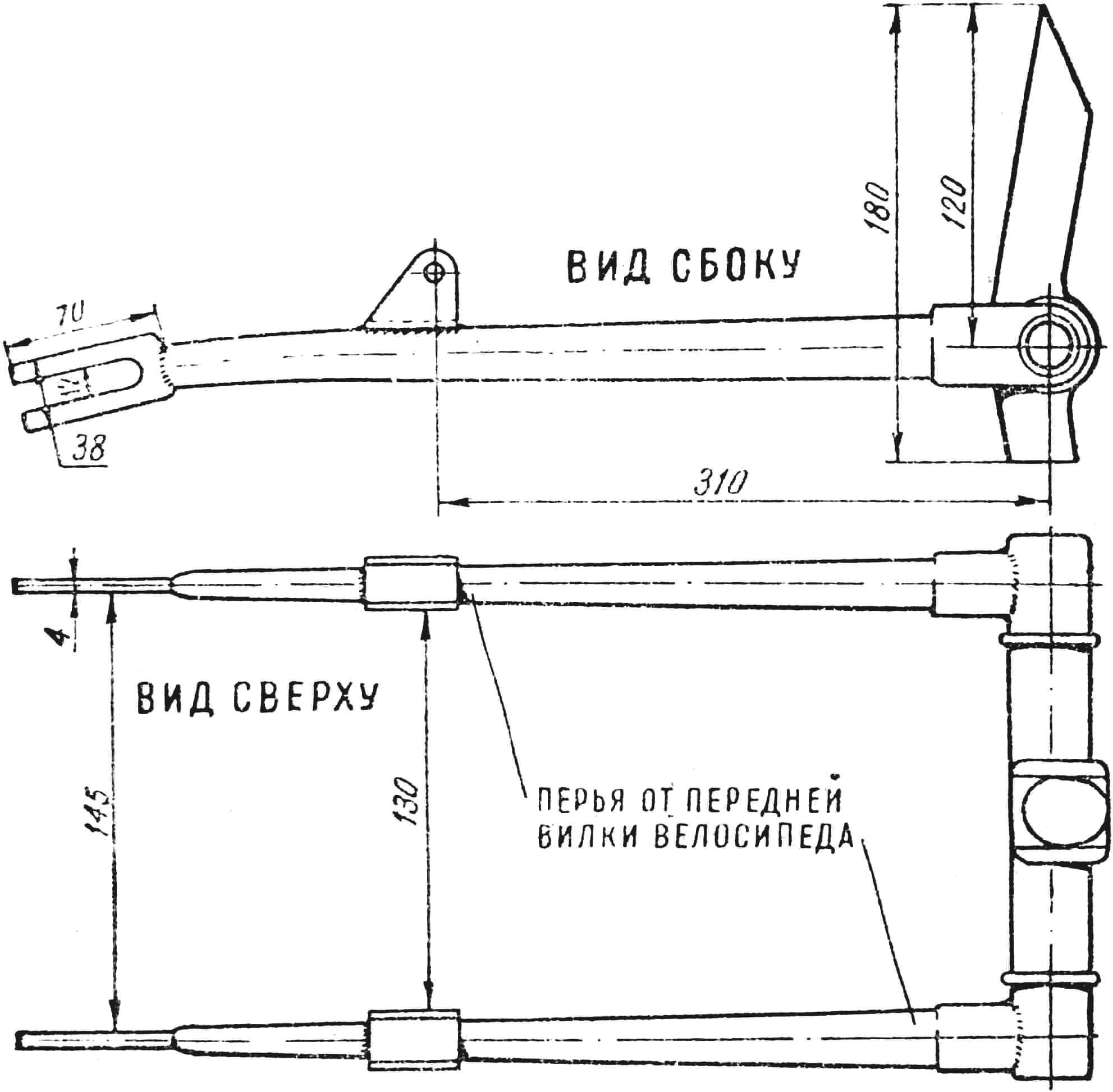
REAR FORK (Fig. 3) with shock absorbers — from Jawa motorcycle. This unit from Riga moped can be used. The drawing shows which part of the frame needs to be cut out from the old motorcycle frame and welded into the “Agidel” frame.
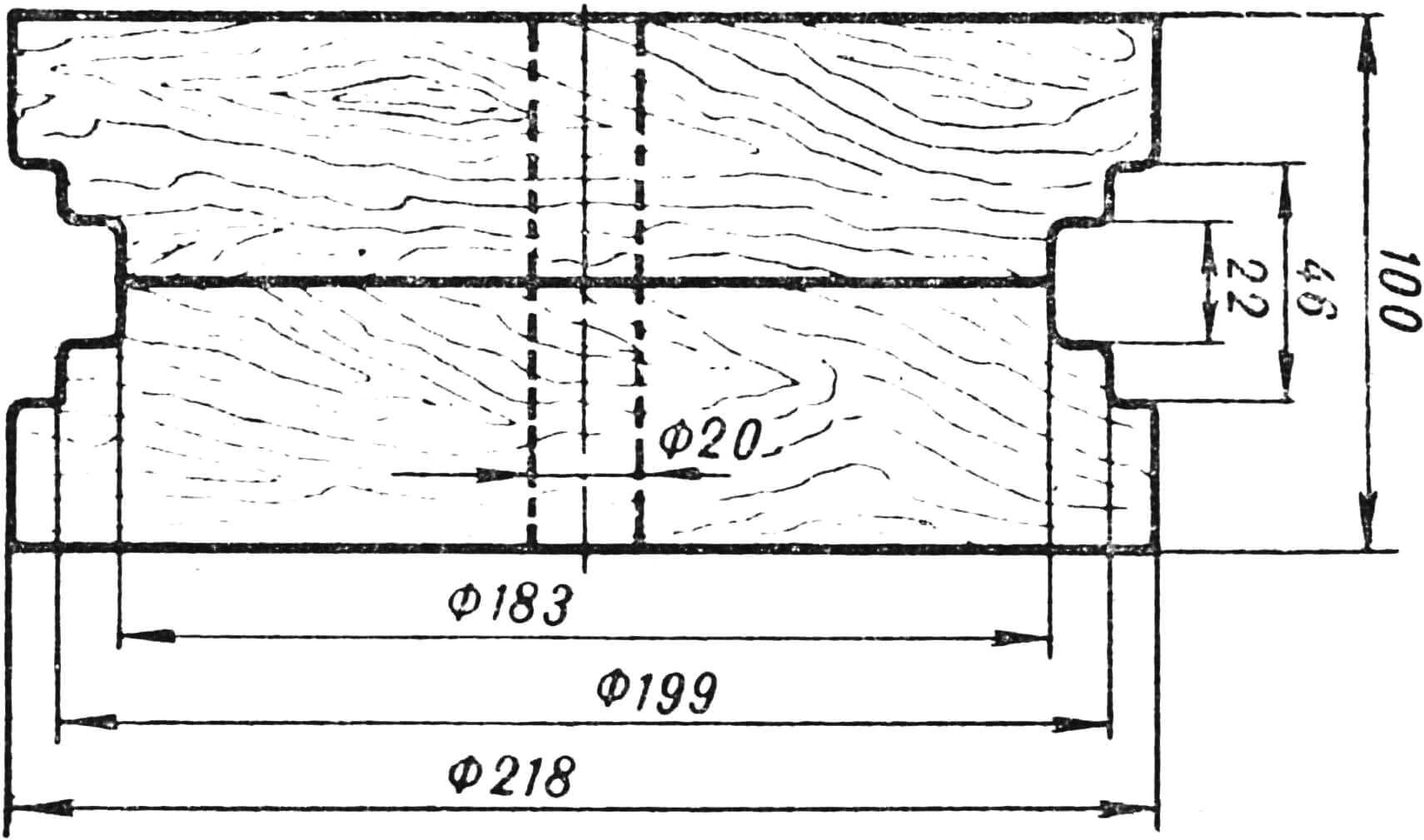
WHEEL RIMS AND DISCS (Fig. 5 and 6). The homemade tires installed on “Agidel” are 1.5 times wider than the scooter tires usually used in similar machines. Therefore, the width of the rims between the flanges is 38 mm. The mounting dimensions are standard. The rims are made from Riga moped wheel on a mandrel (Fig. 4).
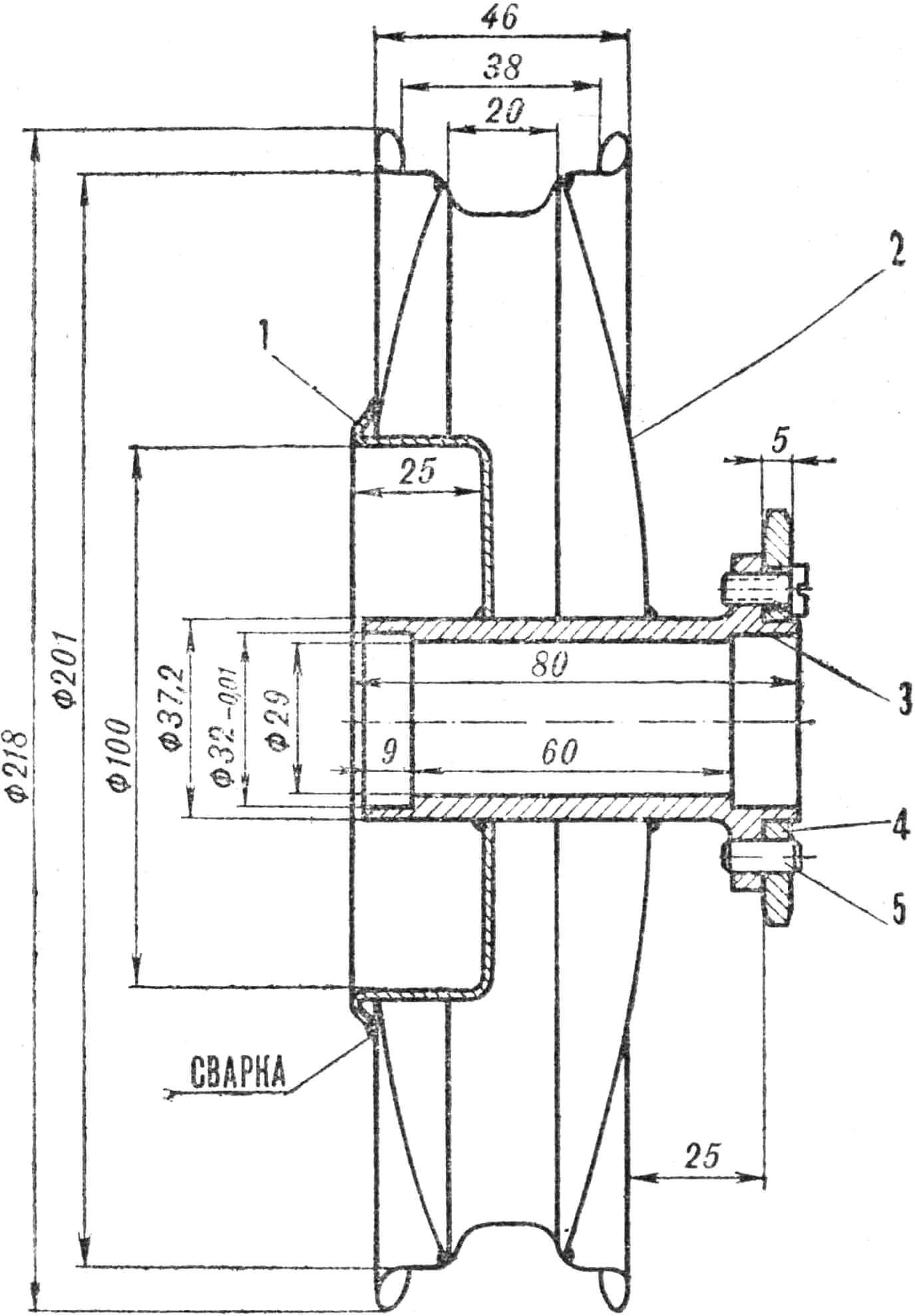
1 — brake drum, 2 — wheel disc, 3 — bearing location No. 201, 4 — 18-tooth sprocket, 5 — pin Ø 6 mm.

ENGINE is installed on the frame after a series of modifications: pedals are removed and a kickstarter is installed (Fig. 7, 8).
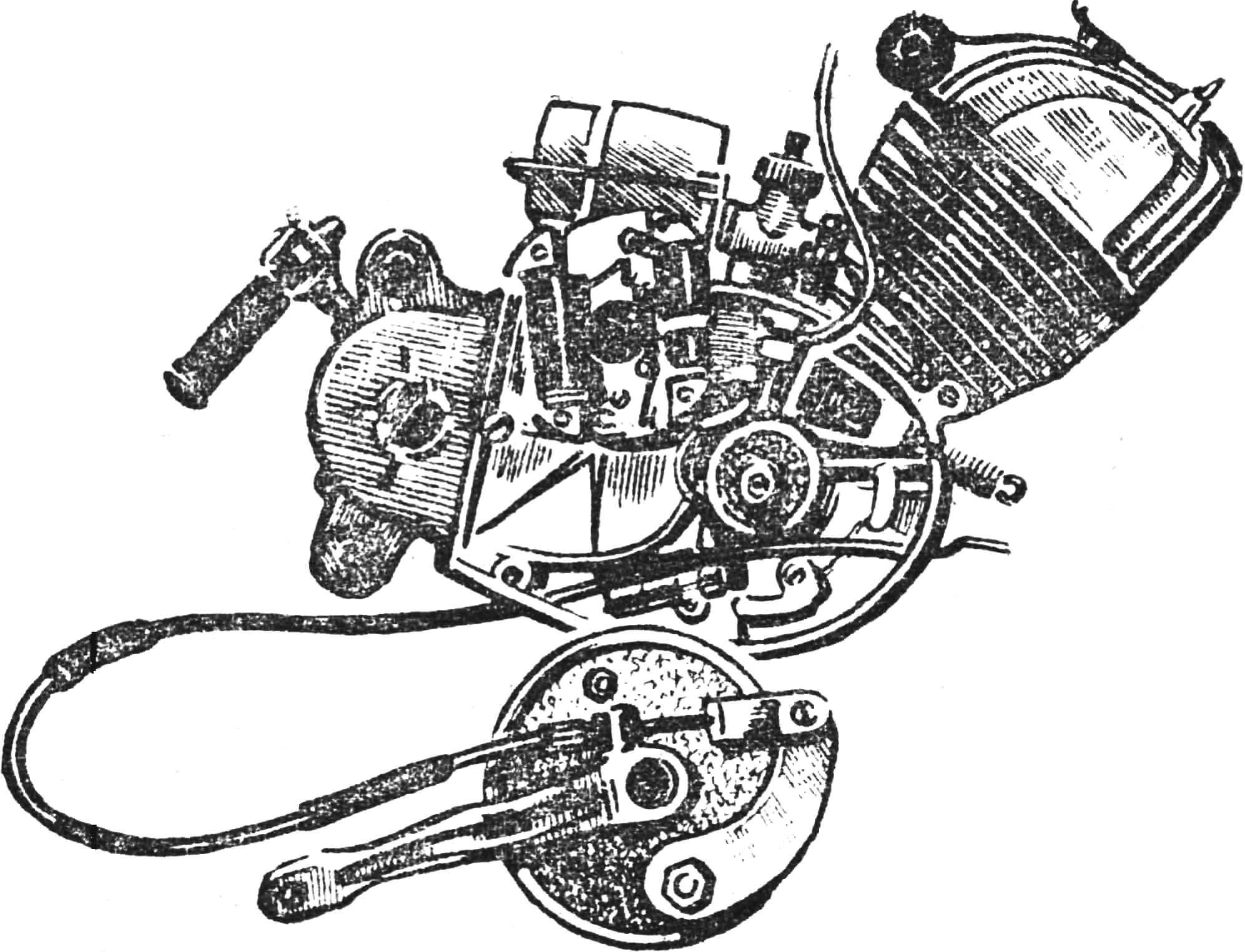
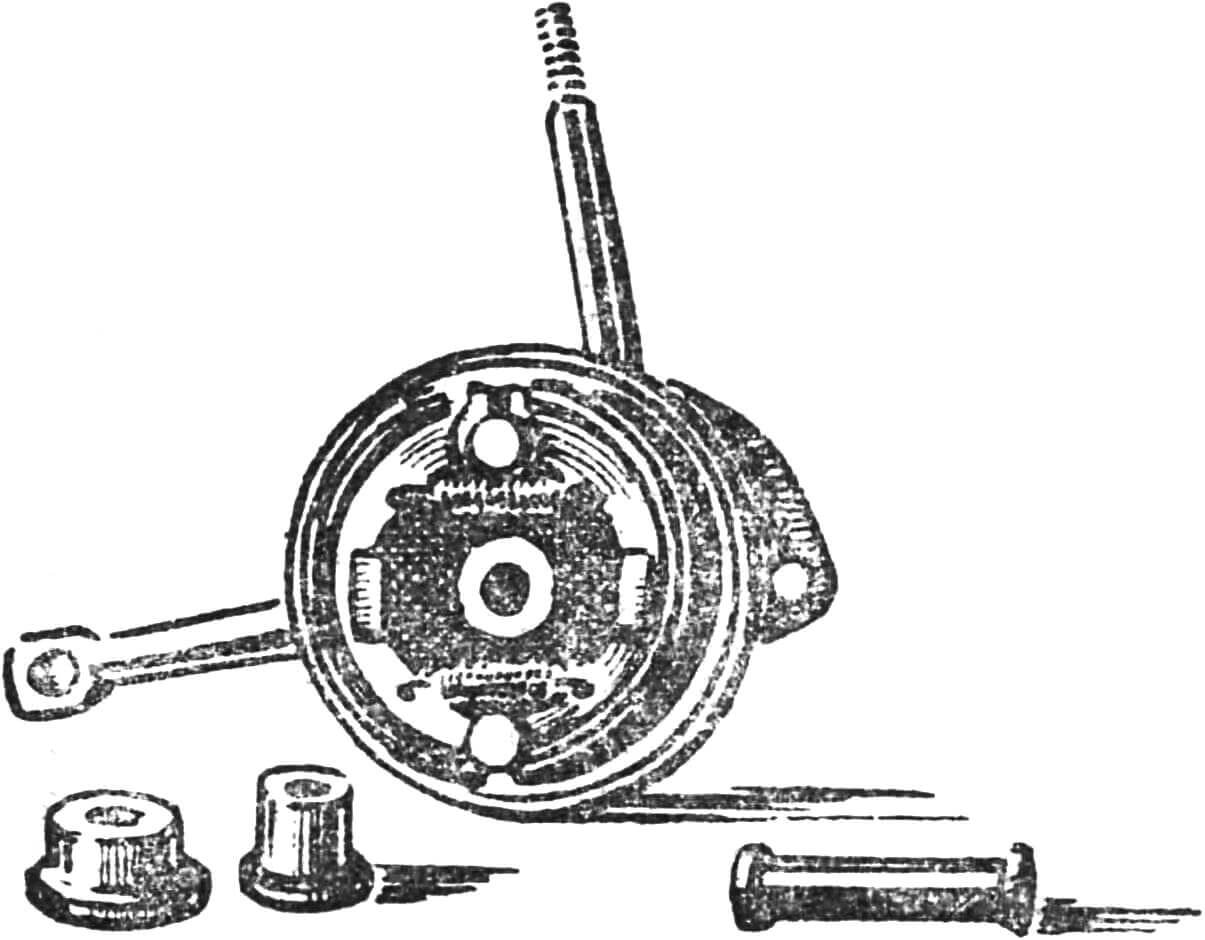
On the assembled engine, the boss of the right half of the crankcase, through which the connecting rod shaft passes, is cut off with a hacksaw. The height of the remaining part of the boss should be 3 mm, and a mark remains on the shaft. Next, the engine is disassembled, the crankcase halves are separated, and the connecting rod shaft is removed, the mark location is annealed and the “excess” is cut off. A plug made of 3 mm thick duralumin plate with a pressboard gasket is placed on the boss of the right half of the crankcase. Then the brake hub is cut and put in place, a groove for the kickstarter spring from K-125 motorcycle is made on the connecting rod shaft, and the engine with kickstarter is assembled.
HANDLEBAR — from Riga moped, shortened to 500 mm, all its parts are standard.
BRAKE PADS and drums — from bicycle 16-V front wheel.
STOP SIGNAL — from M-20 car, its switch — from VP-150 motor scooter.
Technical specifications of Agidel micromotorcycle
Weight (dry), kg … 27
Engine Sh-52, hp … 2.0
Overall dimensions, mm:
length … 1100
width … 500
height … 900
Ground clearance, mm … 150
Maximum speed, km/h … 65
V. PETROVSKY
Recommend to read
 Kursk kart
The kart design (Fig. 1) has no complex units requiring high qualifications of performers and can be replicated in technical clubs of schools or at young technicians' stations that have a... THE WATCHMAN INVISIBLE
If the stock is illiquid. burden burden of low-power portable radio (or a set of two stations), designed for communication in civil band 26,9 — 27,2 MHz, offer the option of their useful...
