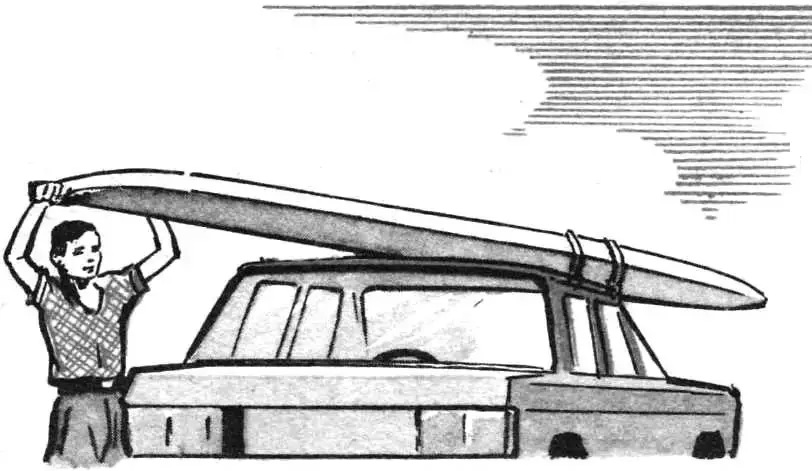
When designing this car roof rack, the aim was to create a device that, in addition to everyday use, would suit the active outdoor enthusiast—allowing two sets of sailboards to be carried in summer and (with minor changes) 5–6 pairs of skis in winter.
Given the considerable weight of two sets of sailboards (about 54 kg), the rack itself is made as light as possible and the load’s centre of gravity is kept low. The design allows loading and unloading of the gear in 1–5 minutes by two people.
The most suitable material for the main structural elements is stainless steel tube Ø12 or 14 mm with 2 mm wall thickness; otherwise use tube of at least 16 mm diameter with wall thickness at least 1.5 mm. The remaining parts are less heavily loaded and can be made from smaller-diameter tube.
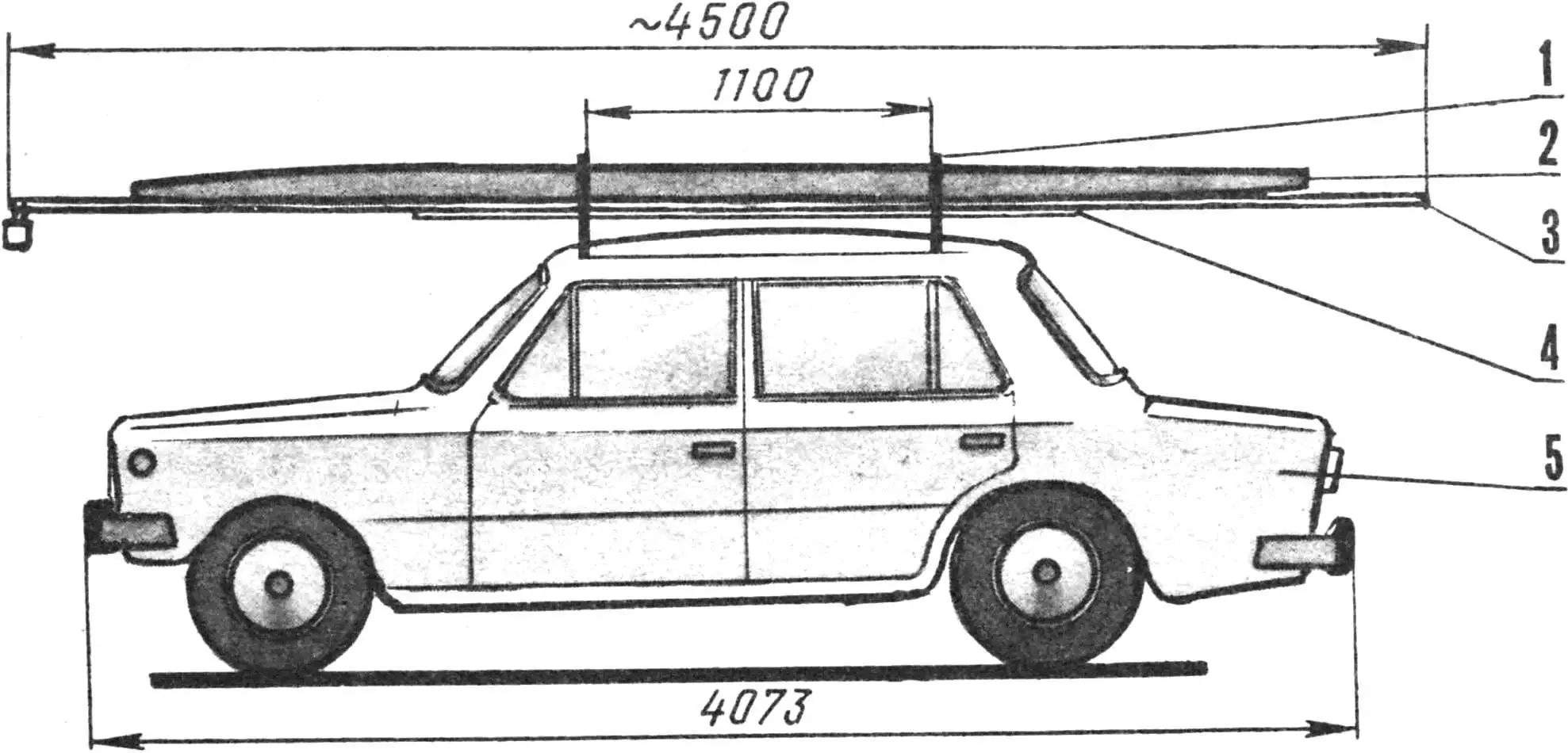
1 — universal roof rack, 2 — sailboard hulls, 3 — masts with hinges, 4 — booms with stops, 5 — in the closed boot: sail sets, centreboards, fins, life jackets.
The rack consists of two paired arcs with roof-mounting points and special cradles fixed to the arcs by screw clamps.
The cradles have clamps for masts and booms: mast clamps are made from 1 mm strip steel, and booms are held under the rack arcs by 4 mm steel wire fittings and hooks welded to the arcs. The cradles are removable so they can be moved along the rack and adjusted to the sailboard hull size. Cradle-to-arc connection is by bolts. The centre cradle fixes the touching sides when carrying two sailboard sets. To make loading and unloading easier, the clamping element is pivoting and attached to the rack.
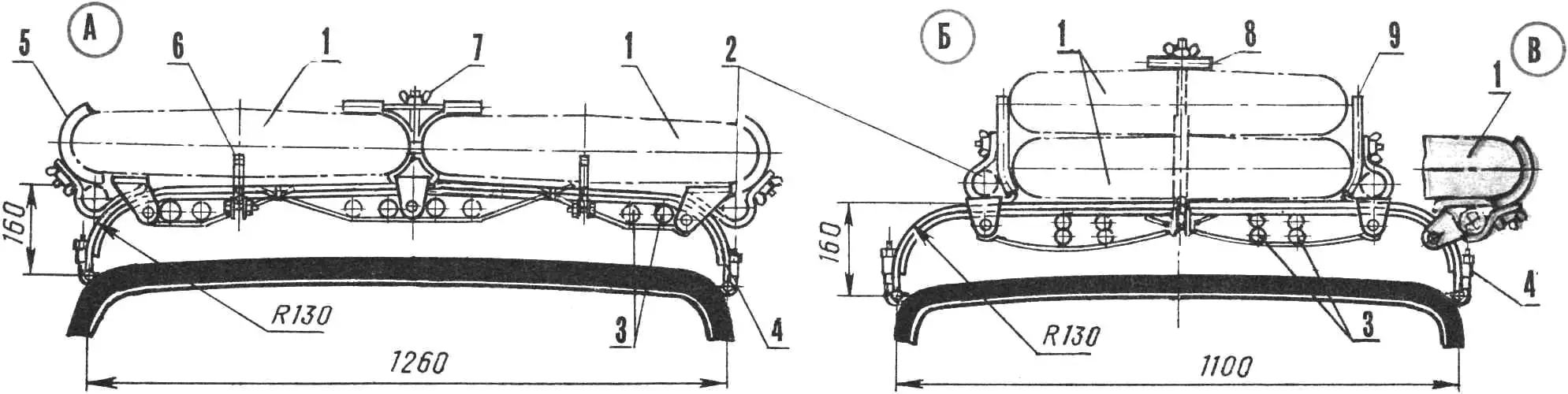
1 — hulls, 2 — masts, 3 — wishbone booms, 4 — rack base, 5 — side cradles (4 pcs.), 6 — longitudinal stop, 7 — inner support, 8 — extended longitudinal stop, 9 — side cradles (4 pcs.).
Because the Zaporozhets roof is somewhat narrower than the Zhiguli’s, the side cradles differ in some details. The setup gives enough longitudinal restraint since the hulls sit nearer the edges where the hull narrows. For extra security, especially on long trips, it is useful to make an auxiliary longitudinal stop; it is fixed to the rack’s longitudinal tie(s)—there may be two or three.
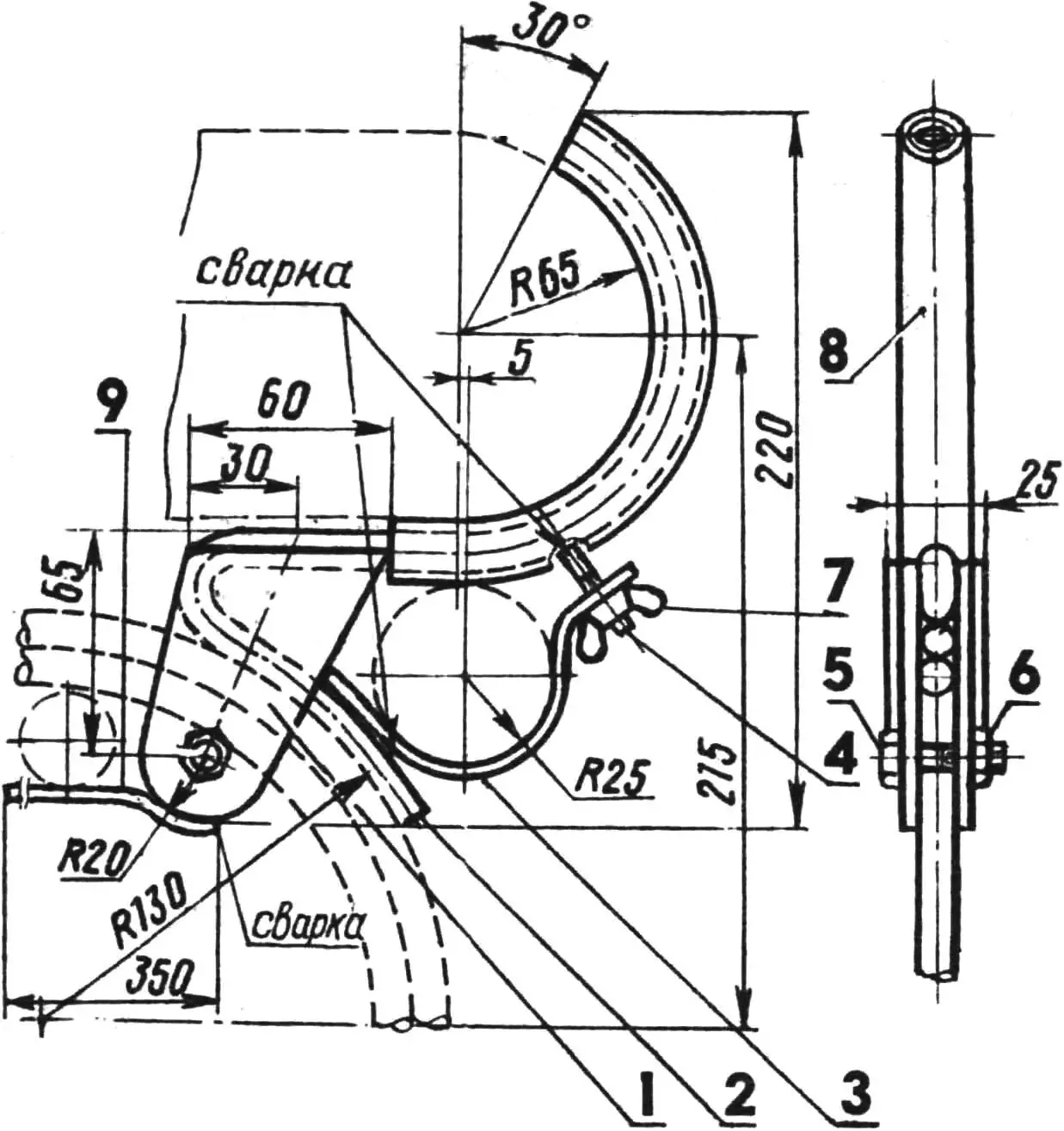
1 — cheek (2.5 mm stainless steel, 2 pcs.), 2 — cradle base (Ø 12… 14 mm stainless tube), 3 — half-clamp (1 mm stainless steel), 4 — M8 stud, 5 — M8×40 mm bolt, 6 — M8 nut, 7 — M8 wing nut, 8 — lining (rubber tube), 9 — retainer (4 mm spring wire).
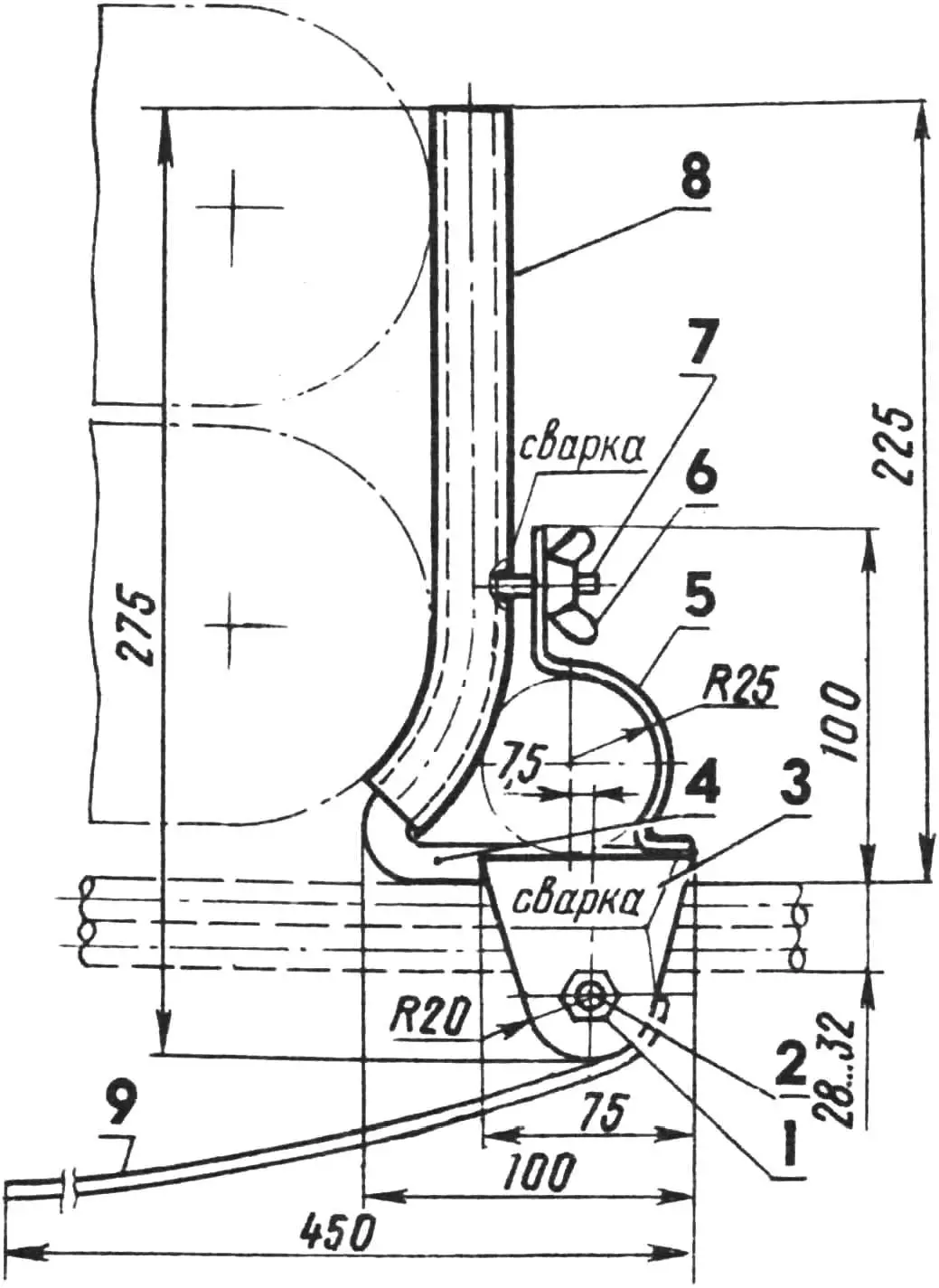
1 — M8 nut, 2 — M8×40 mm bolt, 3 — cheek (2.5 mm stainless steel, 2 pcs.), 4 — cradle base (stainless steel, Ø 12…14 mm tube), 5 — half-clamp (1 mm stainless steel), 6 — M8 wing nut, 7 — M8 stud, 8 — lining (rubber tube), 9 — retainer (4 mm spring wire).
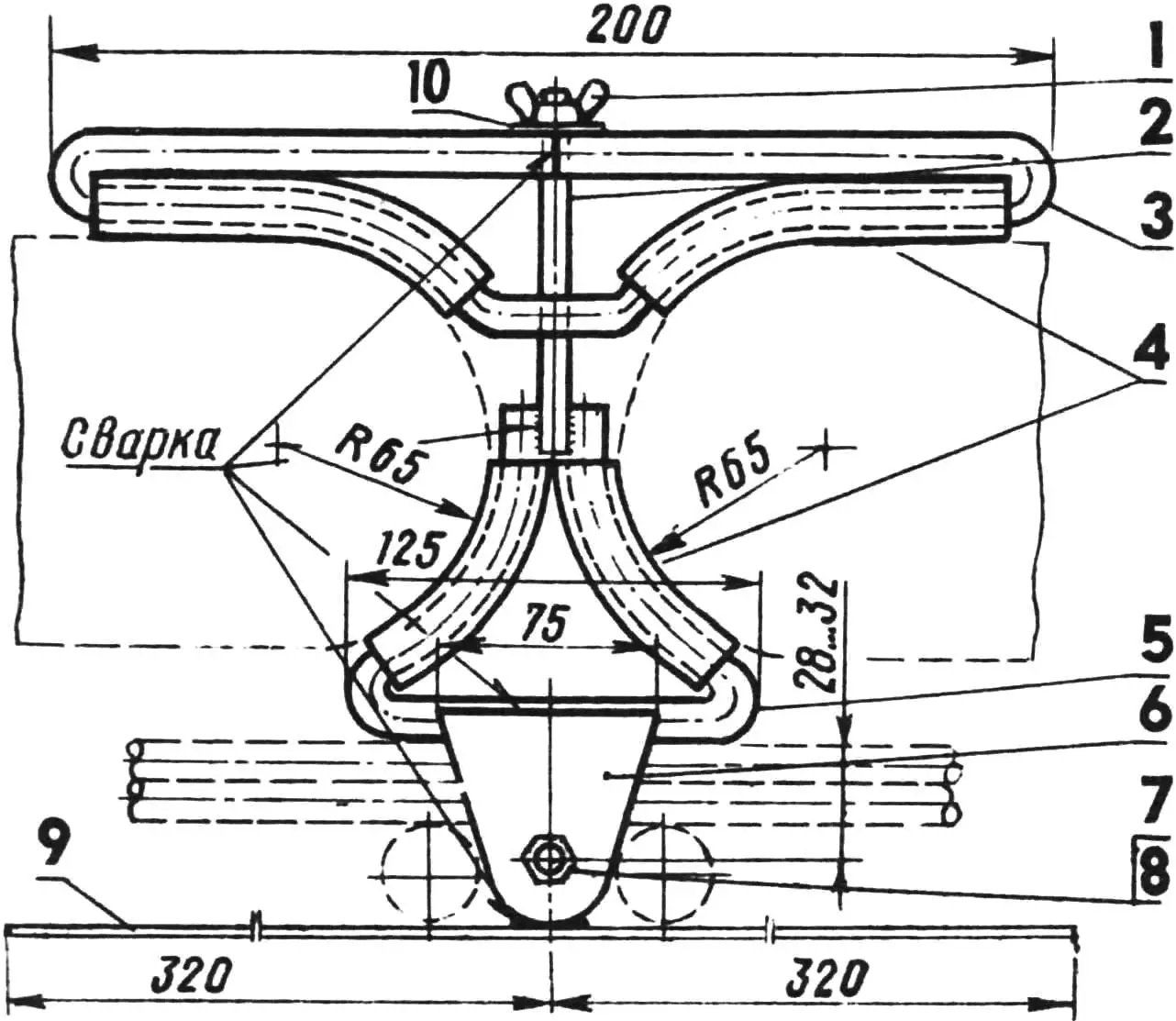
1 — M6 wing nut, 2 — M6 stud, 3 — cradle base (stainless steel, Ø 12….14 mm tube), 4 — lining (rubber tube), 5 — lower cradle base (stainless steel, Ø 12…14 mm tube), 6 — cheek (2.5 mm stainless steel), 7 — M8 nut, 8 — M8×40 mm bolt, 9 — retainer (4 mm spring wire).
All rack parts are assembled by welding. To protect the board’s polished surface, rubber tubes are slipped onto the rack elements. Fit them before welding or use tubes split lengthwise and secure with adhesive tape.
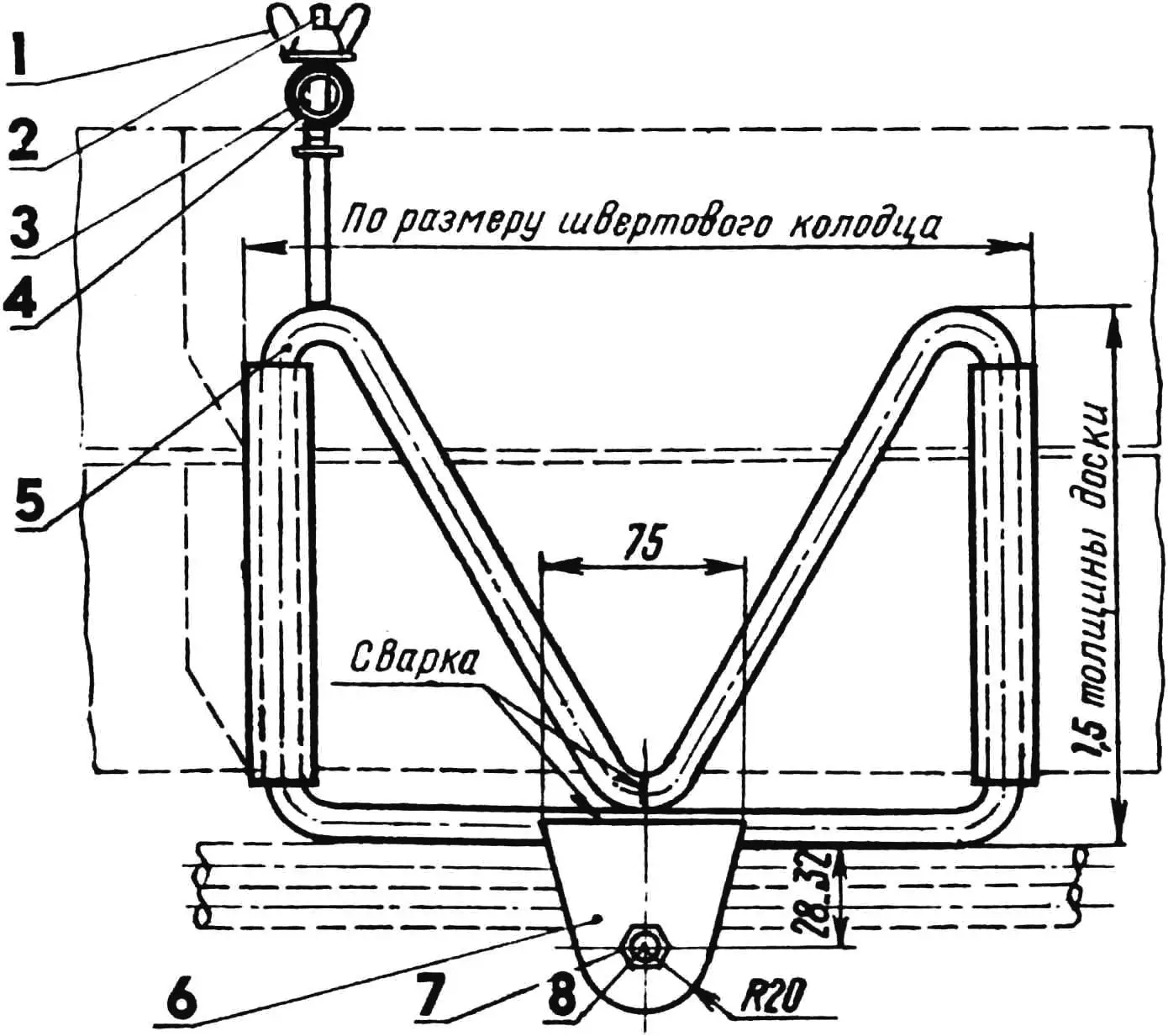
1 — M6 wing nut, 2 — M6 stud, 3 — clamp (stainless steel, Ø 12… 14 mm tube), 4 — lining (rubber tube), 5 — stop base (stainless steel, Ø 12… 14 mm tube), 6 — cheek (2.5 mm stainless steel), 7 — M8 nut, 8 — M8×40 mm bolt.
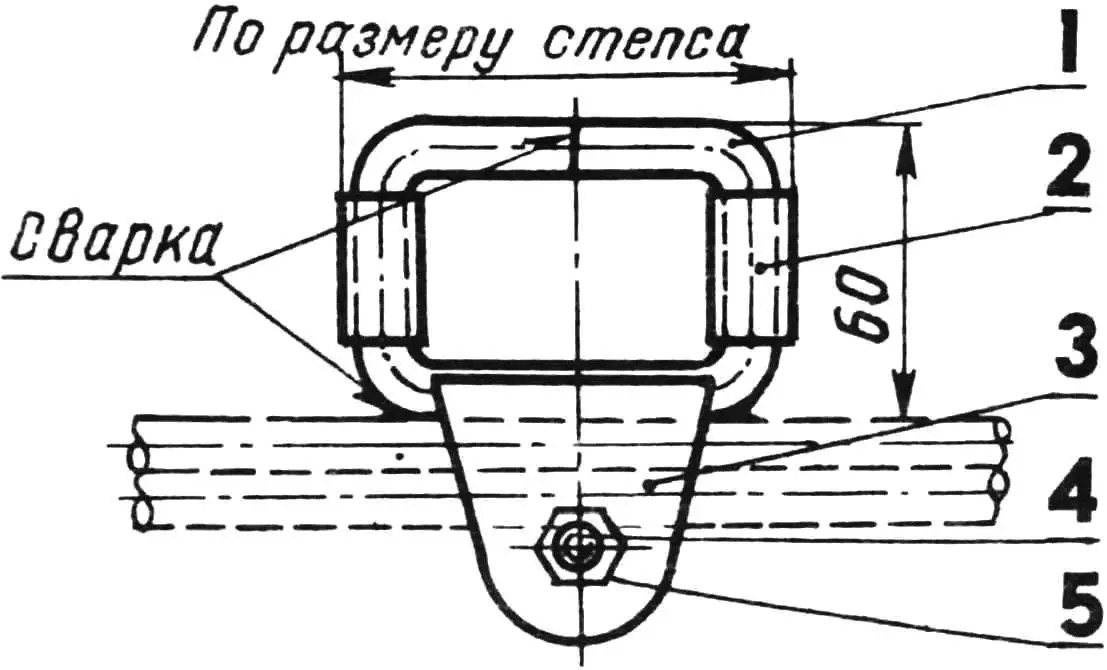
1 — stop base (stainless steel, Ø 12… 14 mm tube), 2 — lining (rubber tube), 3 — cheek (2.5 mm stainless steel), 4 — M8 nut, 5 — M8×40 mm bolt.
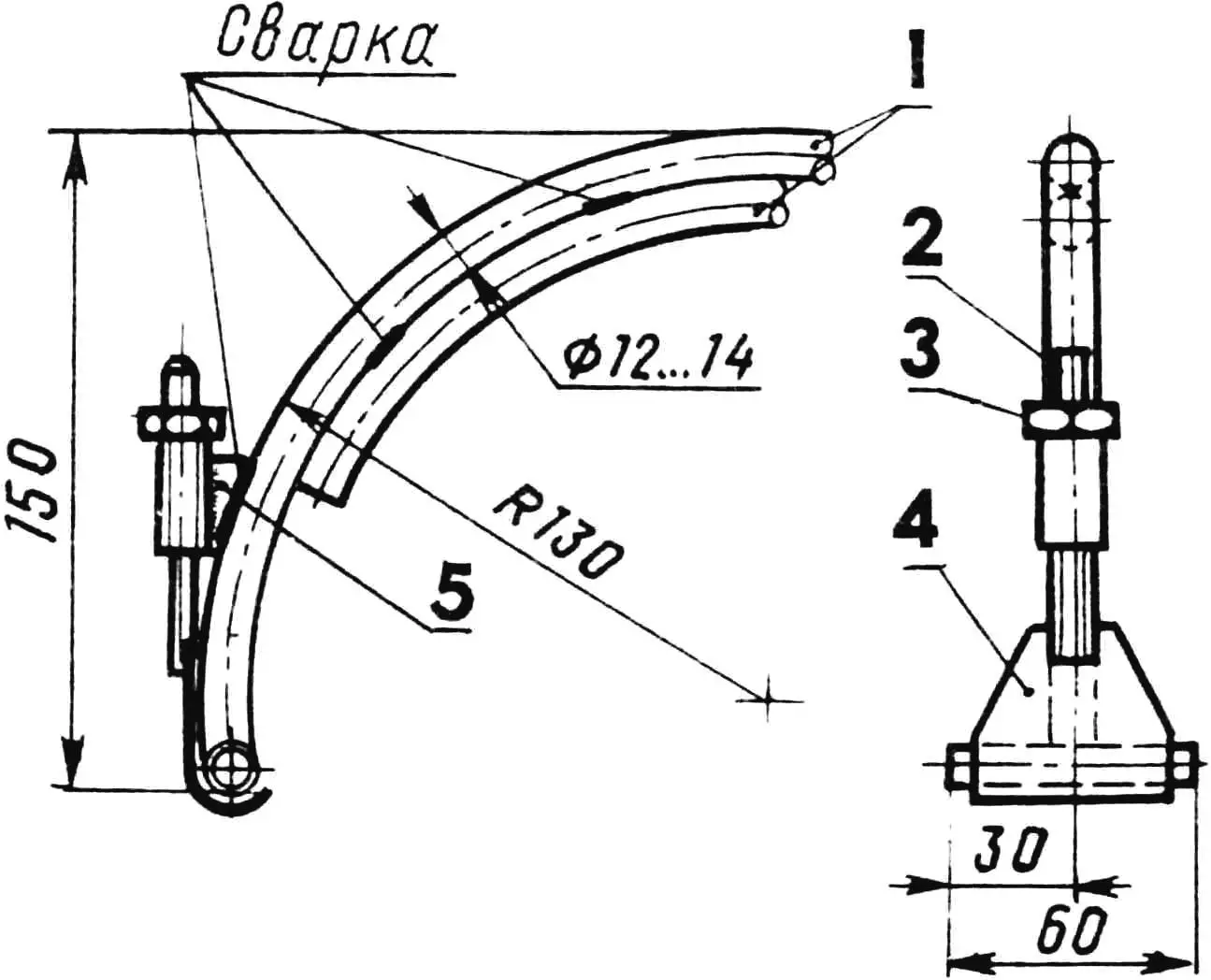
1 — rack frame (stainless steel, Ø 12… 14 mm tubes), 2 — M8 stud, 3 — M8 nut, 4 — bracket (2.5 mm stainless steel), 5 — gusset (2.5 mm stainless steel).
For winter use—carrying skis or sledges—simple fittings are used instead of the cradles; the clamps are best made from 1 mm stainless steel.
«M-K» 4’93, Yu. ZOTOV, N. SHERSHAKOV
Recommend to read
 AWNING FOR BALCONIES
All good loggia! The only drawback — it is vulnerable to a slanting rain or snow. Some glazed it, turning it this way in the apartment, but this measure can not be recommended — the... HANDHELD VACUUM CLEANER…
This kind of "vacuum cleaner" uses the property of plastic to electrify the friction of the fabric. And the device it is very simple. In the lid of a conventional soap dishes, cut a few...
