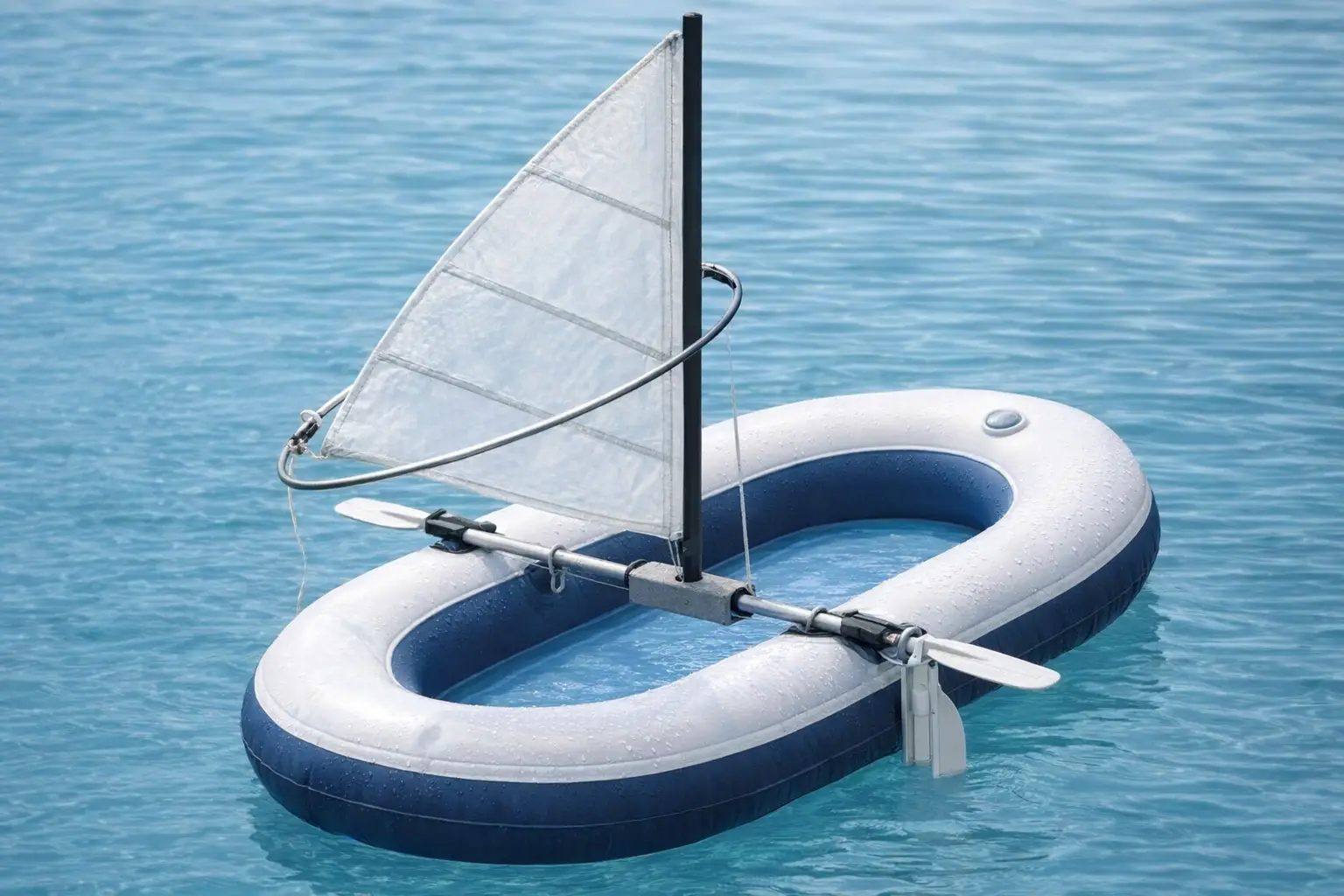
For all their advantages, an inflatable boat of any design has the same common drawbacks: short oars, a tortoise-like pace, and poor maneuverability.
We managed to get rid of all of them at once by adapting our boat “Nyrk-4” for sailing: with a sail it became both faster and more responsive. And the additional equipment itself turned out to be quite simple and compact, that is, it fit within the conveniences typical of inflatable boats.
To equip the “Nyrk,” a triangular sail from a windsurfer is used, together with the mast and boom, but with some modifications. A sail area of about three square meters is quite enough to provide good speed, while the necessary stability of the boat on the water is maintained. The sailcloth is cut according to drawings recommended for a windsurfer,
The mast is made in two sections, from two duralumin tubes 30 mm in diameter with a wall thickness of 5 mm; the mast length is 2.3 m.
The windsurfer boom undergoes the greatest transformation. It is assembled from curved bamboo poles 1.5 m long or from aluminum tubes Ø 25 mm with a wall thickness of 3 mm joined in pairs. They form two halves of the boom, connected to each other by two sections of thick-walled rubber hose, bent in half and slipped simultaneously onto both ends of the boom arcs. This design is distinguished by simplicity and reliability in operation.
The mast, and also the boom if it is made of duralumin tubes, have foam plug stoppers at the ends for buoyancy.
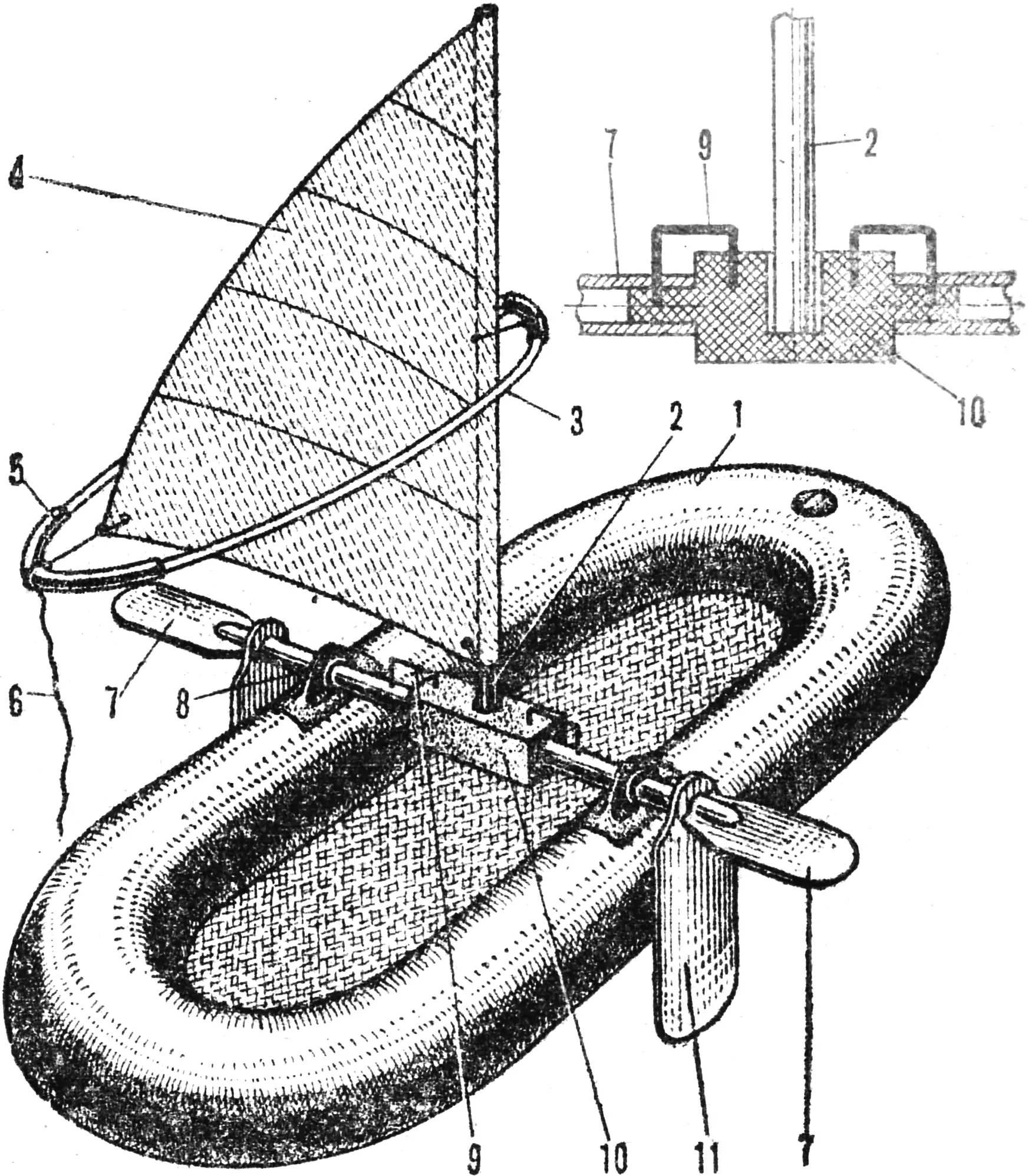
1 — rubber boat, 2 — mast, 3 — boom, 4 — sail, 5 — hose — boom connector, 6 — boom sheet, 7 — oar, 8 — rubber rowlocks, 9 — connecting clamps (D16, Ø 7 mm), 10 — strut (step), 11 — leeboard.
To stabilize the boat’s motion under sail, two more side leeboards will be needed. They can be made from sheet duralumin of suitable thickness (or with stiffening ribs), as well as from thick plywood. The leeboards are installed on both sides of the boat directly on the oar blades; for this purpose, the leeboards have corresponding holes. The oars themselves are joined by means of a wooden (or duralumin) strut that has special holes for the oar handles, as well as a vertical socket for the mast: thus, it is the central mounting unit.
The entire assembly can be carried out directly in the boat. The blade parts are taken off the oars; the leeboards are hung on them so that the widening parts of the oar blades enter the slots in the leeboards; the oar handles are passed through the boat’s rubber rowlocks into the strut and secured with wing bolts. Then the mast and boom are assembled; the end of the mast is set into the strut. The entire structure turns out to be both rigid and flexible at the same time: longitudinal displacement is neutralized by the leeboards pressing against the sides of the boat, while the mast can tilt only forward or backward. At the same time, it is held with one hand, and the other holds the boom sheet to control the sail: all this resembles “working” on a windsurfer, only instead of a “standing” position — a “sitting” one. When the mast is tilted, the leeboard beam turns — the strut with the oars, and then the ends of the leeboard blades move forward or backward accordingly. By holding the boom sheet and tilting the mast, we not only regulate the driving force, but also shift the center of effort relative to the center of lateral resistance — turning the boat in the desired direction. The distribution of forces is such that the effort required to hold the mast is insignificant; moreover, it is possible to steer as a pair, dividing the duties.
All parts of the rigging must be made to meet buoyancy requirements, since assembly, as we have already said, can be performed afloat; disassembly as well. The strut and leeboards are stowed in a bag included with the boat, and the long boom and mast tubes — in a special narrow cover.
Of course, this design has its drawbacks. And above all, the fact that when steering you must constantly hold the boom sheet and the mast in your hands. True, this inconvenience is compensated by the sporting interest in steering itself. The same cannot be said about bow waves splashing over the side into the boat. However, a way out can be found here too, by reducing speed or by designing a simple removable wave breaker on the bow of the boat.
«M-K» 5’81, V. and G. BOROZDINOV
Recommend to read
 INDIVIDUAL “SHADOW”
Going on a fine summer day at the beach, you take a small bedroll, which at the chosen place and unfold the envy of all the neighboring vacationers receive individual oblong tent at the... SCOUTS BATTLE
At the initial stage of the Second world war, tasks of intelligence in the interest of armored and motorized units of the Wehrmacht did pretty well armored. Their use in this role was...
