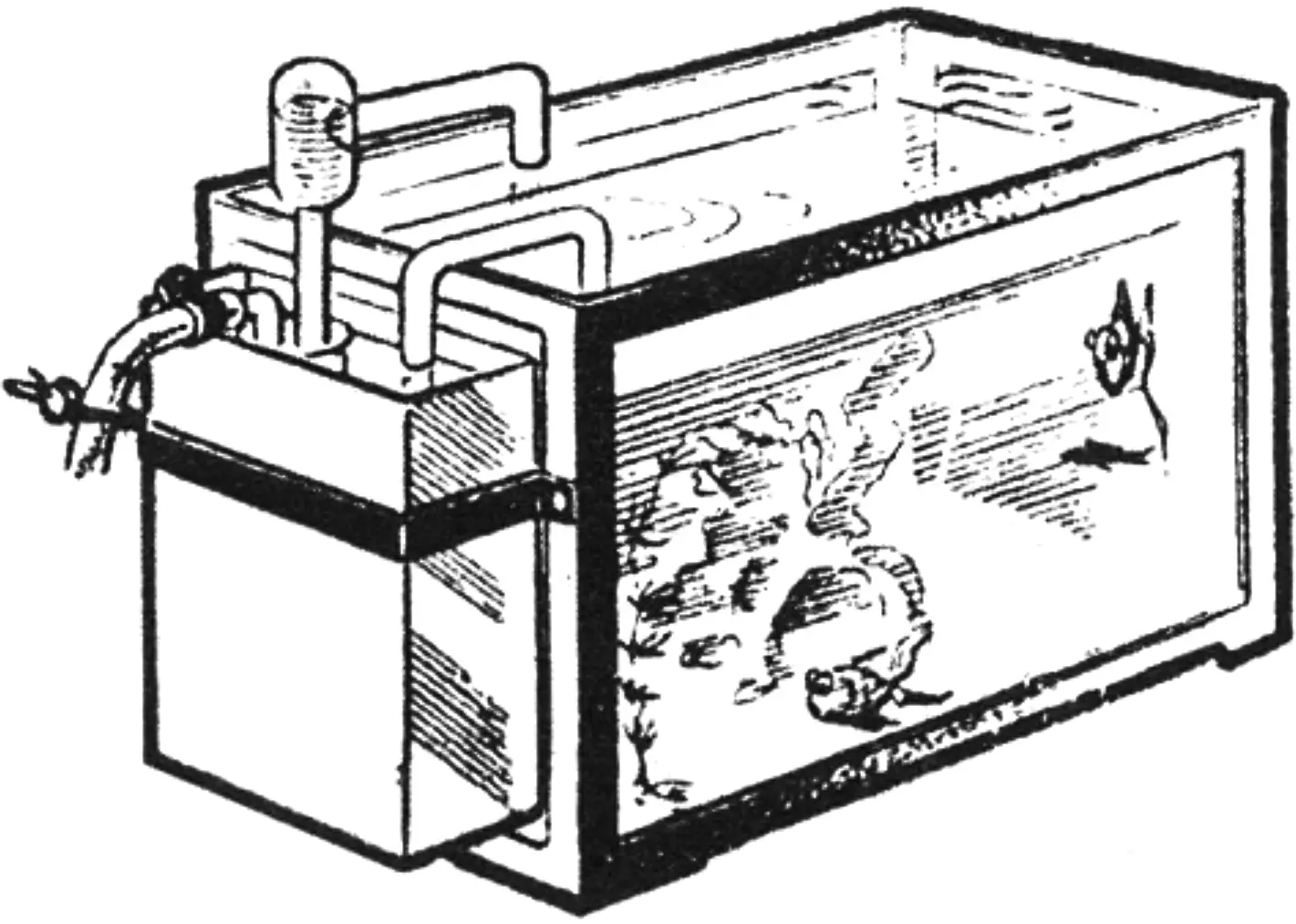
A filter is an important device that helps clean the water in an aquarium and, at the same time, saturate it with oxygen.
Water is passed through the filter by means of a system of communicating vessels, and the motive force for pumping water from the bottom of the filter into the aquarium is created by any compressor or cylinder with compressed air, etc.
The proposed filter (Fig. 1) is mounted in a rectangular glass or plastic vessel (1) and secured on metal brackets on the aquarium so that the water level in the vessel is at the height of the aquarium frame edge (2).
A bent glass tube (3), ending in a mesh, connects the aquarium to the filter and transfers water from the bottom to the upper part of the filter. A wide glass tube (4) runs along the entire height of the filter; it houses the device that pumps water. It consists of tubes (5) and (6) that supply air and water to the siphon (7).
The siphon is connected to a horizontal tube that “throws” water back into the aquarium. Compressed air is supplied to the filter through a rubber tube (8).
Water filtration takes place as it flows through a layer of coarse and fine gravel, fiberglass, activated carbon, and coarse gravel.
Sometimes small pieces of fiberglass get into the aquarium and are then swallowed by fish, damaging their internal organs. To prevent this, a layer of nylon or other synthetic fabric is placed between the fiberglass and the carbon.
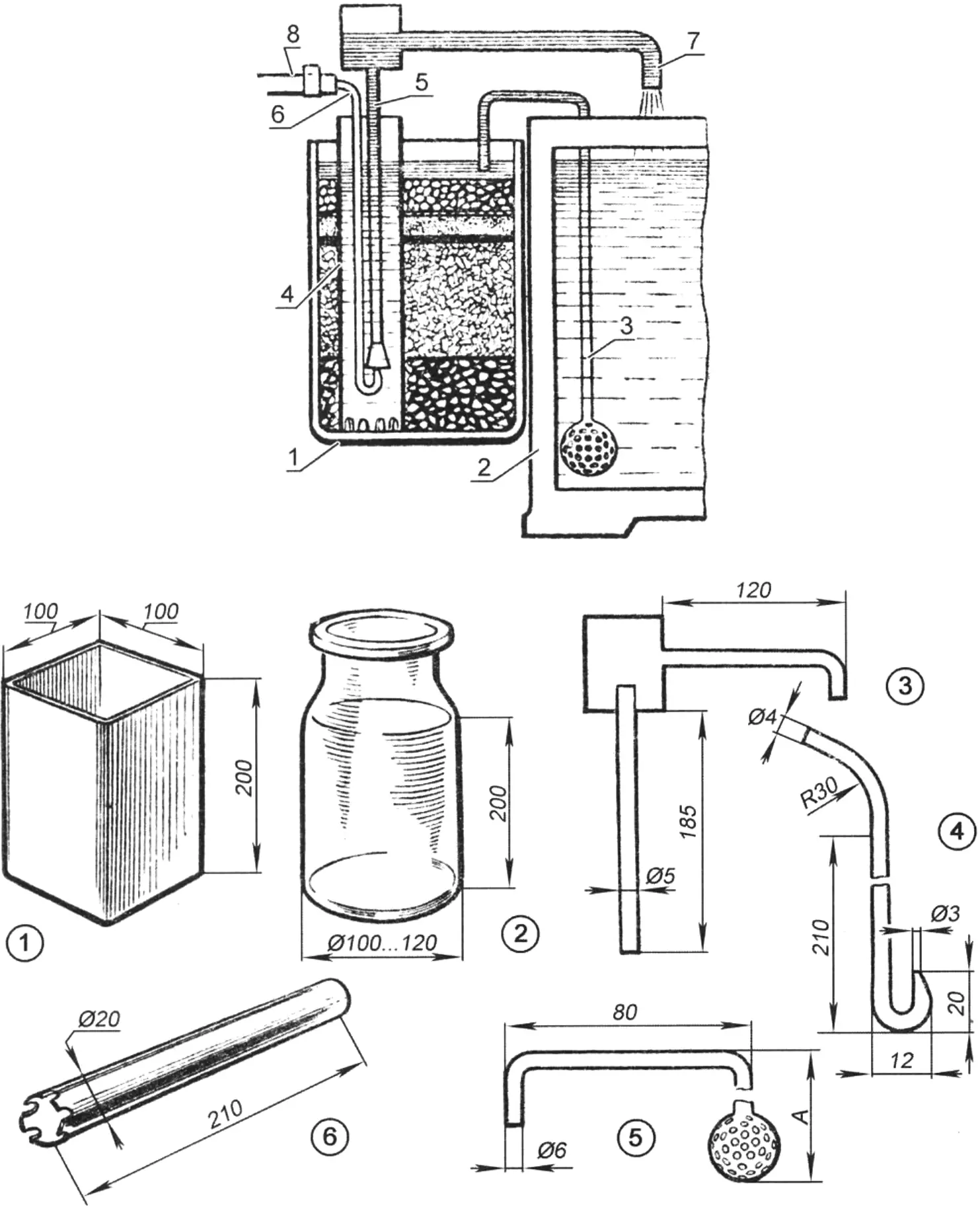
Work on making the filter begins with selecting a vessel that will serve as the housing (Fig. 3). The dimensions indicated at position (1) are approximate, but if the vessel height is changed, the tubes should be shortened or lengthened accordingly. As a last resort, you can use a cylindrical vessel (2).
The wide glass tube, which serves as a protective casing for the pumping tubes, is bent according to position (6). Small cutouts are made in the lower part to provide access for water to the interior. If cutouts cannot be made, use a porous plastic plug inserted into the lower part of the tube.
The air supply tube (4) is made as follows: a long section of glass tubing with an internal diameter of 4 mm is heated over an alcohol lamp or gas burner and, while bending, given the required shape. Then, at the point where the constriction should be, it is heated and drawn out to obtain the required cross-section. After cooling, it is cut at the constriction. This produces a nozzle with a pumping orifice diameter of about 2–3 mm.
The tube together with a simple siphon (3) can be purchased with other aquarium equipment or made yourself. In the latter case, the siphon can be simplified.
The tube that draws water from the aquarium (5) is bent from a section of glass tubing with an internal diameter of 6 mm. The length A of its vertical part should be selected experimentally. The end of the tube is wrapped in fabric (or gauze); it should be 40 mm above the aquarium bottom (from the surface). The finished filter is hung on the aquarium using brackets.
«Modelist-Konstruktor» No. 10’2016
Recommend to read
 “COWBOY” GUITAR
Banjo - a stringed musical instrument with a body in the form of a tambourine and a long wooden neck as the guitar, which usually stretch from four to six strings (can be up to nine).... THE “WORKHORSE” OF THE BRITISH ARMY
In 1966, the military command of the British army felt that the troops needed a new car a solid class that would be easier and on dimensions less than the then car firms "Austin",...
