We read with great interest in the magazine the descriptions of the hydro-sleds “Pioneer”, “Dolphin” and “Pirate”. We should note that on the waters of the Ob Sea, such vessels can be seen every summer. These are “Typhoons”, the drawings of which were developed in the experimental mechanics laboratory of our KUT.
Undoubtedly, the new type of water motor sport — aquakarting, or, otherwise, hydrokarting — will continue to develop. Hydrokarts, thanks to their simple design and relative cheapness of manufacture in amateur conditions, open wide prospects for attracting youth to water motor sports. With good organization, aquakarting competitions will become an exciting form of water recreation everywhere.
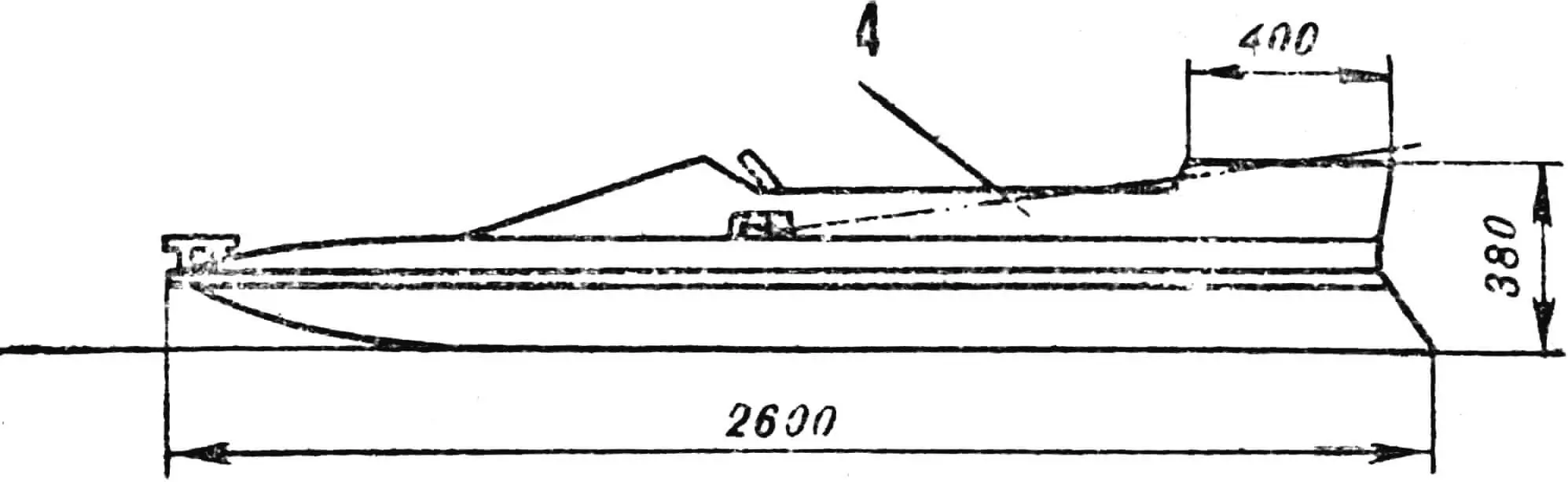
Our “Typhoon” (Fig. 1) is a compact vessel resembling a sports scooter, but its design is significantly simplified. The frame and hull are made of wooden slats and plywood. As an engine on a hydrokart, you can use: outboard engines “Strela”, “Veterok-8”, “Priboy”, “Moskva”, “Veterok-12”, that is, classes from 125 to 250 cm3. You can also install stationary engines from motorcycles with a working volume from 50 to 175 cm3, however, in this case it is necessary to ensure good airflow of the engine for cooling, using the oncoming air flow, or, which is certainly better, use a specially made fan with a drive from the engine itself, as is done on motor scooters VP-150 and T-200.
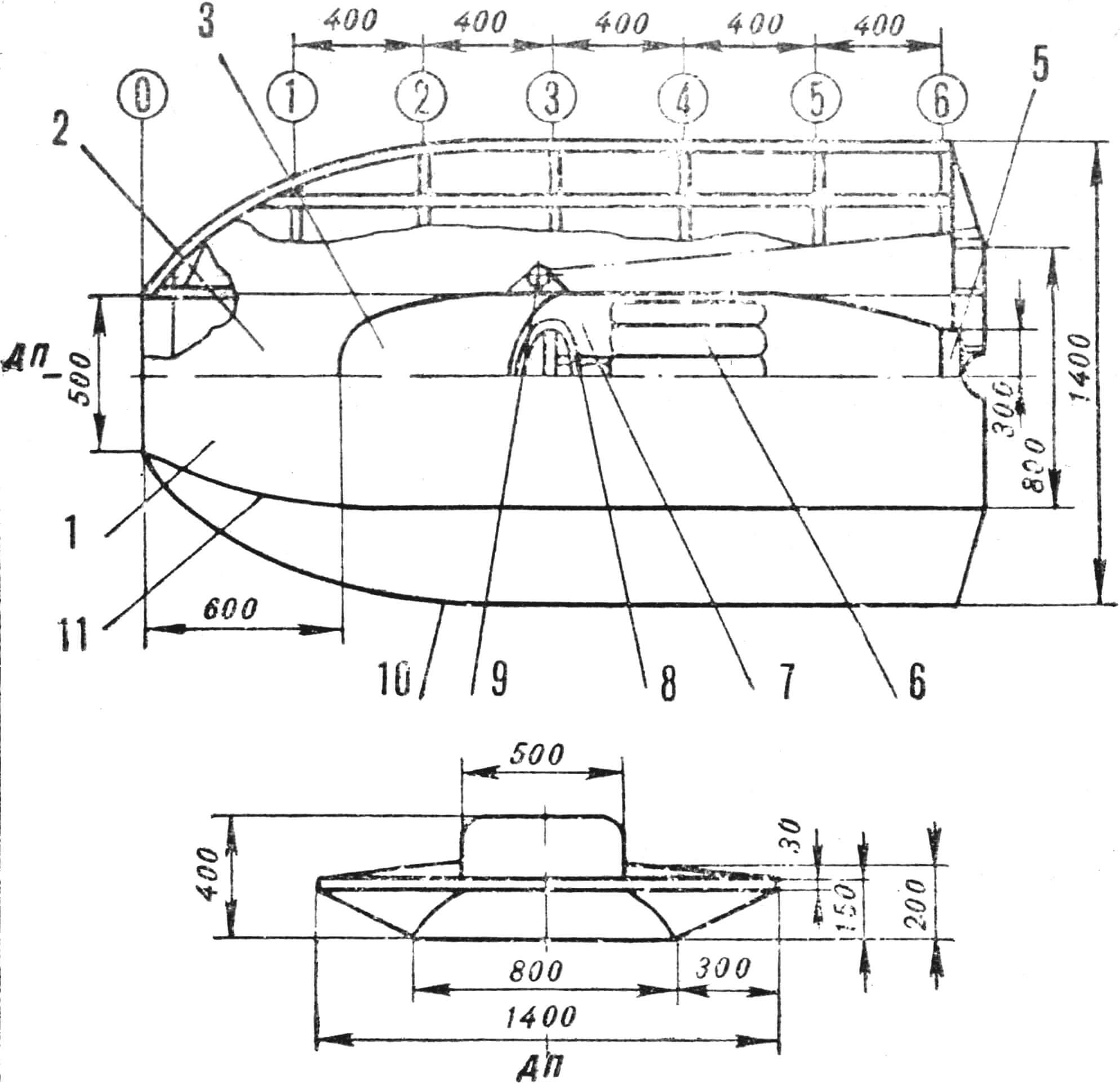
1 — bottom, 2 — deck, 3 — cockpit, 4 — bulwark, 5 — transom, 6 — cushion, 7 — chine, 8 — steering wheel, 9 — roller, 10 — side, 11 — stem.
If it is planned to install an engine with a separate fuel tank on the hydrokart, it makes sense to make a special compact tank that fits conveniently near the transom of the vessel, or use a canister with a capacity of 5—10 liters, equipping it with an intake tube and a drain hole. A homemade tank is conveniently attached inside the hull and also allows you to save more space for the driver. Any forcing of engines and changes to their design are prohibited by competition rules, except for propeller selection and polishing of the underwater part of the engine.
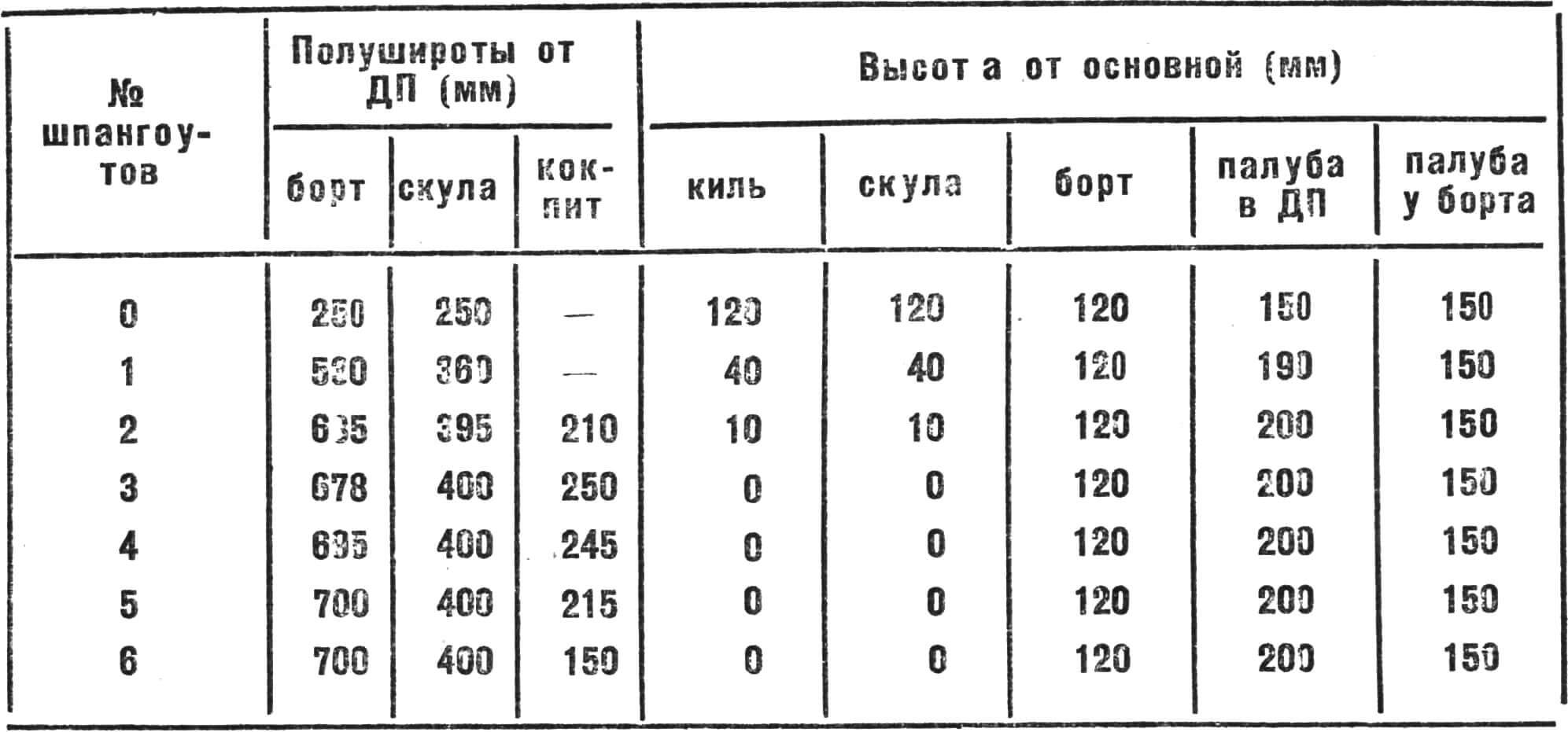
To build the “Typhoon” hydrokart, pine slats (dimensions are indicated on the drawing) and waterproof plywood with a thickness of 3—6 mm are required. You should start with the manufacture of frames, then blanks of stringers and bottom sheathing. Assembly is carried out on a table or directly on the floor. Frames, stringers, and transom are installed and fixed on the bottom blank according to the marking, then the top and side chines are sheathed. All connections of stringers and frames are made with screws with glue or epoxy resin. The sheathing is fastened with screws or small nails to the stringers and frames; it is desirable to also pre-coat the surfaces of stringers and frames adjacent to the sheathing with glue. When building, it is advisable to use two plywood sizes by thickness: on the bottom 4—6 mm, upper sheathing — 2.5—4 mm. The joints of plywood on the bottom are well fitted and screwed on a pad with glue, located inside the hull, or connected “on a scarf” (the latter connection is more complex).
TABLE OF PLANK ORDINATES OF THE “TYPHOON” HYDROKART
Hull painting is done after preliminary impregnation with linseed oil.
The hydrokart is controlled by a steering wheel mounted on a post fixed to the keel stringer and beam. Engine control — from a throttle lever fixed on the left side near the steering wheel.
When operating a hydrokart for competitions and recreation, it should be known that it is a racing vessel. Safety measures on the water for all high-speed sports vessels fully apply to hydrokarts as well. Drivers must wear a life jacket and helmet.
Beginning racers should first get used to the vessel, practice all basic movements: starting the engine, turns. You should not immediately develop high speeds, considering that at speeds of 35—45 km/h, hull control requires skill.
V. MIKULIN, V. SHOLOKHOV
Recommend to read
 EXACT HIT
In the inset lock on the door in the jamb groove so that the bolt hit it when locking. The correct location of the groove to define is not so simple, but the widening it is undesirable.... ROUTE “MAZDA”
Despite market saturation, radio-controlled car and their simplistic and relatively cheap likes — RC avtokraski, EN-route kits are all also attract the attention of fans of sports...
