By August 1914 the British Empire was bound by alliance treaties to France and Russia, yet after those countries entered the war against Germany it remained neutral for several more days. His Majesty’s Government needed a “worthy” pretext for declaring war, and it did not take long to find one. The Germans violated the neutrality of Belgium, which the United Kingdom (not yet an empire at the time of the guarantee) had guaranteed since 1839. The British ultimatum to Germany expired on the evening of 4 August, after which “the Empire on which the sun never sets” formally entered the war against the Second Reich.
The North Sea. “First Blood”
While politicians and the “general public” were debating the prospects of war between the British Empire and the Second Reich, the German military prepared for the start of hostilities with great energy. Sailors who feared a sudden strike against their ports considered the laying of minefields one of the most effective precautions. Yet no proper notice was given of areas closed to navigation — including to German captains and pilots. And that approach to shipping safety immediately led to the loss of vessels.
The first to strike a mine was a British steamship — the tanker San Wilfrido of 6,458 GRT, belonging to The Eagle Tanker Company Ltd and commissioned only recently, in 1914. On 3 August the ship was in the River Elbe, about eight miles above Brunsbüttel. Having received permission to continue its voyage (the future antagonists had not yet begun arresting and seizing each other’s ships), the master of San Wilfrido put to sea with a call at Cuxhaven. But there was no pilot there who could take the British vessel through the mined area, so the steamer followed the usual course. Crews of German harbour craft noticed that San Wilfrido was in a dangerous position and tried to warn the master, but he could not be saved. There are two versions of how exactly the unlucky ship struck the mines. According to one, her master correctly understood the German warnings and tried to manoeuvre into safe water, but did not succeed in time. According to another account, the ship was caught by a strong ebb tide and was literally carried onto the mines.
Be that as it may, San Wilfrido struck three mines (Admiral R. Scheer’s memoirs speak of two explosions) and began to settle rapidly by the stern, listing heavily to port. Although the steamer sank in a very short time, a German tug managed to approach her and take off the crew (after the outbreak of war the rescued seamen became prisoners — in English-language accounts, “crew made prisoners”).
It soon became clear that the mines were dangerous for the Germans themselves as well. On the evening of the following day the auxiliary vessel Skelleftea (Depotschiff C) fell victim to a German mine — a small steamer taken into naval service, built in Denmark in 1902 and of 810 GRT. The disaster occurred in the evening off the island of Sylt (an older name — Silt; Ger. Sylt), at 55°04′ N 8°23′ E. This time there were casualties: the entire small crew of 13 men perished.
In the literature one can find many references to the operations of German raiders — both specially built warships and various armed vessels (auxiliary cruisers and minelayers) — against the shipping of the Entente and the neutrals. Far less is said about the measures taken by the British navy against the enemy’s mercantile and fishing fleets. Yet even from “classic works,” for example Volume 1 of J. Corbett’s Operations of the English Fleet in the World War (originally Naval Operations, Vol. 1 by Sir Julian S. Corbett), one learns that the sailors of Foggy Albion acted very resolutely: “Having received a wireless message about 5 p.m. and learning from it that the transport of the expeditionary army was not expected, Adm. Jellicoe continued the cruise already begun into the North Sea. It soon became clear that the Germans were trying to discover the whereabouts of the fleet — fishing trawlers with carrier pigeons were encountered. Some of the trawlers, after their crews had been taken off, were sunk; some were sent to Scapa and Cromarty.”
It should be noted, however, that small fishing vessels at that time had no wireless sets, and carrier pigeons were therefore the ordinary means of communication with their home ports. But once the war had begun, all scruples could be cast aside. As I. A. Krylov’s fable puts it: “You are to blame simply because I want to eat.”
Another British naval commander took the struggle against enemy shipping just as seriously — Rear-Admiral John de Robeck, who at the outbreak of the Great War commanded the 9th Cruiser Squadron. Sir Julian Corbett writes: “De Robeck in the cruiser Vindictive, accompanied by Highflyer, left Plymouth on 4 August and on the way met and seized the German passenger steamer Tubantia with stores and gold and sent her in under the escort of Highflyer.”
In fact, in August 1914 De Robeck’s cruisers — including the later-famous Vindictive and Highflyer — “netted” a good many German ships at sea and in Belgian ports, including such liners as Schlesien and Graecia. But there was a catch: the steamer Tubantia belonged to the Dutch shipping company Royal Holland Lloyd, also known as N.V. Koninklijke Hollandsche Lloyd. It is true that there were a good many German reservists on board who were trying to return home, as well as a cargo of grain destined for Germany. But the Dutch cargo-passenger liner had left the shores of South America before the declaration of war, and the gold she carried was intended for London banks (including the London branch of the Deutsche Bank). In the end some hundred and fifty reservists were arrested and the gold confiscated.
After all these misadventures Tubantia was released by the British authorities. But the liner was unlucky: she was later detained several more times on charges of carrying war contraband, and on 16 March 1916, while sailing from Amsterdam to Buenos Aires, she was torpedoed by the German submarine UB-13. Since the ship wore all the markings required of a neutral, a major international scandal ensued.
Königin Luise. Voyage and Loss
By August 1914 the British Royal Navy substantially outmatched Germany’s naval forces. The German command therefore decided to avoid a major battle while trying by every possible means to weaken the enemy. Reinhard Scheer (Ger. Carl Friedrich Heinrich Reinhard Scheer; at the outbreak of the First World War a vice-admiral commanding the II Battle Squadron of the High Seas Fleet) later noted: “The task set for the commander of the High Seas Fleet was formulated in the operational order given to him: ‘The object of operations should be to inflict losses on the English fleet by offensive action against the naval forces maintaining a watch and blockading the German Bight, and also by carrying minefields forward to the English coasts and, if possible, by active submarine operations. After such a method of warfare has succeeded in equalising the forces, an attempt should be made, after all forces have been made ready and concentrated, to bring our fleet into action under favourable conditions. If even before then an opportunity arises of striking a blow, it should be used. In addition, warfare against commerce under prize law should be waged, and the ships destined for that purpose should be sent into foreign waters as soon as possible.’”
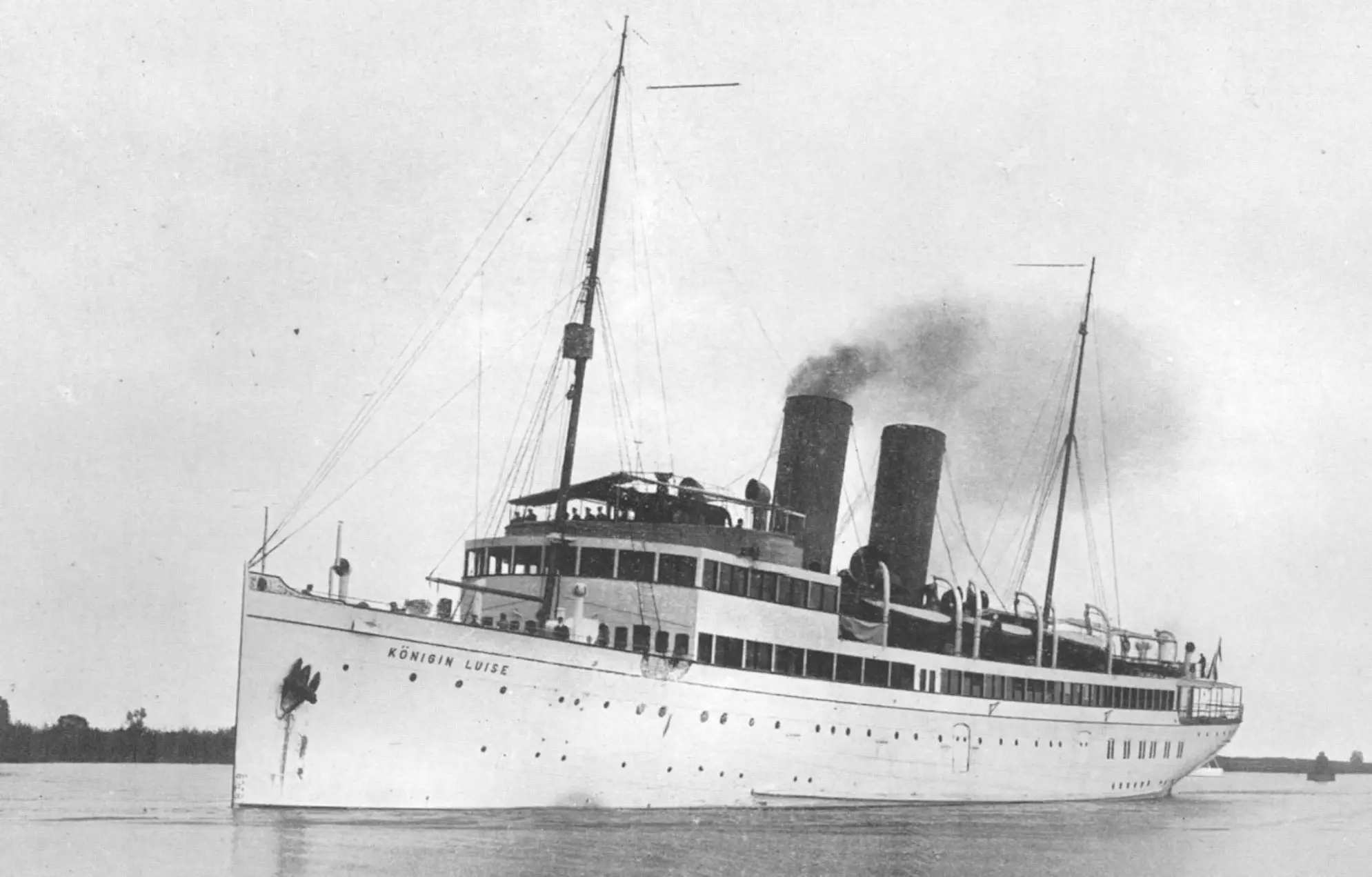
The first actions undertaken in accordance with this directive were the dispatch into the Atlantic of the auxiliary cruiser Kaiser Wilhelm der Grosse and the sortie toward the English coast of the auxiliary minelayer Königin Luise. In R. Scheer’s memoirs the events of the evening of 4 August are described thus: “…the auxiliary minelaying steamer ‘Königin Luise’ left the Ems at 9.30 p.m. for the mouth of the Thames. Thus began the first operations connected with cruiser warfare and small-scale war off the English coasts. With strained attention we followed in the wireless room of the flagship the progress of these first two operations. Would the large fast steamer be stopped, or would she succeed in breaking out unhindered into the ocean? The wireless message to ‘Königin Luise’ ran: ‘Proceed at full speed for the Thames. Lay mines as close as possible to the English shore; do not lay them near a neutral shore or north of the parallel of 53°.’ The steamer which until recently had maintained a summer service to the bathing resorts on the North Sea islands had, the next day (5 August) about 11 a.m., to engage enemy cruisers and destroyers. The steamer was sunk by a torpedo. Before the action she had succeeded in laying her mines, and the cruiser Amphion which pursued her fell victim to them.”
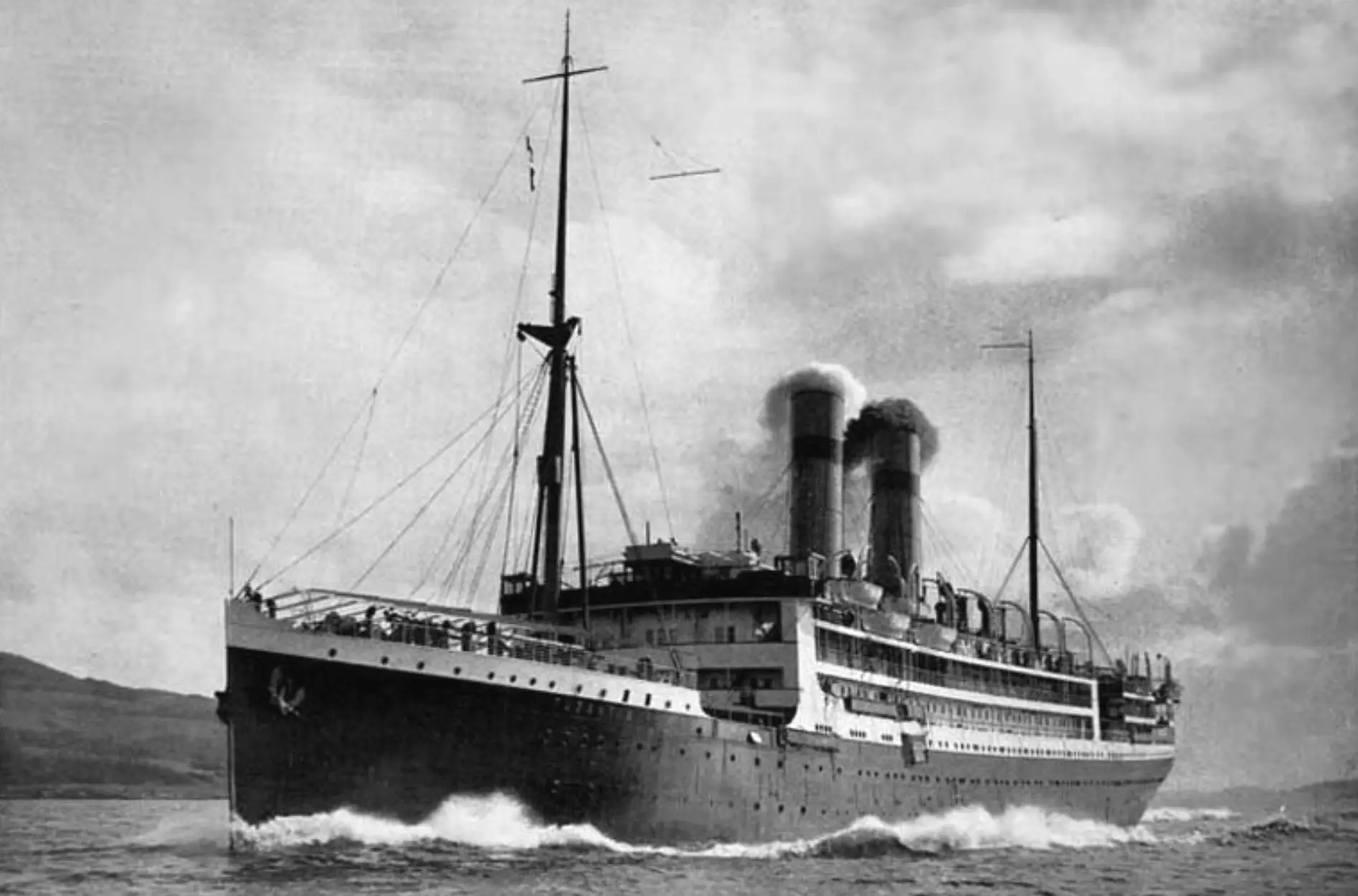
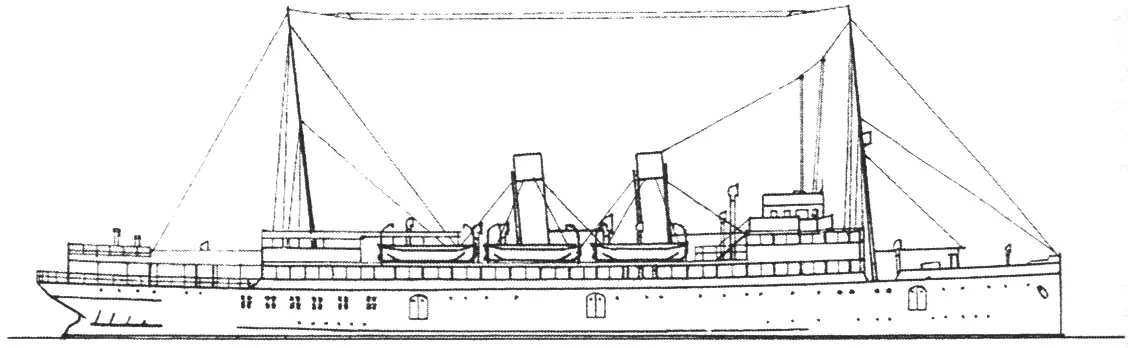
The vessel chosen for the risky voyage to the English coast was a “resort liner” (sometimes classed as a ferry) of the HAPAG company, intended to carry holidaymakers to and from the island of Heligoland and in winter to work in the Mediterranean on the Genoa–Nice run. Königin Luise completed her last voyage from Heligoland on 31 July; on 2 August the navy requisitioned the ferry, and as early as the 3rd work was in full swing converting her into a minelayer, command of which was assumed by Korvettenkapitän Biermann.
The ship, named after Queen Louise — wife of the Prussian king Frederick William III — was built at Stettin in the Vulcan yard (yard number 344) and commissioned at the end of September 1913. Her tonnage was 2,163 GRT, displacement 2,160 tons. Her main engines were steam turbines of 6,500 hp, and the “feature” of the plant was considered to be the Föttinger transformer — a hydraulic transmission which at that time had not yet come into any wide use. The ship’s maximum speed was 20 knots.
It is known that under the original plan Königin Luise’s gun armament was to consist of two 8.8-cm guns. The hastily converted minelayer, however, never received them, and two 3.7-cm revolver cannon with an ammunition supply of 400 rounds were mounted instead. To this day German and English-language literature offers two versions of why this “mishap” occurred. According to the first, the required guns simply were not to hand. The second seems more probable: installing heavier guns would have required structural reinforcement, and time was short. So an obvious weakening of the artillery was accepted, but the light rapid-fire guns needed no reinforcement. Problems of ammunition stowage were also reduced to a minimum. The Germans, for their part, did not expect to fight a gun action, relying on the inconspicuousness of a “merchantman” which had even been painted after the style of vessels of the British Great Eastern Railway company. The mine armament, however, was serious enough — 200 mines. For her first and last voyage the ship sailed with 180 mines embarked.
Already on 3 August Königin Luise joined the German navy (as Hilfsstreuminendampfer B), and on the evening of the following day she sailed for the mouth of the Thames. The mine-laying itself appears, so far as is known, to have gone without incident. But to the Germans’ misfortune their actions were observed from one of the British trawlers (so far as is known, the vessel Little Boys of Lowestoft). At about 9 a.m. on the 5th the fishermen reported to a encountered Royal Navy force a suspicious steamer that was “throwing things overboard.” The trawler’s skipper, Charles Wright, also indicated quite accurately where exactly the steamer had been seen.
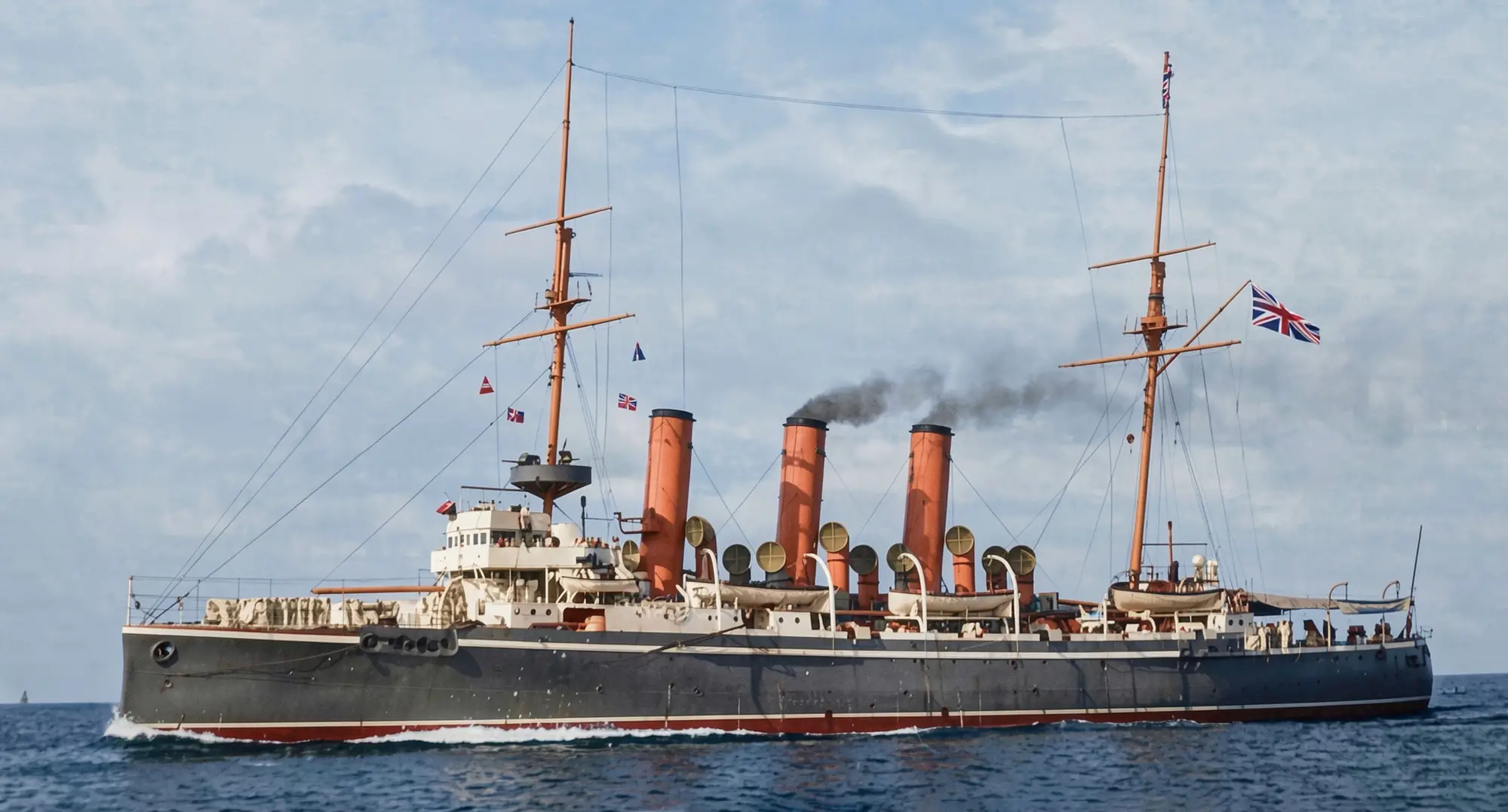
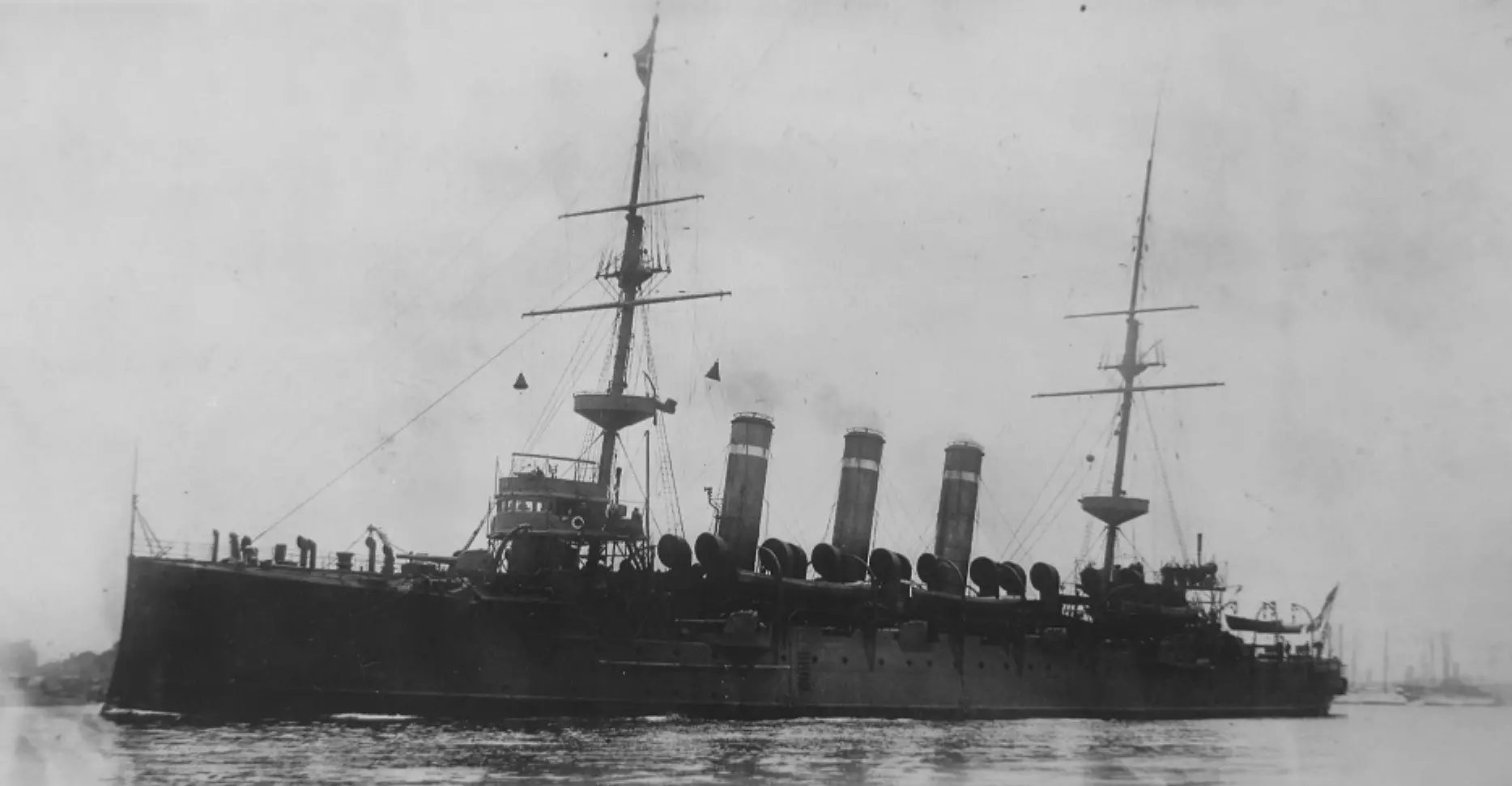
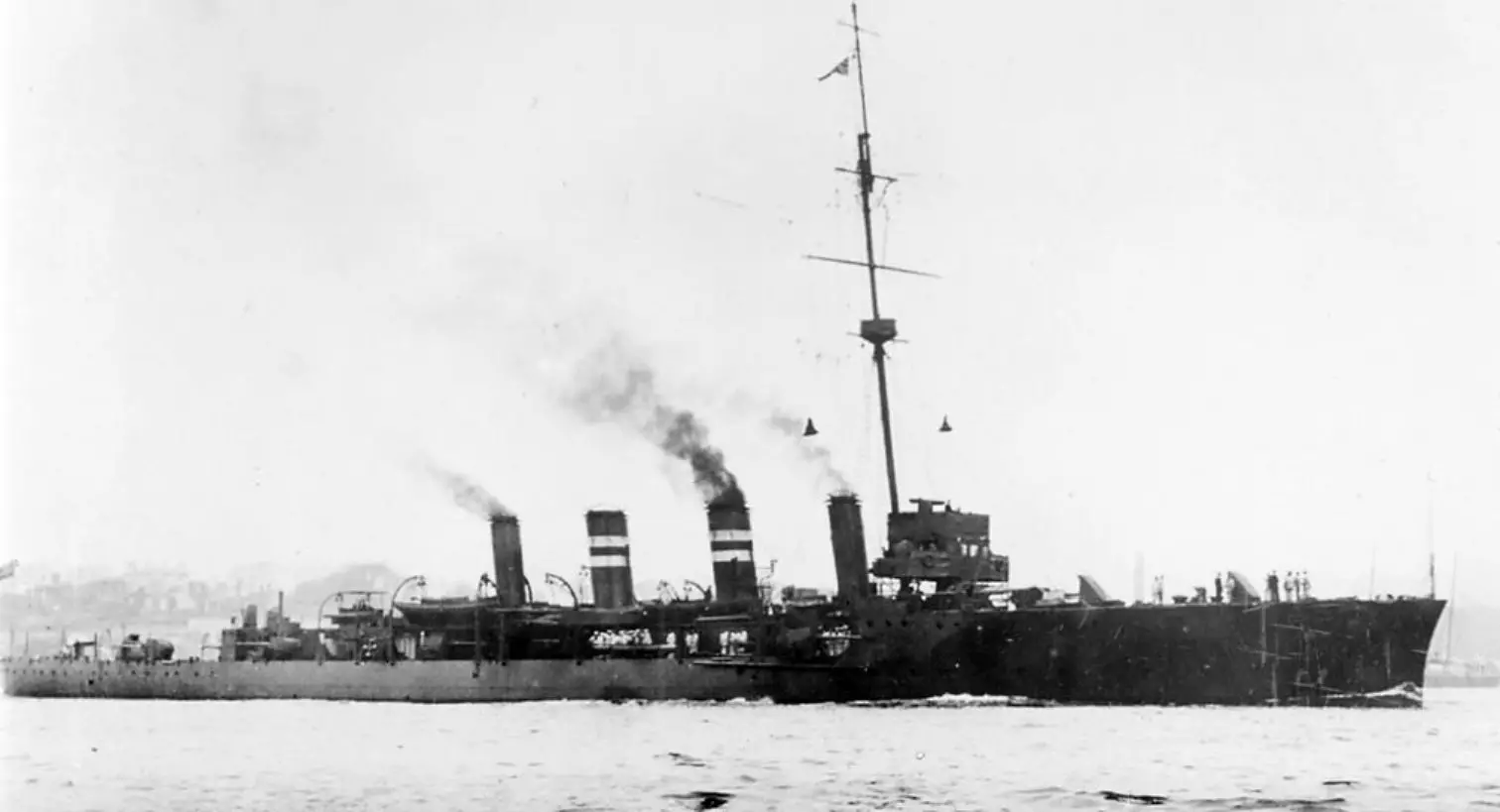
The British force consisted of the scout cruiser Amphion (Active class) and 19 L-class destroyers of the 3rd Destroyer Flotilla, which formed part of the newly created Harwich Force. They were ordered to patrol the sea routes between Great Britain and the Netherlands. The force was led by the cruiser’s commanding officer, Captain Cecil H. Fox. His ship had commissioned in 1913, had a normal displacement of 3,340 long tons and could make up to 25 knots. Her armament consisted of ten 4-inch and four 3-pounder (47-mm) guns, and two submerged 18-inch torpedo tubes. The scout’s armour was described as “slight” — a deck 0.5–1 inch thick and a 4-inch conning tower.
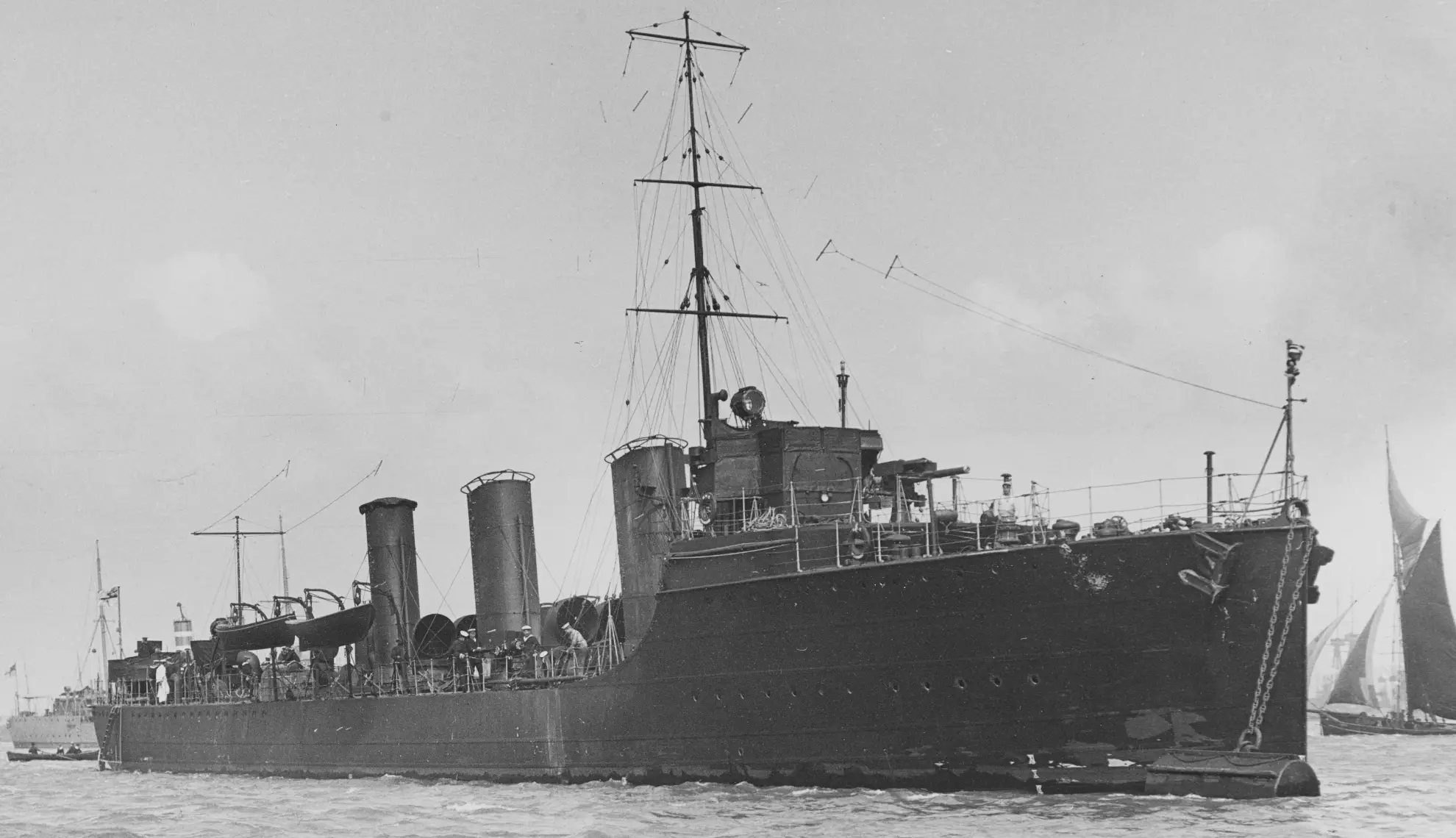
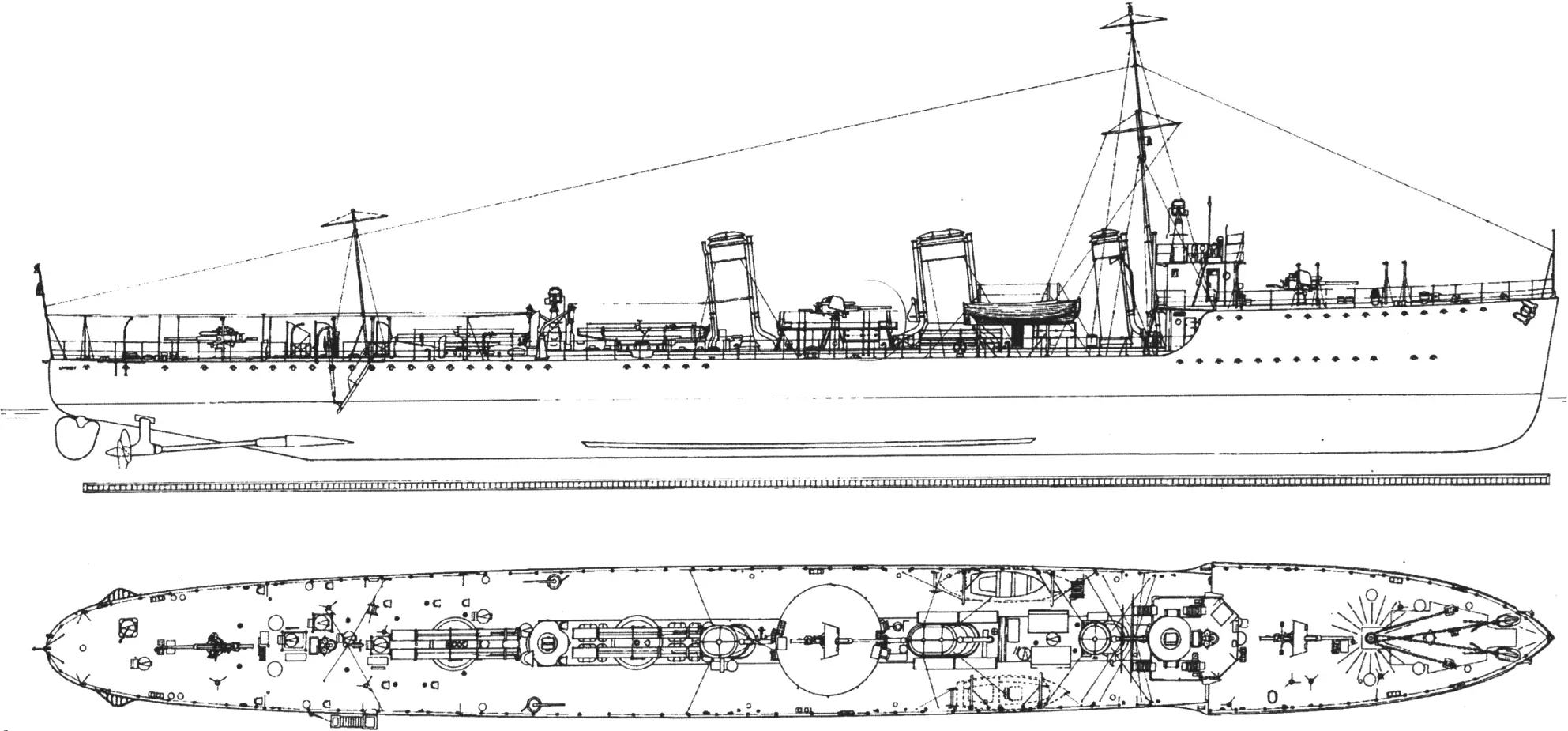
The L-class destroyers were likewise among the newest ships of their type. They commissioned in 1913–1915 (twenty units had been laid down before the outbreak of the “world slaughter,” and two more during the war), were built by different firms and therefore had some differences — both in internal arrangement and in appearance. In performance, however, the ships were virtually identical. Their normal displacement was 970 long tons, speed 29 knots, armament three 4-inch guns and two twin 21-inch torpedo tubes. Only the “secondary” armament differed slightly. Some destroyers carried one or two 2-pounder (40-mm) pom-poms; others, two 1½-pounder (37-mm) guns.
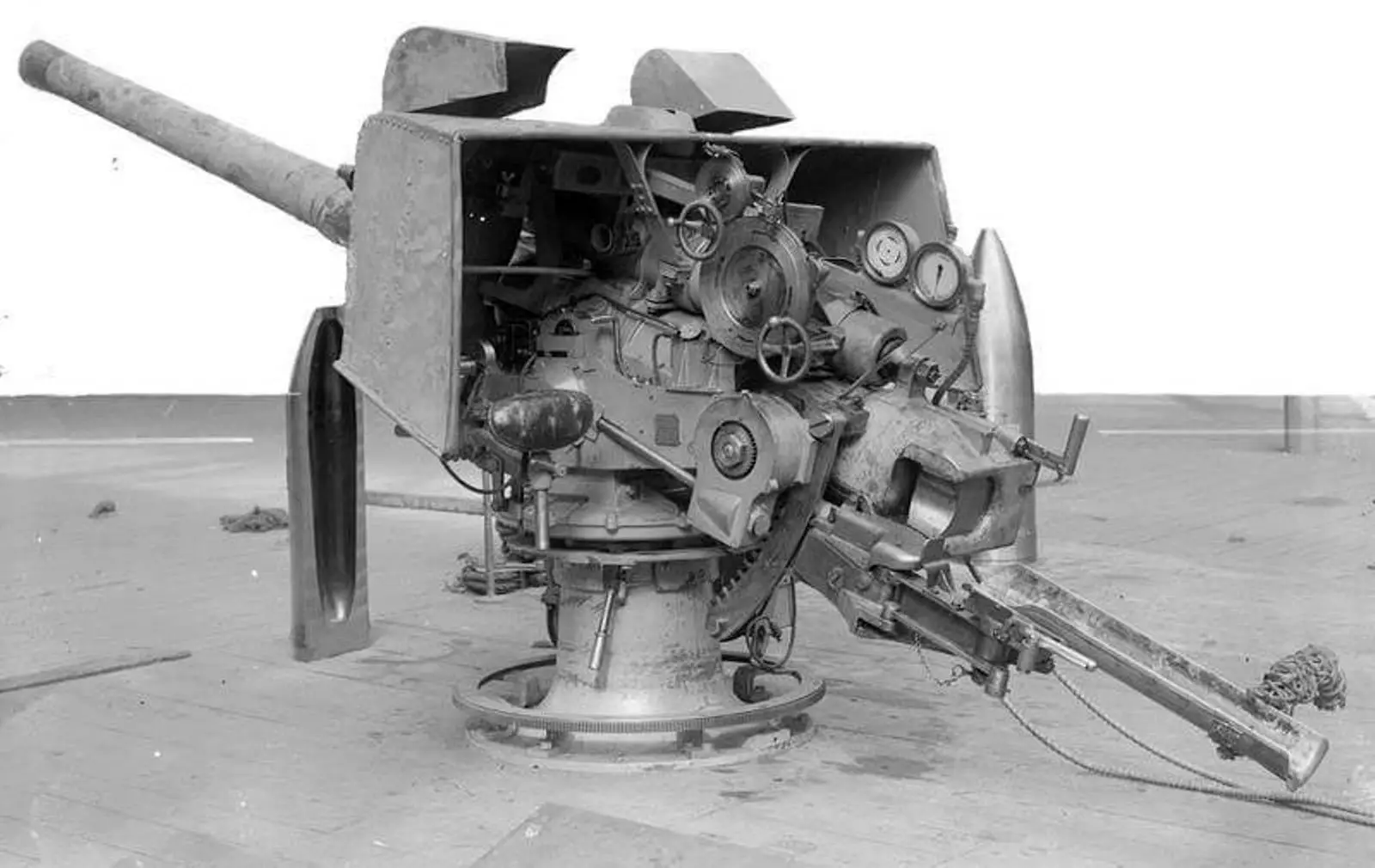
Having received the trawler’s report, Captain Fox sent Lance and Landrail ahead. The German minelayer, seeing the enemy approaching, tried to escape but was overhauled after a 30-mile chase. When the range had closed to 4,400 yards, Lance at 10:45 “went into action” — it was her gun that fired the first British shot of the Great War (that Mk IV 4-inch gun is now an exhibit of the Imperial War Museum in London). The newly commissioned Lance and Landrail, however, did not shoot very accurately, but then Amphion joined the fight. The cruiser opened fire at 7,800 yards, and at about 11:15 hits began to tell on the German, whose position quickly became hopeless. British shells started several fires, there were holes along the waterline, and Königin Luise’s stern was heavily damaged. Korvettenkapitän Biermann ordered flooding accelerated by opening the sea-cocks. Shortly after midday (13:20 Berlin time) the auxiliary minelayer sank. The position of her loss is recorded quite precisely — 51°52′ N 02°20′ E. The victors rescued 75 of her crew (including five officers); Amphion took 21 Germans on board, and Lance 28.
“Dying, kill him who killed you”
One of Lance’s guns was damaged during the firing, so she was sent to Harwich. The British force, continuing its assigned task, steamed as far as the Frisian Islands belonging to the Netherlands. No more German ships were found, and at about 21:00 the force turned back for Harwich. Fox faced a difficult question: which course to choose so as not to run onto the German mines. Alas, ideas of the danger area proved wrong. Meaning to pass seven miles west of the assumed edge of the enemy minefield, the captain made a fatal mistake. At 06:35 on 6 August Amphion, steaming at 20 knots, struck a mine. The explosion occurred near the forward bridge and the ship at once suffered the severest damage. As English writers put it, “the effect was catastrophic.”
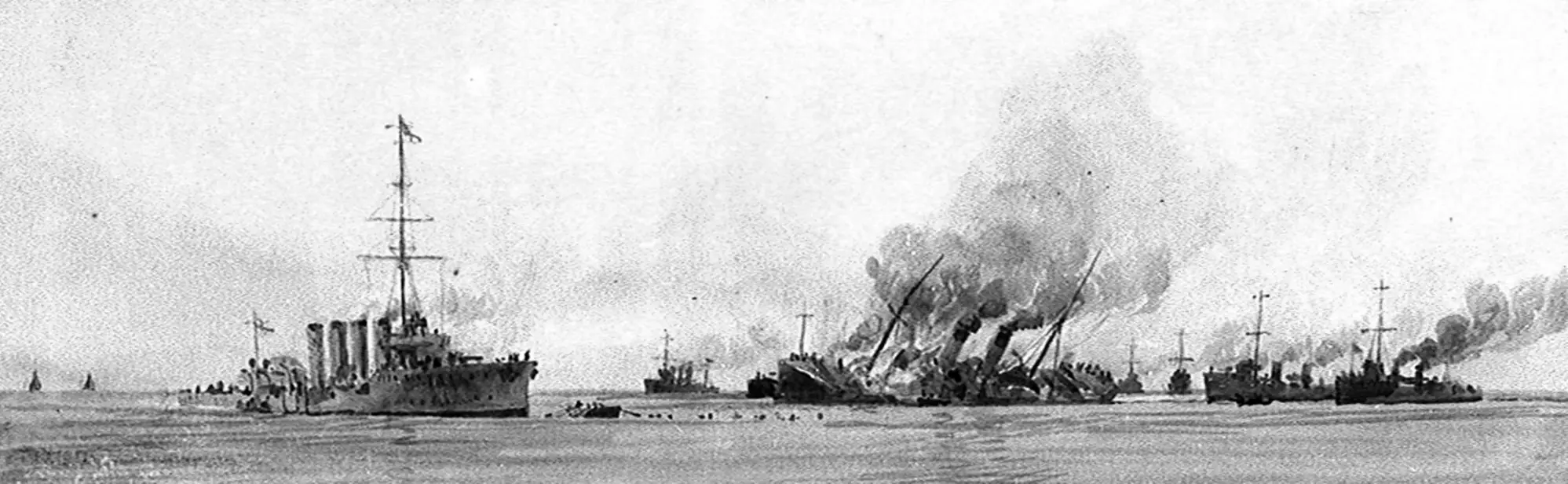
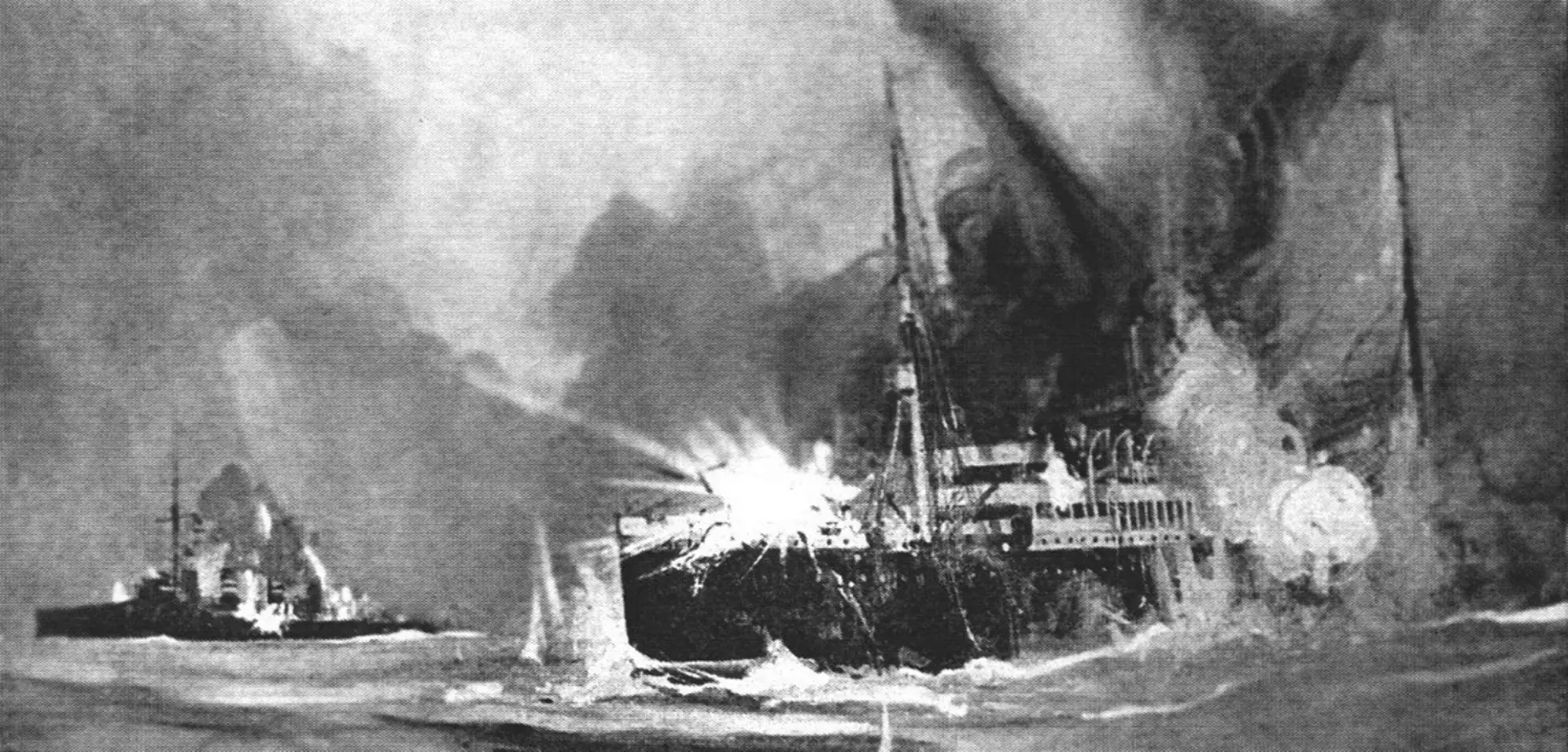
The destroyer Linnet tried to take the damaged flagship in tow, but the structural damage was too severe. It appears that the keel was broken and the bow was literally coming away. Fox ordered the ship abandoned; she soon struck a second mine. The magazines detonated in that explosion, and debris flew in all directions. A 2-pounder (or possibly 4-inch) gun thrown into the air narrowly missed Linnet, but Lark did not escape casualties — two British sailors and a rescued German were killed by a 4-inch shell. Legion, some 4 or 5 cables from the cruiser, received an unpleasant hit from metal fragments. On that destroyer one tube of the after torpedo mounting was damaged — a torpedo jammed in it. Loyal might be called lucky: she was two cables from the explosion, and debris passed over her.
Strictly speaking, the exact cause of the magazine explosion has not been established, but British officers were convinced of the mine explanation. One of them noted: “The second explosion was, in my opinion, undoubtedly caused by the ship striking a second mine under the bridge, as a result of which the lyddite detonated.” It need only be added that Amphion was about a mile from the scene of the first explosion.
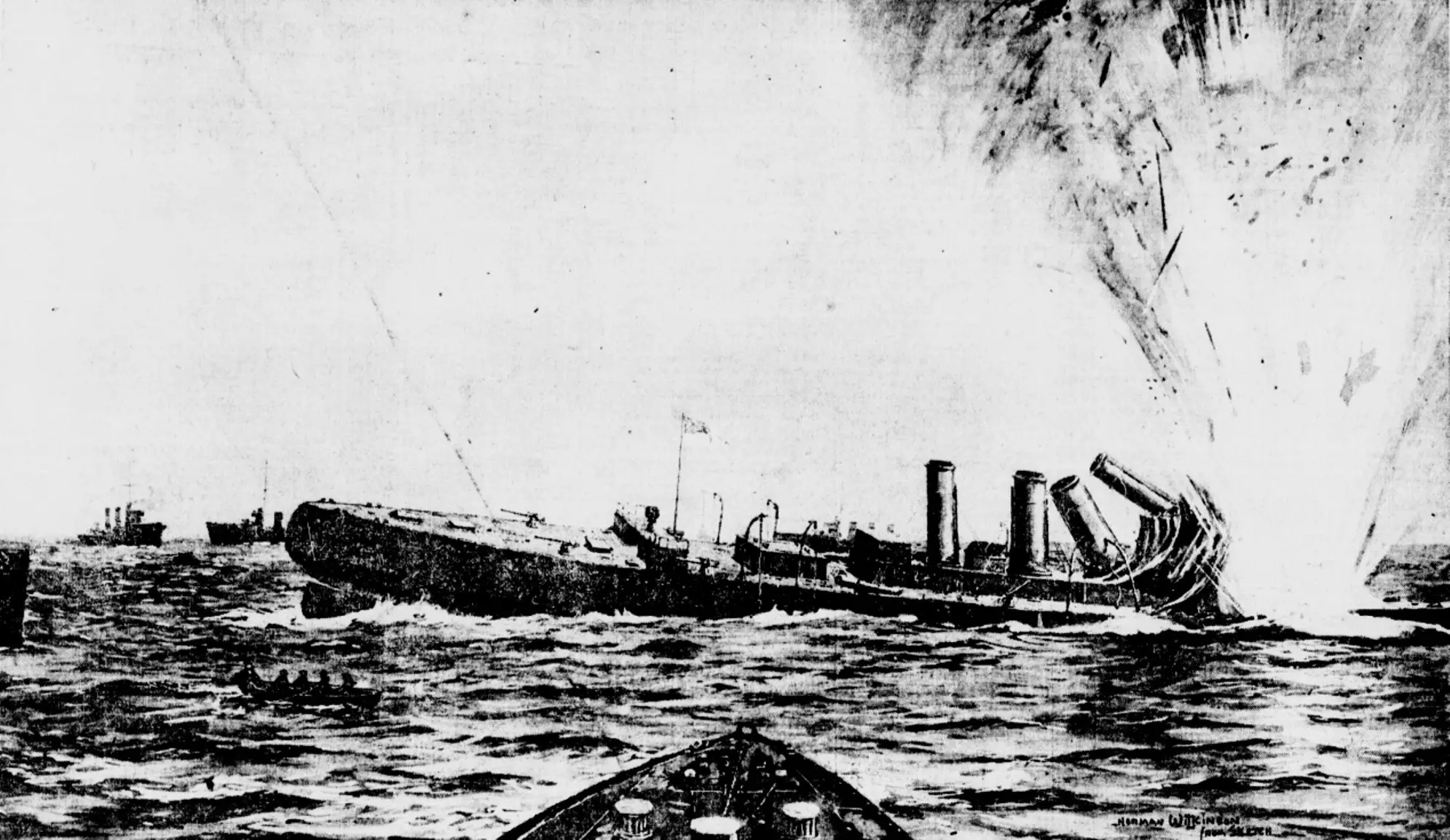
When the smoke cleared, British sailors saw that the cruiser’s bow had gone under and the stern had risen at an angle of 45°. She did not remain long in that position, soon disappearing beneath the water. According to wartime reports, the unlucky scout’s crew losses in killed were 132, including one officer (“one officer and 131 men were lost”); 16 officers and 135 ratings were saved. In the book by the well-known British historian Paul Kemp, The Admiralty Regrets: British Warship Losses of the 20th Century, and in a number of other works, somewhat different figures are given — 151 killed and 174 saved, many of them wounded. Königin Luise’s total personnel losses were 77 men.
Admiral Scheer in his memoirs assessed the story of the auxiliary minelayer’s voyage and loss as follows: “Our sacrifices were not made in vain. First of all they cost the enemy the loss of a new cruiser, but still more important was the impression produced both on ourselves and on the enemy. From the very outset a situation was established in which the opponent, seeking shelter from our aggressive methods of warfare, preferred to withdraw into northern waters rather than choose another course — the blocking of our exits to the sea.”
“Modelist-Konstruktor” No. 7’2025, Boris SOLOMONOV, Pavel SOLOMONOV
Recommend to read
 CLOTHES FOR HOME…
Periodically to the owner of the house or apartment, the question arises about "cosmetic" repair their homes. Many are sent to the shops for Wallpaper, paints, various finishing... THE ENGINE AS A COMPRESSOR
Every driver or owner of the motorcycle with two-cylinder engine can turn the vehicle in... the compressor. It is only necessary to produce the simplest device, shown in the figure. It...
