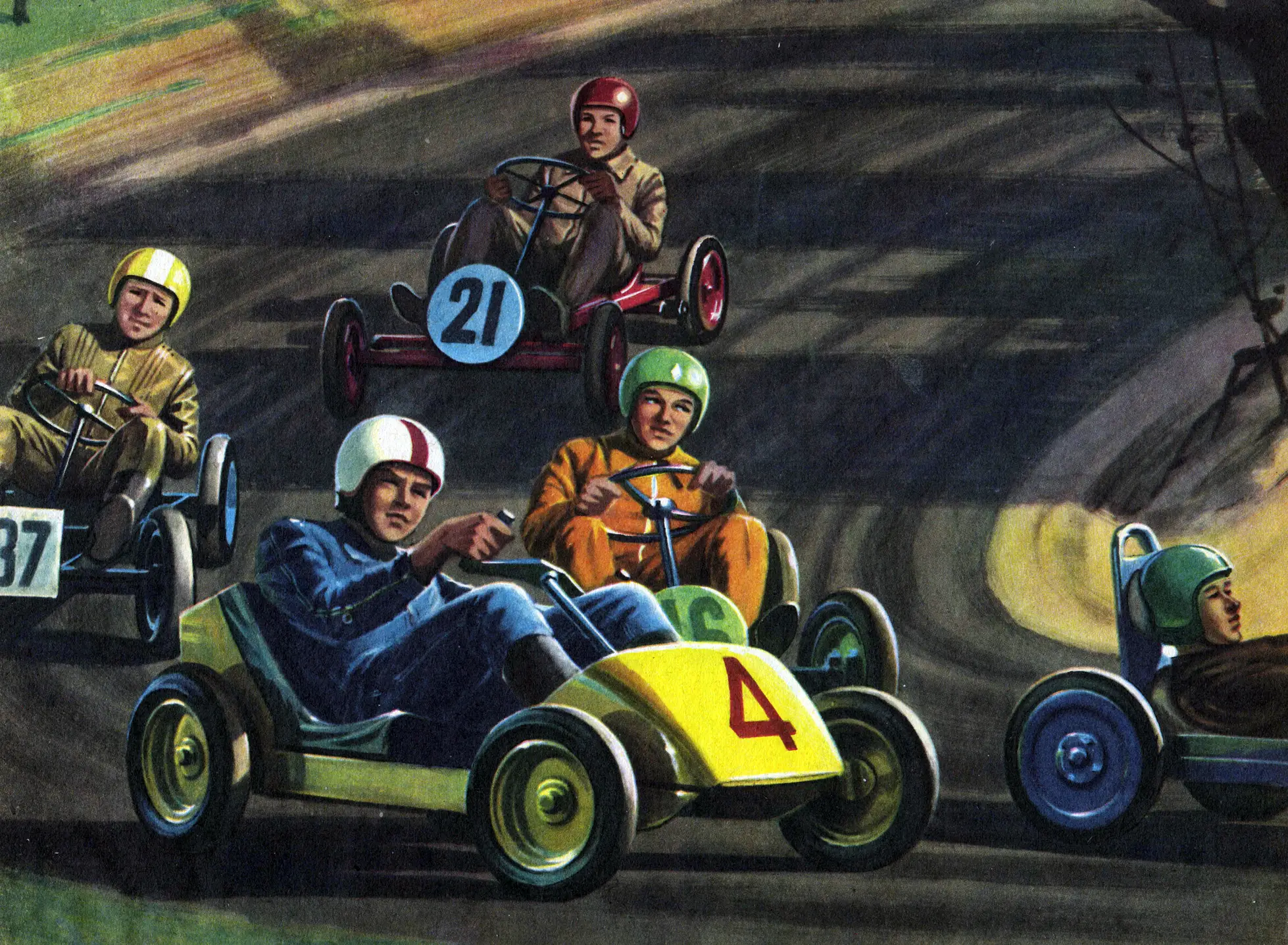
For a long time, the designers of mini-cars could not decide in what position the racer should pass the course. There were even cars of the “bed” type: their advantages were a low center of gravity and low resistance to oncoming air flows.
A mini-car with a simplified sample of steering control: the racer turned the wheels by bracing against the front crossbar — the steering wheel served only as a decorative element.
Elegance and advertising. A series-produced mini-car is convenient and elegant, but… in such a version there is no room left for design inventiveness, for creativity.
For many years they were treated without any respect. Just think, people said: put a box on four wheels — and coast downhill. Primitive!
IS IT PRIMITIVE?
Today, in many European countries competitions for mini-car drivers are held regularly, winners are determined, and prizes are awarded. Even a sports classification has been developed, and the technical requirements for “summer sleds” are defined precisely.
And in fact, racing on cars without engines that are simple to make and equipped with reliable steering and good brakes, if these competitions are organized in a sportsmanlike way, is a thrilling spectacle. And it is also very useful: the kids, almost without noticing it, learn to drive a car in play; and if the competition rules are made somewhat more complicated, elements of traffic rules can be introduced into them, which is perhaps no less important.
Add to this the richest opportunities for design “invention” when building such… you can hardly call them cars — sports devices, so to speak. Steering alone has dozens of variants.
And it will become clear that mini-cars have every right to the widest dissemination among young designers. Especially in pioneer camps, where all their advantages will show up vividly.
So, mini-cars. In the socialist countries, in particular in Czechoslovakia, the following classification has been adopted. Formula A — the simplest designs with a wooden body-frame, cable steering, and block brakes on both rear wheels. Their dimensions, as with mini-cars of all other formulas, are within the following limits: wheelbase — the distance between the front and rear axles — 1600 mm (less is allowed as much as one likes), height (measured at the seat) — 350 mm, track — from 500 to 300 mm.
Formula B is more complicated. Here a semi-enclosed body is possible; the frame may be metal — made of duralumin tubes.
Formula C — series-produced designs.
Steering need not necessarily be of the trapezoid type as on a kart, but the wheels must turn through an angle of at least 45°. An automotive-type steering wheel. On the most advanced mini-cars a safety hoop is installed above the driver’s head to protect it in falls; there are also turn indicators with which the racer signals maneuvers on the track.
A few words about the mini-kartists’ competitions themselves. They are held on any road free of traffic that has a gradient of 30—40°. A straight course should be 150—500 m long; if the chosen route has sharp turns that conceal part of the road — no more than 100 m.
As in real kart competitions, the bends must be made safe with old automobile tires or bags of sawdust.
The younger participants start separately or, if the width of the course and the steepness of the descent allow, in groups of three or four racers. Experienced mini-kartists start in large groups — their number depends on the width of the course and the capabilities of the judging panel — try determining the winners when they rush in a solid mass! The number of heats for determining the winner is not limited; it should be set by the judging panel depending on the competition conditions and the composition of the starters. Places may be assigned either by the sum of the speeds shown by each participant in all heats, or according to the places taken in each heat.
In short, building mini-cars and competing in them is a simple and engrossing matter. It is well within the reach of thousands of future automobile drivers and racing drivers. Try it — and see for yourselves!
Mini-cars have gained general popularity in Yugoslavia. No small role in this has been played by the magazine “Tehničke novine”, which for half a year now has been running on its pages a Club of Mini-Car Designers. In every issue it publishes rationalization proposals by young athletes, discusses their merits and shortcomings, and describes various solutions for individual units of the “summer sleds”.
The best proposals from readers the magazine embodied in a Formula A mini-car design. This is the simplest sports machine, which nevertheless has all the qualities that allow a racer to compete successfully with it.
So here is the “assembled mini-car” of the magazine “Tehničke novine”.
The simplest formula
Figure 1 shows the projections of a Formula A mini-car, which may also be taken as a basis when designing a Formula B machine. The difference here is only in the dimensions. On a Formula A car, in which the youngest racers (from 8 to 12 years old) start, the dimensions are smaller by one-fifth. Something will apparently have to be changed depending on the driver’s height — bring the brake pedals closer or move them farther away, lengthen the steering column, change the backrest angle.
The mini-car frame is assembled with glue and screws from wooden bars of 50×50 mm cross-section. On the two upper rear crossbars is mounted the seat base — a plywood sheet 10 mm thick. The seat-back brackets — boards of 20×40 mm cross-section — are secured to the frame as shown in the drawing.
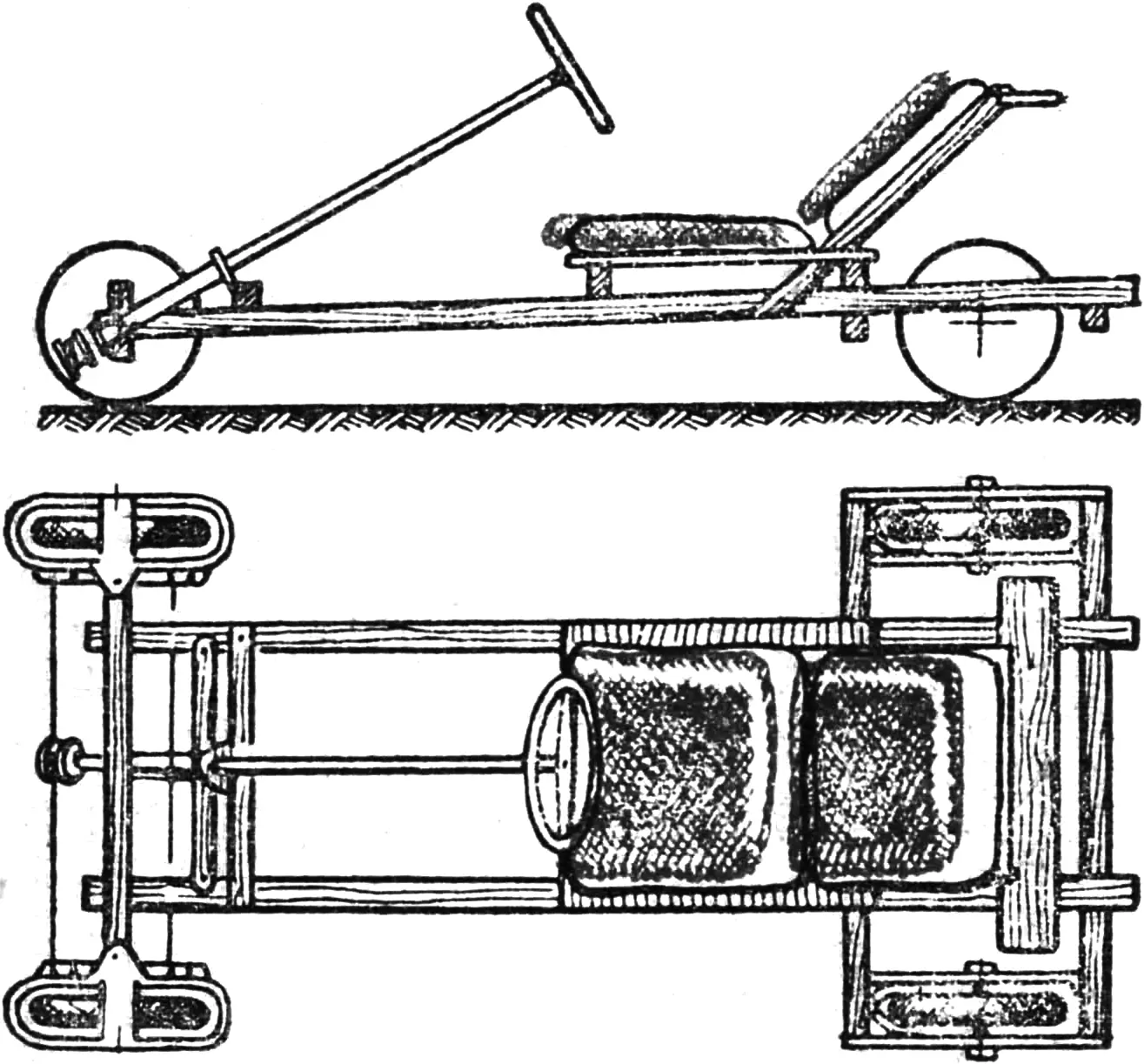
The wheels — pneumatic or simply rubber-tired — are from children’s scooters or even from baby carriages. Their maximum diameter must not exceed 350 mm. They are rigidly mounted on cut-offs of their own axles in the protective frames shown in Figure 1. The front-wheel housings are metal, made of plates 2—3 mm thick fastened with screws. The rear wheels are in wooden frames reinforced on the outside with a metal angle. On the ends of the axle cut-offs a thread of the corresponding diameter is cut. The axles are rigidly secured to the frames by means of brackets and locked.
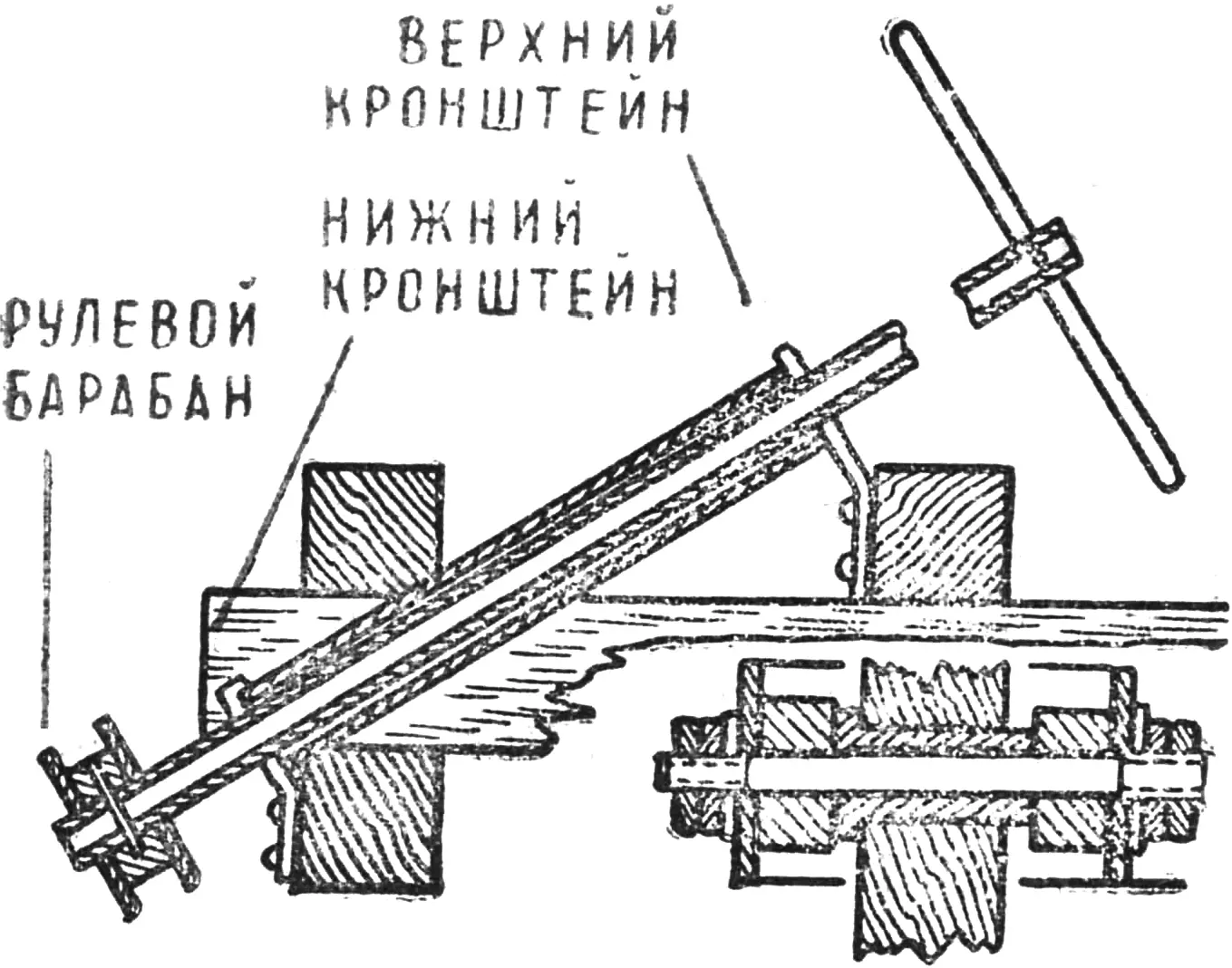
The steering (Fig. 2) consists of two cables, one of which makes two turns on the steering-column drum, while the other serves as a stay. This is only one of the possible schemes and, in our opinion, far from the most reliable. Figure 4 shows several other schemes. Their choice depends on the designer’s possibilities.
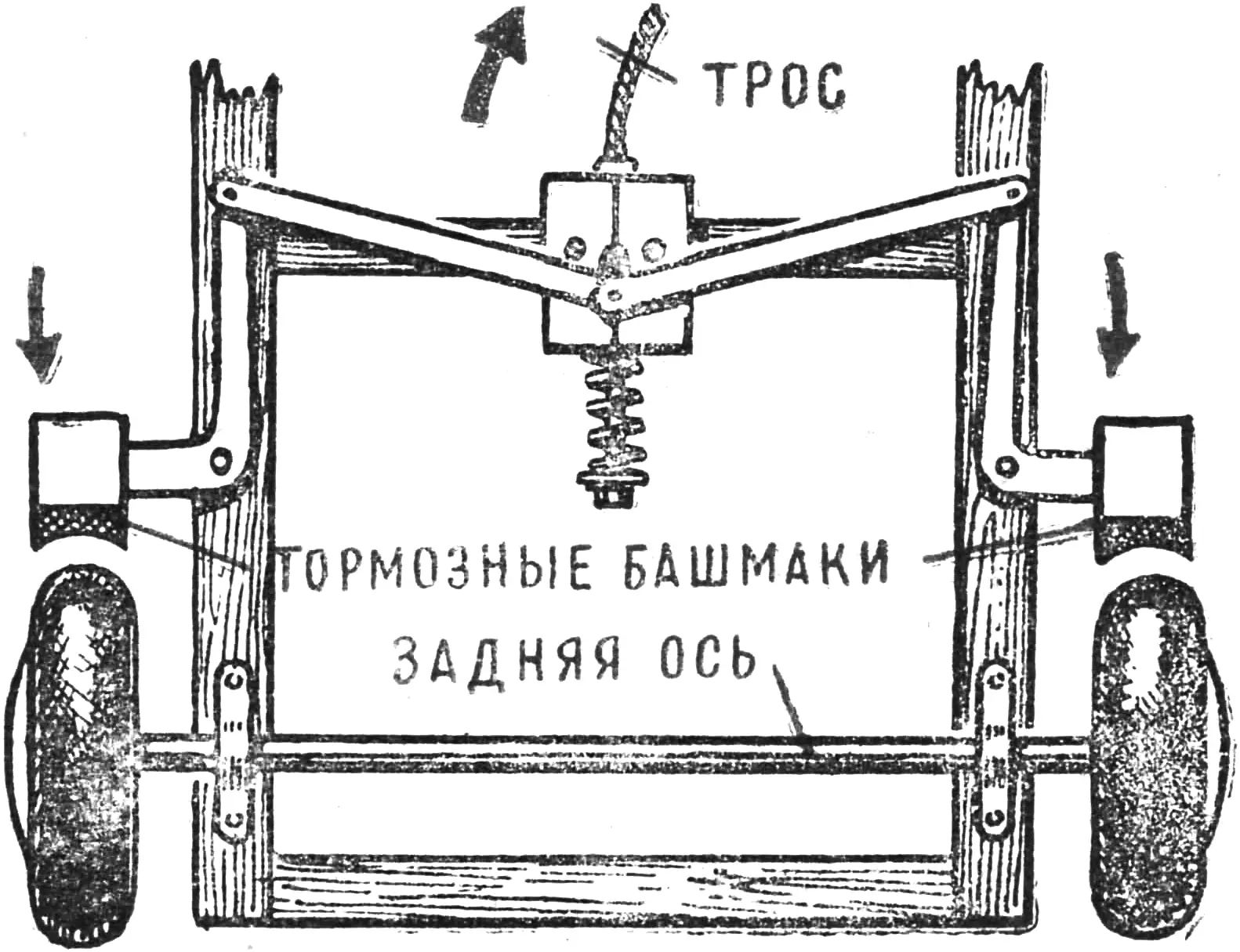
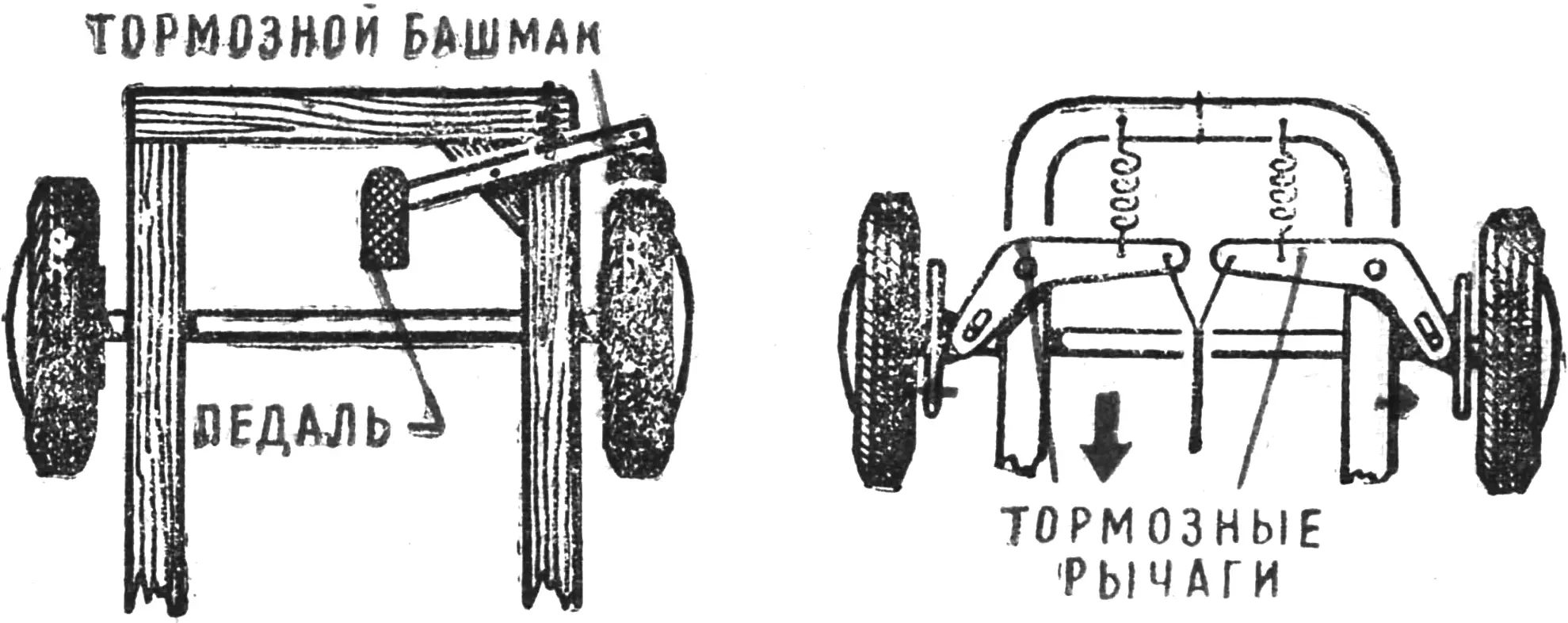
The brakes (Fig. 3) are cable-actuated block brakes. If the tire diameter allows, it is best to use brakes from sports road bicycles of the “Tourist” type. They are actuated by a single pedal located on the second crossbar.
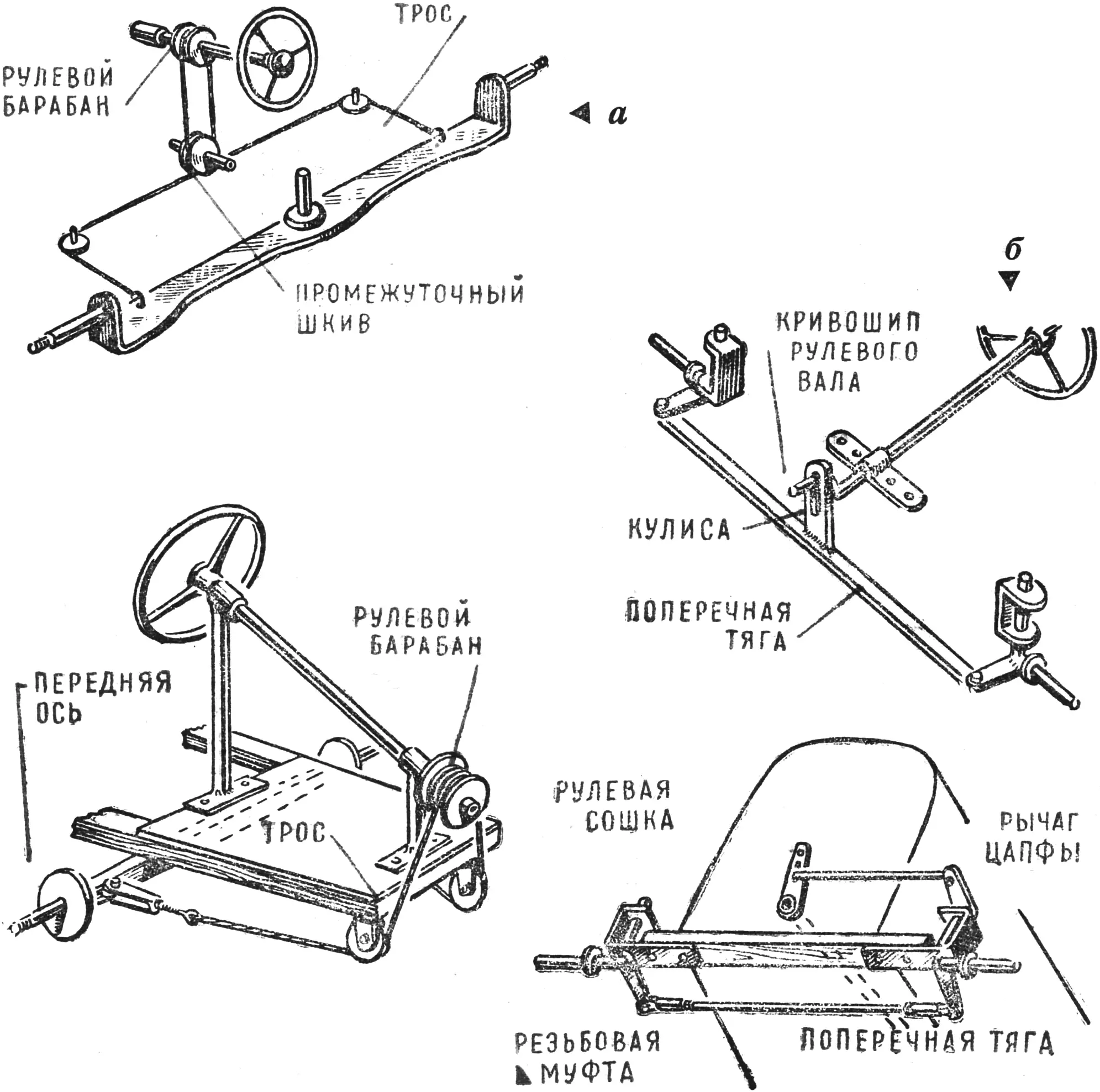
a — cable type, b — lever type.
The simplest solution here is to use the brake pedal of any motorcycle or moped together with a spring. In some designs a bicycle-type hand brake is brought out to a bracket on the driver’s right. Other variants of braking devices are shown in Figure 5.
In tests the mini-car reached speeds of up to 70 km/h.
When designing your own mini-car on the basis of the description given, think right away about possible improvements. In particular, about separate brake control, which may be especially useful when negotiating bends; about a more reliable steering scheme — it should be more rigid; and about a more convenient position for the racer — for some mini-cars allowed driving while lying down, which is especially convenient on a steep course and markedly reduces frontal resistance.
And last of all: do not forget to fasten a hook to the front crossbar. After all, a mini-car goes by itself only downhill!..
Recommend to read
 The APC? NO, CAR
Man I'm not so wealthy to afford to have multiple vehicles for different purposes (even homemade). So the car that was going to build, was conceived as a versatile vehicle not only for... Multi-welding all-purpose unit
Why “multi-welding”? Because this welding transformer (WT) has many important additional functions. Whereas in a traditional welder whose core is assembled from E- and I-shaped laminations...
