
“If I fall ill, I will not turn to doctors; I turn to friends…”, wrote the poet Ya. Smelyakov. But life shows that one has to turn both to doctors and to loved ones, because it is often impossible to do without their help, especially for a bedridden patient.
If bed rest drags on, it would be a good idea to make a bedside table for the sick person, like the one shown in the drawing. It can serve as a light tray, a dining or work table, and even a kind of lectern-stand on which, at the required angle, a book, a manuscript, drawing supplies, or—in a modern version—portable video devices and even a laptop can be placed.
Design features
The table design is simple but functional, since it can serve in the three mentioned roles thanks to the features of its construction. Among the main parts, first of all, there is the tabletop, as well as folding legs that frame it on the sides and, at this stage, turn the table into a kind of tray. When lowered, the table legs hold it steadily on the bed, since they have a fixed position thanks to stop bars.
The tabletop itself is made in two layers: a base panel and an upper panel that can be raised and set at the required working angle, fixed in that position by a simple folding stop.
The materials for making the table will be: chipboard or thin plywood for the two-layer tabletop; paired bars and thin strips for framing it; slats or bars for the legs; a piano hinge or fabric strip for the hinge of the tilted panel; and a plywood folding triangle as a stop to fix its angle.
Manufacturing
Let us begin with the tabletop as the main load-bearing part. As already noted, it is advisable to make it two-layer, from two plywood panels that play different roles in the construction and therefore have different width and length.
The lower panel is the base of the table, the tabletop proper. It can be made of 7 mm plywood, measuring 500×440 mm. Paired wooden bars are nailed along the lower and upper edges of the panel. One of them is the width of the tabletop, with a cross-section of 30×20 mm. The legs are hinged to it on both sides. The ends of the second bar project beyond the edges of the tabletop by the thickness of the legs: they serve as stops for the folding legs.
The upper, face panel can be raised to a certain angle. The dimensions of this panel, made of 4 mm plywood, are somewhat smaller than the tabletop: taking into account the restraining paired bars, it is 430×400 mm. The edge nearest the patient is hinged to the bar with a piano hinge or a fabric strip performing the same function. On the reverse side of the panel, also on a soft fabric hinge, a folding plastic triangle is glued on—a stop to hold the face panel in a tilted (raised) position.
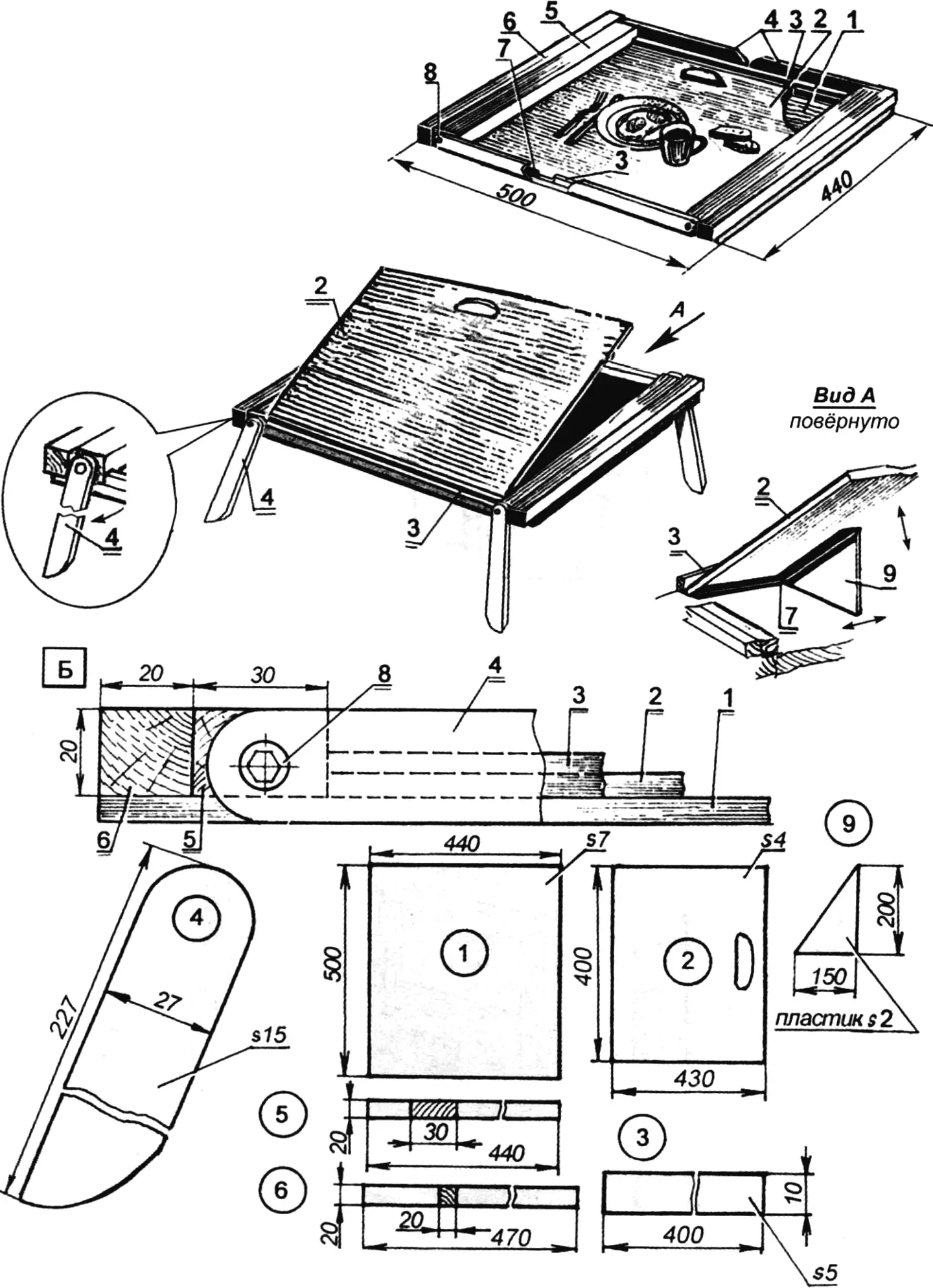
1 — table base (top); 2 — face (raising) panel; 3 — side guard rails (thin strips); 4 — folding legs (4 pcs.); 5 — “short” bar for hinged leg mounting (2 pcs.); 6 — stop (extended) bar for fixing lowered legs (2 pcs.); 7 — fabric strip — “hinge” (2 pcs.); 8 — hinge (screw with washer, 4 pairs); 9 — stop
A special role is assigned to the legs: they must be not only supports for the table in the position on the bed, but also side rails on the way to it—in the “tray” position. Hence their dimensions and mounting features. The legs are made of slats 15 mm thick and 27 mm wide, and the length is chosen so that in the folded position they serve in pairs as additional side rails in the “tray” version. When the legs are lowered, the side restrainers are the thin strips attached along the edges of the tabletop.
The legs are hinged to the ends of the short bars of the base with screws and sealing washers. The mounting point is chosen so that in the folded position the leg rests against the projecting part of the second (limiting) bar, thus being fixed at a slight angle.
Finishing the table
All parts are thoroughly sanded with sandpaper before assembly so that no chipped edges or burrs remain. If the plywood panels have an attractive wood grain, they should be carefully polished and coated with varnish in several layers, with proper drying and intermediate polishing. Varnish can be applied with a pad, a soft brush, or a roller.
Simple painting with oil or enamel paints is also possible, in different colors if desired: for example, the tabletops in green or blue, and the legs in black or brown, according to your taste.
Using the table
As already noted, the design of the table makes it a versatile piece of furniture for the needs of a sick person. In the kitchen, thanks to the folded legs, it turns into a tray with side rails—convenient for “delivering” dishes with food or medical supplies to the patient’s bed. Here the legs are lowered, and the table, thanks to these supports, is easily placed directly on the bed, so that the patient can then do without additional help.
“Modelist-Constructor” No. 11’2009, B. REVSKY
Recommend to read
 HOMEMADE DRILL
Osnova difficulty in creating a homemade drilling machines — making mechanism of vertical movement of the working body. What if you make a machine entirely without the mechanism to... ALL-WEATHER MISSILE-CARRYING AND THE FIRSTBORN
One of the most important tasks of fighter aircraft is to protect important areas, districts and objects on the territory of the country from air strikes. After the Second world war, the...
