At first glance, these are just trifles that mean nothing. In fact, much in our lives (if not everything) is decided by them — though in different ways, depending on what kind of trifles they are. Some, for example, may affect no more than a person’s mood, while others can even change the fate of humanity!
Let us turn, however, to those truly small things that, say, make the objects around us more convenient, safer, and more reliable in operation.
Since I am a great motorcycle enthusiast, I will give several examples of how their consumer qualities can be improved with little effort.
A SAFE CARBURETOR
The K-62, K-63, and K-65 carburetors used on domestic motorcycles conceal a very serious danger for the engine, especially for a two-stroke one. It lies in the fact that the throttle lift limiter is sometimes poorly press-fitted into the carburetor cover. If this limiter falls out of the cover during the running-in of a new engine (or even after running-in is complete) and drops into the cylinder, the engine will fail at once.
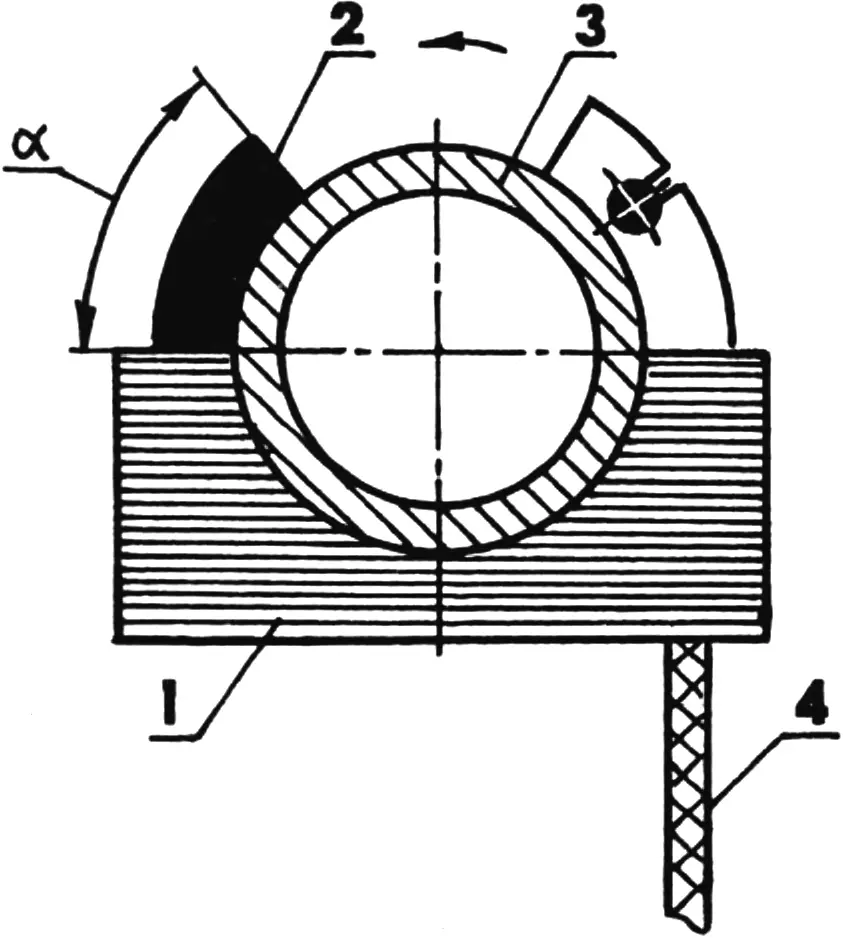
1 — grip housing (cover not shown for clarity); 2 — sector limiting grip rotation; 3 — grip tube (end view); 4 — cable sheath of the carburetor throttle valve control
Such an annoying breakdown can happen dozens of kilometers from home. To avoid it during the running-in of a new engine, I cut a sector from organic glass and inserted it into the throttle grip housing on the handlebar. The sector angle (Fig. 1) corresponds to the throttle lift with the limiter in place.
Then I disassembled the carburetor, knocked the limiter out of the cover, sealed the hole left by it with insulating tape, and reassembled the carburetor.
I ran in the engine without fear for its condition.
A FITTING HELPS
Clogging of the drain hole in a motorcycle fuel tank cap is a fairly common occurrence. At least I have had to clear it more than once.
When the hole clogged again, I made life easier by fitting the cap with a kind of nipple, press-fitting into it the metal tip from a ballpoint pen (Fig. 2).
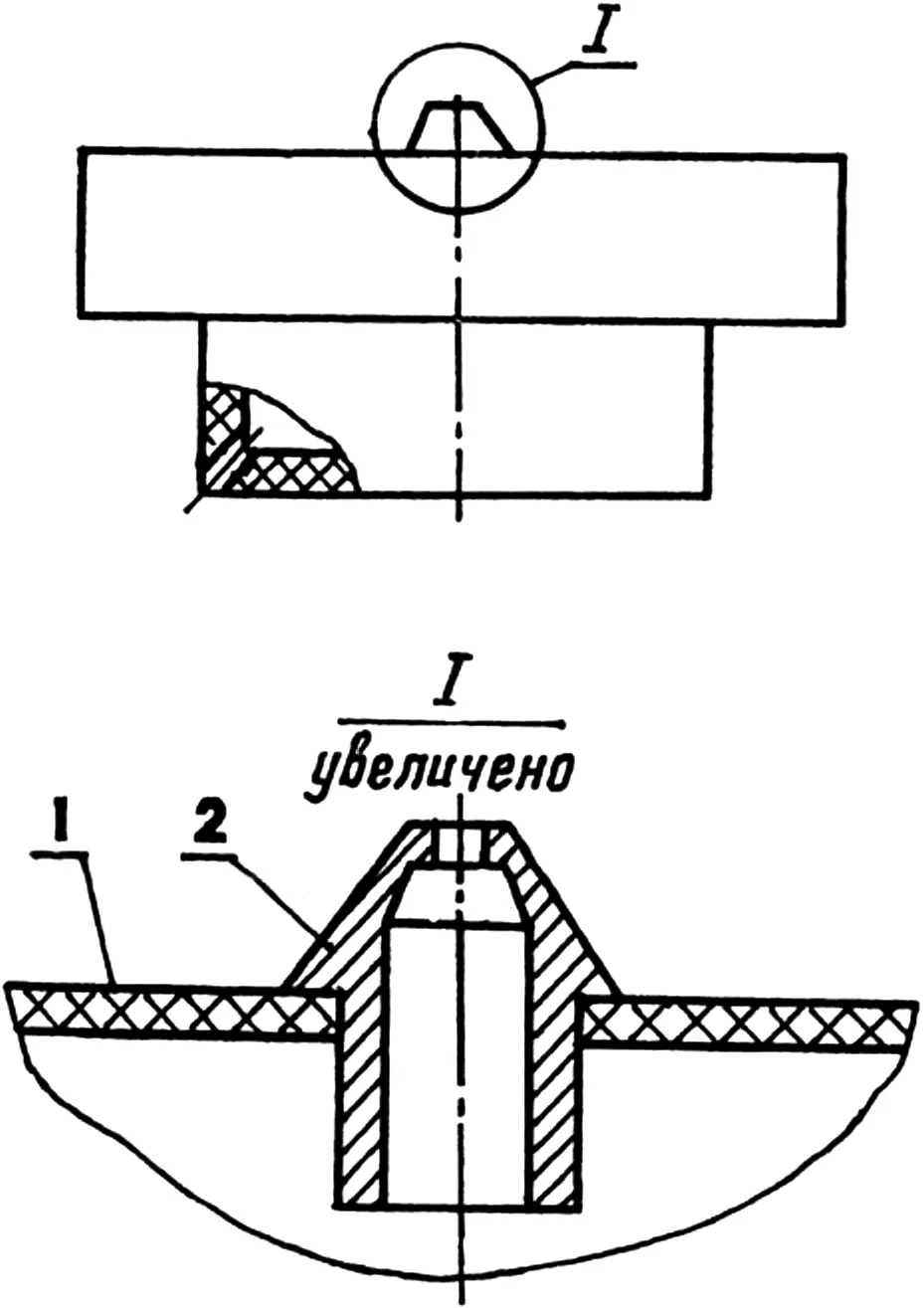
1 — cap body; 2 — nipple (metal tip of a ballpoint pen)
Now, to clear a clog, I only need to press a pump hose against the nipple and pump — blow through the drain hole. And since a pump is far more effective than a piece of wire or a sewing needle, which I used before, cleaning, that is blowing through, is needed much less often.
THE LID WON’T GET LOST
The luggage compartment lid on the Voskhod-3M motorcycle is held rather poorly and can be lost at any moment. To prevent this, I hung it on a piece of piano hinge, making slots in the lid itself and in the glove box wall (Fig. 3). I attached the hinge with steel rivets.
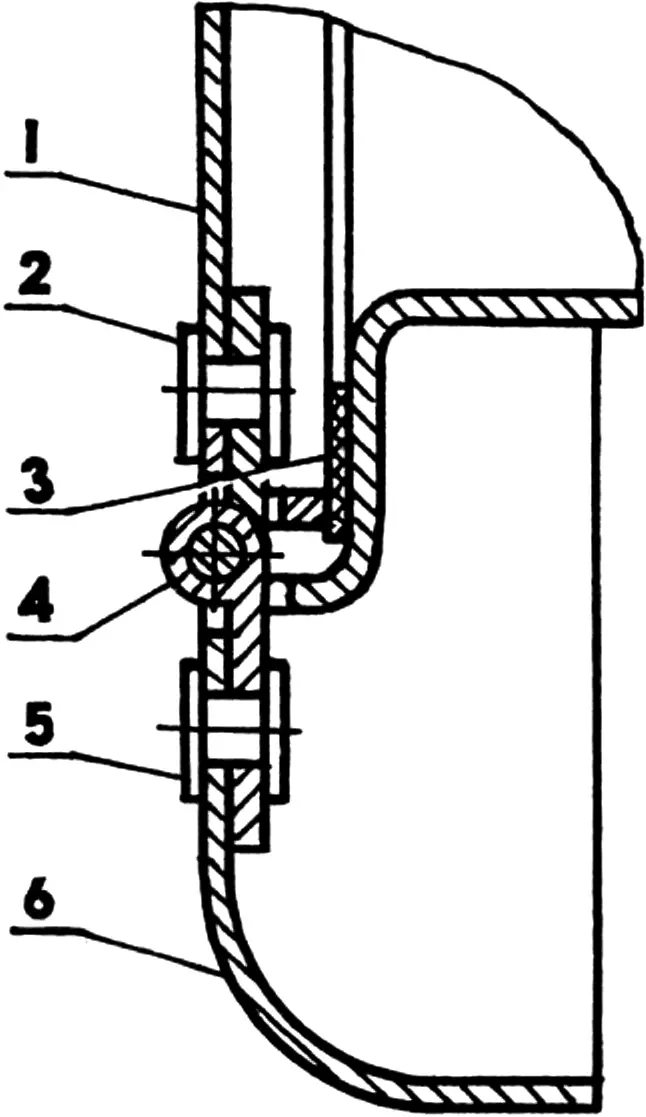
1 — lid; 2,5 — rivets (steel, Ø3); 3 — gasket (rubber); 4 — piano hinge; 6 — luggage compartment wall
Later the lid began to rattle and — worse — let moisture through. Since part of the motorcycle’s electrical equipment (flasher relay, etc.) is located under the luggage compartment, I had to glue a gasket cut from an old inner tube of a motorcycle wheel around the lid contour.
AND A GLOVE BOX FOR THE “VOSKHOD”
However, even the modified Voskhod luggage compartment does not fully serve its purpose. To make it possible to keep small items in it without the risk of losing them on the road, I fitted it with a glove box — a pull-out drawer like on a writing desk. For this I attached a box to the rear side of the luggage compartment lid, with a volume close to that of the glove box (Fig. 4). Now the items stored in it do not fall out onto the road, as they used to as soon as it was opened.
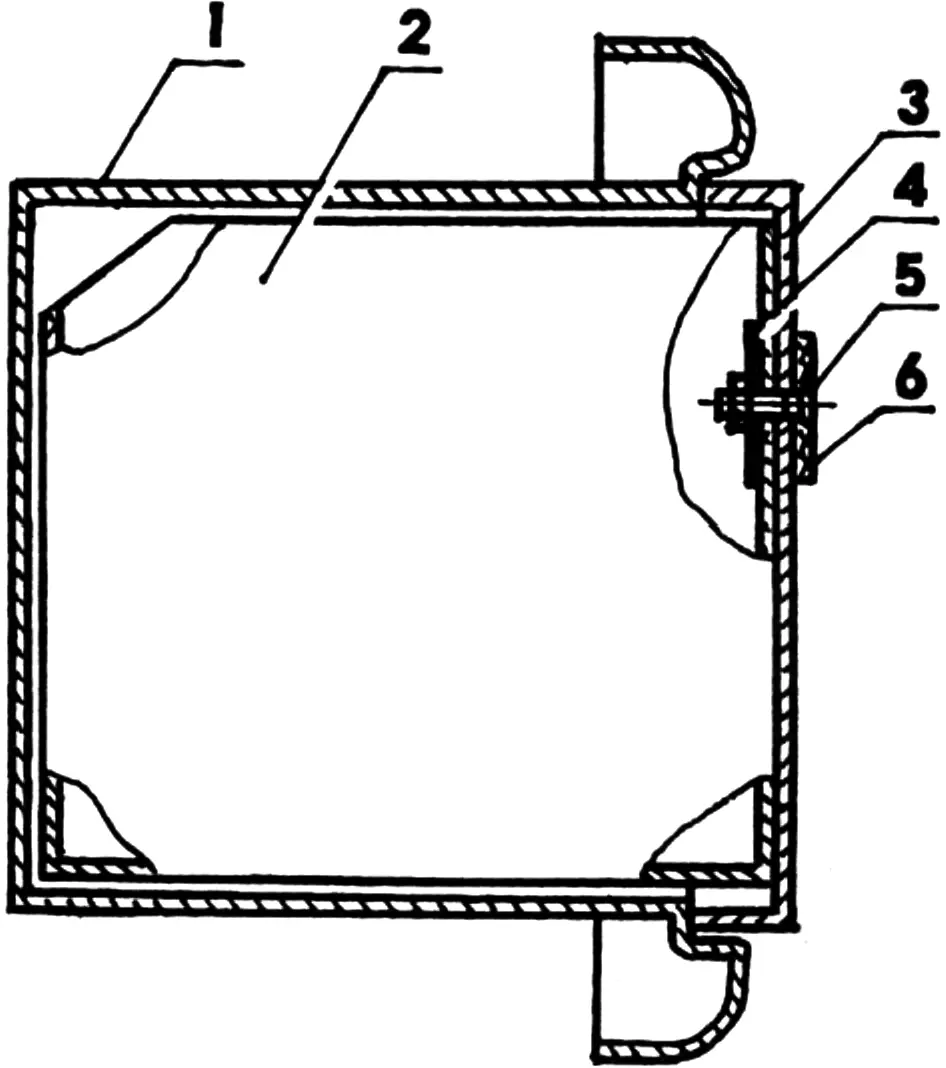
1 — luggage compartment wall; 2 — pull-out box; 3 — luggage compartment lid; 4 — reinforcing plate (steel strip); 5 — M6 bolt (2 pcs.); 6 — decorative trim (plastic)
I selected a ready-made box. However, it can also be made independently from steel or aluminum sheet. The main thing is that the box should fit tightly into the luggage compartment. It is attached to the lid with two M6 bolts, with a reinforcing plate inside and a decorative trim outside.
I believe that such a technical solution can also be applied to motorcycles of other makes — naturally, taking into account their design features.
“Modelist-Konstruktor” No. 4’2004, D. YAKOVLEV
Recommend to read
 UMBRELLA FROM THE SUN
Nice in the summer, sitting comfortably on a bench, in a chair, read a book, chat with friends. To protect the resting place from the sun, we offer you to build beautiful and easy... VIP-cars for the VIP-driver
Mercedes-Benz S-Class 2005 issue. Increased attention okoloavtomobilnoy public to high-end machines are difficult to explain from the perspective of common sense, as these luxury...
