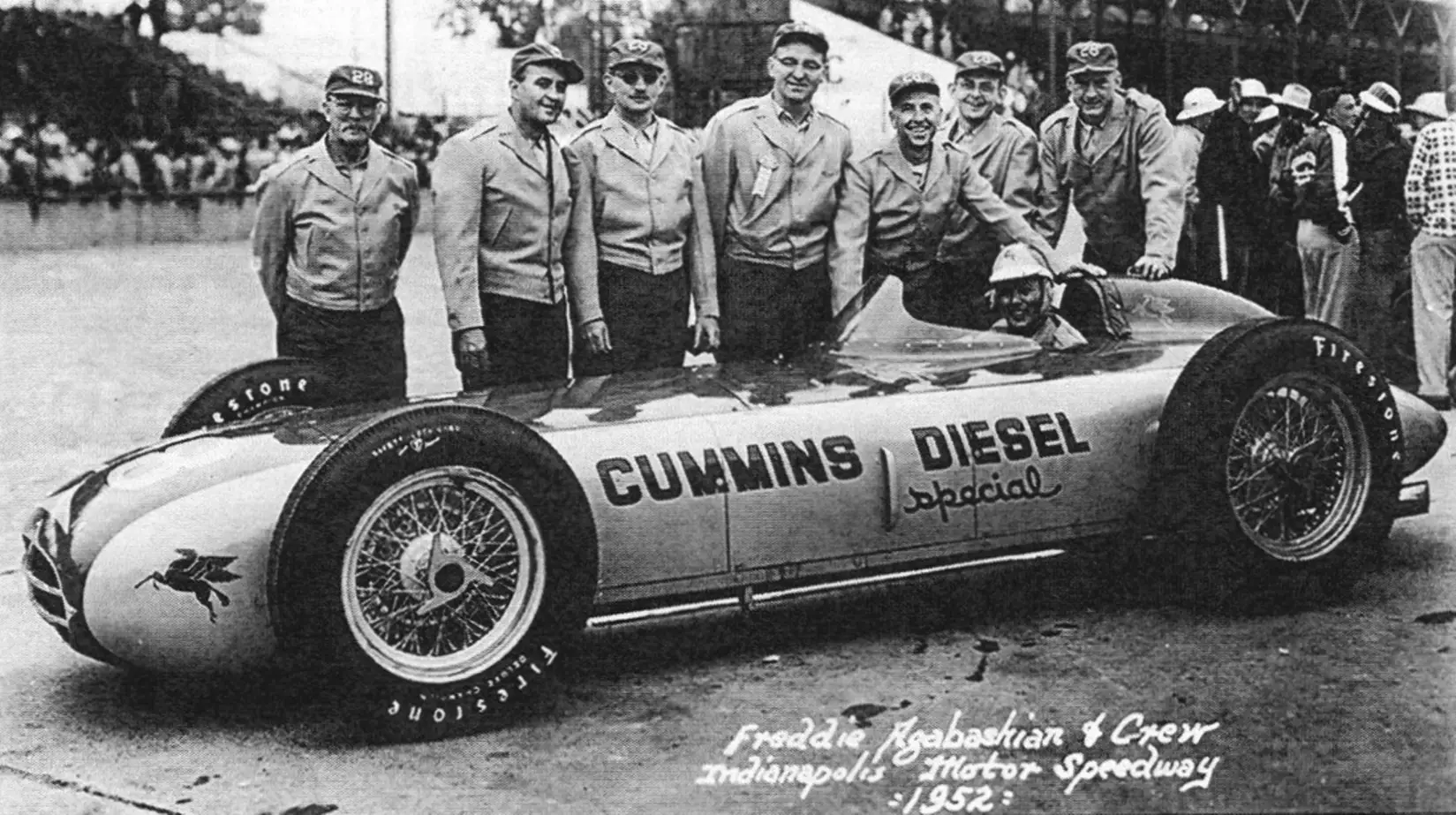
The prototype of this slot-car model (for how to build a simple home or school track for model-car racing, see “M-K” No. 3, 2025.) was the Cummins Diesel Special racing car, a participant in the 500-mile race of 1952 on the track in Indianapolis (Indiana, USA).
In the early days of the automobile industry, racing tracks became a proving ground for the boldest technical experiments. So Clessie Cummins — inventor and founder of a diesel-engine company — decided in 1929 to enter his car in the Indianapolis 500. However, a diesel is heavier than a gasoline engine, and the car finished last. Nevertheless, in 1931 it set a world speed record (163 km/h) for diesel-powered automobiles.
The peak of diesel race-car evolution was the Cummins Diesel Special of 1952. It posted the best result in qualifying, but retired from the race due to a turbine failure. The following season the organizers limited the displacement of diesel engines, and the racing career of Cummins cars came to an end. Today this motorsport legend is an exhibit at the Indianapolis Motor Speedway Hall of Fame Museum.
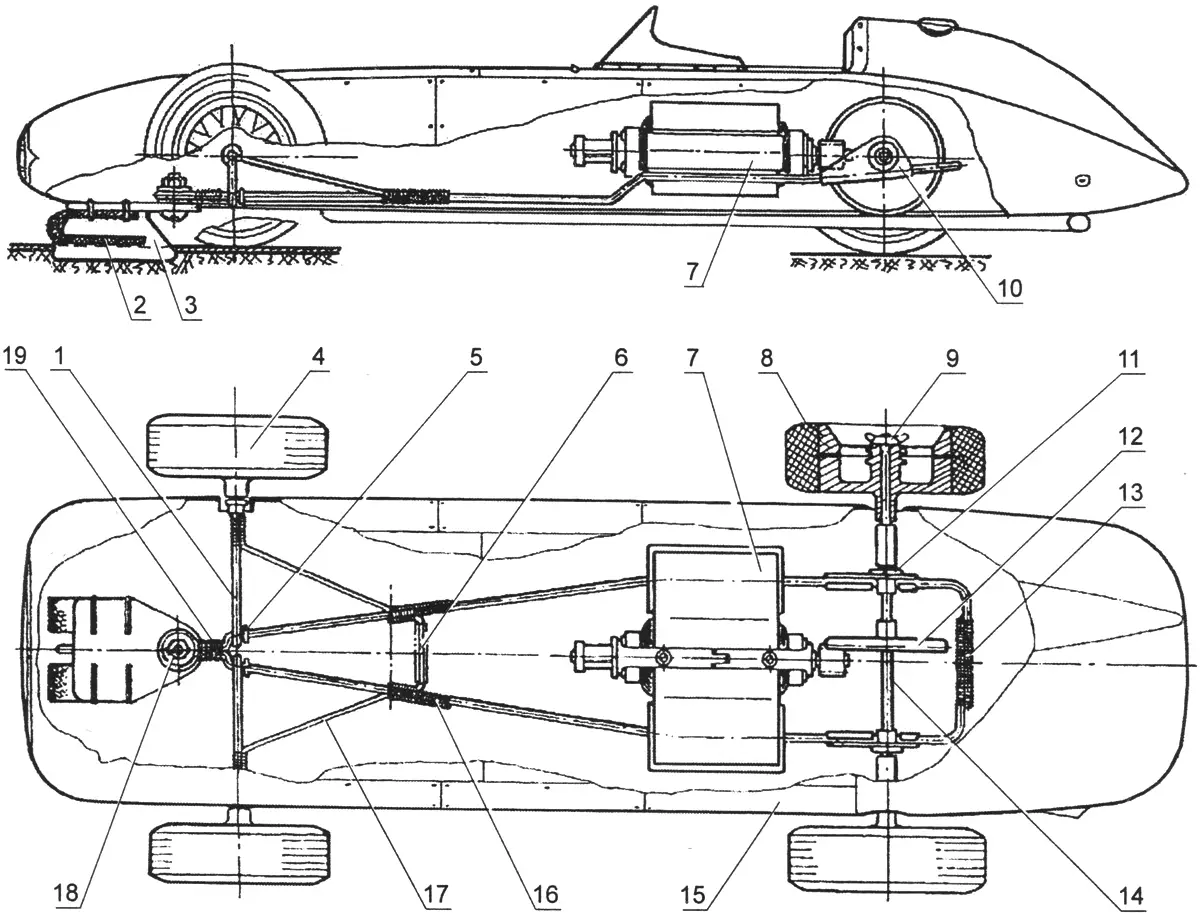
1 — front swinging half-axle (steel, OVS wire Ø1.2 mm); 2 — pickup brush (antenna-cable braid); 3 — pickup housing (fluoroplastic); 4 — front wheel; 5 — washer; 6 — frame brace; 7 — electric motor; 8 — rear wheel; 9 — shaped nut; 10 — bearing clamp (sheet metal s0.3 mm); 11 — plain bearing (brass or bronze); 12 — main-drive gear (steel); 13, 16 — frame-rod joints (copper wire with soldering); 14 — rear swinging half-axle (steel, OVS wire Ø1.2 mm); 15 — body; 17 — strut (steel; OVS wire Ø1 mm); 18 — vertical hinge (with pickup centering device); 19 — binding (copper wire with soldering)
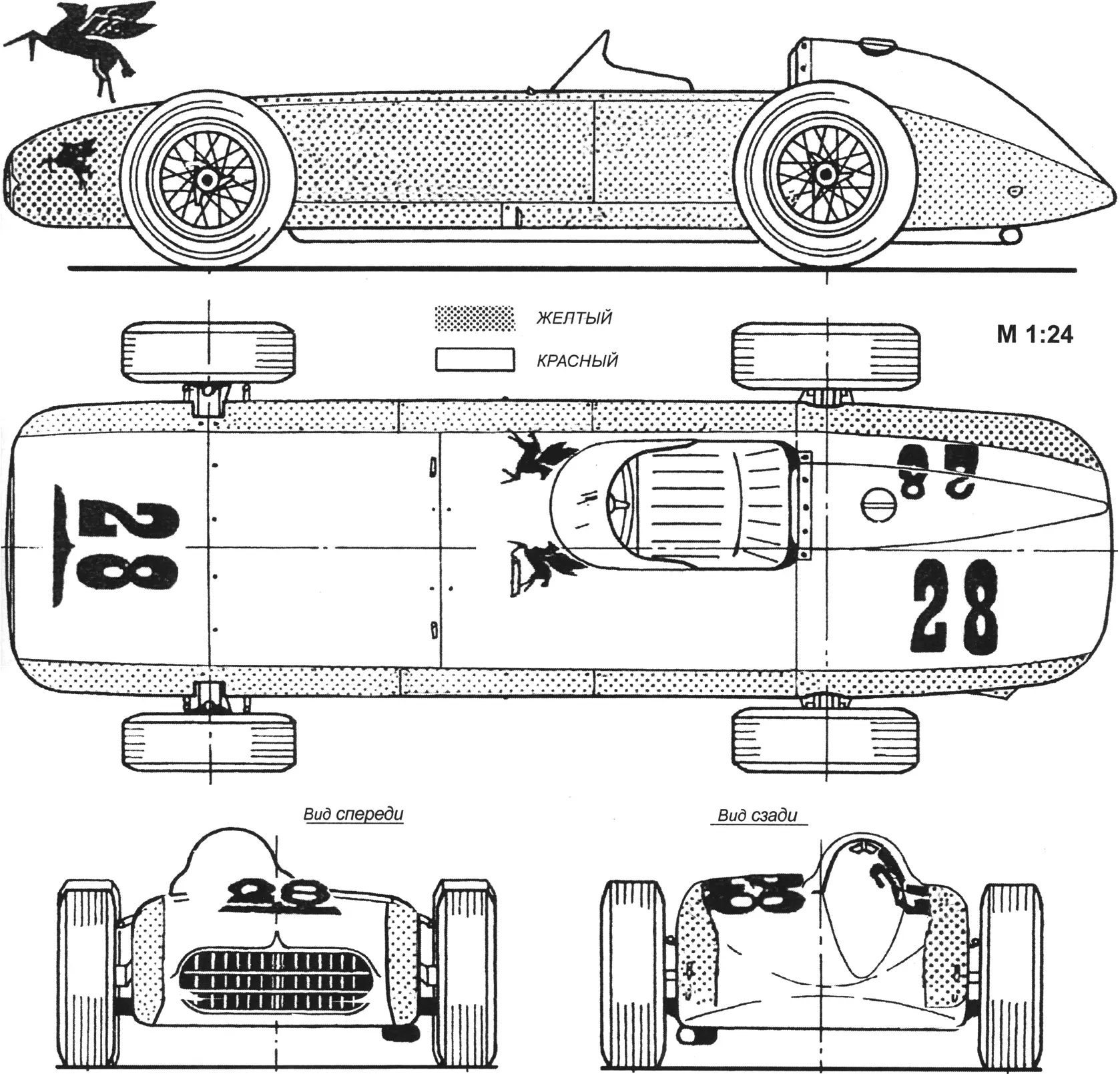
The Cummins Diesel Special is very attractive to beginner modelers because it has no particularly complex parts and an extremely simple body — it is easy to laminate over a plug or in a mold from epoxy resin and thin fiberglass cloth.
Of course, the best results come from laminating in a mold. To make one, you need a master model — for example of linden wood, which saws, cuts, and sands beautifully. A release layer (parquet wax) is applied to the polished master model, after which its lower part is covered with several layers of fiberglass cloth and this part is placed in a box filled with an epoxy compound mixed with ordinary river sand. After the binder has cured, a mold is taken in the same way from the upper part of the master model as well.
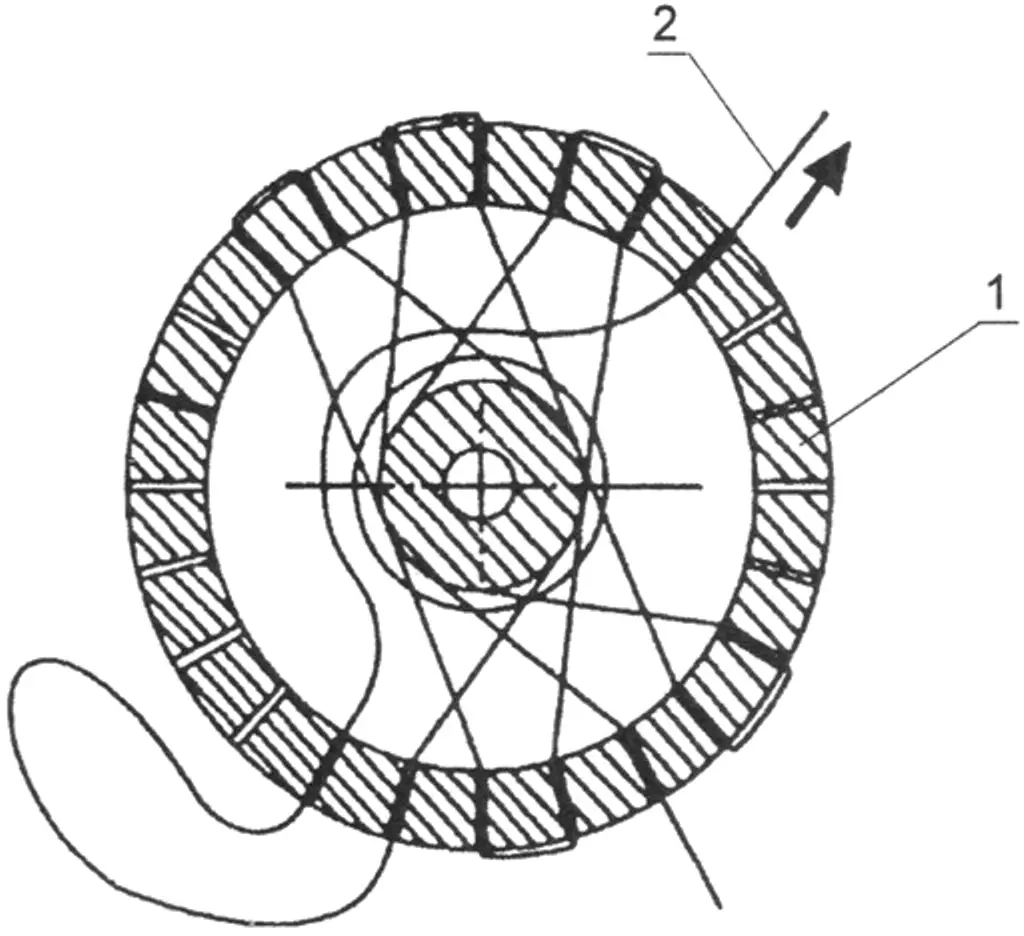
1 — hub; 2 — tinned copper wire
The finished half-molds are coated on the inside with a release layer, and paint made from epoxy, magnesia, and artist’s oil pigment is applied to them. When the color coat has partially polymerized, the half-molds are lined on the inside with thin fiberglass cloth in several layers. After the binder has cured, the “skins” are removed from the half-molds, cleaned up, and fitted to each other.
The model frame is made of steel wire; all joints are wrapped with thin copper wire and then carefully soldered. The pickup housing is fluoroplastic; the brushes — from the shielding braid of an antenna cable — are mounted on the frame using copper-wire bands and soldering.
The model’s power plant is a miniature electric motor capable of about 70 W, which is quite enough even for competition. Torque is transmitted to the rear-axle shaft by a gear pair with a 1:5 ratio, consisting of a spur pinion on the motor shaft and a bevel gear on the rear-wheel shaft.
The model’s wheels are of a simplified design, with turned light-alloy disks and porous-rubber tires. Spokes are reproduced on the wheels from tinned copper wire passed through half-millimeter holes drilled around the circumference of the disks.
Cummins Diesel Special specifications
Weight, kg … 1114
Engine displacement, cc … 6570
Number of cylinders … 6
Power, hp … 430
Top speed, km/h … 222
“Modelist-Konstruktor” No. 8’2025, Igor ATOM
Recommend to read
 CHEST FOR “HUNTER”
It has been over a year since then, as reconstructed roof rack for UAZ Valery PAL, as he again asked. This time he took the trunk in the trunk, but simply to say, a large metal box for... MOPED TRAILER
A moped is often considered an expensive toy for children. And in fact, a significant portion of these two-wheeled machines are purchased by young people for purely recreational purposes....
