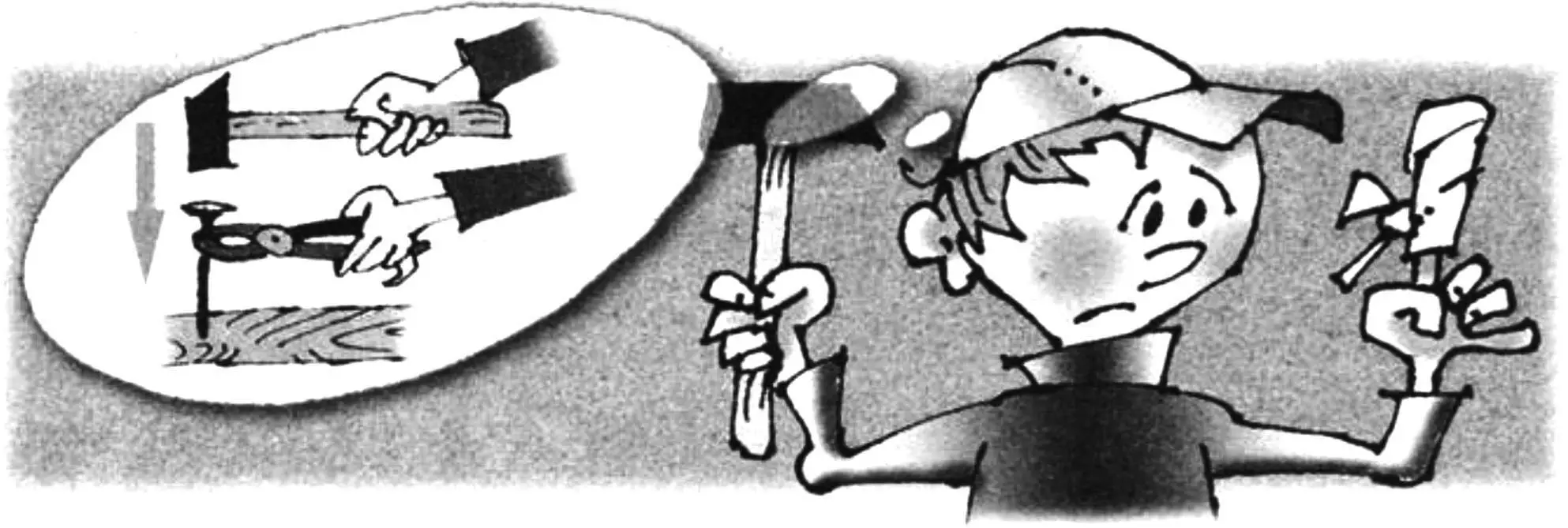
It would seem there’s nothing simpler than driving a nail. Any boy can do it, to say nothing of women. Why, then, even for men does this seemingly extremely simple operation sometimes not go smoothly: either the nail goes in poorly and suddenly bends; or the hammer blow lands not on the nail head, but on a finger!
It turns out that this common and, at first glance, simple process has its own rules and peculiarities that cannot be ignored.
Thus, a nail is easier to drive into fresh moist wood than into dry wood, because the elasticity of such wood is reduced. And for the joint to be strong, the nail must be long enough and enter the structure into which it is driven by at least one third.
To give greater strength to boards being nailed together, nails are driven at a slight angle (1).
A nail enters dense wood poorly. To keep it from bending, it should be held with pliers (2).
In cladding boards (planks, lining) 100–120 mm wide for the façades of wooden houses, one nail is driven into each board. Boards wider than 130 mm are fastened with two nails. When nailing a board, especially a wide and thick one, its grain must be taken into account: this determines which way it will warp when it cups.

To avoid splitting the wood, the diameter of the nail should be no more than one quarter of the thickness of the board being nailed. When you drive a nail into a thin strip, it should first be blunted by nipping off the point with wire cutters. A nail with a blunt tip will only crush and cut the wood fibers and will not split the strip. If nails are driven near the end or edge of a board, a hole should first be drilled for them with a diameter slightly smaller than the thickness of the nail. Preparatory holes are also recommended when using hardwoods (3).
If several nails need to be driven, then, so that the workpiece does not split, they should be placed not in a single line, but in a staggered pattern, in two or three rows (4).
When the joint of the boards is unsupported and hangs in the air, while driving the nail it is braced from below with something massive, for example a large hammer or a sledgehammer (5).
The quality of nailing also depends largely on the tool you use. The most convenient hammer weighs 400–500 g. Begin driving nails first with light “wrist” blows. Once you are sure the nail is going in correctly, finish driving it with force, “from the elbow” (6). A nail driven in with two or three blows will hold more firmly, because it splits the wood layers less.
If you need to bend a nail that protrudes from the other side of a board conveniently and securely, it is best to use an old triangular file of such size that the protruding end of the nail is one and a half to two times longer than the face of the file. Press the edge of the file firmly against the protruding end of the nail and bend it with light blows. Then pull the file out, and finally drive the resulting hook into the wood (7).
For pulling nails it is better to use a nail puller or pincers that provide a firm grip and good leverage. First pry up or bend back the head of the old nail with a screwdriver or another sharp tool, then grip it with the pincers or nail puller (8). To avoid damaging the board surface, place a wooden block or a metal plate under the pincers.
“Modelist-Konstruktor” No. 4’2009, B. REVSKY (based on materials from the Polish magazine “Zrób sam”)
Recommend to read
 TSENTROISKATEL
Before there was the drawing tool for finding center of round parts. My version of such a device — shaped ruler, cut from steel plate with a thickness of 2-3 mm. hole is punched on... NEW OLD COIL RUHMKORFF
Induction coil, in the last century invented Rumkorem, and is now used in experiments in physics. But now it is not fully satisfy the requirements of physical experiment creates...
