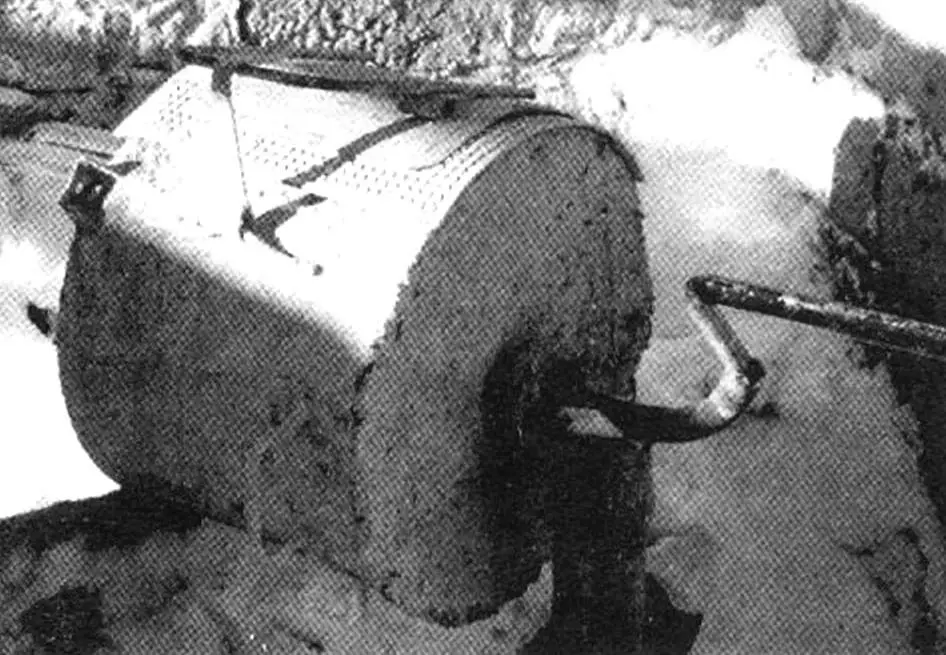
In two evenings I built a simple but productive concrete mixer that makes work on country-site construction much easier and faster.
I was building a garage from 400x200x200 mm concrete blocks that I formed myself using formwork and this very mixer. It is made from an old 50–60 litre barrel. Anyone can assemble something similar using whatever is at hand. So I give only a basic diagram and a description of the main parts and assemblies; those interested can adapt them to their own materials and possibilities.
A square hatch is cut in the barrel and closed with a hook-fastened lid. The lid is about 100 mm wider than the hatch on all sides. For sealing the lid, a rubber mat is used (like in a bathroom; airtightness is not critical: gaps are filled with cement, and whatever seeps out still lands in a tray placed underneath).
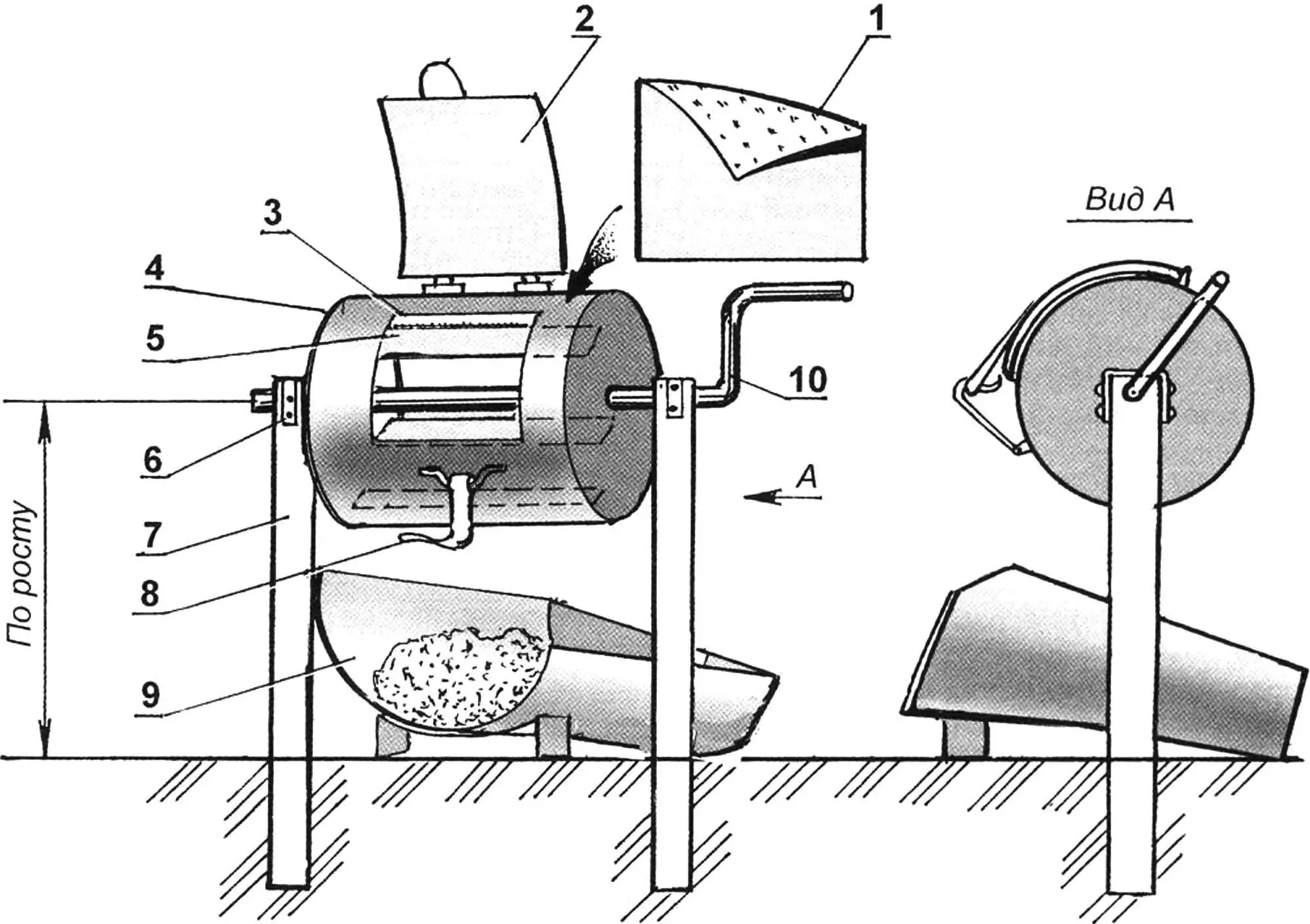
1 — cover gasket (rubber mat 500×500 mm); 2 — hatch cover with bail handle (in view A the cover is closed); 3 — hatch; 4 — barrel (60 L); 5 — paddle (full barrel length, 3 pcs., h = 100); 6 — shaft clamp (2 pcs.); 7 — support (2 pcs., wooden post Ø100…150, h = 1500); 8 — hook for the bail handle; 9 — mortar drip tray; 10 — crank shaft (3/4″ pipe)
A 3/4″ water-pipe shaft is passed through the middle of the barrel and welded; it protrudes on both sides. On one side it is bent into an elbow (the crank); on the other, a 300 mm support end sticks out. Both ends rest on posts slightly above belt height — that is more comfortable to work. The pipe shaft is fixed to wooden supports with clamps.
Inside the barrel, mixing paddles about 100 mm high are welded in.
Below the mixer is a metal tray, also cut from a barrel.
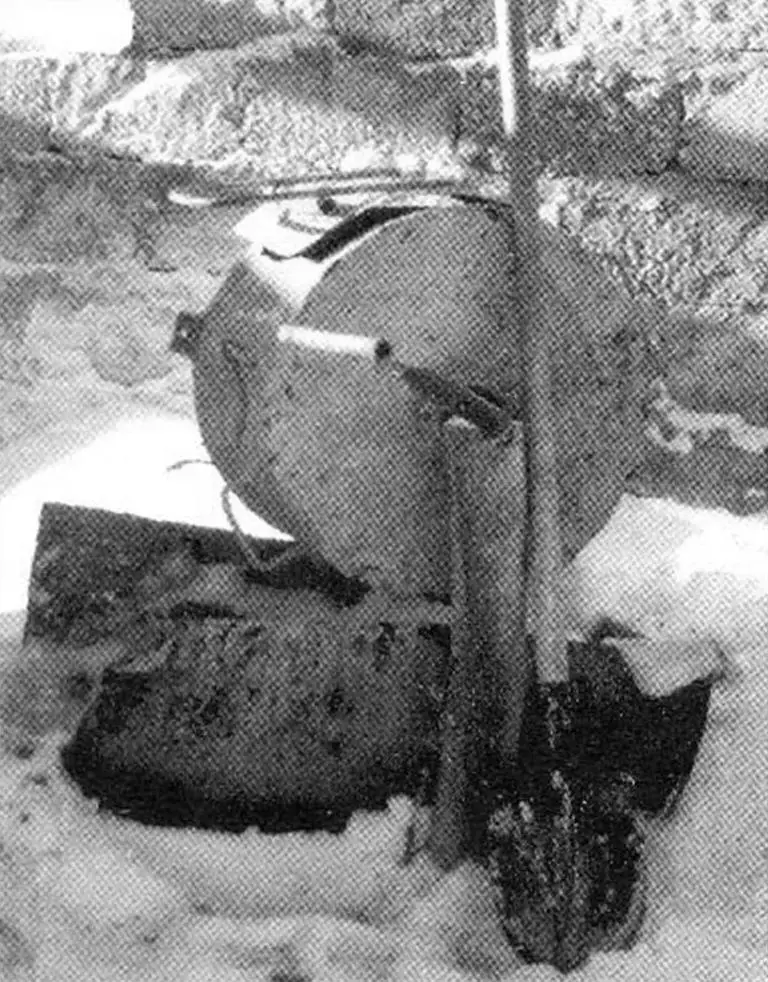
The process is: one bucket of cement, 2–3 buckets of sand, 3–4 of fine gravel, one bucket of water. Fill the barrel completely, because the volume drops by about a quarter when mixing. Do not mix dry — start turning after filling. Ten to fifteen turns are enough and the mortar is ready.
If a foundation only needs formwork filled with mortar, that is enough; for blocks it is better to make demountable moulds, even for 9–12 blocks at once.
P.S. You can of course use a 200–250 L barrel, but then two people or a motor will have to turn it — that is already a different design.
«Modelist-Konstruktor» No. 9’2010, G. TURYGIN
Recommend to read
 FIND “THE FOX”
In the early 30-ies of the radio Amateurs of the Soviet Union, mastering of ultrashort waves, for the first time faced the necessity of direction finding of radio transmitters. The... AQUAPAD
That move through the water can be sitting for the PA log, and water starting from the first available under the hand with a stick, has been known for many thousands of years. For such a...
