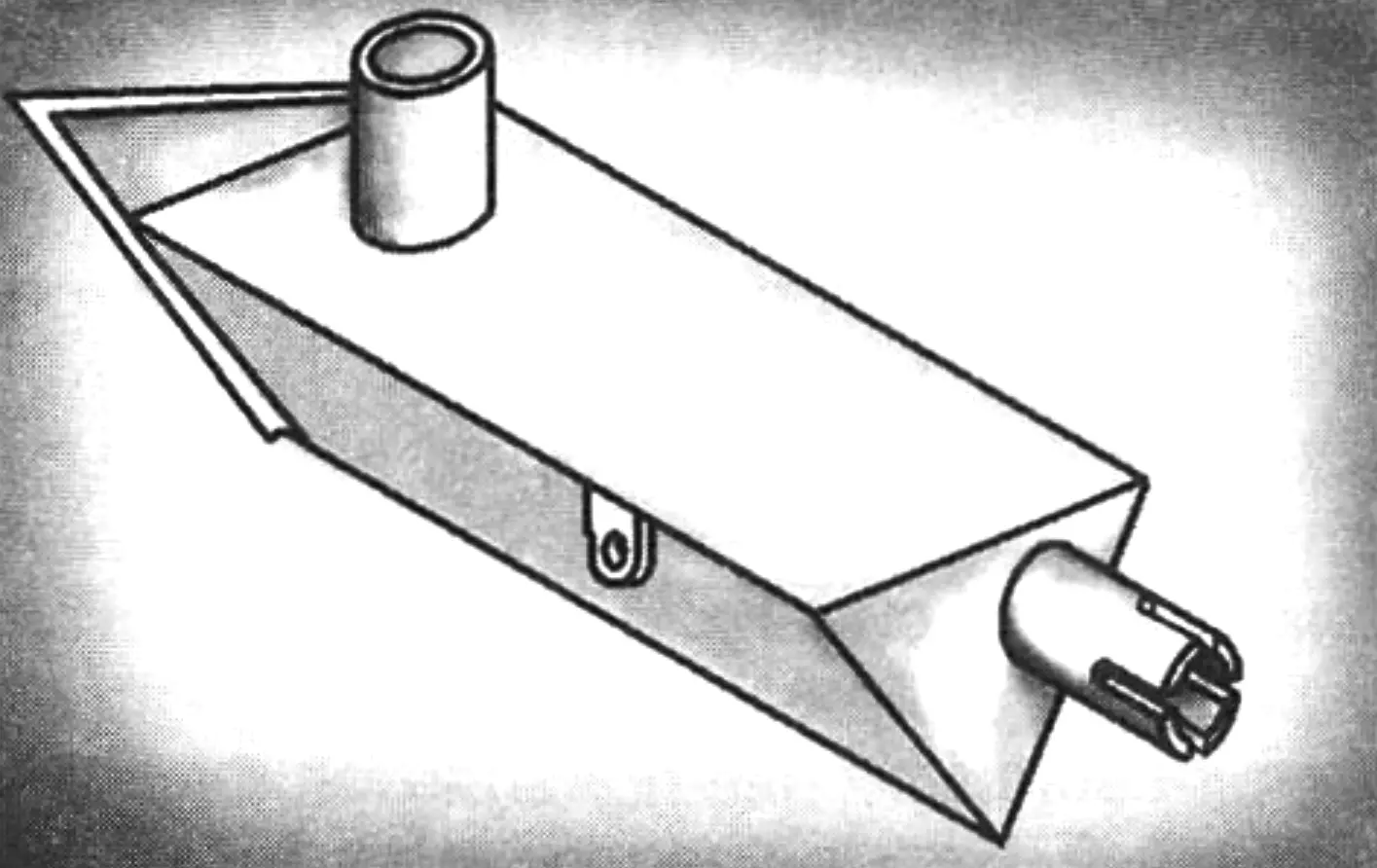
Interest in homemade mufflers is driven primarily by the unsatisfactory quality of series products. It is quite natural for an amateur designer to want to improve the parameters of their vehicle. Of course, it is practically impossible to significantly increase engine power through a muffler at a given exhaust noise level, but eliminating some shortcomings of factory designs is entirely feasible.
First of all, one can do without perforated holes, which become clogged with soot during engine operation, causing vehicle noise to increase somewhat. In addition, the design of the main muffler on many domestic cars forces the exhaust gas flow to turn sharply through 180° twice. This greatly increases resistance and robs the engine of additional power.
Therefore, car enthusiasts may be interested in a muffler I made. Building a similar one is not difficult, and its metal consumption and weight are significantly less than those of a factory unit. Used as the main muffler, it works together with the series secondary muffler (VAZ design) and maintains approximately the same noise level at all engine operating modes, not exceeding permissible standards.
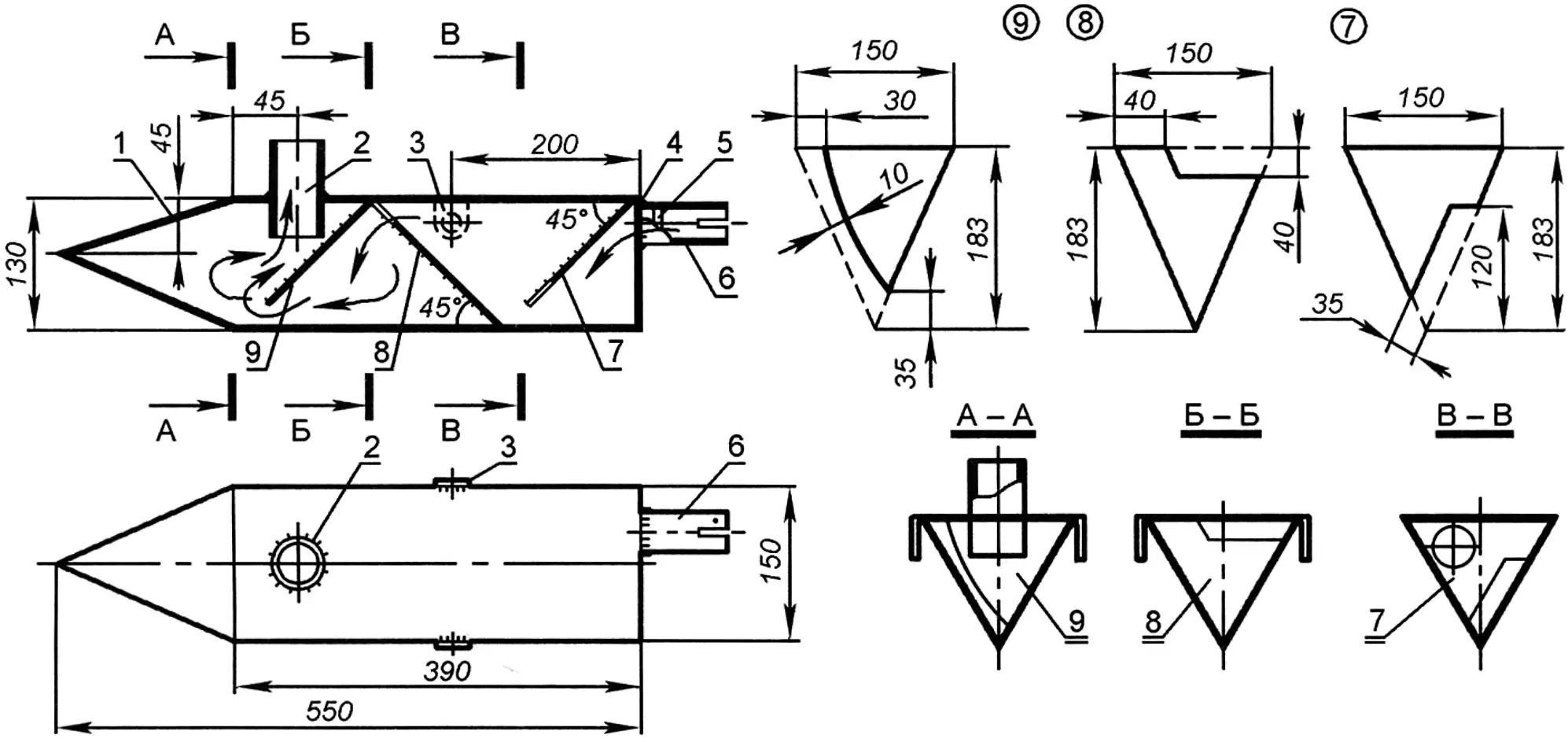
1 — housing; 2 — outlet pipe; 3 — body mounting lug (2 pcs.); 4 — wall; 5 — flow splitter mounting location; 6 — inlet pipe; 7, 8, 9 — guide plates
The muffler housing is an equilateral triangular prism ending in a pyramid at the front (Fig. 1). An inlet pipe is welded into the base of the prism; four slots are cut at its end to ensure a reliable fit of the exhaust pipe. All dimensions of the joint are determined by the diameter of the latter.
Inside the muffler, three guide plates are placed at a 45° angle to the longitudinal axis. A gap remains between them and one of the housing faces, with the plates arranged so that each subsequent one overlaps the gap between the previous plate and the housing when viewed through the opening. Technologically, the plates can only be welded to two faces of the housing, since the third is overlaid and welded from the outside last.
The outlet pipe is recessed inside the housing by about 30—50 mm. Its diameter and height are chosen for the same reasons as the inlet parameters, and connection to the secondary muffler is made by welding.
The gas flow from the engine side first passes through the splitter (which simultaneously acts as a swirl generator and throttle), then is deflected by the guide plates at a set angle, rotates around the central axis, and expands three times. At the final stage, the flow enters a triangular pyramid acting as a wideband resonator and is displaced through the outlet pipe into the secondary muffler. Throughout the entire path, kinetic energy is converted into thermal energy.
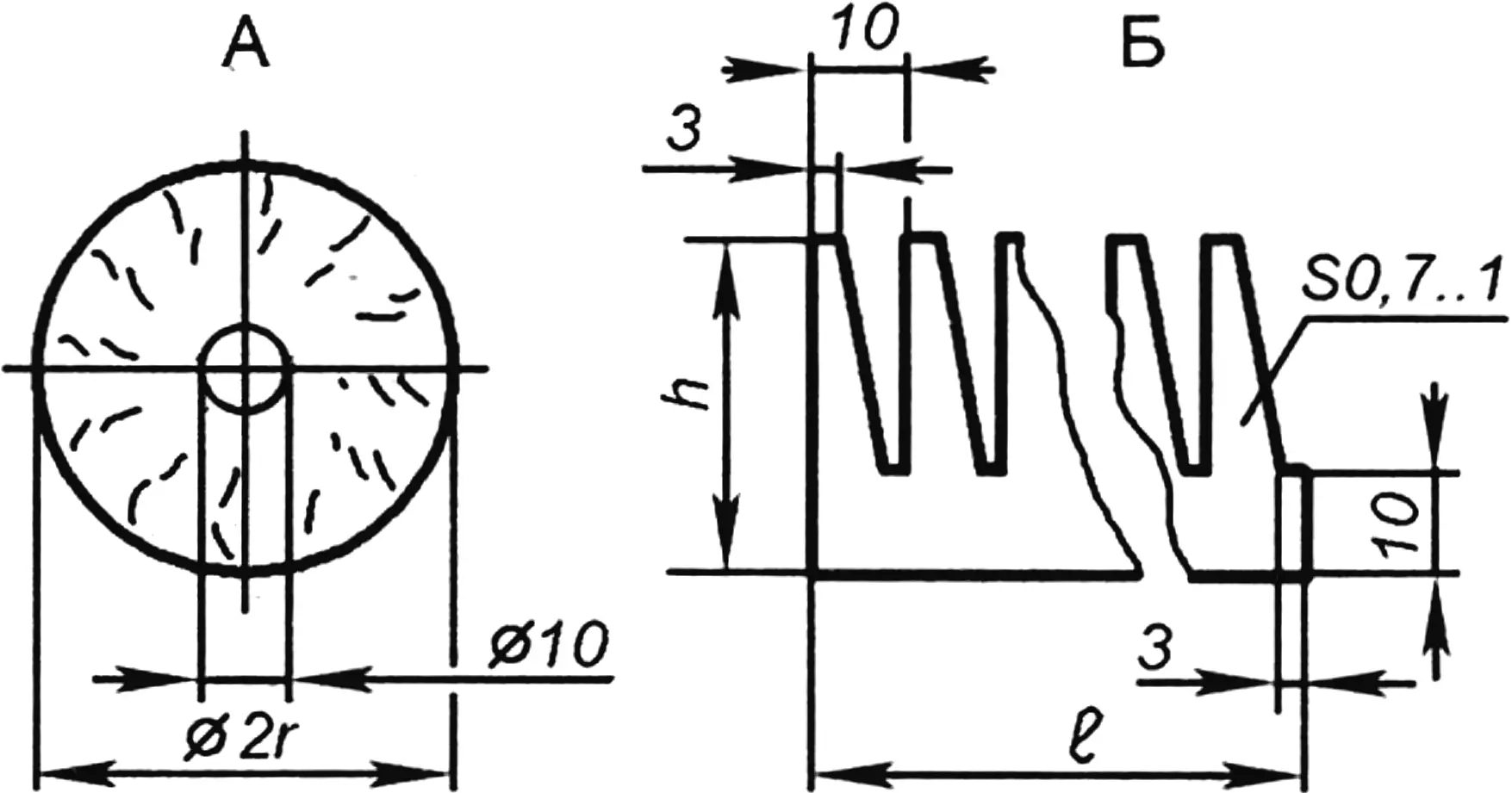
A — view along the inlet pipe axis; B — development
The exhaust gas flow splitter (Fig. 2) is placed in the inlet pipe and is intended for primary smoothing of pulsations. It is made from sheet steel 0.7—1 mm thick, preferably corrosion-resistant. First, a plate of dimensions l × h is cut out. The length l is determined by the known formula for the inner circumference of the inlet pipe: l = 2πr, and the width h = r + 5 mm (where r is the inner radius of the pipe). Then teeth are cut along the length of the blank at 10 mm intervals, and each is bent in a wave pattern at an 80° angle, then again at 90° at the base of the tooth so that a ring with a 10 mm internal passage hole is formed. The splitter is secured by welding at several points.
“Modelist-Konstruktor” No. 11’2010, V. BARYBIN, Mukachevo
Recommend to read
 BRM “LUX” WITH TWO DRIVERS
In the encyclopedic reference book "Tanks" Hagle, published in 1935, stated that "with the installation of the dual control of the military value of the vehicles... can be enhanced as... “DOLPHIN” IS AIRED ON THE CHANNEL
Dreams everyone has their own. Who about what, and Sergey Rudenko, an employee of city station of young technicians, in Slutsk, Minsk region, dreams of a children's technology Park. And...
