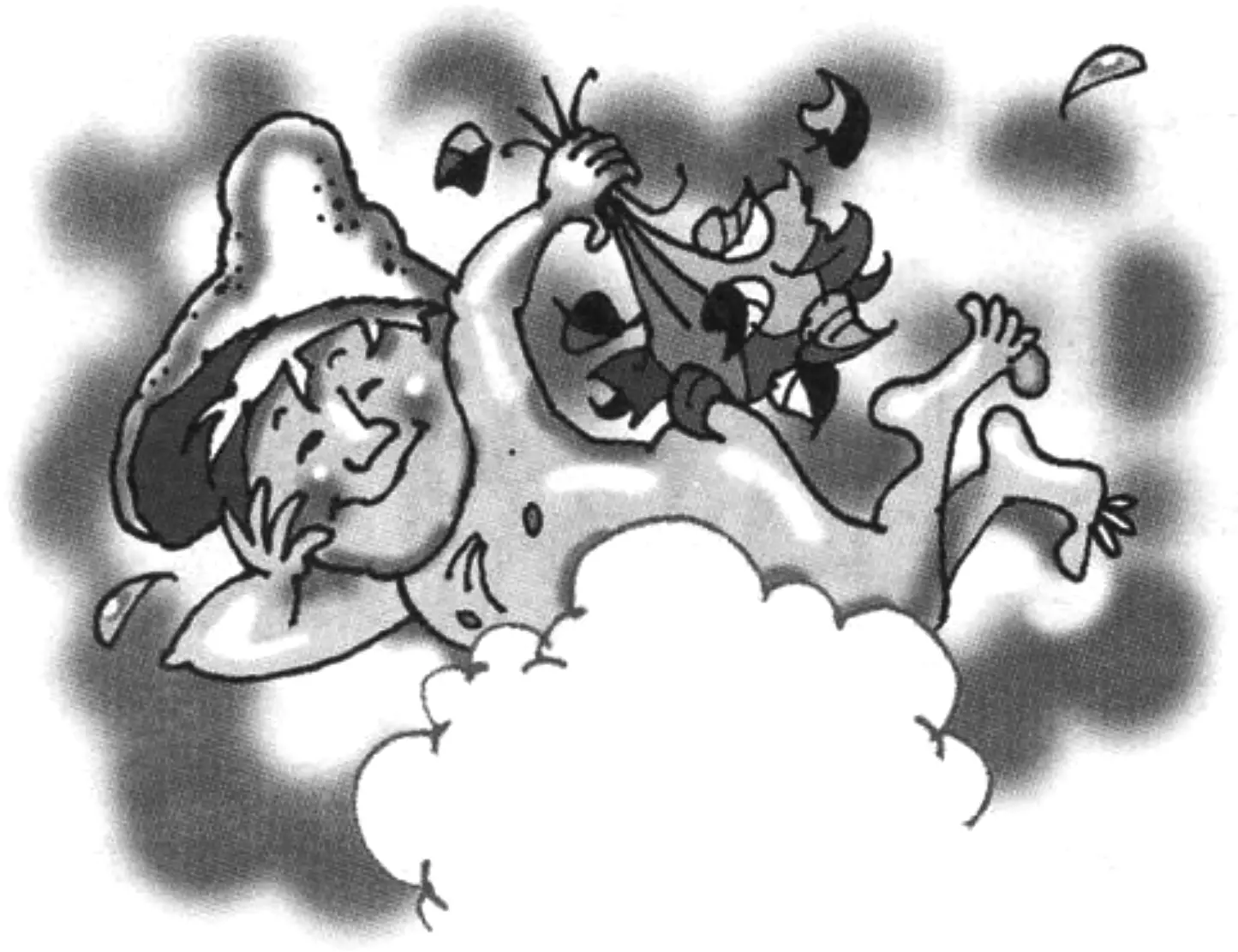
The sauna stove described below is not the first one I have designed and built. Before that, there were designs for a portable sauna “badger hollow” with a simple “samovar”-type stove, and also country saunas with a fairly successful stove-and-steam room unit that served as the prototype for this one, which I called “the bather’s dream.”
In overall dimensions, the stove is not large — length × width × height (without the chimney) approximately 1030×520×1400 mm. But, according to my estimates (and operation confirmed this), these dimensions proved to be the most optimal for a sauna with overall dimensions of the steam room and washing room of 3.3×2.3×2.0 m (length × width × height).
In plan (spatially), the stove is located in the washing room, and only one of its sides with the hinged doors of the steam room unit is brought into the steam room through a non-combustible asbestos-cement concrete partition. In addition, a gap (clearance) is left between the stove and the sauna wall. The wall in this place is lined with an asbestos-cement sheet.
The stove construction is combined: the firebox is brick, while its other elements are metal — made of steel sheet of various thicknesses. The flue channels — the afterburner-spark arrester and the stove pipe — are round in cross-section and made of steel pipes.
The stove stands on a ground foundation from which the top vegetative layer has been removed. Flat rubble stone is laid on the ground. The gaps between the stones are filled with crushed stone mixed with clean river sand, and the surface is leveled strictly horizontally.
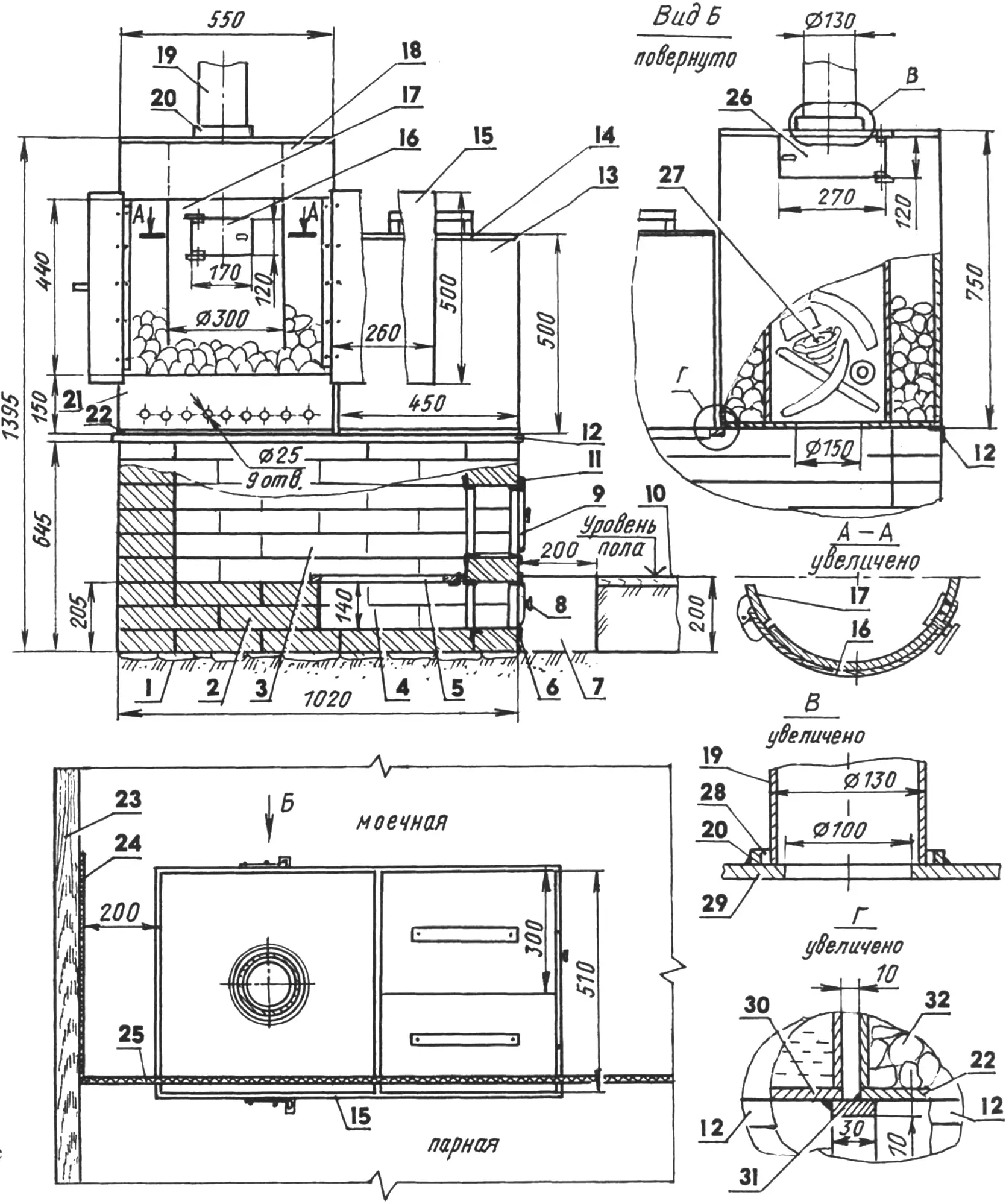
1 — foundation (flat rubble stone, river sand); 2 — stove (ceramic brick 250×125×65); 3 — firebox; 4 — ash pit; 5 — grate (cast iron); 6 — ash-pit door frame (angle 25×25 and steel strip s3); 7 — pit; 8 — ash-pit door; 9 — firebox door; 10 — sauna floor (board s30); 11 — firebox door frame (angle 25×25 and steel strip s3); 12 — firebox tie (angle 25×25); 13 — water tank, 100 l capacity (steel sheet s4); 14 — tank lid (duralumin sheet s2) with handle (aspen); 15 — steam-room door leaf (steel sheet s2, 2 pcs.); 16 — afterburner door; 17 — afterburner (steel pipe Ø300); 18 — steam-room lintel (steel sheet s4); 19 — steel chimney pipe Ø130); 20 — nozzle (steel pipe Ø150); 21 — steam-room threshold (steel sheet s4); 22 — steam-room bottom (steel sheet s10); 23 — sauna wall (logs); 24 — fireproof panel (asbestos-cement sheet); 25 — partition between rooms (asbestos-cement concrete); 26 — steam-room door on the washing-room side (steel sheet s2); 27 — afterburner filler (steel and cast-iron scrap); 28 — sealant (mortar); 29 — steam-room lid (steel sheet s5); 30 — water tank bottom (steel sheet s10); 31 — flue damper (steel strip 30×10); 32 — steam-room filler (rough stones, porcelain electrical insulators)
The stove firebox is built of ceramic (fired clay) brick measuring 250×125×65 mm, on a clay-sand-asbestos mortar. Of course, such a stove heats up longer than a metal one, but it has greater thermal inertia (it stays hot for a long time).
An ash pit is provided in the front part of the stove beneath the firebox. In area it is half that of the firebox, but even this is quite enough to ensure good draft even in summer. The stove is sunk into the ground down to the grate that covers the ash pit.
The firebox and ash pit are fitted with doors with industrially made frames. Boxes welded from equal-leg steel angle No. 2.5 with ties made of 3-mm steel strip are installed in the door openings in the masonry. The upper tie of the firebox masonry is also made of the same angle (the tie is made only on the outer side of the masonry).
A 10-mm steel sheet 550 mm wide and as long as the full width of the stove is laid on the rear part of the stove (when viewed from the door side). This sheet serves as the firebox cover and the bottom of the steam room unit.
A hole 150 mm in diameter is cut in the center of the covering sheet (although this hole can also be made square with the same side dimensions) for the exit of combustible gases and smoke from the firebox.
Afterburning of the gases takes place in the afterburner, which is a hollow cylinder 735 mm high, made of thick-walled steel pipe with an outside diameter of 300 mm. The pipe is set on end on the covering sheet over the hole. Various cast-iron and steel parts and ingots are placed inside the cylinder through a special opening with a door so that they wedge themselves in place and do not fall through the hole. This steel-and-cast-iron filler performs several functions at once. First, it holds back the exit of combustible gases into the pipe, thereby promoting their more complete combustion directly in the afterburner. Second, it (the filler) serves as a spark arrester. Third, the parts and ingots accumulate heat, which is later transferred to the steam room unit. The afterburner is closed on top by a lid common with the steam room unit, made of 5-mm steel sheet.
The steam room unit is a cabinet inside which the “muffler” is located (that is what I call the afterburner-spark arrester-heat accumulator for short). Rough stones and porcelain electrical insulators are placed in the steam room unit to about one-third of its height. I am almost embarrassed to explain their purpose to sauna enthusiasts, but I will still remind you — this is the main and long-lasting heat accumulator for generating steam. In addition, after the sauna procedures are over, releasing the remaining heat together with the stove bricks, it also helps the floors in the washing room dry faster.
The steam room unit has two doors: one relatively small one — on the washing-room side, and a second hinged double-leaf one — on the steam-room side. On this side of the steam room unit, only the lower part remains from the wall — the threshold — and the upper part — the lintel. The threshold holds the stones piled up in the oven cabinet. Holes 25 mm in diameter are drilled in the threshold in a row for better exit of steam formed by evaporation of water that has reached the bottom. Cold air also enters the steam room unit through these same holes when the leaves in the steam room are closed and the door in the washing room is open. Steam, however, is “produced” in the traditional way — by splashing a portion of hot water from a ladle onto the heated stones and insulators.
The lintel, in turn, serves to obtain “superheated” steam, when the steam, rising upward from the stones, is heated even more strongly by the heated walls of the “muffler” and then exits the cabinet into the steam room. In addition, with both doors open (in the steam room and washing room), the lintel helps direct part of the heated air through the small door into the washing room.
A hole 100 mm in diameter is cut in the cabinet lid, on the axis of the afterburner, for smoke exit. A short nozzle with an inside diameter slightly larger than the outside diameter of the pipe is welded above the hole. A chimney pipe is inserted into the nozzle; it goes outside through fire-safe penetrations in the ceiling and roof. The chimney pipe is steel, 130 mm in diameter. The pipe has no damper, but it is covered on top against precipitation with a cap. Draft, however, is regulated by opening the ash-pit or firebox door. The gap between the pipe and the nozzle is sealed with masonry mortar or with any non-combustible material to prevent smoke escape here.
On the remaining free surface of the firebox next to the steam room unit, a welded steel tank for hot water with a capacity of about 100 l is mounted. The tank is shaped like a “square” — a rectangular parallelepiped. The tank bottom is made of 10-mm steel sheet, and the walls — of 4-mm sheet. Two tank lids are made of 2-mm duralumin sheet, and their handles are cut from aspen board. The tank bottom and the steam room unit bottom are connected to each other by a steel strip welded to them, serving as a flue damper. The ends of the strip are joined by welding to the firebox tie angles.
There are two main firing modes:
1 — with the ash-pit door fully open, the sauna heats up quickly (within 1—1.5 hours) even in cold weather;
2 — with the door partly closed, firing is carried out in warm weather and heat is maintained in cold weather.
At the same time, one of four options for heating individual sauna rooms can be used:
1 — the steam-room unit door leaves in the steam room are open and the steam-room unit door in the washing room is open — both rooms are heated evenly at the same time;
2 — the steam-room unit door leaves in the steam room are closed and the door in the washing room is open — priority heating of the washing room takes place;
3 — the steam-room unit door leaves in the steam room are open and the door in the washing room is closed — accelerated heating of the steam room takes place;
4 — all doors are closed — heat is accumulated in the stones in the steam room unit (this option should preferably be used only in the second firing mode — with the ash-pit door partly closed).
To heat the sauna I use firewood of the most varied tree species: both hardwood and coniferous, and even insufficiently dried wood is used. Of course, gas and coal can also be used, but the spirit in the sauna will no longer be the same. Smoke does not enter the sauna interior during firing, relatively little firewood is required. The steam in the sauna is light, there is a lot of it and it lasts a long time, and the water even in a full tank heats up to 90°C.
In short, my family and I are satisfied with the sauna.
“Modelist-Konstruktor” No. 4’2006, A. MATVEYCHUK
Recommend to read
 HOME BATH
For a fan of going to a bathhouse to steam means not only (or rather, not so much) performing a routine procedure of cleansing the body, but a ritual process of “cleansing the soul”. And... ON-A-STRING — LINGERIE
For drying clothes instead of rope is convenient to use thick fishing line, advancing on the strength (calculated on the force of 35 kgf). It is less visible, doesn't spoil the view and...
