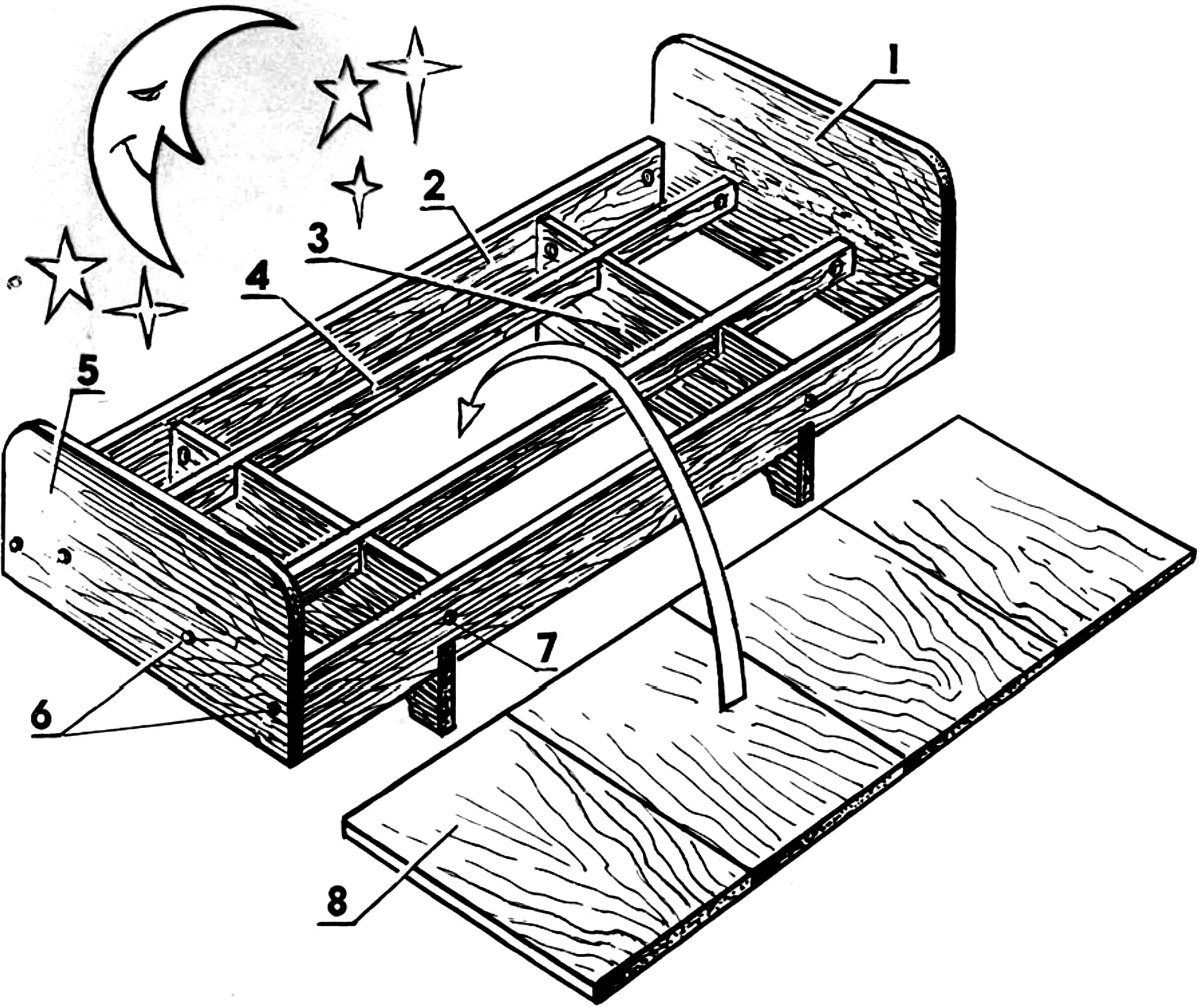
With the approach of the summer-cottage season, this bed in disassembled form can be taken to your country plot even by suburban train or local bus: its parts are easy to dismantle and reassemble.
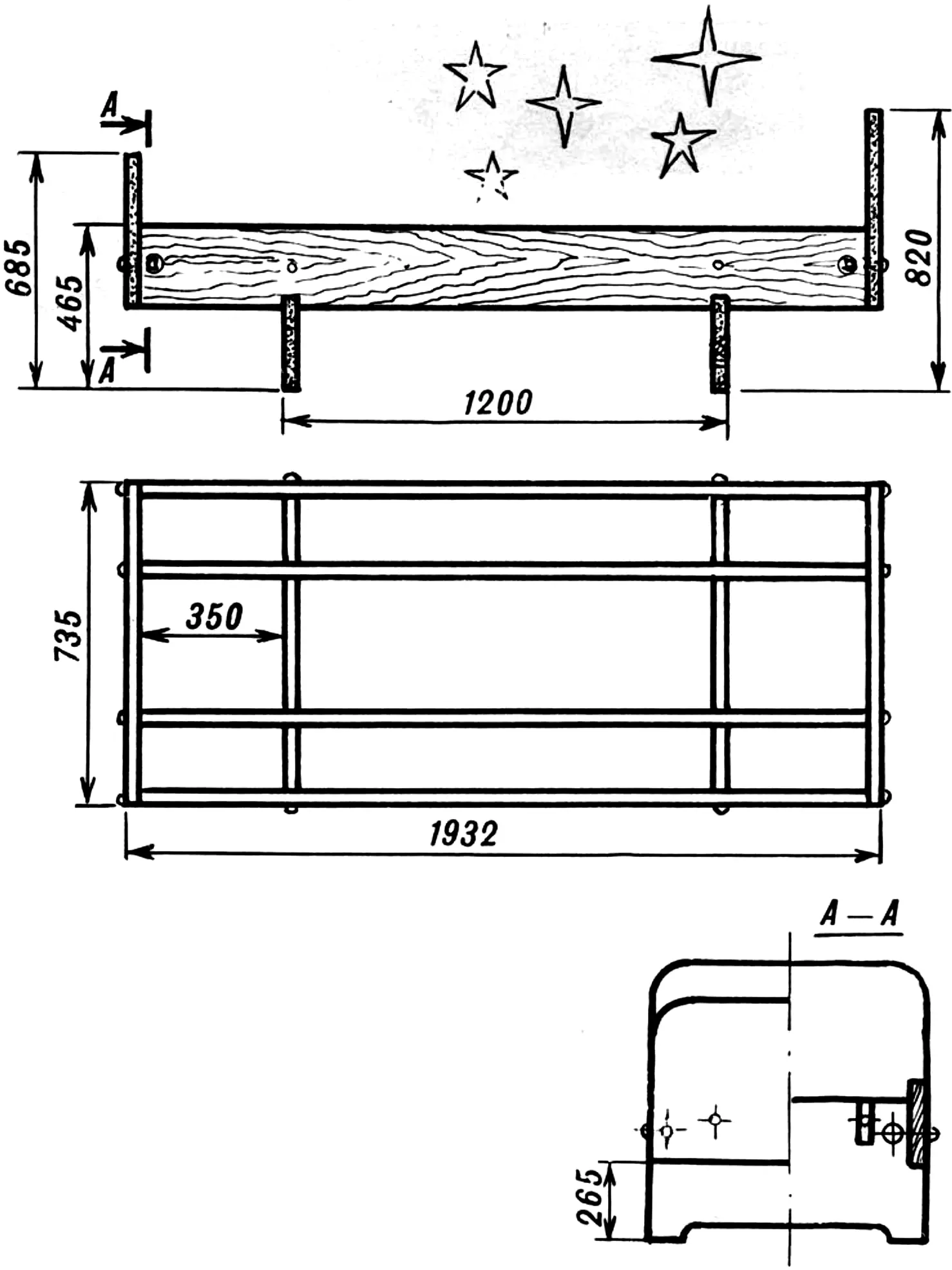
The bed consists of a headboard and a footboard, two side rails, two support panels that serve as legs, and two longitudinal crossbars on which a sectional mattress base rests. All of them are joined with screw furniture connectors, which is why the bed is easy to take apart and put together.
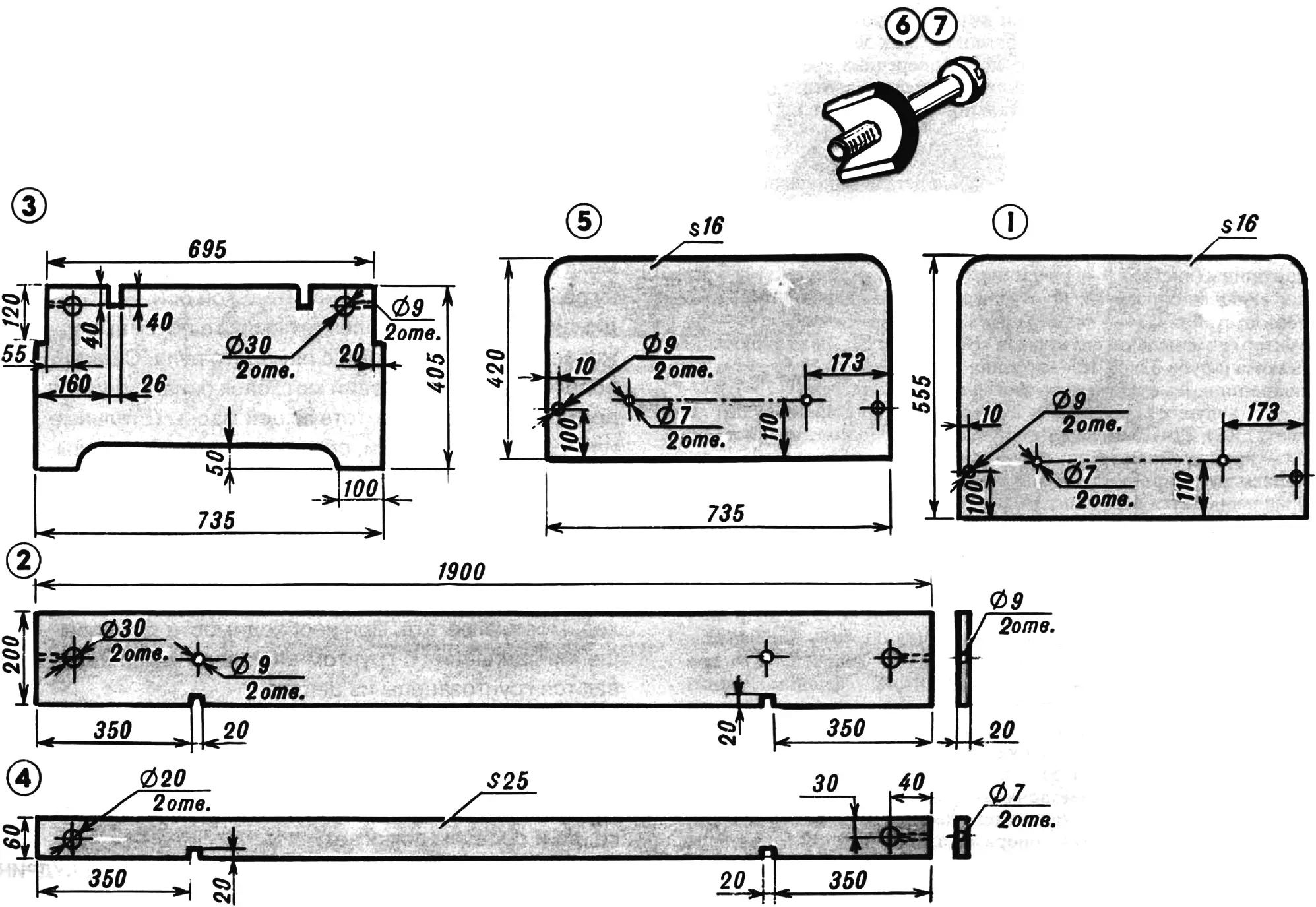
The boards at the ends are made of 16 mm chipboard; the headboard is somewhat taller than the footboard. The upper corners of both panels have rounded edges of an arbitrary but identical radius. In the lower corners there are holes 9 mm in diameter for the furniture connector screws joining the end boards to the side rails. At the same level, each end board also has two more holes for connectors with the crossbars. The side rails are made of 20 mm boards; at the bottom they have grooves for mating with the support panels. The crossbars, made from a 60×25 mm board, have the same grooves for the same purpose.
The support panel-legs are cut from 20 mm chipboard. At the top on the sides they have cutouts for the bed’s side rails, and next to them — grooves for the crossbars. A long shaped cutout is made along the bottom edge; the remaining outer parts of the panels act as the actual legs. Polyethylene strips are fastened underneath as feet so that the legs do not scratch the floor.
10|
1 — headboard (chipboard, s16); 2 — side rail (board, s20, 2 pcs.); 3 — leg panel (chipboard, s15, 2 pcs.); 4 — crossbar (board 60×25, 2 pcs.); 5 — footboard (chipboard, s16); 6 — furniture connector, end (M6 screw, 8 pcs.); 7 — furniture connector, side (M8 screw, 4 pcs.); 8 — mattress base.
Since the bed’s side rails end up slightly higher than the level of the support panels with the crossbars, they act as stops for the mattress base, keeping it from shifting sideways. With this in mind, the width of the mattress-base blanks is selected; they are several panels of plywood or chipboard packed tightly between the headboard and the footboard. The base could also be solid, but a sectional one is more practical and easier to transport.
Standard furniture connectors available for sale are used. However, they are not hard to make yourself. All you need are eight M8 screws 80 mm long and four M6 screws 60 mm long, plus a tube 15—30 mm in diameter. From the latter, rings are cut with a hacksaw to a width equal to the thickness of the bed parts, then split in half into half-rings. Next, holes are drilled in them and M6 and M8 threads are cut.
After all of the bed’s panels — the headboard, footboard, leg panels, and base — have been made, their edges must be veneered or edged with plastic. The surfaces should be primed with natural drying oil and, after being thoroughly dried, painted with enamel paints in brown, yellow, or dark green.
A standard cotton or foam mattress 8—10 cm thick is laid on the mattress base.
Enjoy your rest!
“Modelist-Konstruktor” No. 4’99, B. POTAPOV
Recommend to read
 Canoe-shuttle
It often happens that guides on how to build a boat yourself simply scare off beginners with such “mysterious” words as “epoxy resins,” “foam,” “fiberglass,” “bakelized” or “aircraft... Plowing… with a winch
Many rural amateur constructors quite rightly consider the motor winch the most promising soil‑tillage unit. It is not without drawbacks, however. The main one is the need each time to...
