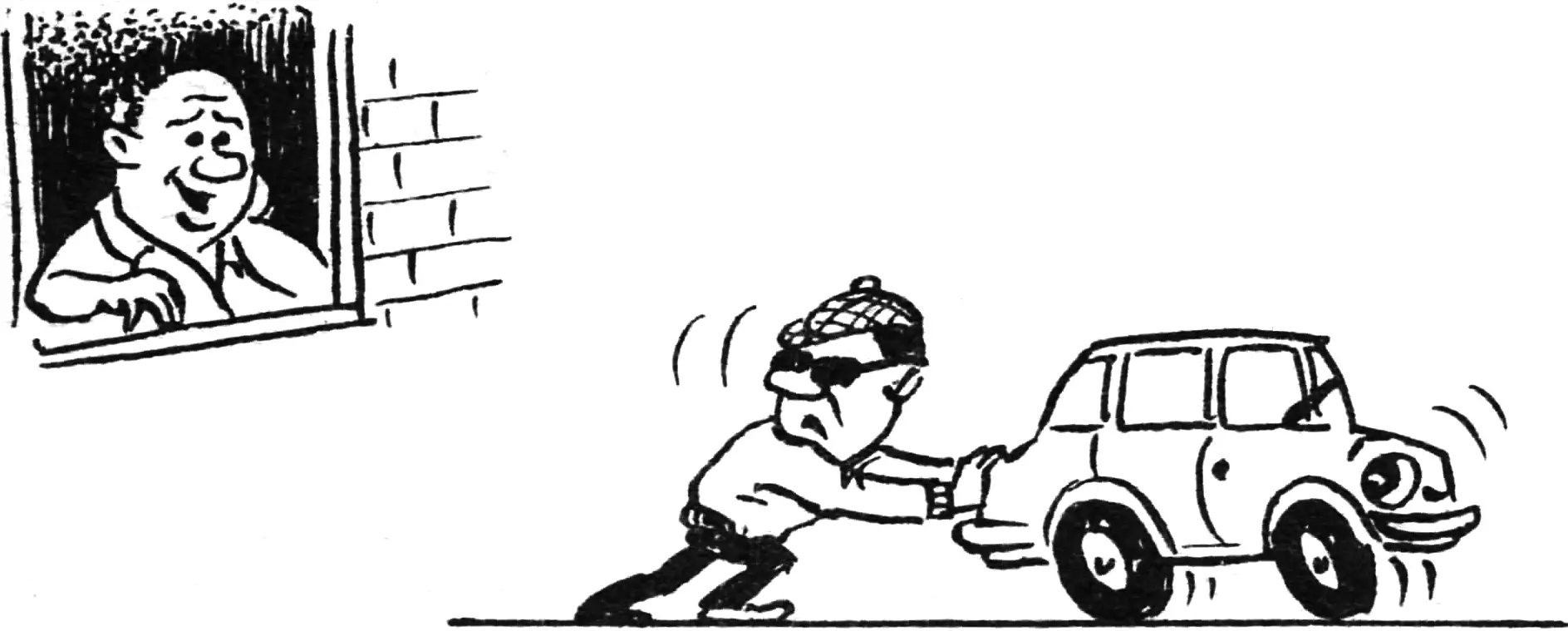
Having read in issue No. 1 of “M-K” for 1989 a description of an electronic vehicle ground cut-out, I decided to use it as a simple anti-theft device. However, when the toggle switch is replaced with a push-button (as recommended by the designer V. Arapov) or with a reed switch, a highly undesirable effect occurs: when the voltage produced by the generator equals the battery voltage, the thyristor turns off. Thereafter the vehicle’s electrical system is powered by the generator alone. And because, to save fuel, the engine is set for minimum idle speed, the voltage produced by the generator in this mode will be reduced. Consequently, when moving off (and with a “weak” generator — also when the lights are switched on) the engine may stall. But the main danger arises during emergency braking, because when the engine stops the onboard system is de-energized and the brake lights do not come on!
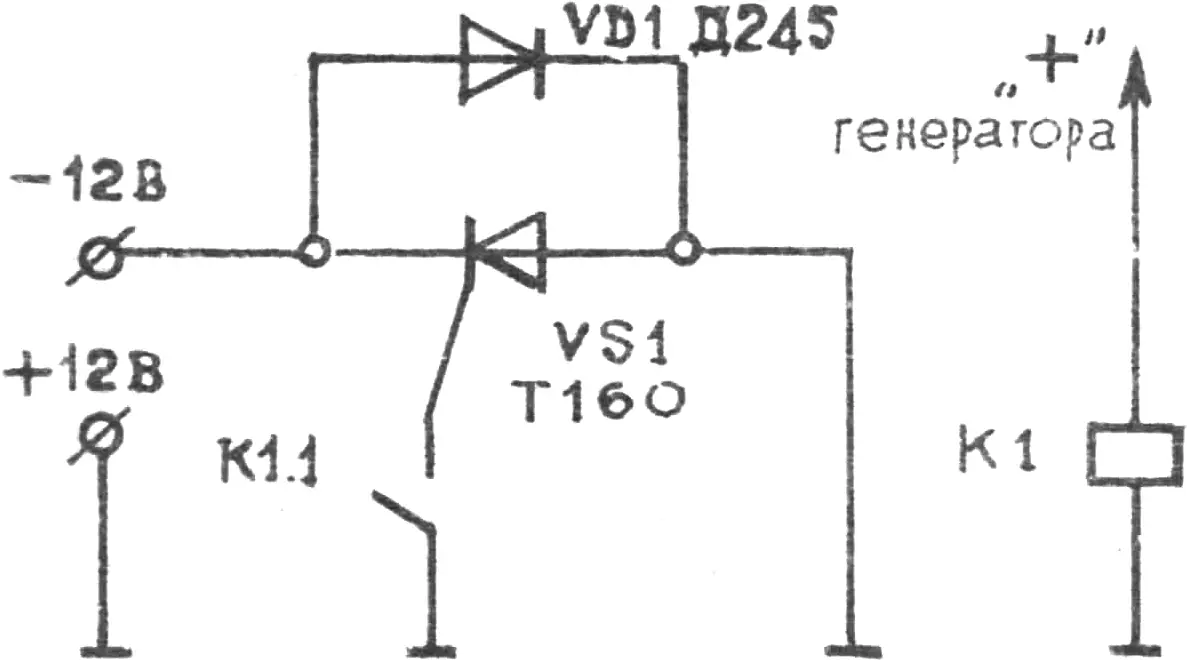
These shortcomings are easily eliminated by using a compact reed relay, type RES-55. The circuit diagram of the device is also substantially simplified. Here the ground is switched on by a magnet brought up to the relay housing, and it is switched off automatically, but only when the engine is “de-energized” with the ignition key.
True, when the device is used as an anti-theft measure it is advisable to replace the semiconductor diode in the previous circuit with a more powerful one. For example, a D132-50, because a concealed installation in the engine compartment impairs cooling. Particular attention should be paid to the diode’s forward resistance. The voltage drop across this element must not exceed 0.5—0.6 V, so that battery charging is not disrupted.
One more point. To cut off the ground in the event of a short circuit, it is advisable to install a suitable toggle switch in series with the thyristor in any convenient place in the cabin.
“M-K” 1’94, V. MORDAN, Tashkent
Recommend to read
 ELECTRODISCO?
No, just securing the bottom of the Ironing Board extension socket, you can remove the wire from under the feet to ensure additional comfort and to comply with the rules technici security. ROCKET – PARITEL’
In one of the rooms "M-K" in the report from the championship of Russia on model rockets, I noted the rocket plane category S4 Nikolay Tsygankov team in Murmansk region. I must say that...
