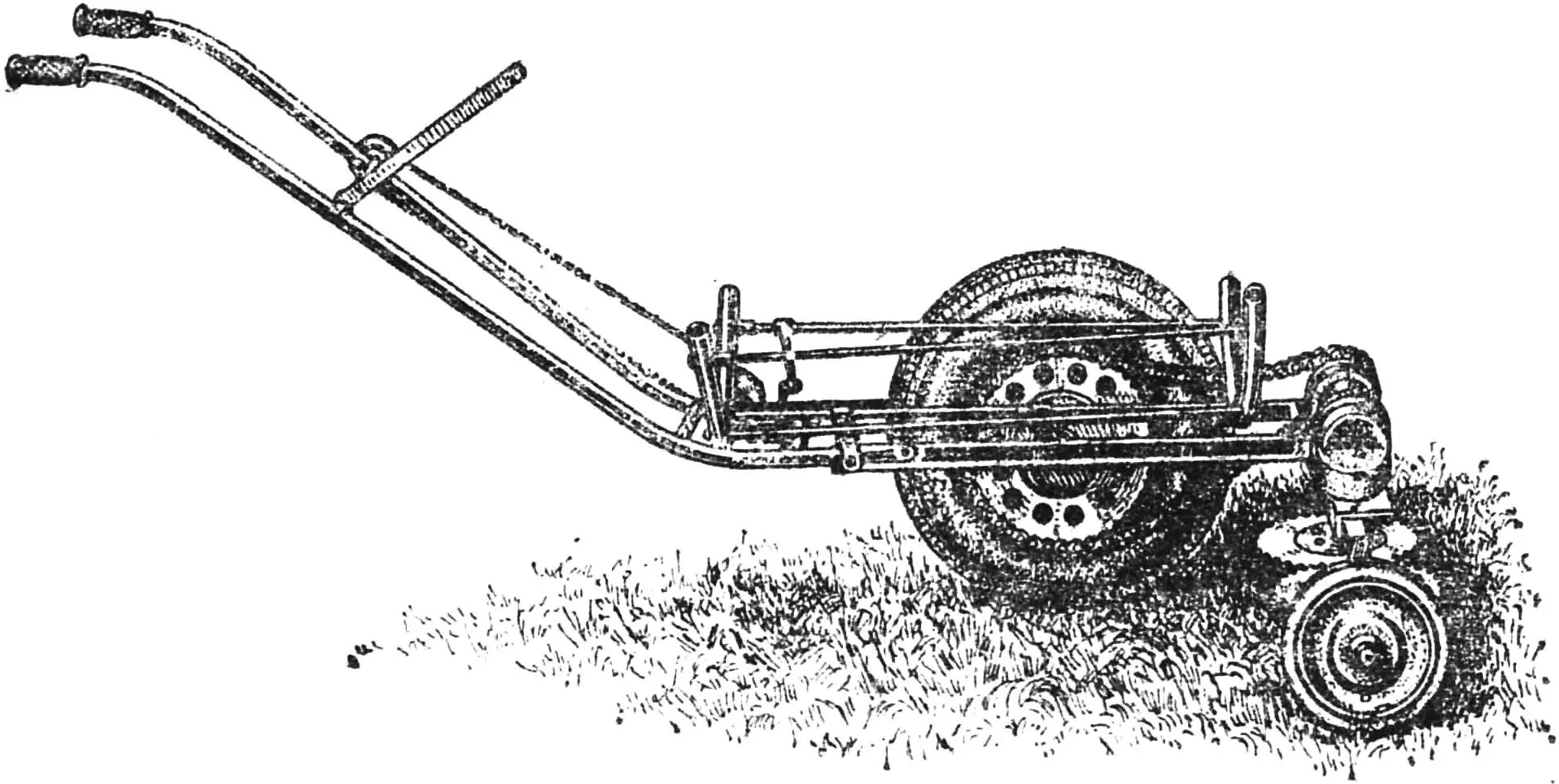
Everyone knows how corn and sunflowers grow. But few people can picture what harvesting them looks like. On large areas, of course, combines and other machines are used, while on small ones — say, school or experimental plots — lawn shears are still used to this day. Yet such work is very tiring and, more importantly, unproductive. Our young technicians Tolya Sinkevich and Sasha Ketiya set out to design a hand mower for thick-stemmed plants. They came up with a simple and interesting design that became the basis of the mechanism. The mower took its final form after a series of improvements and refinements proposed by Sasha Malkov and Sergey Bolgarchuk: now it is a real unit that not only cuts but even neatly lays down the cut plants.
They are cut by means of two metal disc blades with counter-rotation. The blades are driven by two gearboxes — gear drives with intersecting shafts — and a chain drive from the sprocket of the drive wheel when the mower is pushed.
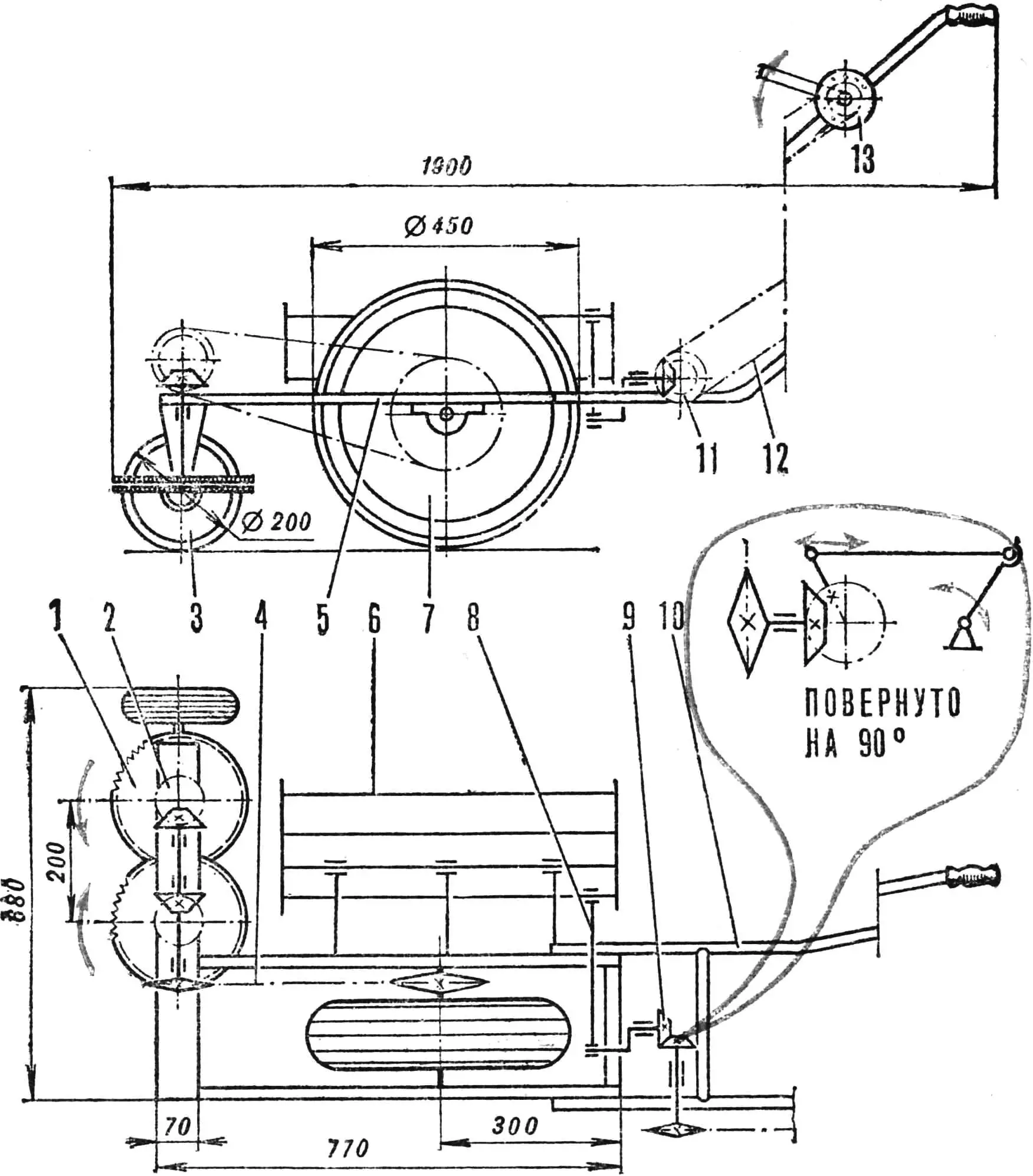
1 — disc blade, 2 — disc blade gearbox, 3 — mower support wheel, 4 — disc blades chain, 5 — frame, 6 — gatherer cage, 7 — drive wheel, 8 — cage rod, 9 — cage gearbox, 10 — mower handle, 11 — gatherer control mechanism sprocket, 12 — control mechanism chain, 13 — control unit.
A gatherer with a cage welded from metal rods, onto which the cut plants fall, is intended for collecting the mown stems. There is also a gatherer control mechanism: a chain drive, a gear reducer, and a pair of rods bent at a right angle that act like a crank. Tilting the control unit handle is transmitted via the chain, gearbox, and rods to the cage: it tips aside, and the stems slide off it. Moving the handle back returns the cage to its place.
Recommend to read
 DOSING THE GLUE
A commercially available kit of epoxy resin and hardener not work: I unscrewed the lid of the containers and figure out what to extract and how to dose the contents. So I made this. A... “DESNA” WITH THE MOTOR
For his bike, I chose a folding bike "Desna-2" In model-849 with smaller wheels (20 X 1.75). To install it on the motor, did some fine-tuning. Fig. 1. Bicycle "Desna" with...
