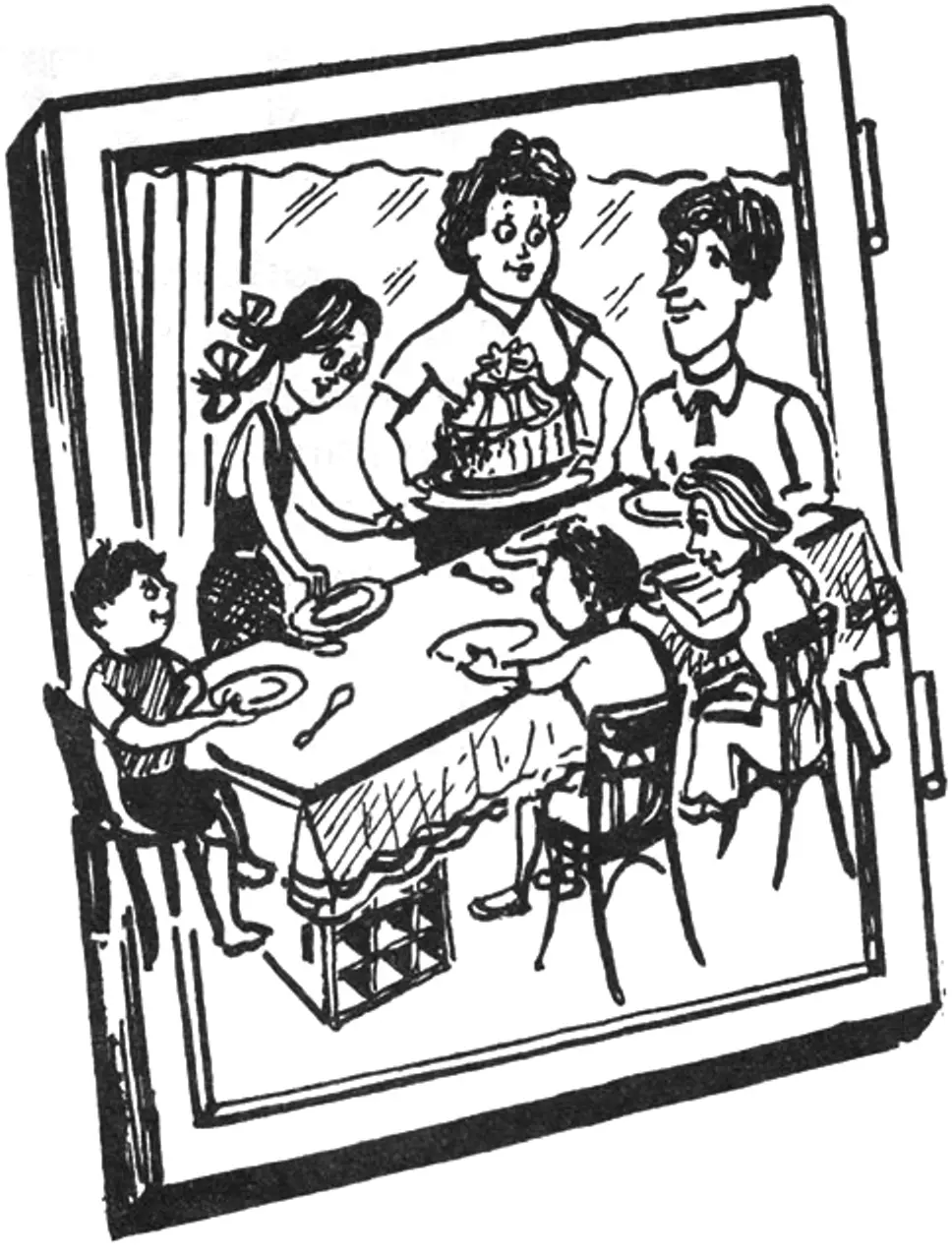
The need for a large guest table at a country plot does not arise very often — only when friends or relatives come together to relax in the fresh air or to celebrate some family event or occasion.
But it hardly makes sense to make special furniture for such a case, furniture that will remain unused most of the time and stand idle. Moreover, it will get in the way, taking up useful space, or deteriorate in bad weather if kept out in the open, like all garden structures.
Of course, for such an occasion you can assemble something from small tables brought out onto the lawn. However, you will most likely end up with something uneven in size and inconvenient.
Nevertheless, there is an option that will help in such a situation, even if it arose unexpectedly. The Hungarian magazine “Ezermester” suggests that you can quickly put together a large table without making anything special, by using… any door.
It is preferable to use not a panel door but a smooth one, so that irregularities do not create “surprises” under the tablecloth or oilcloth when the door temporarily becomes a tabletop. The only thing it will need, once removed from its hinges, is some kind of support.
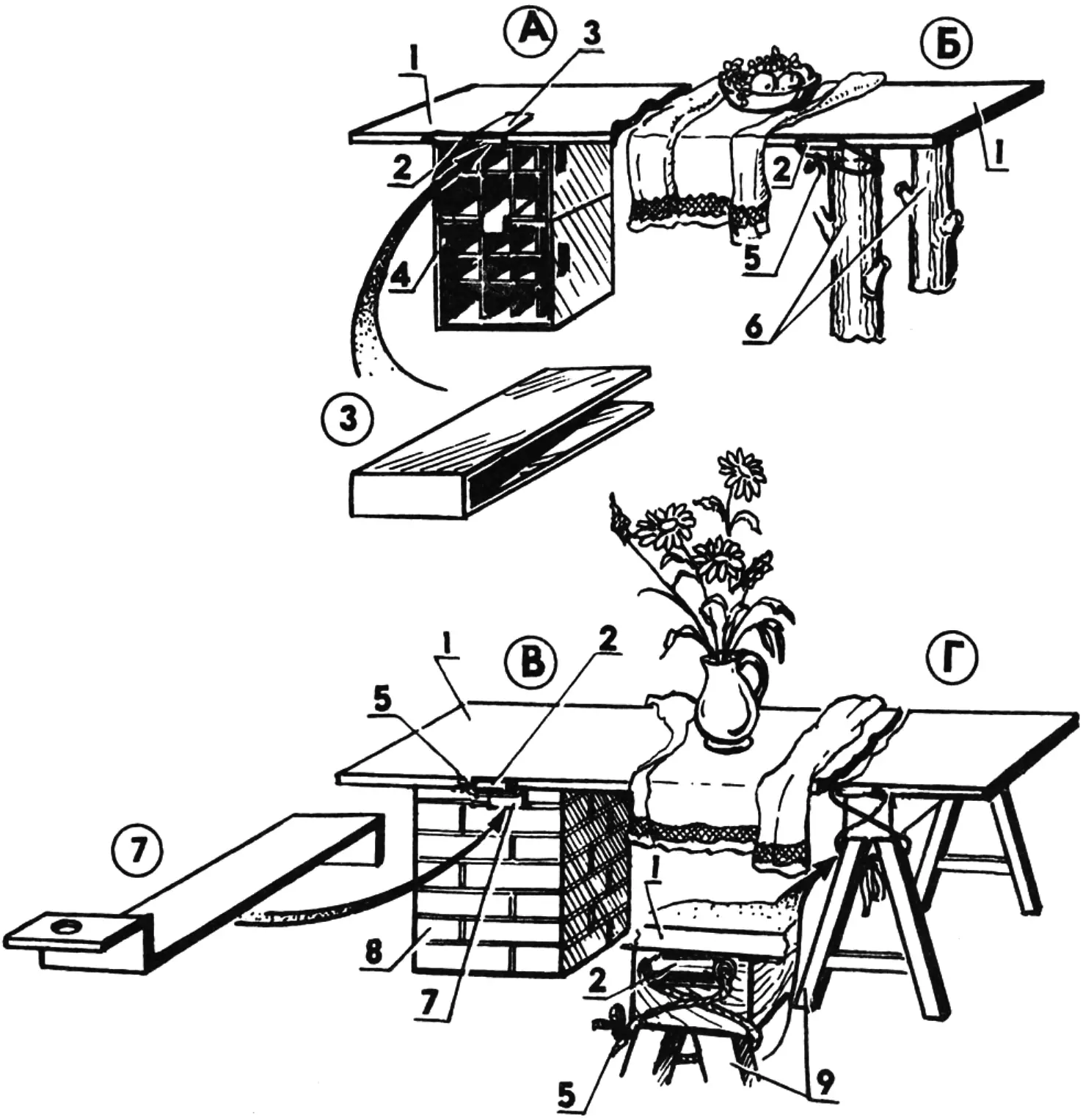
1 — door-top; 2 — door hinges; 3 — clip made from a metal strip; 4 — packing crate; 5 — cord (wire); 6 — stumps; 7 — shaped bracket; 8 — pedestal; 9 — sawhorses
Almost any stand will do as a support (examples are shown in the drawings). Interestingly, in all versions the door hinges play an active role: they make it possible to reliably fix the improvised tabletop on any stand so that there are no shifts during careless movement by those seated at the table.
The table options shown are extremely simple and depend only on what happened to be at hand at the moment. If suitable stumps of the same size are found in the woodshed, they can also be used as legs, not forgetting to attach the door-top to them with cord or wire through the hanging hinges.
Packing crates stacked one on top of another and fastened together and to the door with improvised clips made from metal strips bent in half will also serve as a sufficiently stable support.
More solid options are also possible, providing maximum stability and reliability for a temporary table. For example, wooden or metal sawhorses will serve no worse than legs (and perhaps even better), to which the door leaf must also be attached through the hinges. And a truly sturdy table will result if brick pedestals for garden planters are used. Especially if, when laying them, a shaped metal bracket is built into the top row of bricks in advance, which will make it easier to fasten the door-top (also through the hinges).
“Modelist-Konstruktor” No. 3’2002
Recommend to read
 PROTOTYPE -HOURGLASS
The Romanian magazine "Technium" offers a diagram of the electronic timer operates on the principle of the 5-minute hourglass clock every minute. The indication to carry out the LEDs.... Funicular for a skier
For tourists and skiers in "large" mountains with complex terrain and significant elevation differences, chairlifts are usually installed. On their traction-carrying cable, they have...
