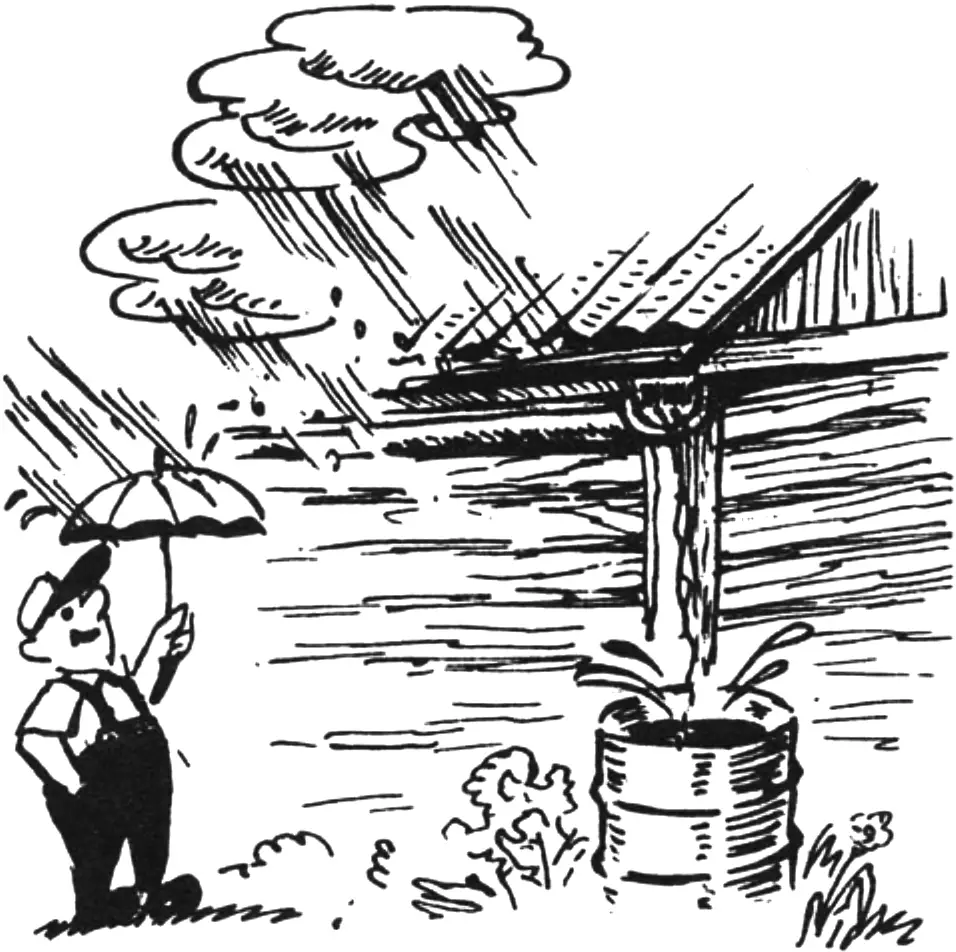
My new house is good in every way, but it has no gutter. Rain runs off the roof onto the foundation, and in windy weather it also hits the walls. In the store, drainage gutters with brackets and especially the elbow pipes with funnels inspire a quiet melancholy with their appearance. I did not want to spoil the house’s attractive look with them.
So I decided to do it my own way. Why not hang the gutters directly on the edge of the roof, since corrugated iron roofing is rigid, and even stronger at the overlaps between sheets? I made brackets from steel strip and coated them with primer and enamel paint. I shaped the “bed” in the brackets to match the radius of the gutters, and the gutters themselves were made from defective plastic pipes 100 mm in diameter, cut lengthwise along the axis with a fine-tooth hacksaw.
I determined the bracket mounting points on the ground in advance, according to the gutter length and the spacing between roof sheet overlaps. It is also acceptable to install brackets outside the overlap, especially if the gutters are removed for the winter. I selected aspen spacers between the roof and the brackets in different thicknesses: the closer to the downspout, the thicker they were, so as to create a slight slope in the gutters. For a secure connection, I first attached the spacers to the brackets with one screw, then drilled holes through the brackets into the spacers and the roof, and joined everything with galvanized M6 bolts.
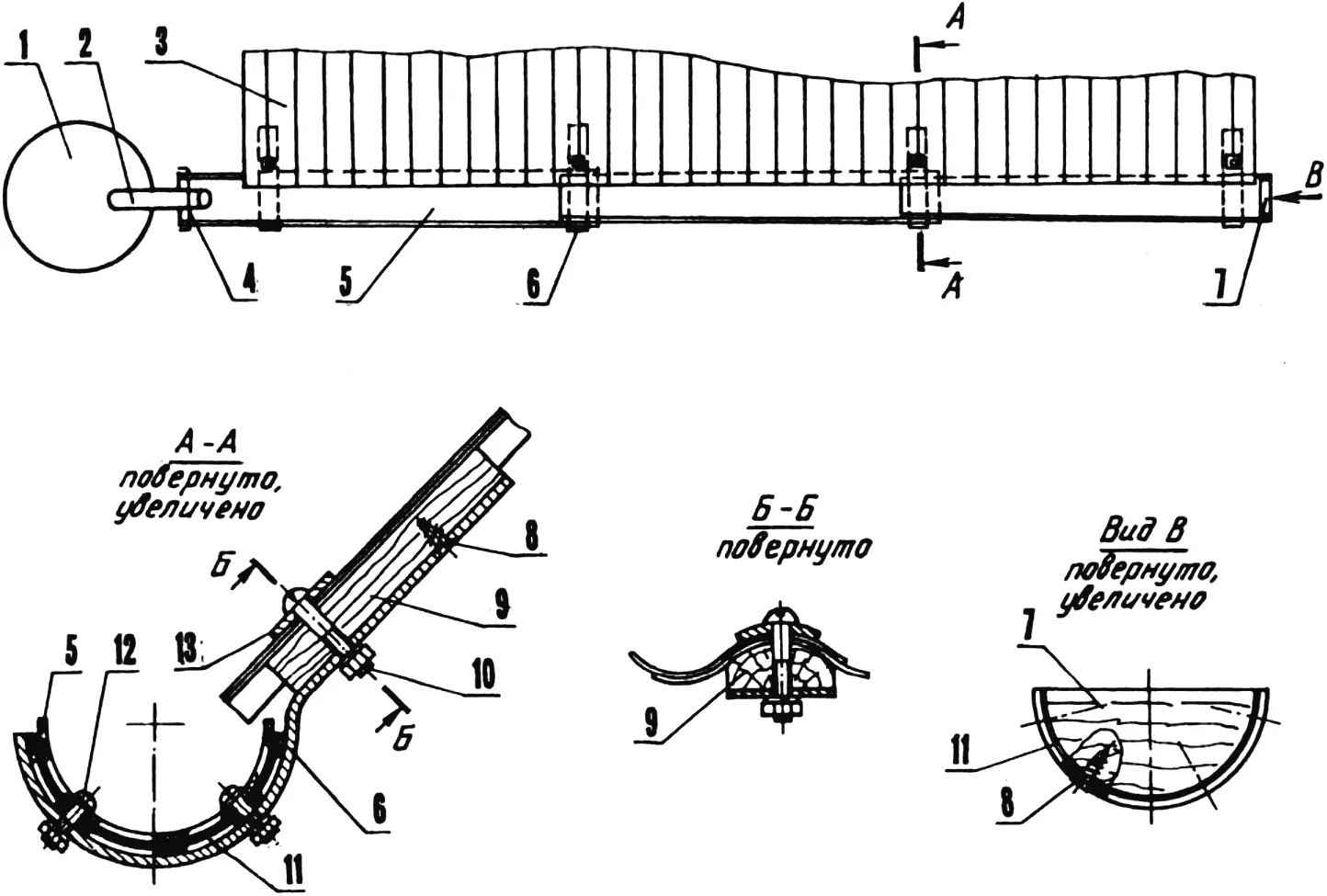
1 — barrel; 2 — downspout (pole Ø30, L3200); 3 — roof; 4 — retainer (aluminum wire, Ø2); 5 — gutter (blank — plastic pipe Ø100, L2000, 3 pcs.); 6 — brackets (steel, strip 300x36x2, 4 pcs.); 7 — end cap (wood); 8 — screws 4×16 (8 pcs.); 9 — spacer (wood, 4 pcs.); 10 — bolt M6x48 (4 pcs.); 11 — sealing gaskets (soft rubber 140x15x2, 3 pcs.); 12 — bolt M4x16 (8 pcs.); 13 — shaped washer (aluminum alloy, sheet 20x20x3, 4 pcs.).
During assembly, I placed sealing gaskets made of soft rubber 2 mm thick at the gutter overlaps. I plugged the end of the gutter farthest from the downspout.
My downspout is the simplest kind — an aspen pole stripped of bark, installed between the end of the gutter and the bottom of a water-collection barrel. The upper end of the pole is secured with wire passed through two holes in the gutter. Water runs down the pole, and only during strong gusts of wind is it partly blown off and falls beside the barrel.
To some people, a pole downspout may seem unattractive. Well, it can be painted a bright color, the upper end protruding above the gutter can be decorated imaginatively, and so on. After all, it would also be nice to spruce up the water barrel.
So, rainwater ends up in a trap — reasonably attractive, inexpensive, and made with one’s own hands.
“Modelist-Konstruktor” No. 8’2000, V. NOVIKOV
Recommend to read
 ROCKET FIGHTER TANKS
In 1957 the Soviet Union began to develop missiles for army vehicles. In the Kolomna Design office of mechanical engineering B. Shavyrina studied the possibility of equipping tanks... JAGUAR XK8
British company Jaguar Cars belongs to Ford, and thanks to his financial assistance develops and manufactures high-quality cars, combining sporty performance with ride comfort. Their...
