A diamond glass cutter cuts window glass perfectly, but using it correctly is not that simple. Unfortunately, the skill comes only after a dozen or two panes have been irreparably ruined, and even then a precise cut is far from always achieved.
To prevent this, while cutting you must keep the tool constantly perpendicular to the glass. The pressure on the tool should be such that the diamond leaves behind, as it moves, an even, thin, barely visible line. If the clamping force is too great, a wide scratch and a film of glass dust form; glaziers say the diamond “whites.” If the pressure on the tool is insufficient, no scratch is produced at all.
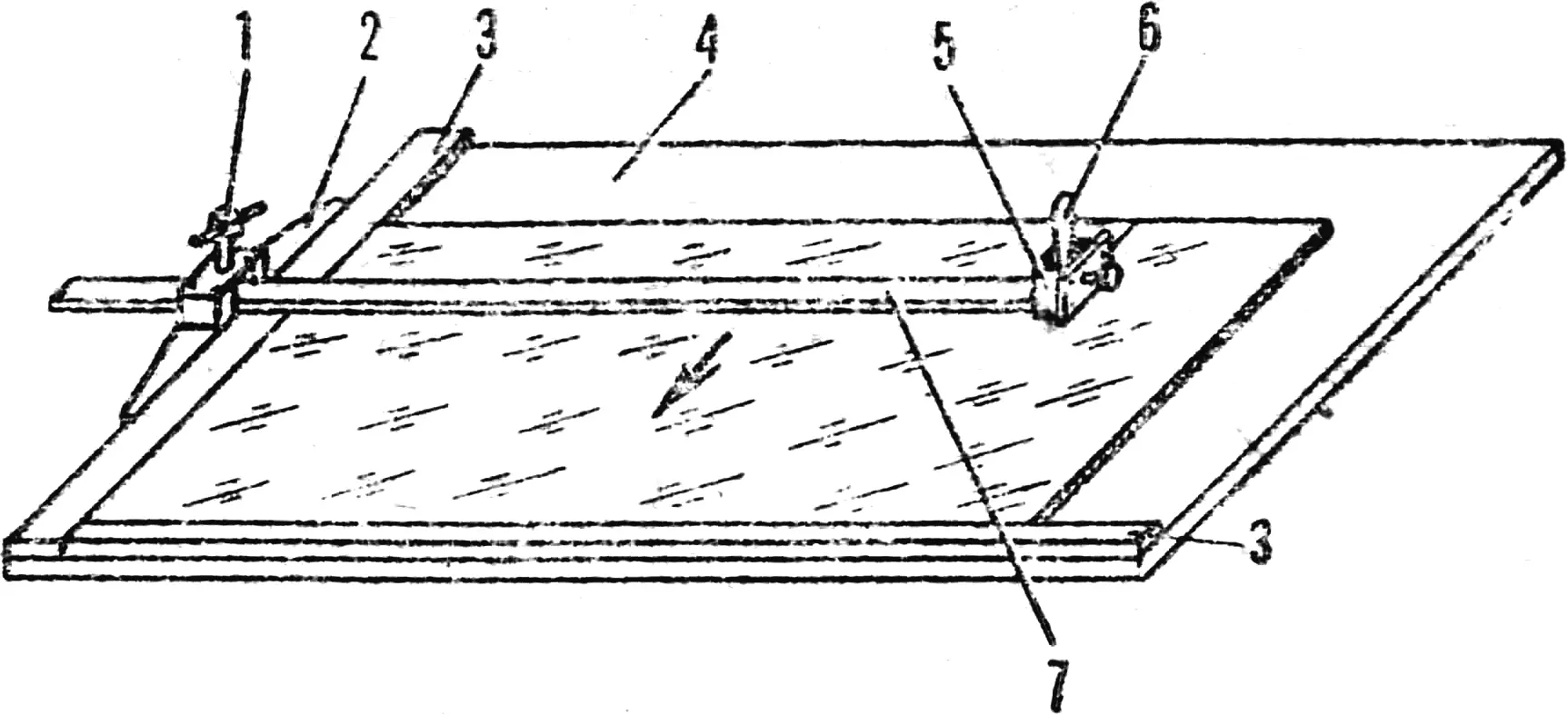
Fig. 1. Fixture for cutting glass:
1 — T-square rail lock, 2 — T-square guide bar, 3 — stop rulers, 4 — table, 5 — diamond glass-cutter holder, 6 — diamond glass cutter, 7 — T-square rail.
I designed a fixture that keeps the diamond perpendicular to the glass surface and moves it in a straight line. All that remains is to watch the pressure on the glass cutter.
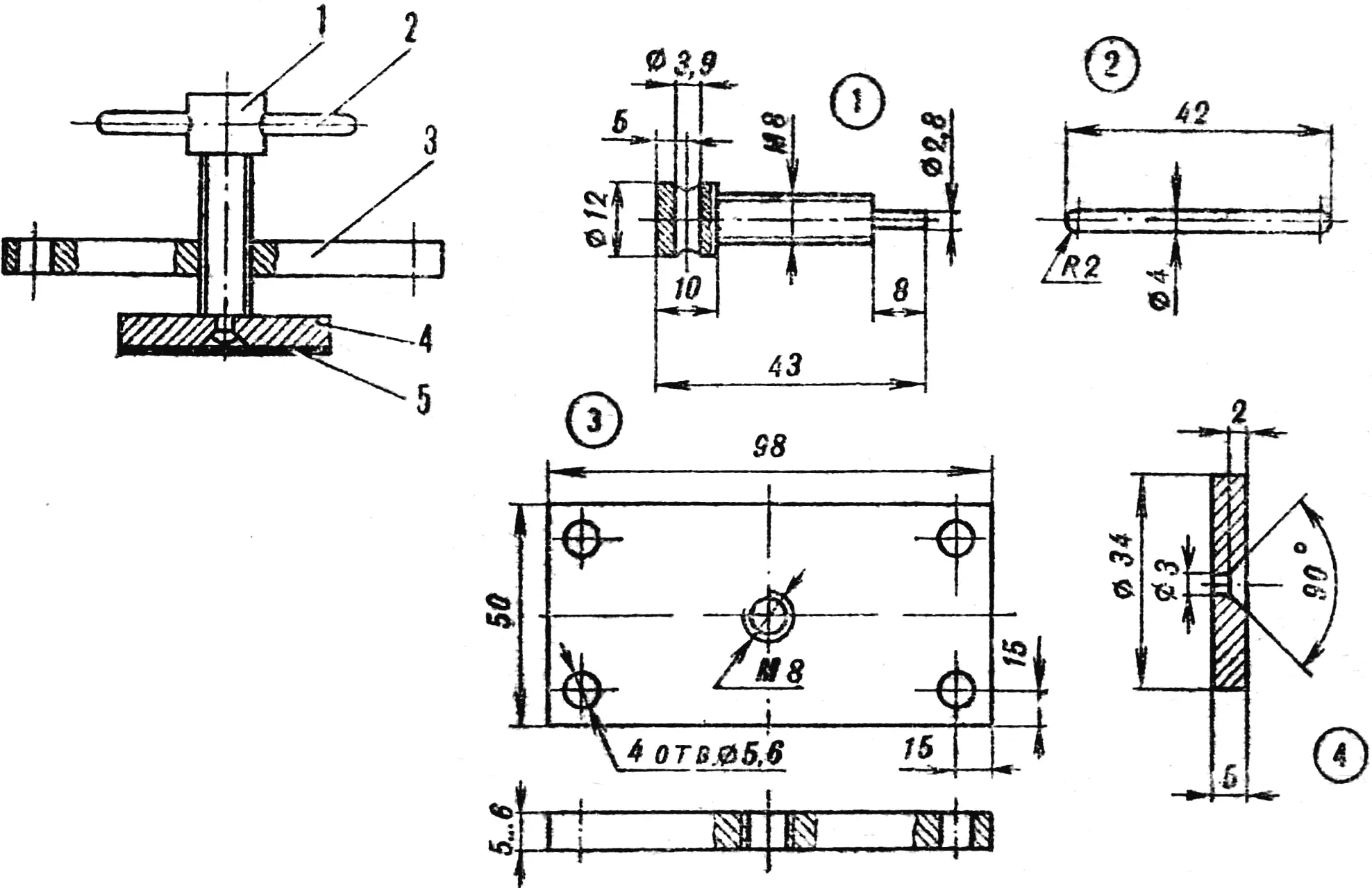
1 — M8 bolt, 2 — rod, 3 — bar, 4 — clamping washer, 5 — leather pad.
The table is cut from particle board. Its left and bottom edges must be strictly straight and perpendicular to each other, because they serve as guides. Stop rulers of 2X30 mm cross-section, made from beech or birch strip, are glued to these same edges and marked with divisions at 5 mm intervals. The zero marks must be at the vertex of the right angle.
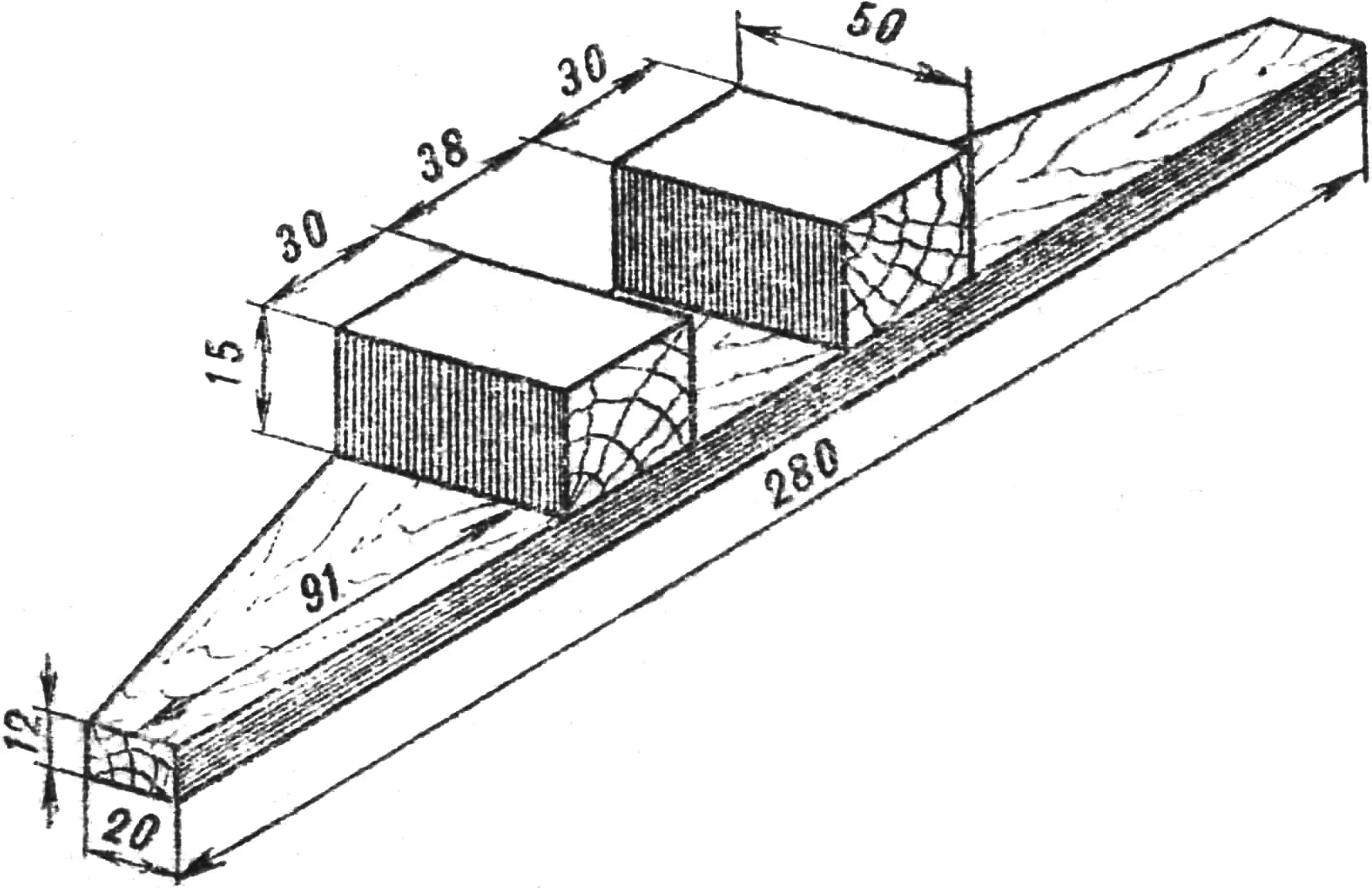
The T-square rail is beech or birch; its dimensions are 10X38X1500 mm. At one end of the rail a recess is made, where the glass-cutter holder is fastened with countersunk-head bolts. The reference point for the divisions that must be marked on the T-square rail is the edge of the table guide bars.
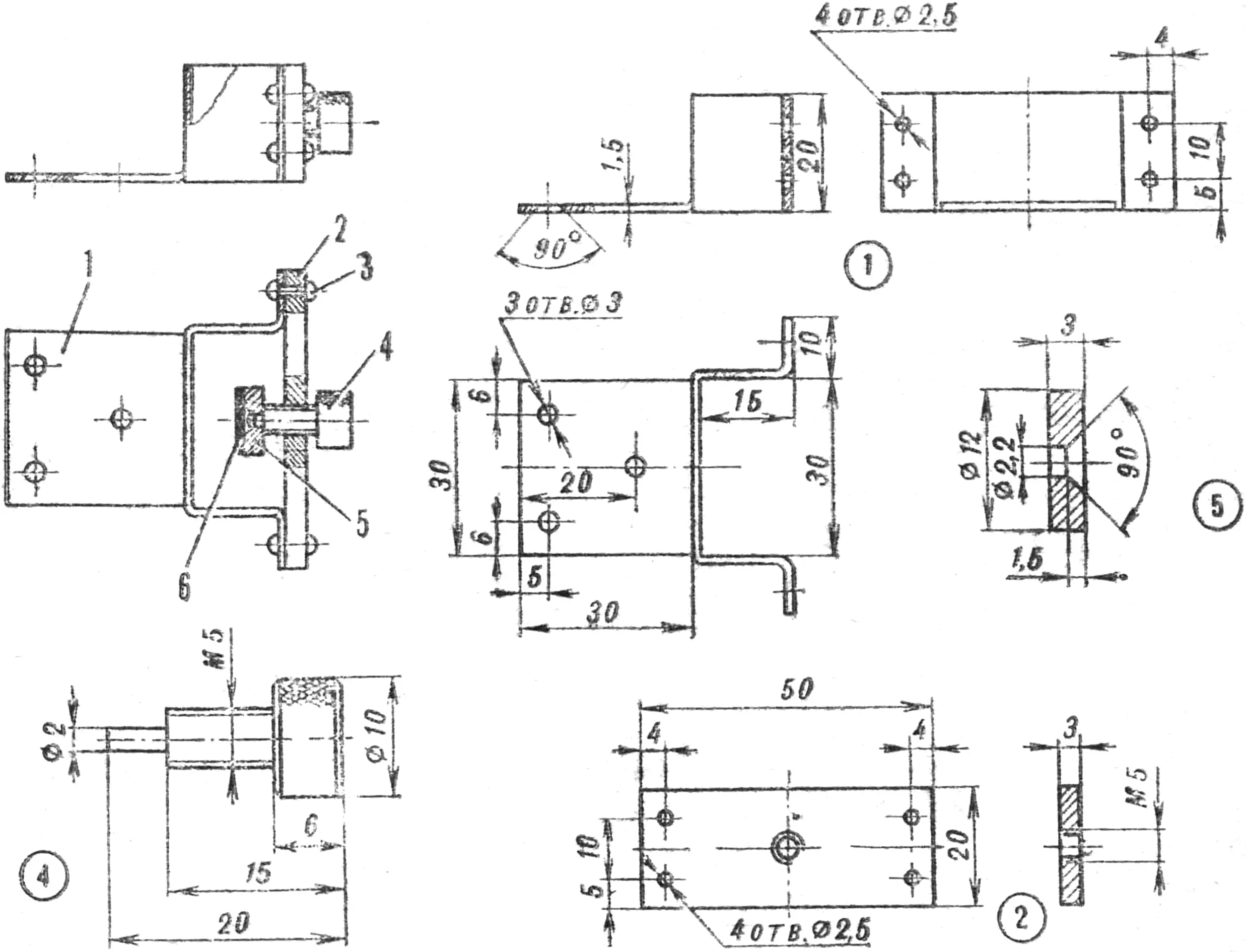
1 — base, 2 — post, 3 — rivet, 4 — clamping screw, 5 — washer, 6 — leather pad.
A rail lock is fitted on the T-square guide bar. The leather friction pads in the lock and in the glass-cutter holder are secured with “88” glue. The T-square rail should move in the guide freely enough, but without play.
Finally, all wooden parts of the fixture are coated with several coats of furniture varnish.
For use, the fixture is set on a workbench or a sturdy table. The glass cutter is inserted into the holder and locked with the screw. The size of the glass to be cut is set by the divisions marked on the table stop strips. The glass sheet is laid on the table flush against the stop rulers. A score is drawn on the glass by moving the rail toward you. Glass can be cut using either the left or the bottom side of the table as the reference.
“M-K” 4’83, Yu. ZHDANOV, teacher
Recommend to read
 RENAULT CLIO V6
The history of automotive technology well know that the majority of technical solutions, successfully used in mass-produced cars first appeared on race cars. Apparently, the same process... WOOD ENGINEERING
Say, in the Urals during the difficult years of chaos after the civil war an artificer built a car where everything was wooden, even the engine. However, if the wizard so the echo...
