
One day I came across an article “Vitamin jack” (“M-K” No. 7 for 1985), where the author writes that when preparing juices he crushes apples with a wooden mallet in a small barrel. His argument in favor of such a technology — purely manual — seemed unconvincing to me.
Therefore, I decided to share with readers my design of a crusher driven by an electric motor. I tried three variants and settled on this one as the simplest to make and at the same time sufficiently high-performance and convenient to use. With it, you can crush all kinds of fruits and vegetables, even zucchini and pumpkins cut into pieces. Experience showed that when crushing the same apples this way, the juice yield during subsequent pressing is much higher than when crushing by hand.
It is also important that the setup pays off from a hygienic point of view: after use it is easily disassembled for cleaning, washing and drying.
All the main parts and assemblies of the crusher are mounted on a wooden support base made from a 30 mm thick board, having two legs made from the same board, as well as a window for the crushed mass to exit into a container placed underneath.
Any electric motor with a power of 300 to 500 W and a shaft rotation speed of about 1500 rpm can serve as the drive. It is fixed to the base so that its shaft is directed along the supporting board to which it is attached with M10 bolts and Grover washers.
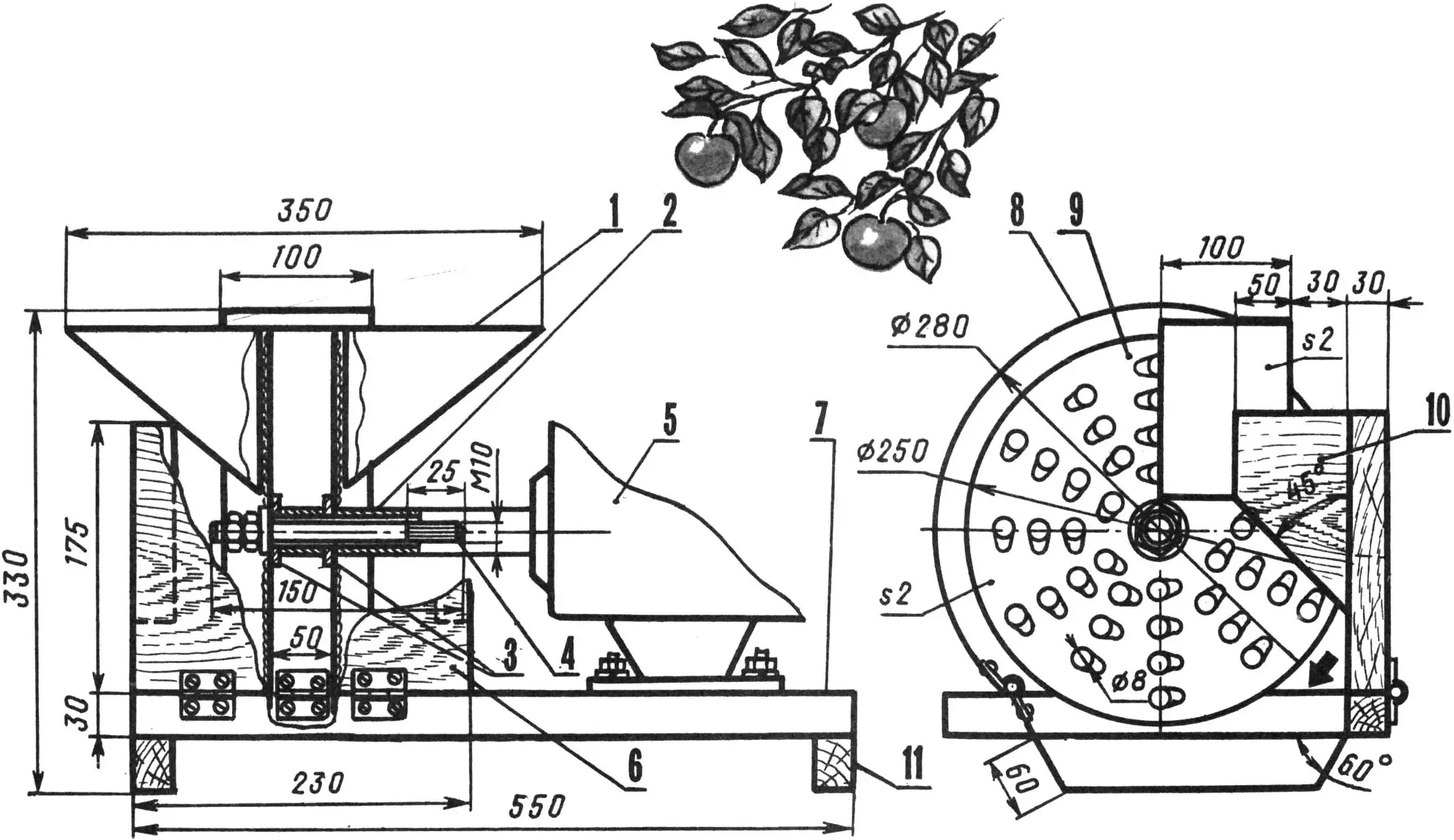
1 — hopper, 2 — sleeve-spacer; 3 — washers, 4 — stud, 5 — electric motor, 6 — bracket, 7 — base, 8 — protective casing, 9 — disc, 10 — side panel, 11 — leg.
To install the crusher’s disc knives, the motor shaft is modified. A hole about 25 mm deep is drilled in it and a thread is cut for an M10 stud: onto it is fitted a sleeve-spacer with a washer for subsequent fastening of the disc knives.
Disc knives of Ø 250 mm are cut from galvanized sheet iron 1.5—2 mm thick. Holes are made in them, as on a grater. To vary the degree of crushing, one disc has holes Ø 8 mm, the other Ø 12 mm. Then the discs are laid one after another on the wooden base, and taking into account their relative position on the shaft and the direction of rotation, a cutting “dimple” is made for each hole: the shank of a drill bit is placed at an angle on the edge of the hole and hammer blows form a recess.
When the discs are ready, a sleeve-spacer and washers are put on the shaft together with them, and then the whole set is clamped with a nut and a locknut.
On the base, using two window hinges, a wooden stand-bracket made from the same board as the base is installed. On the one hand, it will act as a baffle for the crushed mass, and on the other, as a support for the funnel-shaped hopper. Their mutual fastening is done via an auxiliary horizontal bar mounted at the top of the stand. Another variant is also possible: solder the protective casing made of galvanized sheet metal to the hopper into a single unit. The lower part of the casing is also fixed to the base board using a window hinge; when the casing is lowered onto the discs, the hopper will take its place, resting on the stand-bracket by its conical part. The second variant of the hopper attachment is shown in the figure. This provides additional convenience when putting the mechanism into the working position, as well as during its maintenance.
To prevent the wooden parts from suffering from moisture, they should be impregnated with hot linseed oil several times; and they can also be additionally painted with oil paint, preferably green or orange.
«М-К» 6’89, E. Sychov, engineer-mechanic, Korsun’-Shevchenkovskyi
Recommend to read
 LITTLE SECRETS OF THE GREAT MASTER
In the "Modeller-designer" No. 12'99 edition began publication of a series of materials one of the leading "rocket men" of Russia I. shmatova. Today we continue and offer the... THE PLOUGHSHARE OF PIPE…
Paradoxically, for many Amateur designers to make a good plow harder than a mini-tractor! And only due to the fact that the tool consists of parts having a curved shape, which can only...
