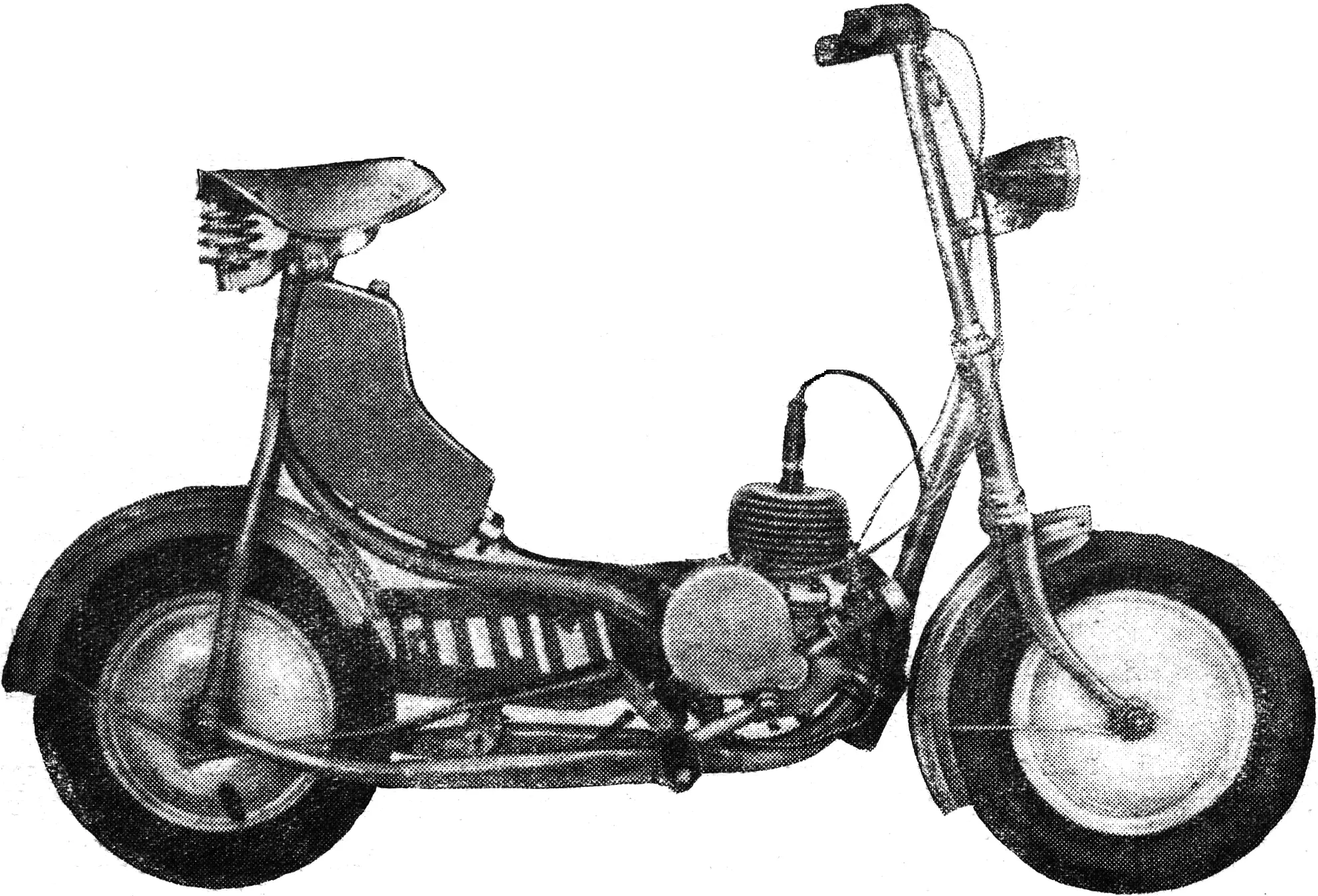
This name was given to a micromotorcycle built on the basis of a children’s scooter.
The authors of the “Moth” are Zhenya Gavrilov, Sasha Golev, Seryozha Golubenkov, and the head of the micromobility club Boris Pavlovich Chernov. The club operates at the Young Technicians Club in the Moscow-region town of Pavlovsky Posad.
The “Moth” was demonstrated in the “Young Naturalists and Technicians” pavilion at the Exhibition of Achievements of the National Economy of the USSR (VDNKh).
The original layout of the micromotorcycle’s parts and components was to the taste of many visitors. A message was received recently: the main exhibition committee of VDNKh of the USSR awarded the “Moth” authors with bronze medals.
Our correspondent met the club’s head, B. P. Chernov, who described the micromotorcycle’s design and provided the magazine with its drawings.
The “Moth” is fitted with the widely used D-5 bicycle engine together with a throttle control lever and a clutch lever.
The scooter’s handlebars are modernized: a bushing is press-fitted into the upper part of the fork, and instead of ball bearings between the fork and the frame, bronze washers are installed.
Note the fenders. They are much wider than on the scooter. The students peened 1 mm-thick aluminum strips onto them, which reliably protected the engine from dirt.
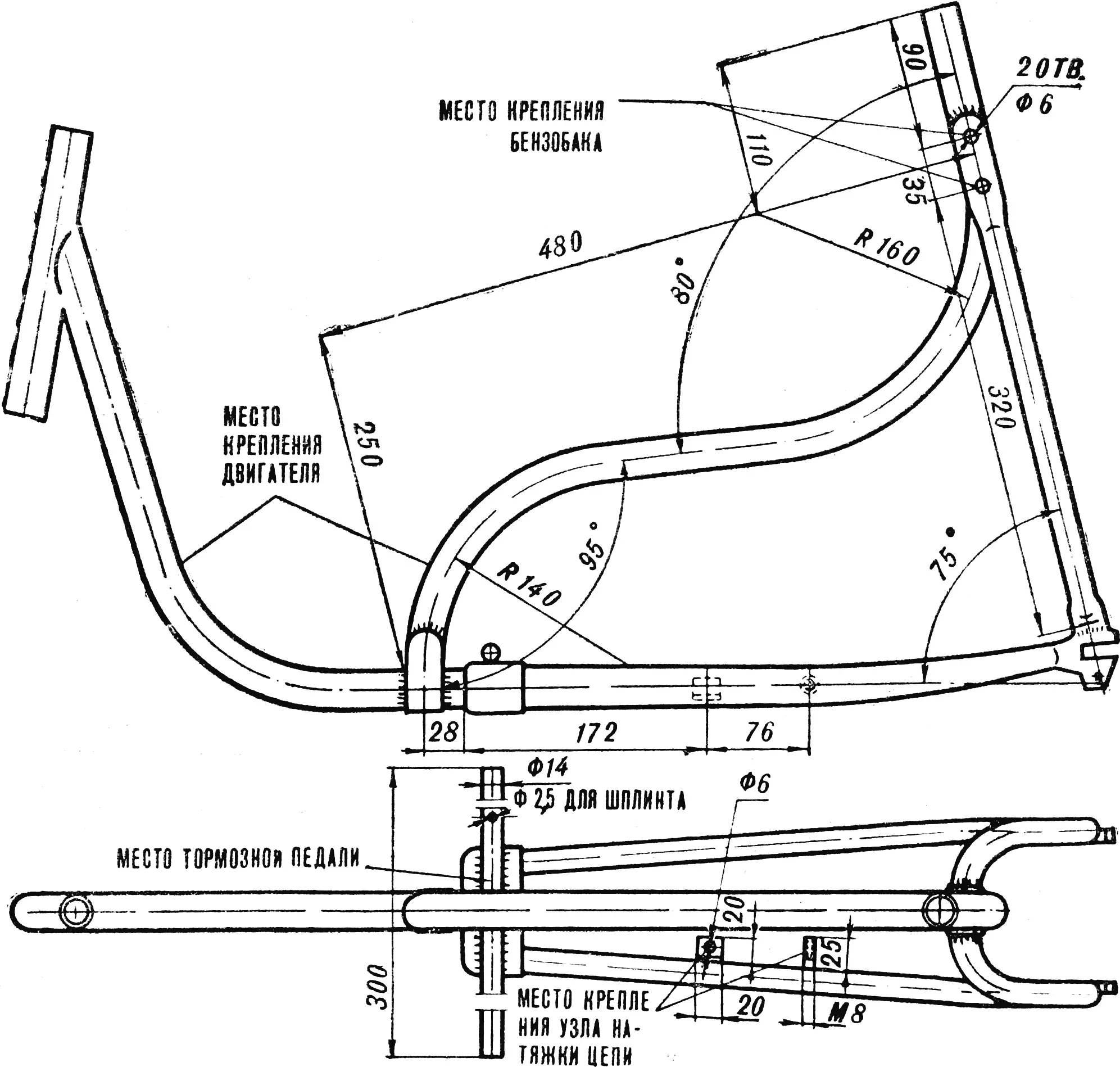
Now look at the frame design (fig. 1). Three small tubes are welded to the stock scooter frame. The first, 800 mm long, is bent on a tube bender. One end is welded to the stock frame, the other is connected by two tubes 360 mm long.
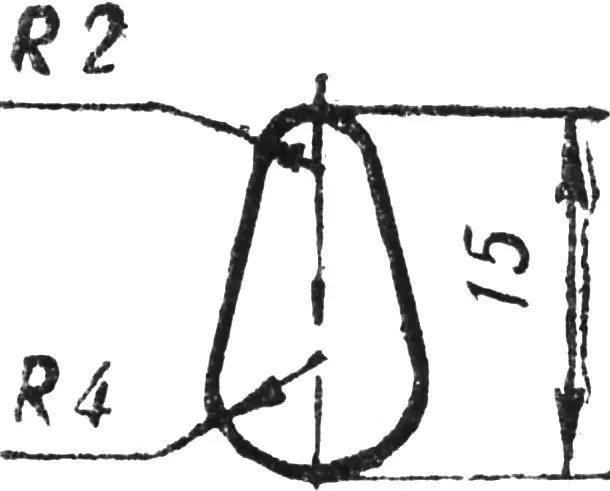
Braking is provided only on the rear wheel. It is a somewhat modified brake from a road bicycle. Five rollers on the driving cone are replaced with wedges (fig. 2), which allowed play between the cup and the brake cone to be avoided. The protruding parts of the wedges are filed to the cup diameter.
On the brake cone the rollers remain, but they are now fixed only in the upper position. For this, light strikes with a center punch made new staking marks on both sides of the bushing.
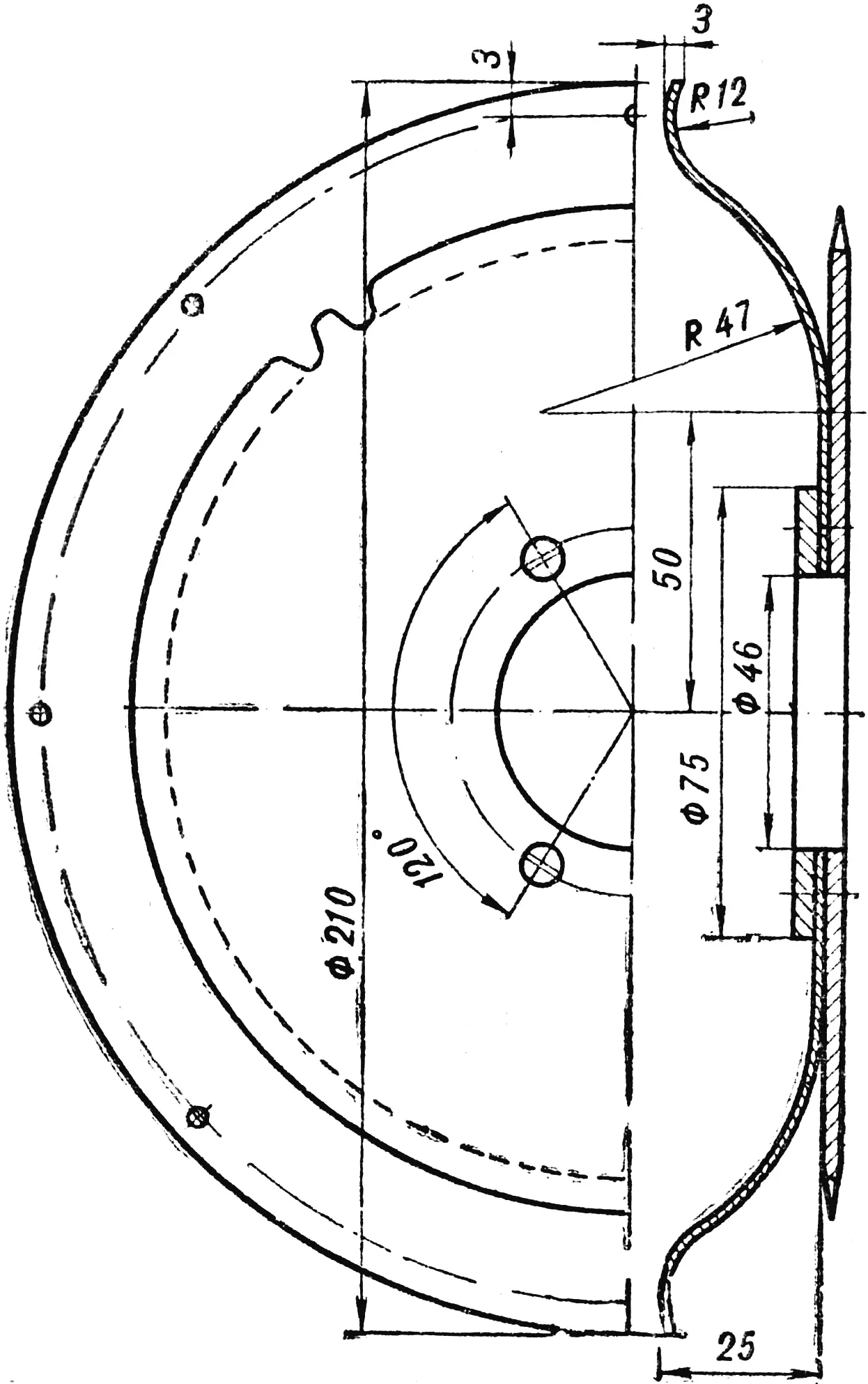
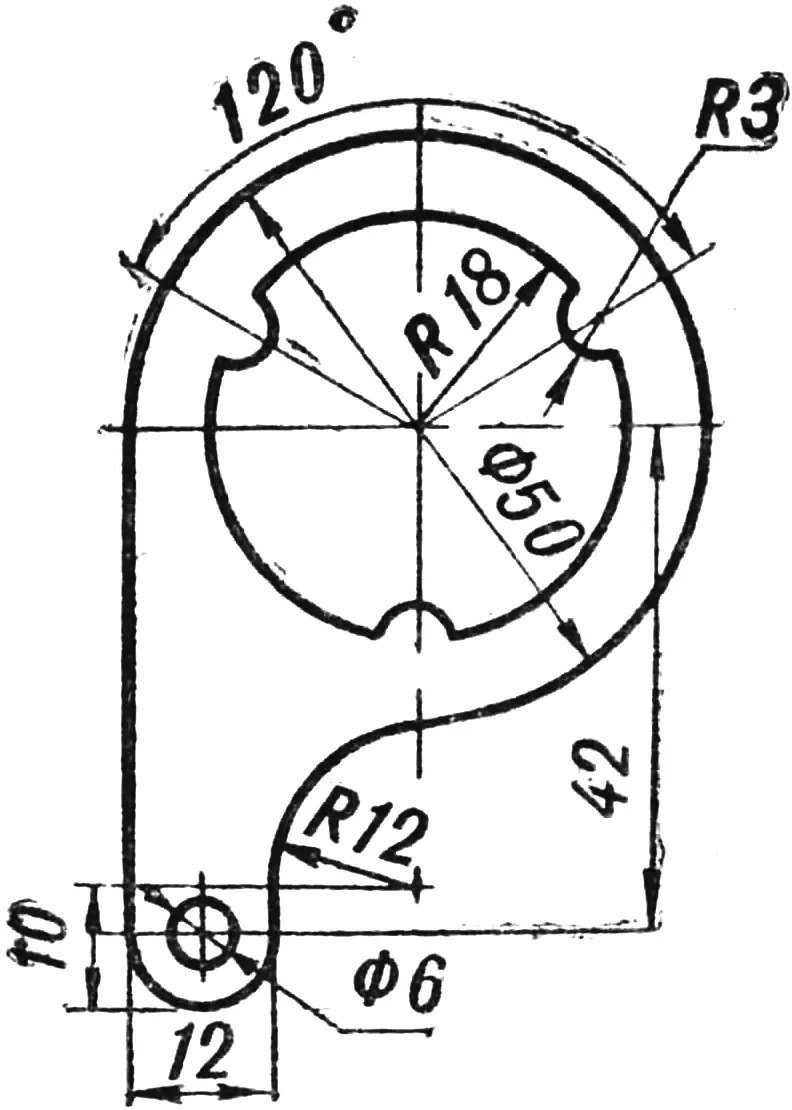
The sprocket layout is changed (fig. 3). The sprocket is mounted not on the cone but on a disc. A washer-lever is placed on the cone (fig. 5); it is linked by a rod to the brake pedal. The washer-lever is made from sheet steel 3 mm thick.
The chain tensioner can be seen in fig. 4. Small sprocket 1 is taken from a sports bicycle. It is mounted on ratchet 2 and assembled in two uprights 3. Bronze bushings 4 are press-fitted into them; the ratchet with the sprocket rotates in those bushings.
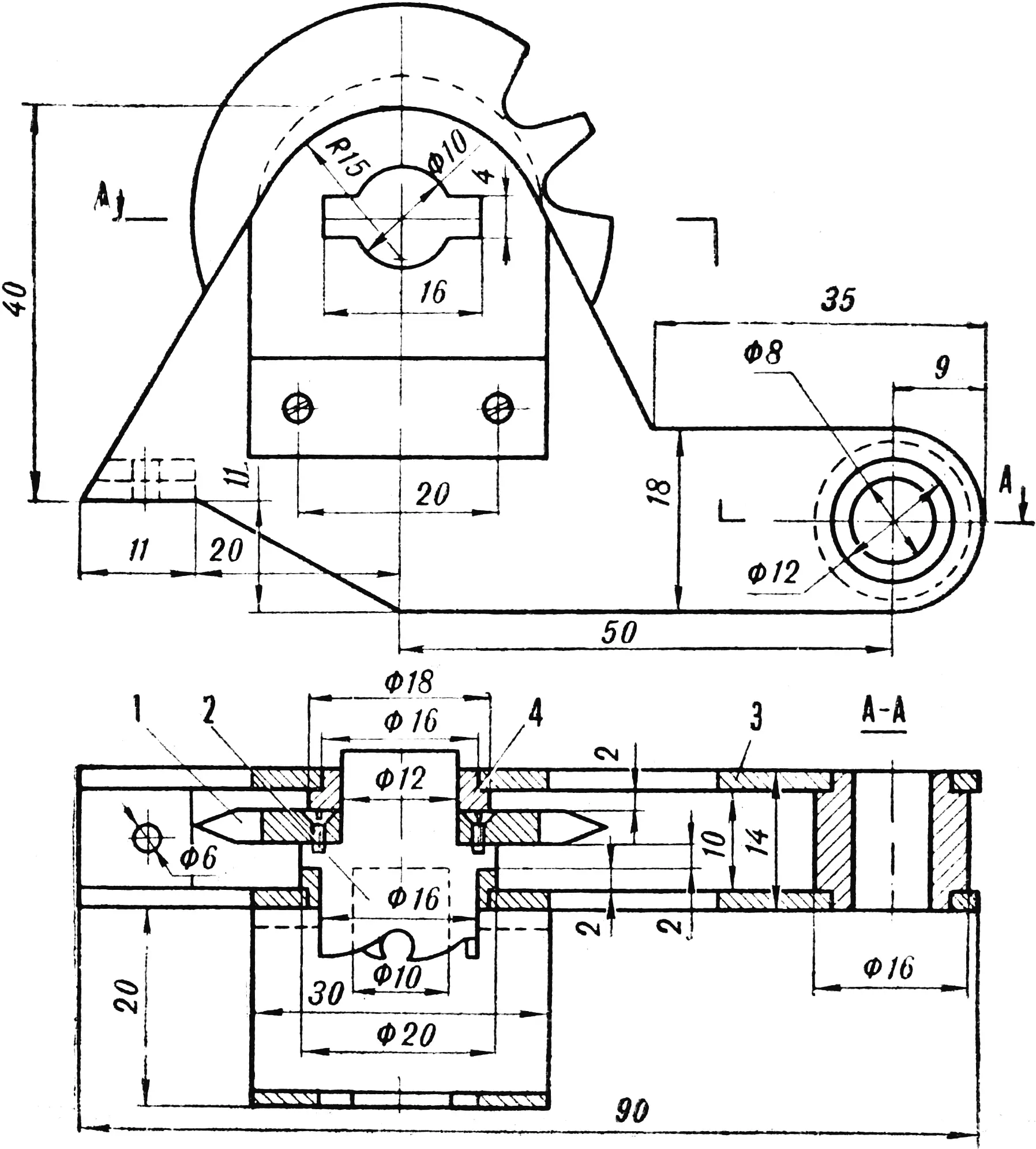
1 — small sprocket; 2 — ratchet; 3 — upright; 4 — bushing.
The engine starting handle is made from a 10 mm-diameter rod. When starting the engine, a stud press-fitted into the handle engages the ratchet.
The muffler (fig. 6) is welded. It consists of tube 1, shell 2, nozzle 3, and plug 4. The tube inside the shell has 4 mm-diameter holes drilled on four sides. The upper part of tube 1 is flared to the nut’s inner diameter.
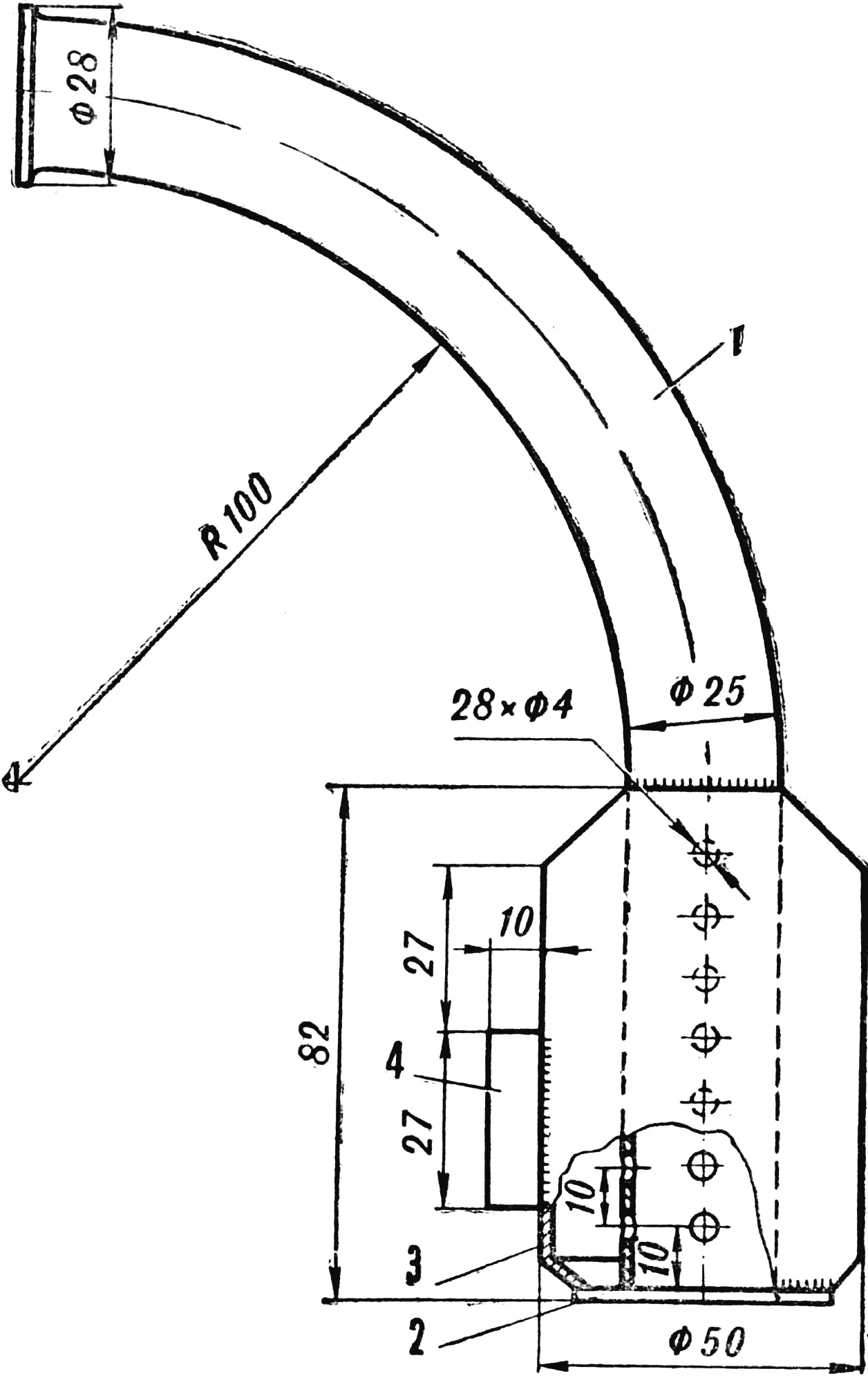
1 — tube; 2 — shell; 3 — nozzle; 4 — plug.
The fuel tank (fig. 7) is made from white tin; its edges are flanged, spot-welded, and soldered. The tank is attached to the frame with two brackets 1 and a clamp 2. A copper tube 4 is soldered into tap 3. Holes are drilled along its entire length, and it is wrapped with a filter screen on top.
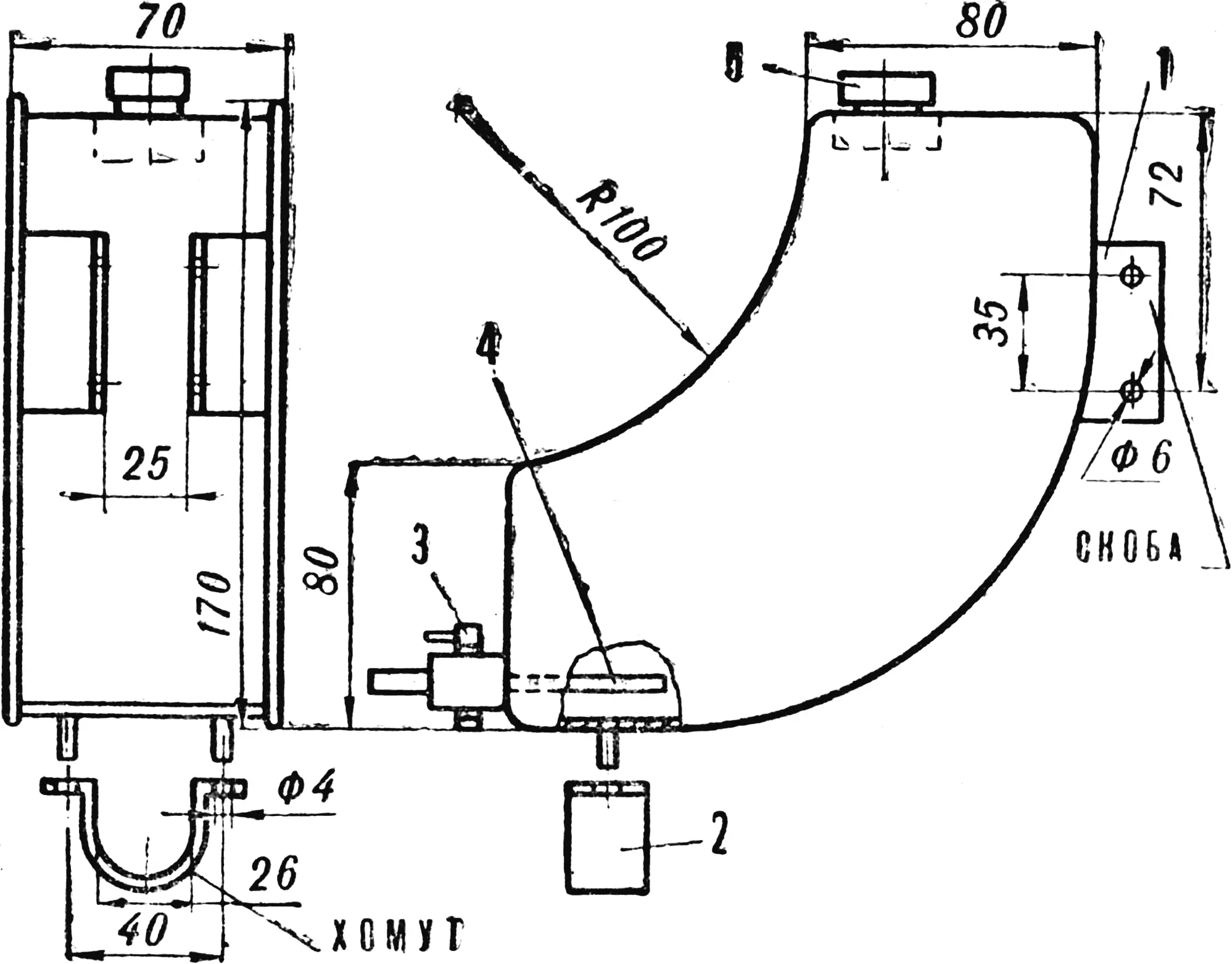
1 — bracket; 2 — clamp; 3 — tap; 4 — tube; 5 — plug.
The tank cap is an electrical fuse insert.
The foot brake pedal (fig. 8) is of a crank type. Its bushing slides onto the footrest axle. Lever 1 is connected to the brake rod; lever 2 is the pedal.
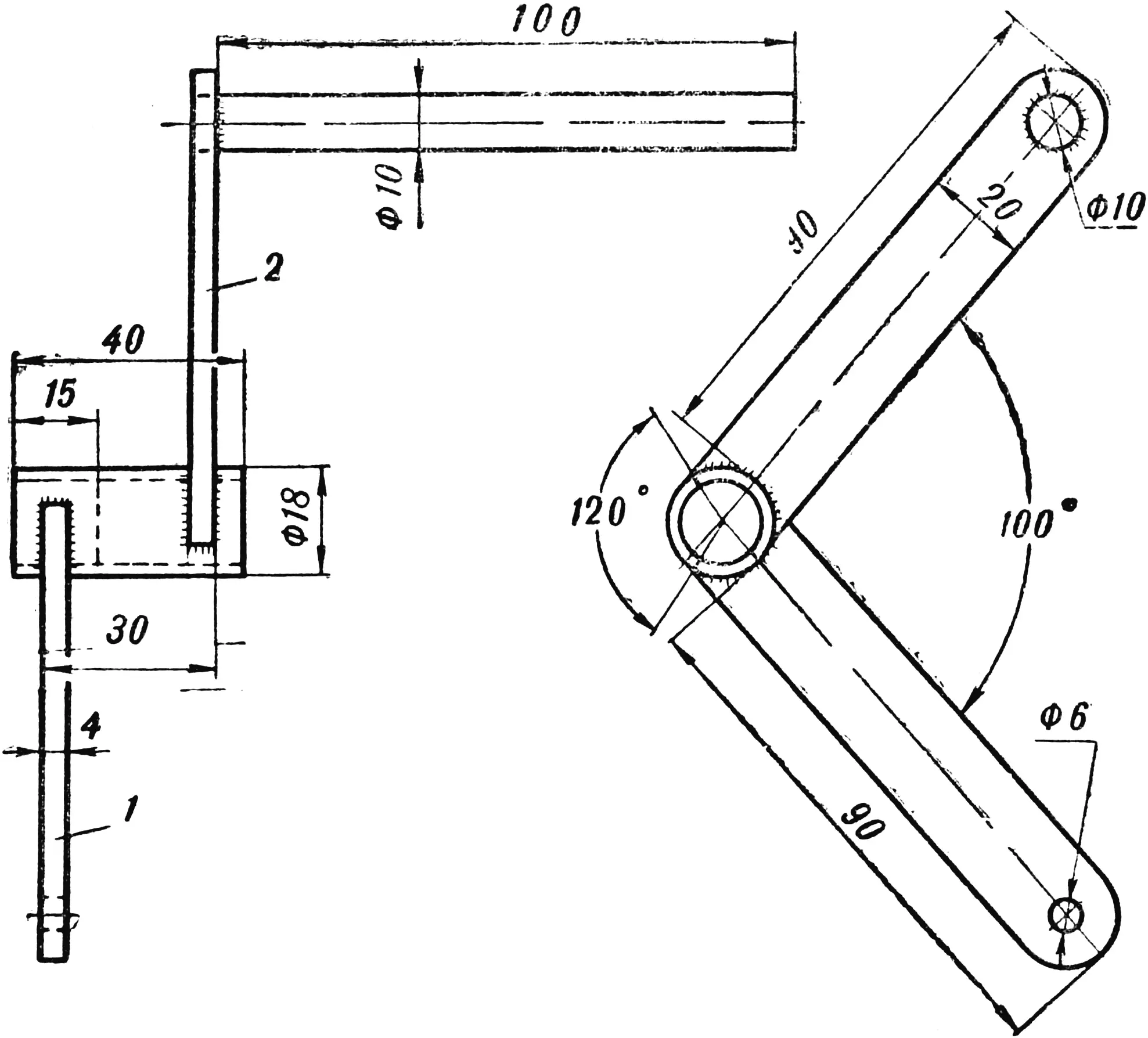
1 — lever; 2 — pedal.
The chain guard is made from sheet steel 0.6 mm thick. It is attached to the engine with two bolts and to the rear fork blade with two clamps. The bicycle headlamp is powered by a pocket flashlight battery.
Here are the main specifications: “Moth” weight — 12 kg, length — 1140 mm, height — 800 mm, ground clearance — 100 mm, speed — 20 km/h.
The club members are now working on a new micromotorcycle variant in which an electric motor will replace the internal combustion engine. “Moth-2” is what the new micromotorcycle design will be called.
A story about the electric motorcycle will appear in upcoming issues of the magazine.
Recommend to read
 SELECTAMARK “MALEK”
Numerous family water bikes added another interesting machine designed by our reader — engineer G. Ovchinnikov from Dnepropetrovsk. Ovchinnikov — motorist. Therefore, the main task for... ABRASIVE SNAIL
For grinding flat surfaces simply wrap sandpaper any bar — and work will become easy and convenient. Where you want to clean up the abrasive from the inside of the tubular part or...
