No one in the small gardening cooperative near Bryansk suspected anything miraculous. The gardeners had only one thing on their minds: extracting water from wells. In hot weather, every able-bodied resident was tied to the heavy handles of cast-iron pumps. They had to pump bucket after bucket to water the thirsty seedlings.
One of the cooperative members, Pyotr Antonovich Radchenko, found a way to pump water not with his hands but… with his feet, being a large man. He would come out in the morning, connect “frog” pumps — the kind used to inflate rubber mattresses — to the pipe, stand on them, and “march in place.” Once he had stored enough water, his exercise was over.
Then, for some reason, he abandoned this routine. He spent all day working in the garden beds and tending the trees, yet he had plenty of water. Every tank was filled to the brim.
One morning, a neighbor got up early and waited for Radchenko.
“What is that gurgling at your place all night, Pyotr Antonovich?” the curious woman asked.
“The water is flowing…”
“But who is pumping it?”
“No one. It flows by itself.”
Radchenko smiled and squinted at the early morning sun. The woman took offense.
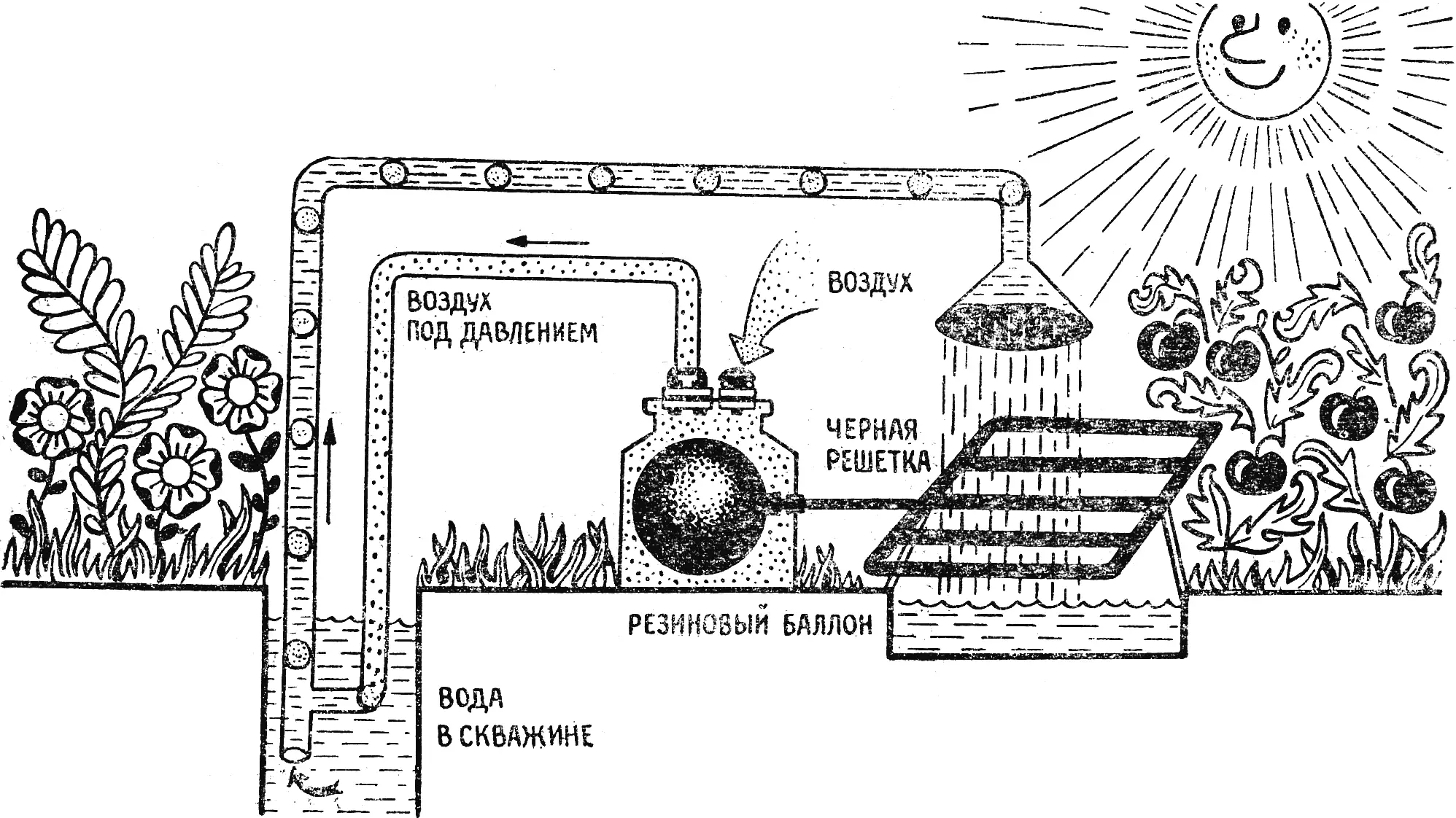
Soon another delegate arrived from the neighbors. Pyotr Antonovich led him to his installation: a black grid, a milk can, and two pipes lowered into the well. To make the explanation clearer, he drew this diagram on the ground (Fig. 1).
Here is how it works: the tubes making up the black grid contain a liquid that boils at a low temperature, such as propane-butane. The grid is connected to a rubber bulb lowered into the can. The lid of the can has two valves: one lets air in, while the other releases it in portions at a pressure of about one atmosphere into the air pipe.
Now let us start the “machine.” To do this, pour a scoop of cold water over the black grid. The liquefied propane-butane in the grid tubes cools. Its vapor pressure drops, and the rubber bulb contracts. Meanwhile, the can fills with air.
While I was writing this, the sun had already dried and heated the black grid. The liquid began evaporating rapidly and inflating the rubber bulb. The bulb, in turn, compressed the air inside the can. At a pressure of about one atmosphere, the pipe valve opened, and a plug of air rushed into it. Traveling through the pipe inserted into another pipe, it acted like a piston and drove the water ahead of it toward the shower attachment. The “gulp” of water lifted from the well splashed onto the black grid.
The grid cooled. The bulb contracted, and another working cycle began. Then came a second, a third, and so on without end, until the valves wear out or the pipes rust through.
“What about at night?” you may ask. “What about it? Summer nights are warm, while the temperature of groundwater remains constant at about +8 °C. At night, the working cycle becomes slightly longer because the grid dries more slowly. That is all.” — “And in winter?” — “It will work in winter too, but with a ‘reversed’ cycle: the groundwater will heat the grid, while the freezing air will cool it.” This wonder machine can operate at any time because its principle is based on the temperature difference between groundwater and the surrounding air. Of course, there is theoretically one condition — thermal equilibrium — when Pyotr Antonovich will have to run around with buckets again, but that moment is very brief.
Nature knows no stagnation. It is all motion. Heat is the most “fluid” form of energy. Air is the most mobile substance. That is why the temperature difference between atmospheric air and groundwater persists with remarkable consistency.
From a heating engineer’s point of view, the new device is the simplest kind of heat engine. It is precisely the type with which Sadi Carnot began his famous theoretical studies: to perform work, a machine must have at least two thermal sources — a heater at a high temperature and a cooler at a low one. In conventional devices, they are separate, and one can say exactly where each is located. But where are the cooler and heater in Radchenko’s device?
Herein lies the ingenuity of the new proposal: both are concentrated in one component, the black grid. Under a cold shower it is the cooler; under the sun’s rays it is the heater.
The pump is directly “connected” to nature. It uses natural forces directly. It is a close relative of the windmill, the waterwheel, and the sail.
Anyone can build such a “perpetual-motion machine.” If you obtain water from a well, you already have casing pipes. A milk can is not hard to find. The bulb can easily be glued together from an automobile inner tube. Propane-butane is sold in the familiar red cylinders used for gas stoves. Only the tubular grid must be made by hand. Its dimensions are arbitrary. Radchenko, for example, found an old tubular grid at a dump, adapted it to his needs, and that was that. He spent… six rubles on the entire device.
There is one difficulty, but it is a serious one. The diameters of the air pipe and casing pipe must be carefully selected so that the air bubble pushes the water like a piston. Otherwise, the result will be an airlift in which air mixes with water and a kind of “soda water” rises to the top. As is well known, the efficiency of an airlift is low.
By selecting the pipe diameters, Radchenko achieved a piston effect. His pump lifts 2 liters of water in one “breath.” A unit composed of ten pipes lifts 20 liters accordingly. You will have to experiment as well.
A water pump requiring no fuel will benefit more than gardeners. Fields also need water, especially in arid regions requiring artificial irrigation. Livestock farming consumes a great deal of it too, not to mention the needs of the population…
Extracting that amount of water requires powerful machinery and considerable energy expenditure.
Radchenko’s water lifter can also make a useful contribution to solving this problem.
Geologists, workers at remote weather stations, and residents of taiga settlements, steppes, and deserts will also welcome this inexpensive and uncomplicated installation.
The new device has already been used at the Bryansk division of the Moscow Railway. The wonder pump extracts 72 liters of water per day from a three-meter well without requiring any additional energy.
The Kremenchuk Road Machinery Plant has begun mass production of the new water lifter.
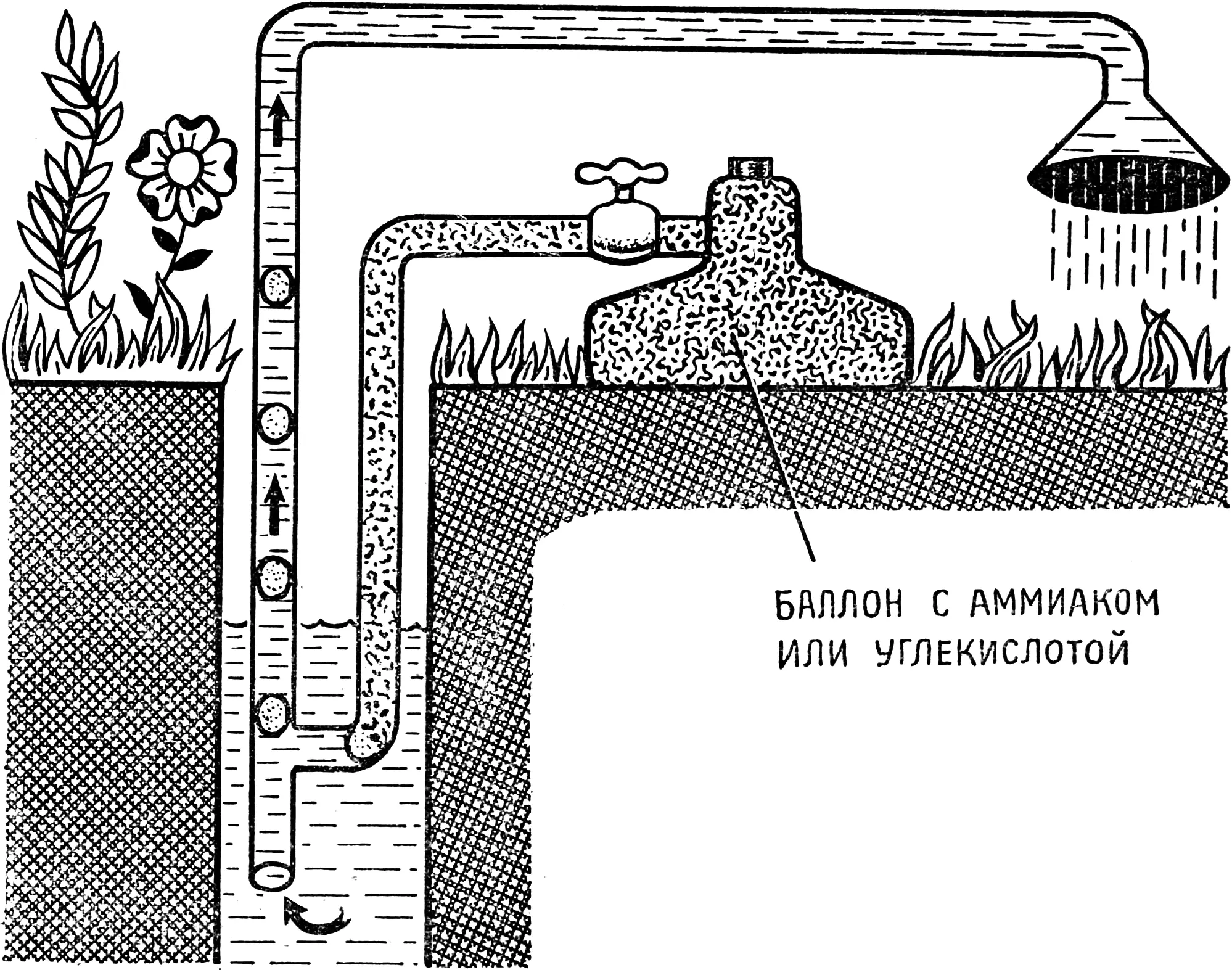
Besides its direct purpose — pumping water — the unusual unit can also be used to… apply fertilizer. Simply connect a cylinder of compressed ammonia to the air pipe. As the gas pushes out the water, it simultaneously dissolves in it, so ammonia water — an excellent mineral fertilizer, and in liquid form most convenient for plants — flows onto the fields.
Now try connecting a carbon dioxide cylinder to the pipe. Use the valve to regulate the pressure in the air pipe so that the gas bubbles push water out of the casing pipe in sufficiently small and frequent portions, and you will obtain an excellent substitute for a carbonation unit. Drinking cold, tasty “soda water” on a hot day during fieldwork is, you will agree, a real pleasure.
“M-K” 3’76, A. RATOV, engineer
Recommend to read
 DRILL-BABY
I made the machine is, in essence, MICROTEL, because it does not have a flexible shaft. It's light and compact, at the same time a significant simplification of the structure did not... IF THE HOUSE PAINTER
This simple and elegant table will be very convenient for children who love to draw. Work the incline of the working Board will ensure correct posture, and located on both edges of the...
