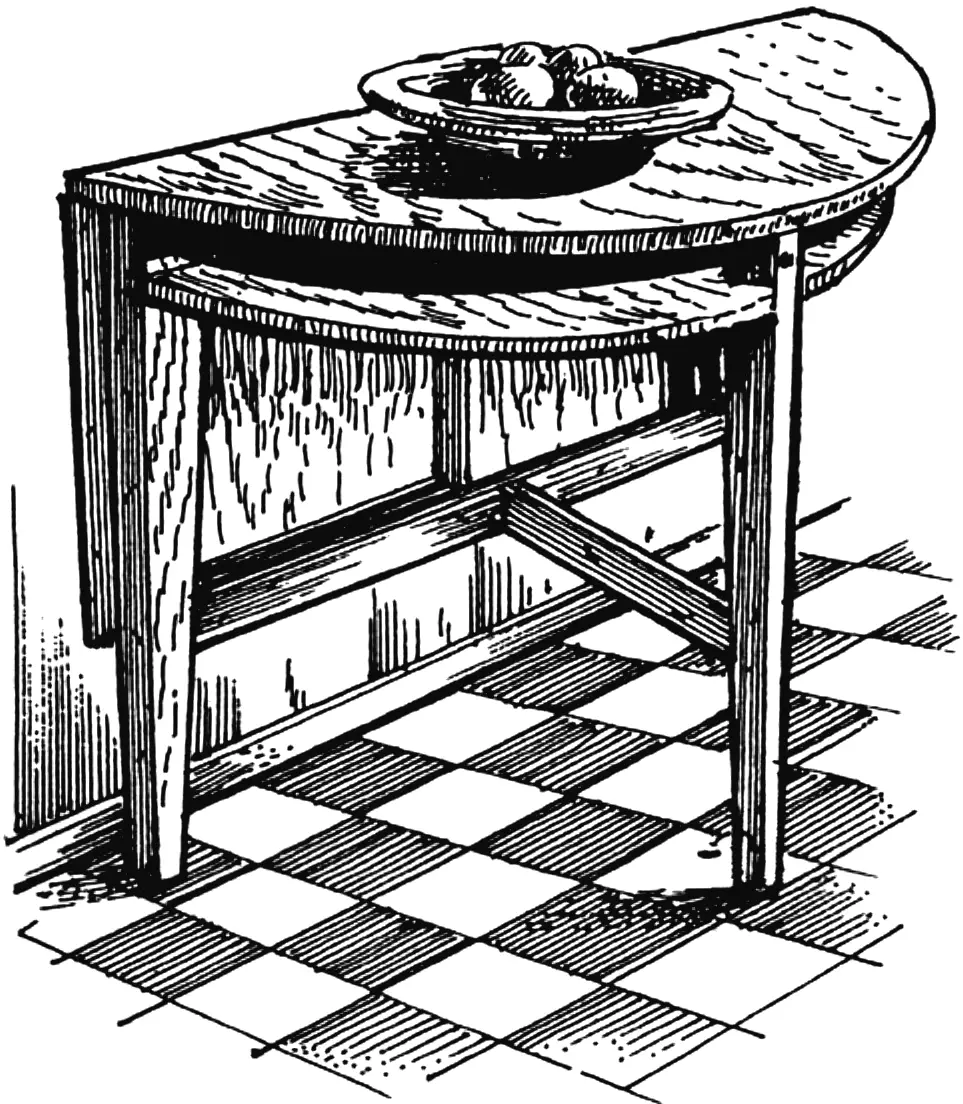
A torn-out magazine page with a photo of a neat little table was lying on a park bench I sat down to rest on. The table — or rather its design — caught my interest (in the past I used to make furniture both for myself and to order).
The photograph, like the table, had been taken professionally (apparently for advertising) — it fully revealed the product’s consumer merits: unpretentious beauty and functional capabilities, while at the same time concealing its design features.
I felt like buying such a table for a country cottage (there was a need for one), if I came across it and the price was right — or otherwise finding time and making it myself.
To that end I took the sheet with the photo with me so that at home I could examine it more carefully and try to figure out the table’s construction. I think I managed to do so; everything was not as disguised and complicated as it first seemed, and some parts I did my own way.
Anyone who can handle ordinary woodworking tools can make such a table. Moreover, all the parts can be made from suitable materials in a home workshop.
A semicircle joined by a piano hinge to a rectangle — that is the geometric shape of the tabletop when unfolded; its serving area is about 0.6 m². In the “standby,” folded position the space taken by the table shrinks by more than half. To do this, a supporting half-frame (a leg with a stretcher and a rail) is pulled out from under the rectangular part of the top; the rectangular “wing” of the top then drops into a vertical position and is pressed, together with the frame, against the rear legs.
But even when folded, the useful table area decreases only slightly — because under the semicircular top there is an undershelf of almost the same size. That is where you can put away serving dishes and cutlery.
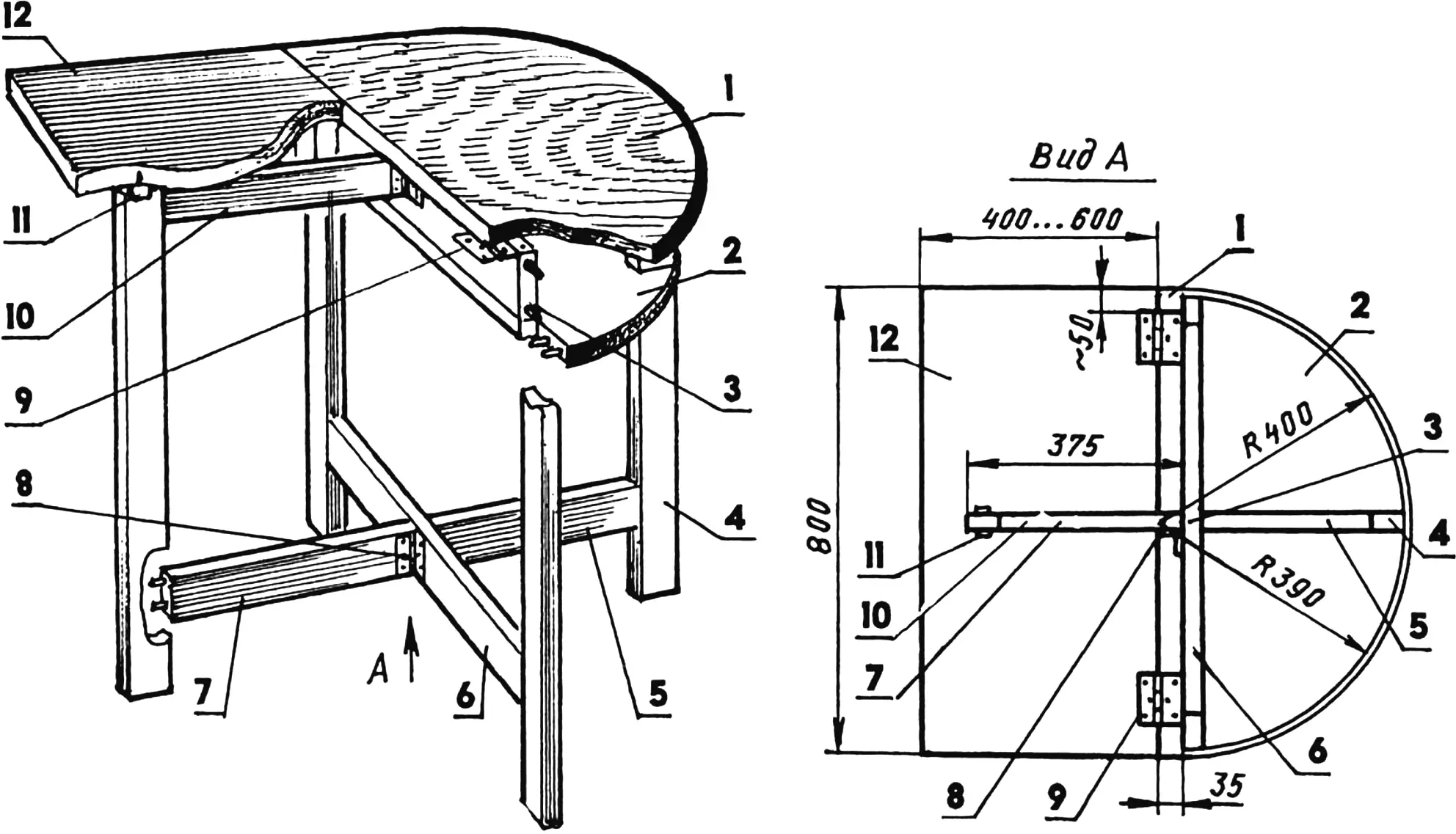
1 — semicircular top (particle board, joinery board or furniture panel, s20—30); 2 — undershelf (particle board, joinery board or furniture panel, s15 — 20); 3 — insert rail (board 120×30 or 120×25, L660); 4 — leg (timber 60×30, L700, 4 pcs.); 5 — cross stretcher (timber 60×30 or 50×25, L260); 6 — longitudinal stretcher (timber 60×30 or 50×25, L270); 7 — half-frame stretcher (timber 60×30 or 50×25, L316); 8 — half-frame butt hinge (2 pcs.); 9 — folding-top hinge (2 pcs.); 10 — half-frame rail (timber 60×30 or 50×25, L316); 11 — clip for locking the half-frame (St3, sheet s1.5); 12 — folding top (particle board, joinery board, furniture panel s20 — 30)
To make the tops of the folding table you will need three joinery panels 20—30 mm thick of the same material: whether finished (film- or plastic-coated) particle board, well-planed and glued boards, or a ready furniture panel. All three panels are the same size — 800×400 mm.
The legs and other auxiliary parts are made of dry pine timber with a cross-section of 60×30 mm. For the connecting parts — rails and stretchers — you can use a smaller section (timber 50×25).
One panel is left as is. From the other two, inscribed semicircles are cut with the center in the middle of one of the long edges. The radius of one semicircle (the top) is 400 mm, of the other — 390 mm: this is the undershelf (for it a thinner panel will do — 15—20 mm thick). Along the diameter another strip 35 mm wide is cut off from it. At the ends of the resulting chord and also at the intersection of the centerline and the arc of the circle, rectangular notches matching the leg cross-section are cut in the undershelf. On the chord the long sides of the notches face each other, and on the centerline they are perpendicular to them.
The clear distance between the tabletop and the undershelf is 120 mm. For practical reasons this gap could be made larger, but then guests’ legs might not fit under the table (for household members this size is easy to determine).
The insert rail between the top and the undershelf should be the same width. It can be made as one piece or glued up from two or three bars. The length of the insert equals the distance between the rear legs of the table — 660 mm. Clearly, the longitudinal stretcher should have the same length.
The length of the front (cross) stretcher is 265 mm; that of the rear stretcher and the half-frame rail is 315 mm. This difference in length arose because the rear legs together with the connecting parts are shifted inward (forward) on the table: so that behind, under the semicircular top, the half-frame pressed against them can fit and not interfere with lowering the rectangular top. For the same reason a 35-mm strip was cut off the undershelf.
One more thing. To give the table a more elegant look, the front legs should be tapered from top to bottom by about one-third of their width.
The table parts can be assembled in various ways.
If there will be no need to take the table apart in the future (for example, to move it elsewhere), the simplest way is to make the joints (except the hinged ones) with dowels and glue. One condition must be met — there should be at least two dowels in each joint. For the hinged joints of the pivoting half-frame and the folding part of the top, suitable butt hinges are needed — two for each part.
In a knockdown version the parts can be joined with furniture brackets.
The finish of the table is up to the maker. When choosing it, it is desirable to observe only one condition — in the end the table should fit the interior of the room where it will stand and harmonize with the other furniture nearby.
“Modelist-Konstruktor” No. 8’2004, A. POLIBIN
Recommend to read
 THE CHANDELIER IS CONTROLLED BY THE DIODE
Chandelier, sconce or a floor lamp in every house. They often burn on several lamps. Do I need it? Not always. And here is the owner of such a lamp becomes involuntary "waster" of... BROOM-“PULVERIZATOR”
For uniform spraying paint when decorating large or small surfaces, to create artificial "rain" indoor plants or spraying vegetable crops and shrubs with chemicals that help to combat...
