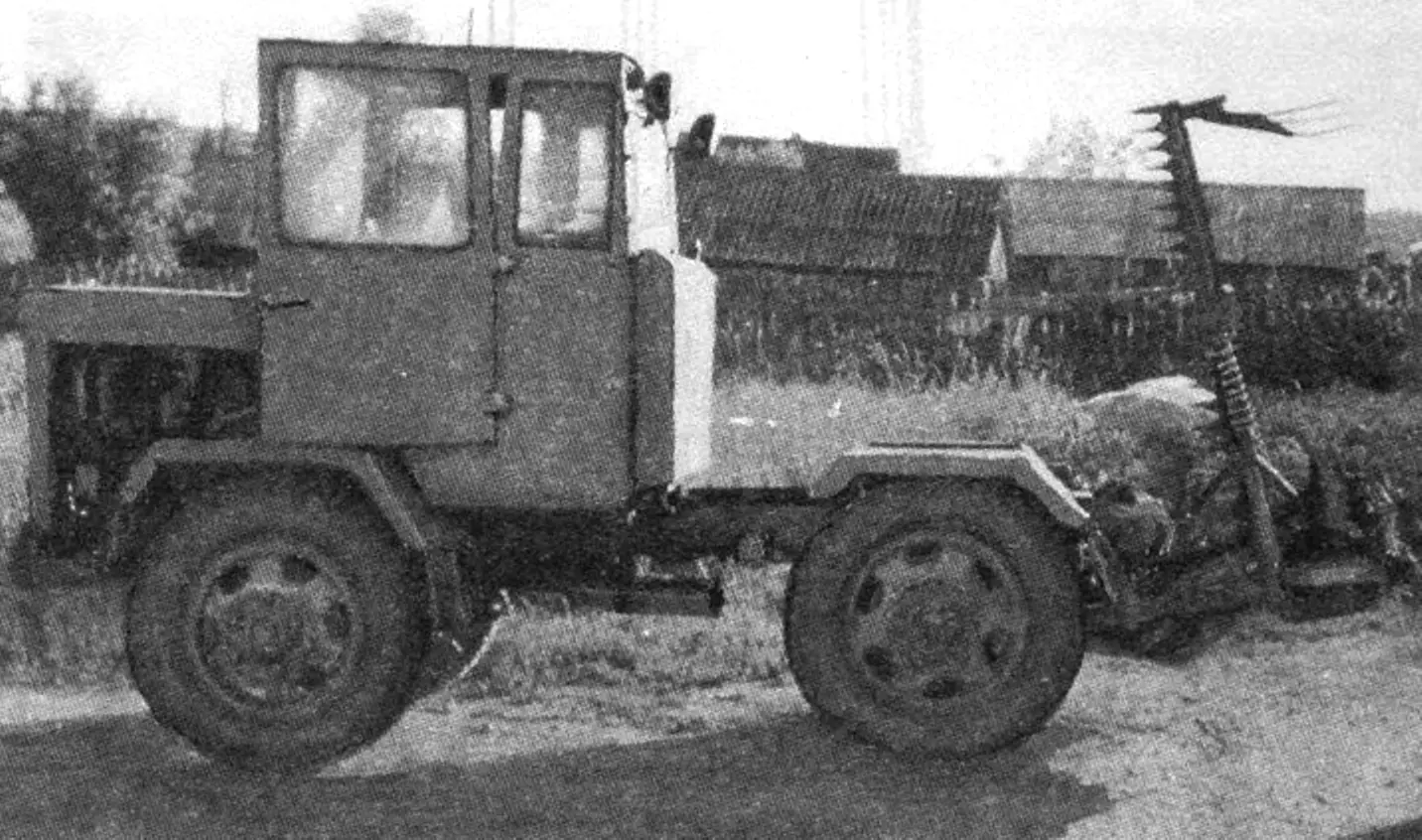
For fifteen years I have subscribed to the magazine “Modelist-Constructor” and in every issue I find many interesting and useful articles for myself. I am a mechanical engineer by training, and I am especially interested in the creative developments of amateur designers.
I myself, back in 1989, practically from scrap metal (units and assemblies of agricultural machinery picked up at collective-farm “equipment graveyards”) built a machine that, for the range of functions it performs, I called a tractoromobile. I cannot boast of the originality of its design or the elegance of its appearance. Rather, on the contrary, the tractor turned out somewhat crude, but for many years it has become my indispensable and reliable helper on the farm — both in winter and in summer. Poorly cut, but sturdily sewn — this saying can be applied to it.
The load-bearing frame is a simple rectangular one, welded from channel No. 12. Such a channel was chosen to provide a strength reserve so that the frame would not warp, since the tractoromobile is intended not only for work in off-road conditions, but also for transporting significant loads both in the body and in a trailer.
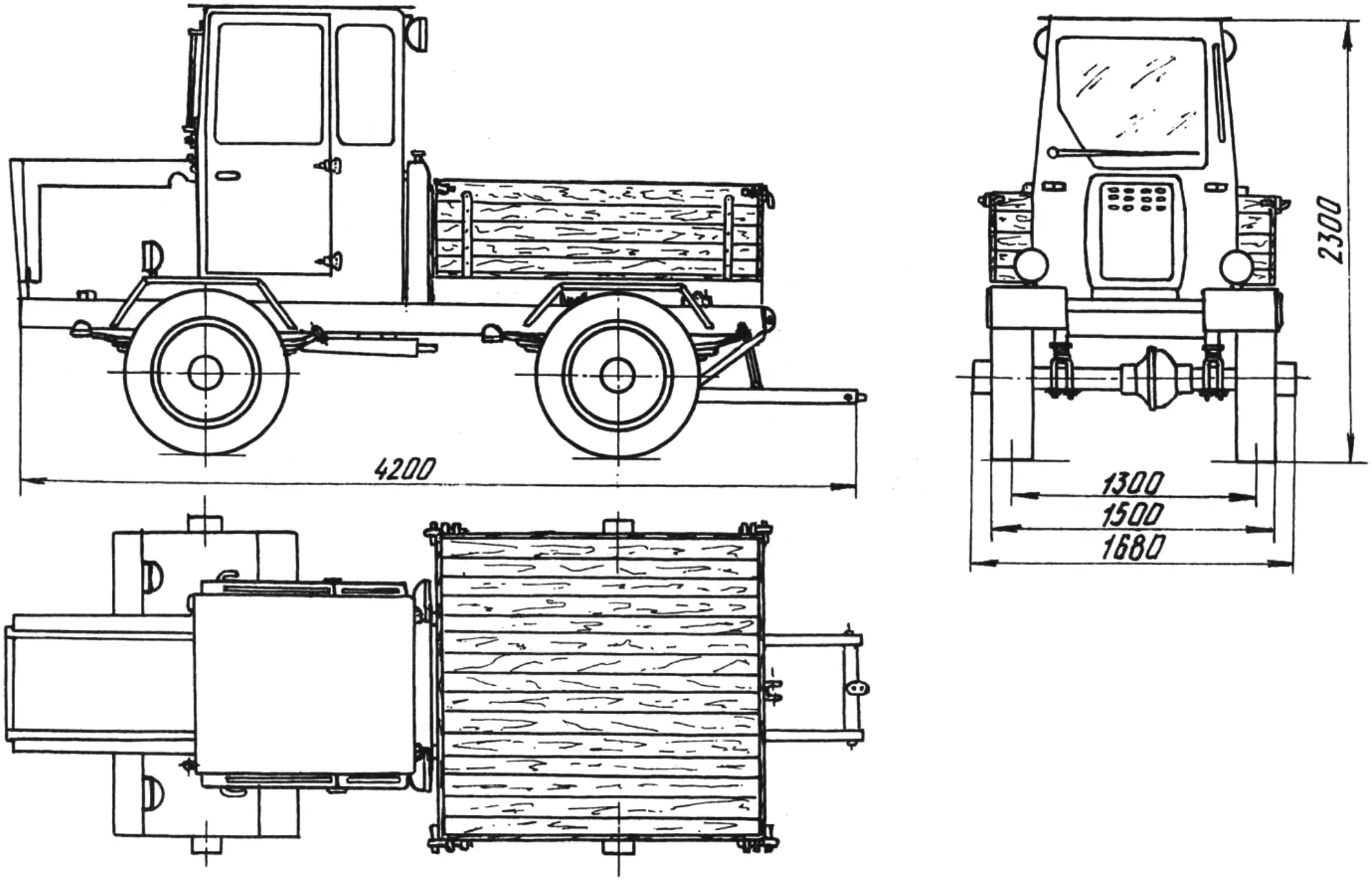
Overall, designing the tractoromobile came down to selecting and coordinating series units and mechanisms. In most cases, it was possible to select auxiliary standard units and parts as well.
The layout of the power unit and transmission is conventional for all-wheel-drive vehicles: engine — clutch housing — gearbox — transfer case — system of cardan shafts to the final drives of the rear and front axles. As an addition — a power take-off shaft running from the gearbox to the end of the frame and therefore consisting of several cardan joints and a chain drive.
The tractoromobile engine is a diesel, 21 hp, from a Vladimirets tractor; the clutch housing is from it as well. The gearbox is from a GAZ-51 automobile. The transfer case, front and rear axles, and cardan shafts are from a GAZ-63. The axle suspension on the frame is leaf-spring. The springs are from a UAZ-452.
Torque from the gearbox to the transfer case is transmitted through a short intermediate cardan shaft, and from it, by means of long cardan shafts, to the differentials of the front and rear axles.
The power take-off (PTO) shaft design turned out to be rather complex. The shaft consists of two cardan joints with an intermediate support between them, a passage across the rear axle, a chain drive, and a drive unit with a splined short output shaft. The shaft is assembled from various units of a written-off SK-5 Niva combine harvester practically without modifications; only in the drive unit a tubular (drilled) splined shaft is fitted and welded onto the output end of the standard shaft. The intermediate support is attached through a 10-mm steel plate to the inner side of the right side member. The PTO passage across the rear axle is accomplished with a bearing unit secured on top of the lower cross member of the frame, and the drive unit — midway between the frame side members on a wall made of 10-mm steel sheet welded to the same cross member. Additionally, the sheet is secured with four braces connected to the frame side members (two on each side member on both sides of the wall). On the same wall at the bottom, the hitch frame axle is secured.
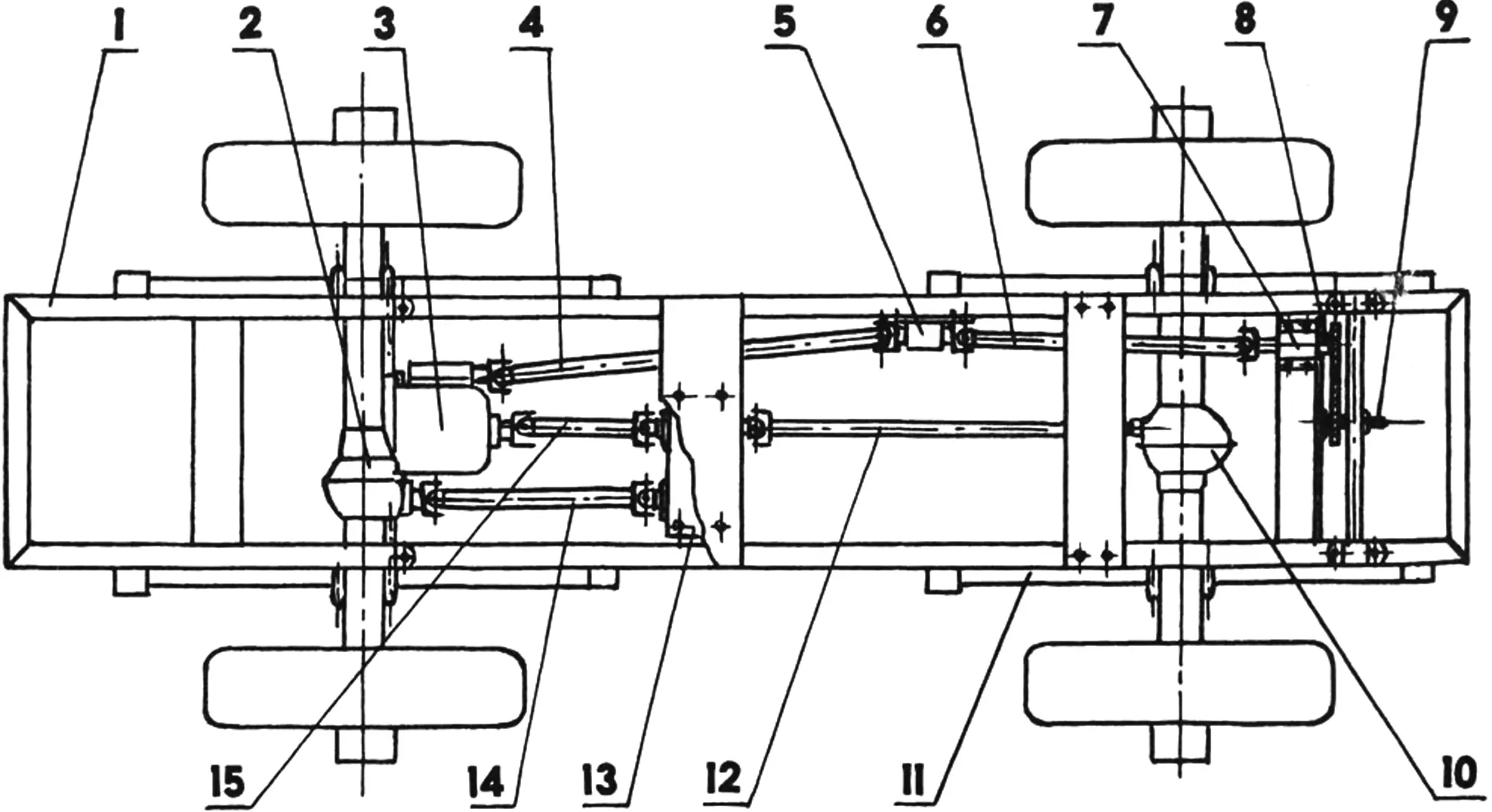
1 — frame (channel No. 12); 2 — front driving axle (from GAZ-63 automobile); 3 — gearbox (from GAZ-51 automobile); 4 — front joint of the power take-off shaft (PTO); 5 — intermediate PTO support; 6 — rear PTO joint; 7 — crossover; 8 — chain drive; 9 — splined tip (from DT-75 tractor); 10 — rear driving axle (from GAZ-53 automobile); 11 — leaf spring (from UAZ-452 automobile, 4 sets); 12 — rear axle cardan shaft; 13 — transfer case (from GAZ-63 automobile); 14 — front axle cardan shaft; 15 — primary cardan shaft; parts and units 4,5,6,7,8 — from SK-5 Niva combine harvester
The wheel track (axle length) has been reduced compared with the base by 300 mm and is 1300 mm. This was done to reduce the width of the machine and improve its maneuverability: with such a tractoromobile it is even possible to skid logs from a logging site to a yard, but, most importantly, it is convenient not only to plow the soil right to the edge of the plot, but also to cultivate row crops.
The tractoromobile is all-wheel-drive and has good off-road capability, which can be significantly increased by installing dual wheels on both axles. This at the same time allows increasing the machine’s load capacity.
With such wheels, the tractoromobile can be operated practically over any off-road terrain and even used as a snow vehicle on fishing or hunting trips.
Nevertheless, the main purpose of the machine is hauling loads and agricultural work. For this, a hydraulic hitch is mounted on the rear part of the frame. It is a small separate frame, hingedly attached to the main frame and controlled from the cab by means of a hydraulic cylinder through a horizontal cross shaft and adjustable vertical links (turnbuckles).
Various farm implements and units are quickly mounted on the hitch.
For plowing soil I made a two-furrow plow; its output on soil of medium heaviness is 20—25 ares per hour. From a KON-2.8 PM cultivator-hiller I made a three-row cultivator and use it to work the inter-rows. For harvesting potatoes I built a single-row conveyor-type potato digger. For haymaking I use a KS-2.1 mower, shortening its cutter bar to 1.8 m. I also ted and rake hay into windrows with homemade mounted tedder-rakes.
The field of application of the tractoromobile would not have been so extensive if it did not have a power take-off shaft. This mechanism provides drive not only for field agricultural units, but also for many stationary ones: a water pump for irrigating the plot, a woodworking machine (through a gearbox); a home mill for crushing grain, and even a trailed loader with a capacity of 0.2 t (converted from a mounted one).
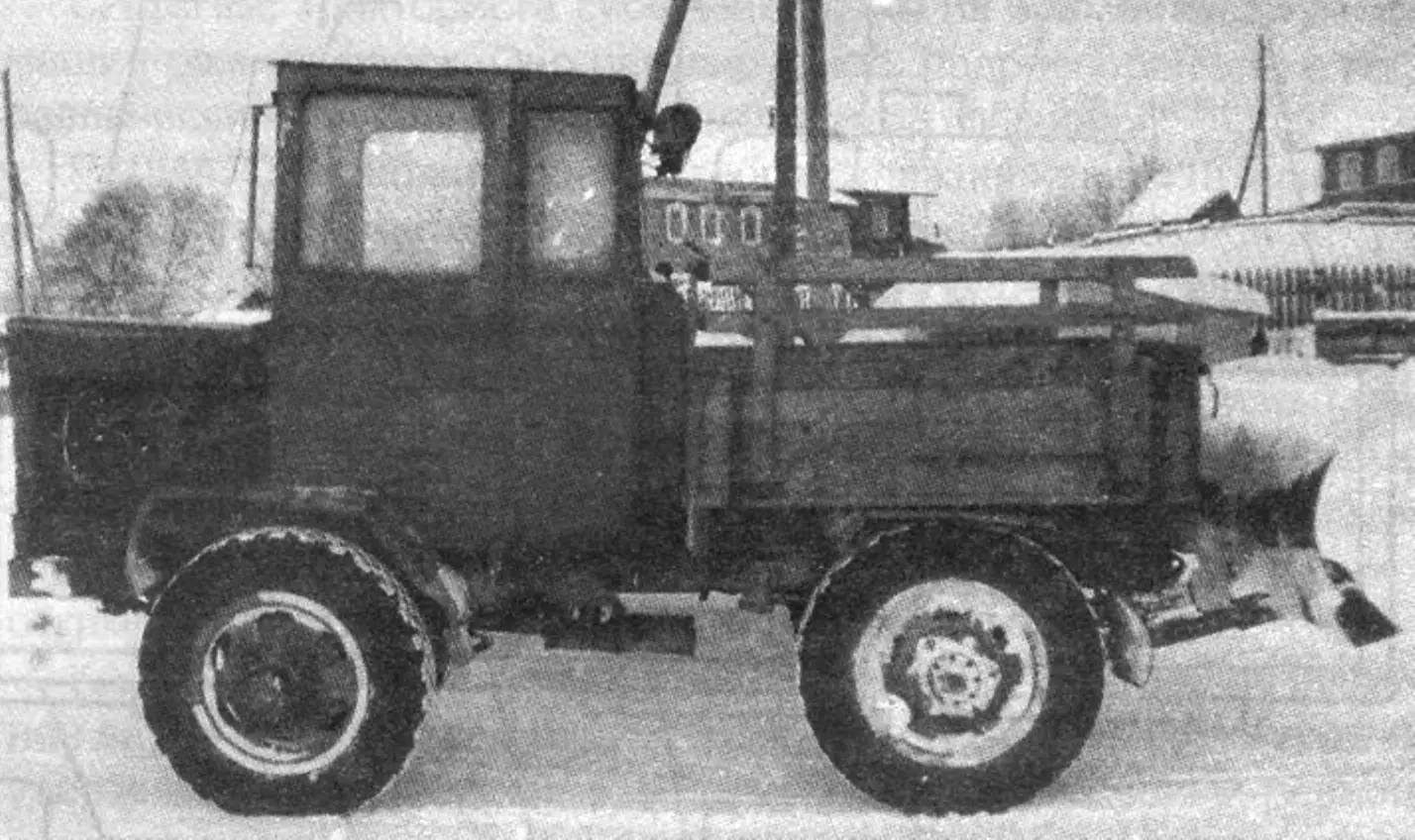
For transporting loads, the tractoromobile is equipped with a easily removable body that is attached to the frame with latches.
When necessary, a two-axle trailer is coupled to the tractoromobile.
The machine meets the requirements imposed by traffic authorities on homemade designs and is registered with the State Technical Inspectorate.
“Modelist-Constructor” No. 10’2002, V. POTYLITSYN
Recommend to read
 With a sidecar and a trailer
I read in the magazine «Modelist-Konstruktor» No. 12, 1992, A. Tatarnikov’s article «Obedient trailer». It suggested a solution to what at first glance seems a rather ordinary, but on... BUILDING A CAR
When vehicle type is defined: scheduled its approximate dimensions, weight, number of seats in the back, the engine, comes perhaps the most important stage of design development of the...
