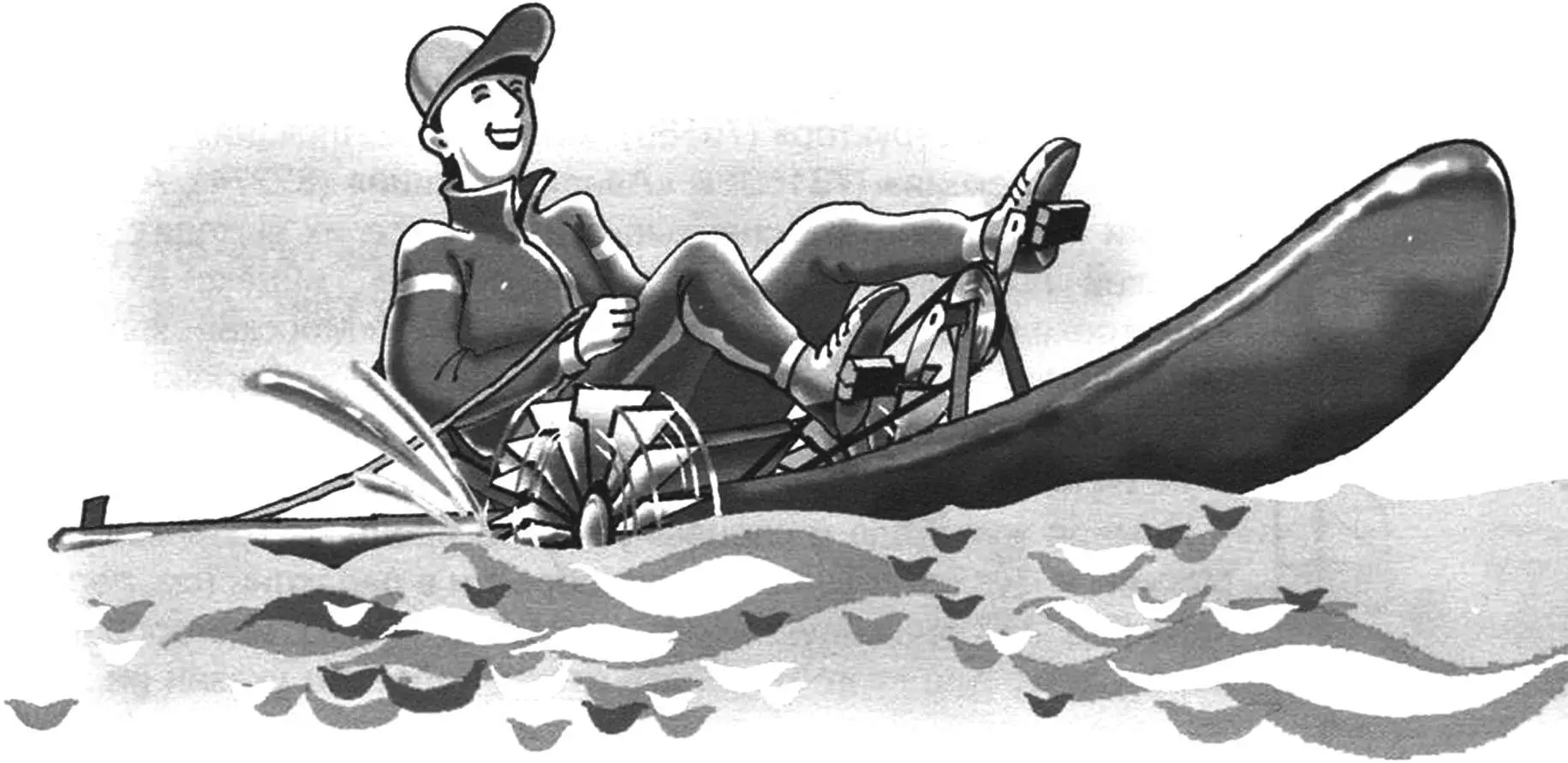
A windsurfer, like any sailboat, needs wind. Meanwhile, on its hull-float it is possible to swim even in calm weather if necessary.
In the magazine “Modelist-Konstruktor” there was once a mention of using the hull in a rowing version — with a two-blade kayak oar, or with an ordinary pair of oars (though in the latter case it was necessary to build a lightweight removable frame with a seat and two supports for the oarlocks).
A recent article in “Modelist-Konstruktor” about a high-speed aquaped led us to the idea of making a rowing attachment that would allow transforming the windsurfer hull, with its excellent hydrodynamics, into a comfortable recreational water bicycle. Soon the idea was implemented, and it turned out not to be that difficult.
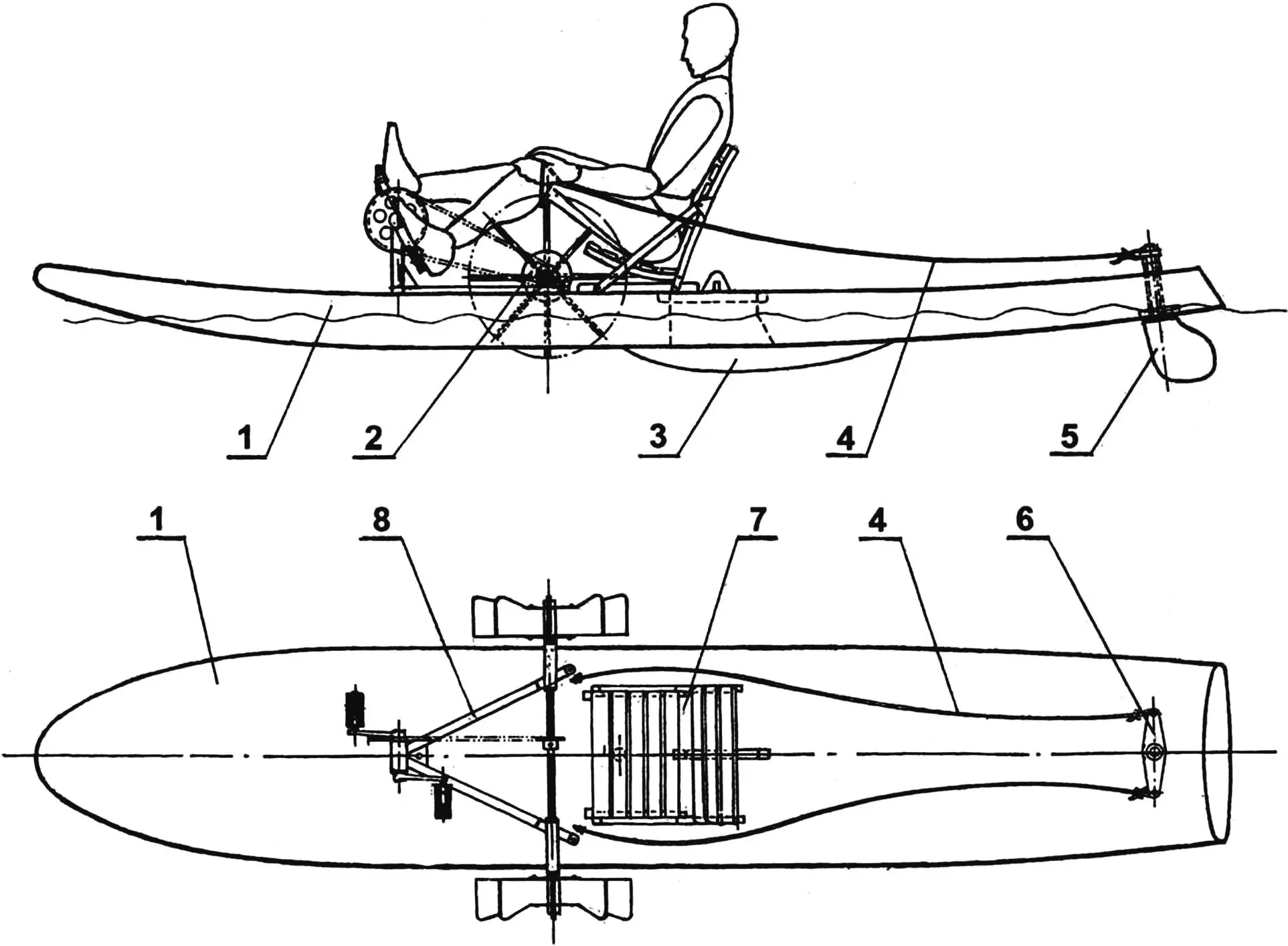
1 — windsurfer hull; 2 — rowing wheel; 3 — keel; 4 — shurt ropes; 5 — rudder foil; 6 — rudder device crossbar; 7 — seat; 8 — frame of the rowing attachment
The rowing attachment with a wheel drive is a light welded metal frame, on which a pedal unit is mounted with a driving sprocket, and a prop shaft with rowing wheels fixed on it, plus a driven sprocket. The rower sits directly behind the attachment on a bench assembled from birch slats.
The attachment frame is assembled by welding from steel square and rectangular-section tubes. In the front part a vertical console made from a rectangular-section pipe is fixed, with a welded-in bicycle bottom bracket. The junction of the frame and the console is reinforced with two triangular steel gussets. The bottom bracket is equipped with standard bicycle pedals and a driving sprocket.
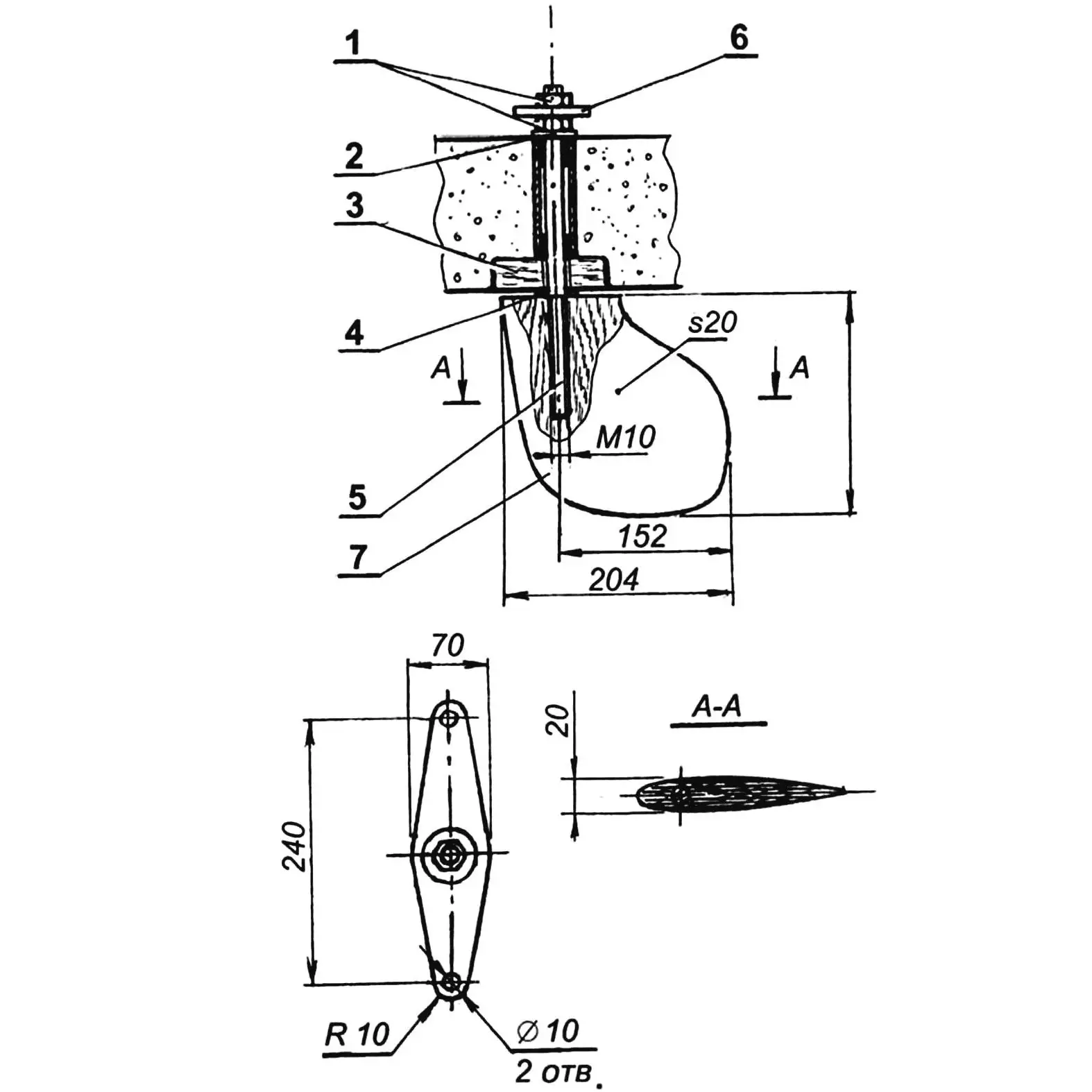
1 — crossbar mounting (M10 nuts); 2 — washer; 3 — insert (birch block); 4 — spacer washer; 5 — steering shaft (steel, M10 stud); 6 — crossbar (duralumin, sheet s3); 7 — rudder foil (plywood s20)
In the middle part of the frame two bearing supports are installed, in which the prop shaft rotates. The body of each support is a pipe section with diameter 34×3 mm and length 100 mm, and the sliding bearings are PTFE (teflon) inserts. The prop shaft is a steel pipe 20×2.5 mm with the driven sprocket mounted on it. The sprocket itself consists of the child bicycle sprocket and a steel sleeve welded to it with an internal diameter of 20 mm. On the shaft the sprocket is fastened using an M6 bolt with a nut and a spring washer.
To ensure alignment of the right and left bearing supports, it is advisable to mount them on the frame by inserting the prop shaft into them. First you should only “tack” the housings, and then, after removing the PTFE bushings, weld them finally.
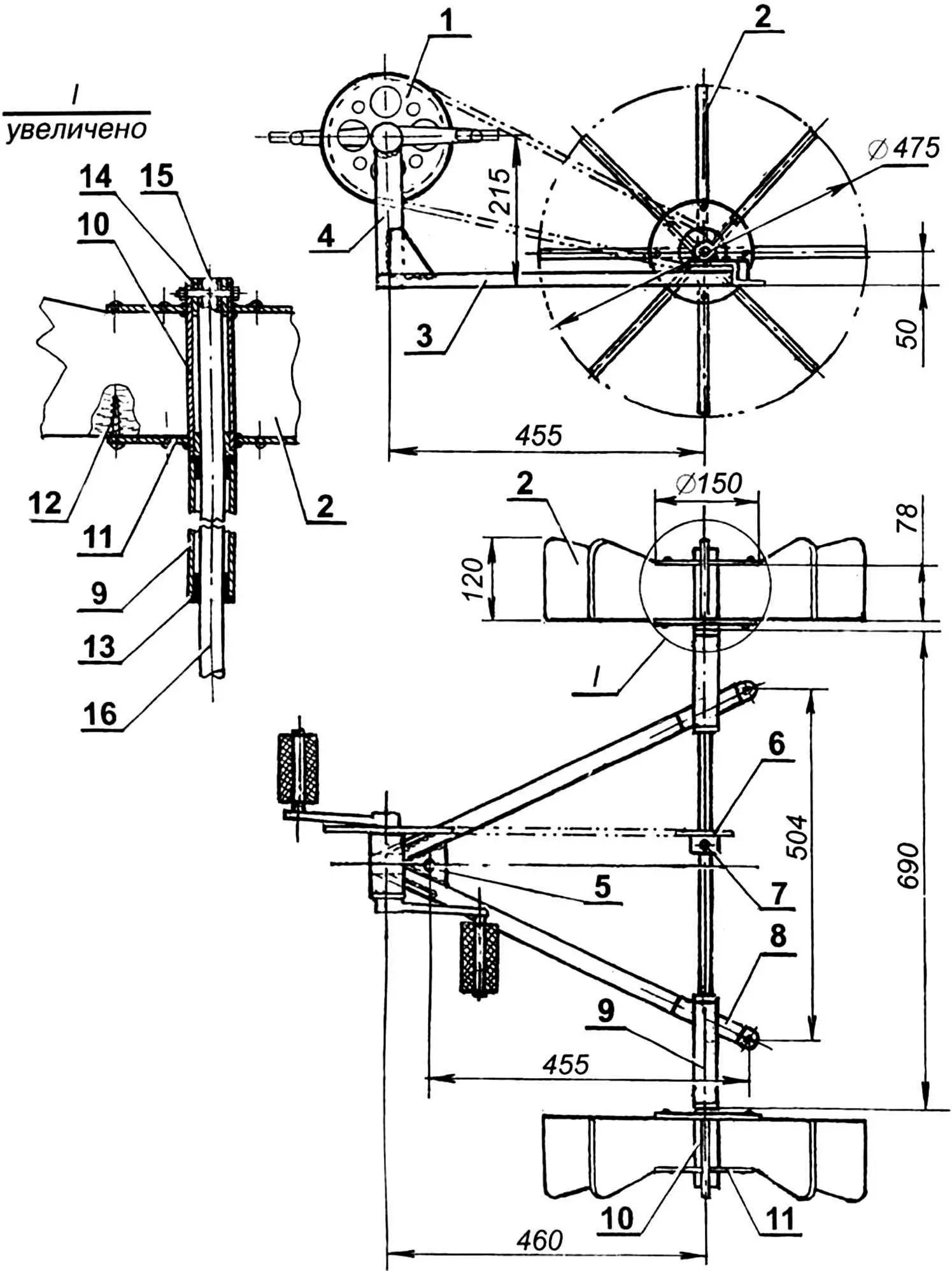
1 — pedal unit (bicycle bottom bracket with pedals and sprocket); 2 — blade of the rowing wheel (birch, board 120×20); 3 — lower part of the frame (steel, tube 30×30); 4 — console (steel, tube 50×30); 5 — gusset (steel, sheet s2.5); 6 — driven sprocket; 7 — sprocket retainer (M6 bolt with nut and spring washer); 8 — bracket (steel, strip 30×3); 9 — bearing assembly housing (steel, tube 34×3); 10 — rowing-wheel hub sleeve (steel, tube 34×3); 11 — hub cheek (steel, sheet s2.5); 12 — wheel blade attachment (screw-self-tapping 4×30); 13 — insert (PTFE); 14 — sleeve (duralumin); 15 — retainer of the rowing wheel (M6 bolt with nut and spring washer); 16 — prop shaft (steel, tube 20×2.5)
At the ends of the shaft, rowing wheels are mounted; each consists of a hub and blades. The hub is welded: it is assembled from a central sleeve (tube 34×3 mm) and a pair of discs cut from a 2.5 mm thick steel sheet. The blades are wooden, made from birch boards with a 120×20 mm cross-section. The blades are fastened to the hub using screw-self-tapping fasteners — four screws for each blade. Before assembling the rowing wheel, the blades are coated with three layers of two-component parquet varnish and bright automotive enamel, and the hubs are treated with a rust converter, primer, and two or three layers of automotive paint.
The seat is assembled from birch slats. First, seat and backrest frames are prepared: for this, cross slats are attached to the corresponding longitudinal slats with screws and epoxy glue; then a seat is assembled from these units using furniture bolts and nuts. At the lower part of the seat, birch base blocks are fixed. The seat coating consists of three layers of parquet varnish.
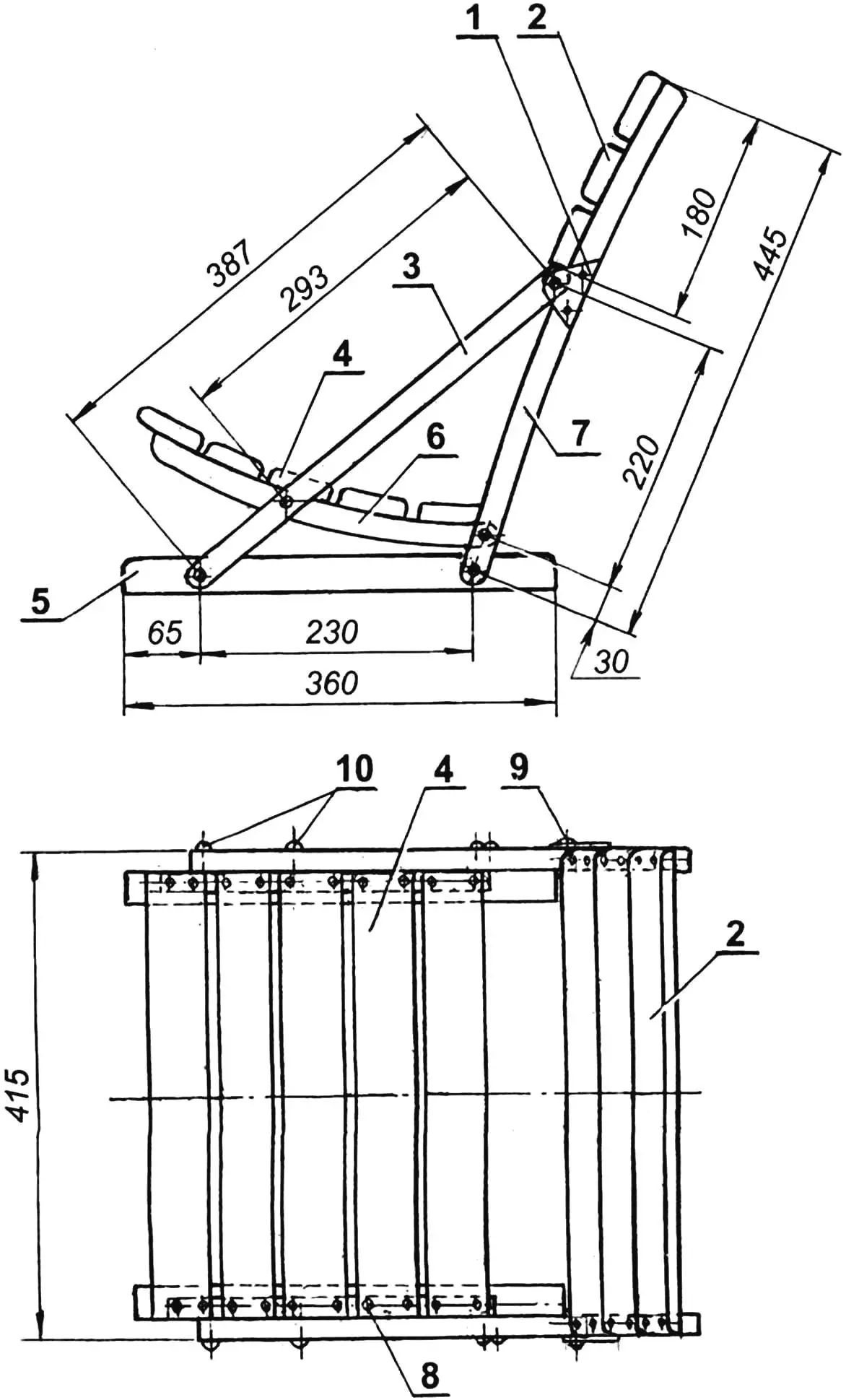
1 — bracket (duralumin, sheet s3); 2 — backrest cross slat (birch, rail 60×20); 3 — strut (birch, rail 25×25); 4 — seat cross slat (birch, rail 60×20); 5 — base (block 30×30); 6 — seat frame (birch, rail 50×25); 7 — backrest frame (birch, rail 25×25); 8 — screw-self-tapping (3×40); 9, 10 — M6 bolts with nuts (10 sets)
The seat and the rowing attachment are secured to the surfer with screws that thread into threaded sleeve-dowels (dowels embedded in the hull casing) made of duralumin.
To achieve optimum course stability, instead of the standard shvert on the surfer a small keel is installed, cut from 20 mm plywood.
The steering device consists of a plywood rudder foil mounted on a shaft — a steel stud with a 10 mm diameter. The shaft is fixed in a hinge — a steel pipe section, glued into the rear part of the windsurfer hull, at the location of the standard fin. PTFE inserts are mounted in the hinge at the top and bottom. The rudder foil has a well-streamlined symmetric profile; after processing, this part is covered with three layers of parquet varnish. The steering shaft is glued into the rudder foil using epoxy. At the upper end of the shaft, a crossbar is fixed with two nuts — a two-arm lever with which the surfer can be controlled. Control is carried out in the simplest way: using two capron shurt ropes built into the crossbar.
«Modelist-Konstruktor» No. 7’2005, I. SERGEEV
Recommend to read
 IN THE ARSENAL OF A JEWELER
Improvised creativity are addicted to for a very long time. And in many respects it was promoted by my favorite magazine "modelist-Konstruktor". Released since 1972. The recommendations... CONVEYOR FRONT EDGE
Came to the end of the Second world war, however, to stop the developing course of the military "machine" was not easy. The fighting was over, however, the industry is yesterday's allies...
