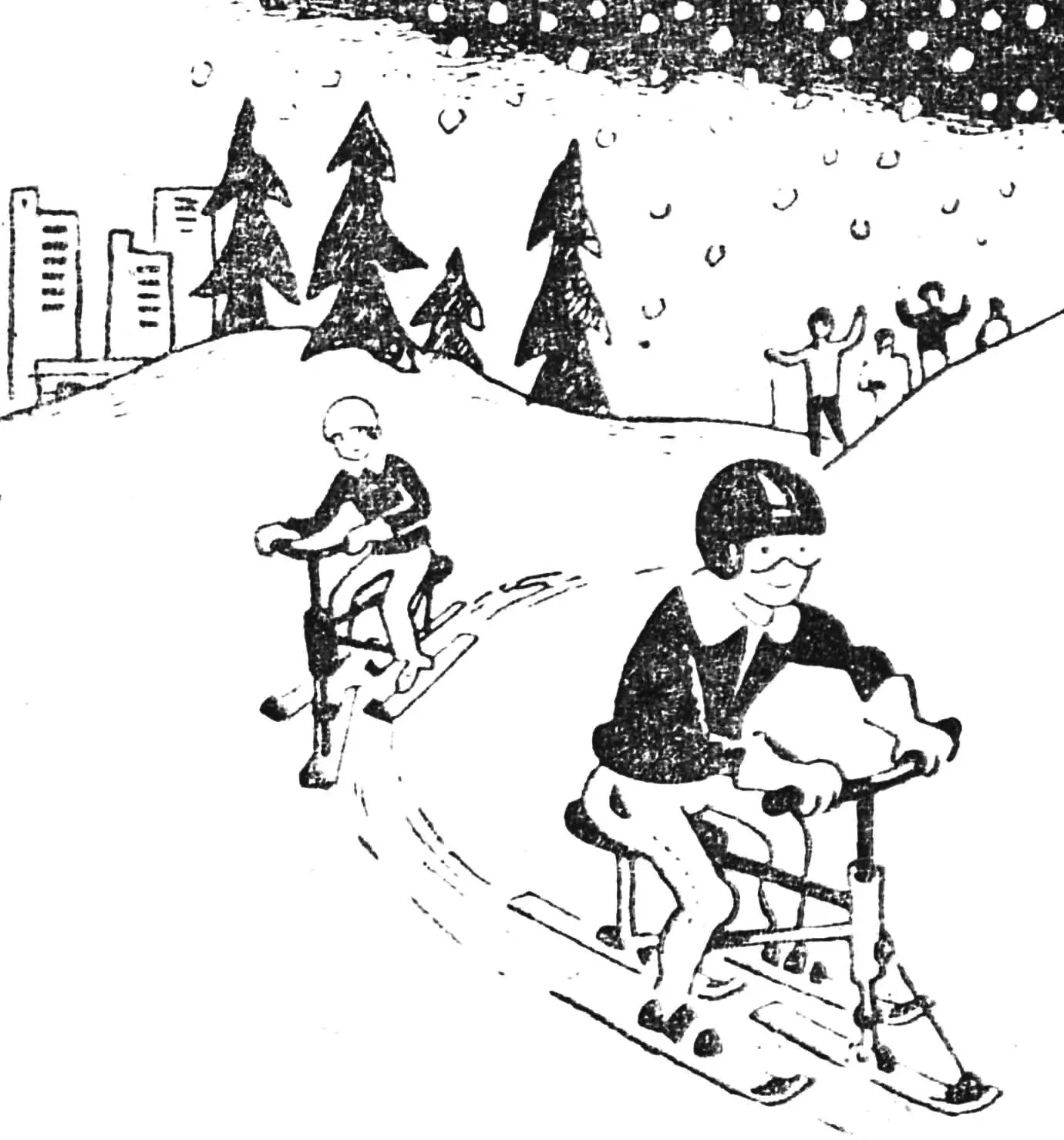
In clouds of snow dust, unusual machines rush down from a high mountain — they look like bicycles, only with skis instead of wheels.
On the riders’ feet are slalom boots and skis as well — short ones, with rigid bindings. The outfit is a dense leather jacket, stretch pants, a hard protective helmet, thick hockey gloves, and sunglasses.
At high speed the “snow jigits” overcome the irregularities of the slope, disappearing into hollows and then flying up over bumps and cornices. And it seems that nothing is impossible for them — so light and swift is their glide, so confident and graceful their movements in the turns! These are snowpedists, unusual “riders” who have mounted a snowped — a type of steered single-track sports sled that demands great courage and good physical fitness. Riding snowpeds on open mountain slopes is so exciting and thrilling that fans and supporters of this new sport grow more numerous every year. Nowadays nobody is surprised when, together with slalom skiers, “snow jigits” with snowpeds under their arms squeeze into the cabins of mountain lifts.
Having reached the summit, they race down together, competing in skill and speed, and it is unclear who will remain the “master of the mountains”: the “classic” slalom skier or the “rider” on a snowped.
According to authoritative sports physicians, a snowped develops significantly more useful skills and reactions than alpine skiing.
But we will not make predictions: these are worthy rivals for each other. And for lovers of technical creativity, building snowpeds of various types is also of interest.
Today we describe the design of such a machine which, thanks to its simplicity of manufacture, is accessible to everyone and can become widespread.
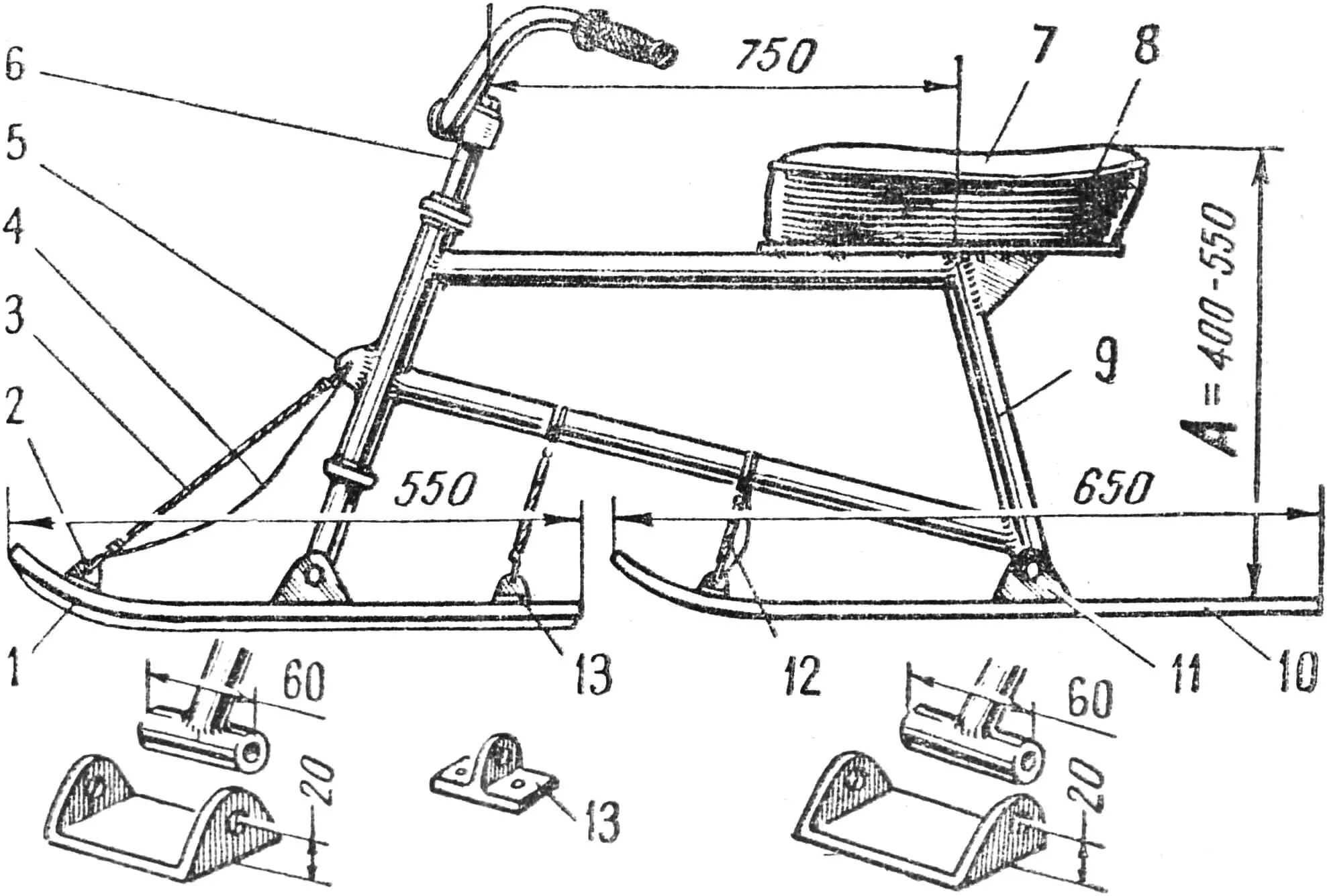
1 — front ski, 2 — shock absorber mount, 3 — shock absorber, 4 — limiting cable, 5 — lug for attaching the shock absorber to the frame, 6 — handlebars, 7 — “sofa-type” seat (from the Verkhovina-4 moped), 8 — seat mounting platform, 9 — rear frame stay, 10 — rear ski, 11 — rear ski shoe, 12 — shock absorber, 13 — lug for attaching the front ski shock absorber; below are the design and dimensions of the shoes.
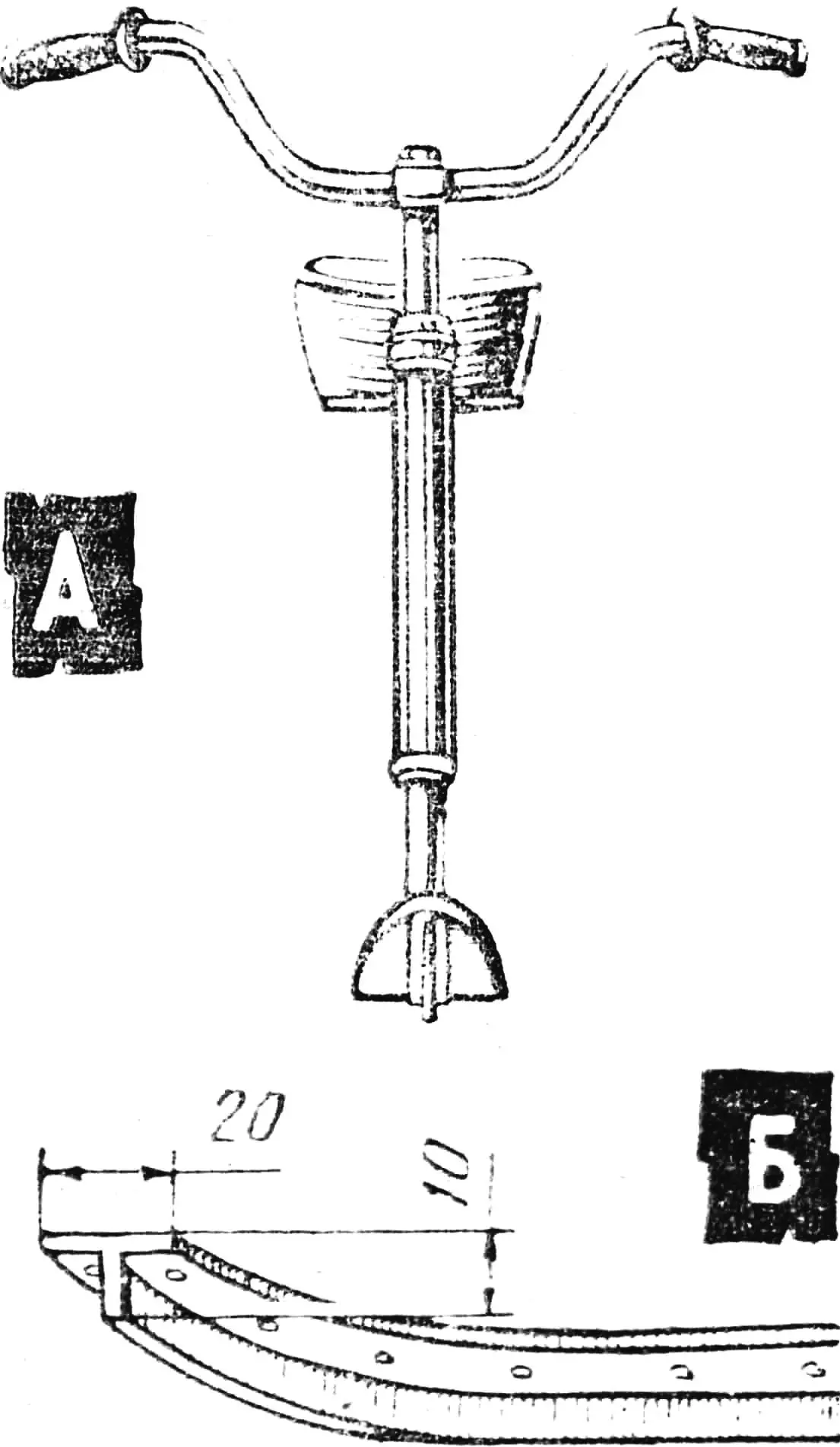
The basis of the snowped is a tubular frame resembling a bicycle frame; at the rear a supporting ski is hinged to it, and at the front — a steering column through which the steering shaft passes. Motorcycle- or bicycle-type handlebars are rigidly connected to the shaft, and a steering ski is hinged to its lower part. The seat is of the “sofa” type. It can be made yourself from a suitably sized piece of foam rubber, or bought in a sports shop.
The best material for the frame is thin-walled steel tubing of round or rectangular cross-section, joined by hard solder, welding, or on gussets (when rectangular tubes or profiles are used). In some cases, if the dimensions allow, old bicycle frames can be used.
Dimension A shown in Figure 1 determines the proportions of the snowped. This dimension is selected experimentally: it should correspond to the length of the athlete’s lower leg at an angle of 80° to the thigh. This ratio makes it easy and correct to perform turns at high speed. If several athletes of different heights will ride the snowped, seat height adjustment will have to be provided.
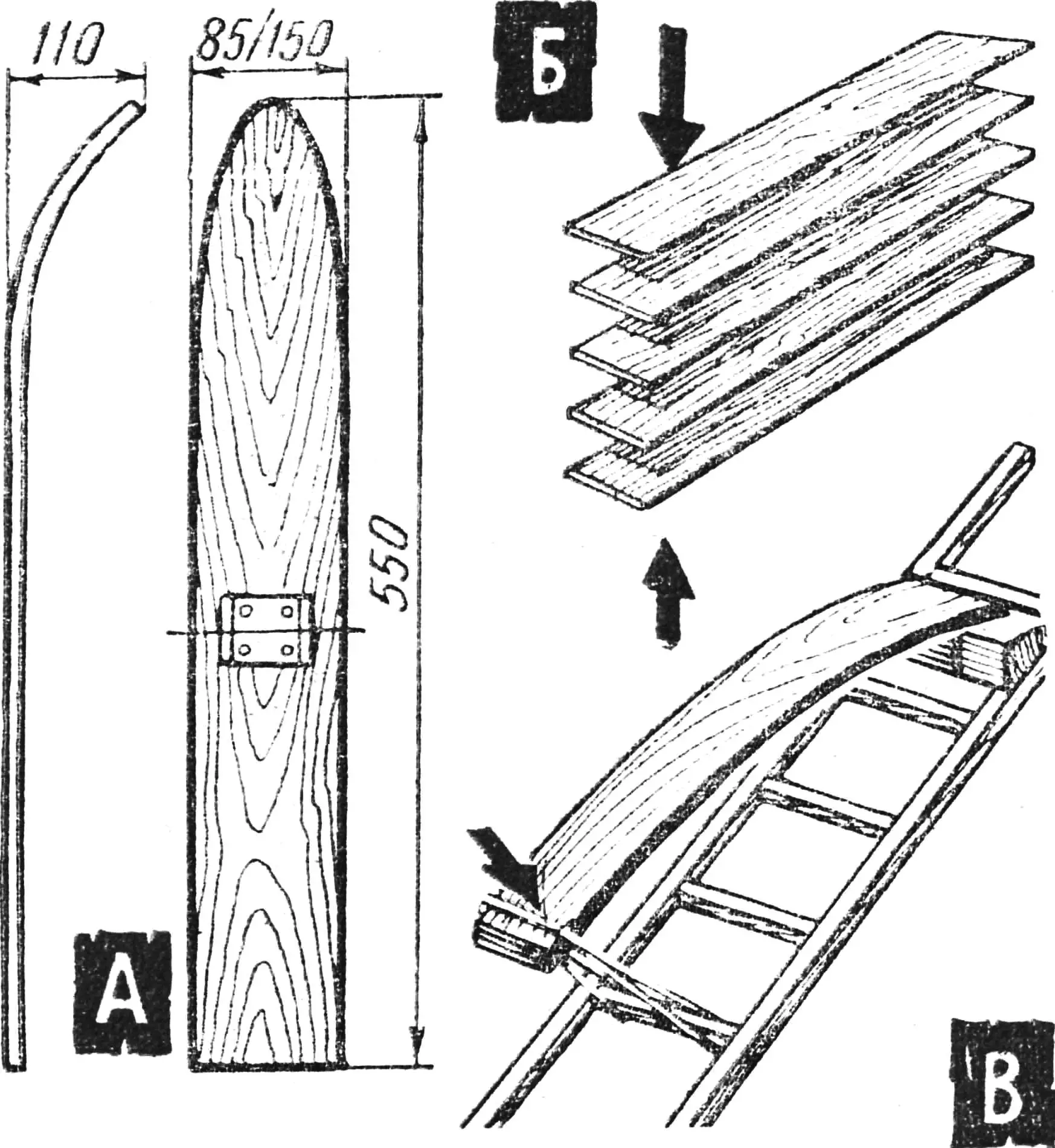
A — main dimensions, B — gluing the blanks, C — bending the ski on a simple fixture (a household ladder).
To be able to use the snowped on snow surfaces of different density, we recommend making two sets of skis: narrow and wide. The simplest way is to use waterproof plywood 3—4 mm thick, gluing blanks from four layers as shown in Figure 2. The shoes that attach the skis to the frame are made of steel according to the drawing (Fig. 1). The lower surface should be covered with plastic or thin brass — to protect against damage and improve gliding. Some amateurs edge the skis with metal, like slalom skis.
The auxiliary skis worn on the feet when riding snowpeds are made in a similar way. A rigid binding of any type is fitted to them, firmly pressing the heel of the boot.
Snowpeds and skis are usually painted orange: that makes them easier to find in loose snow. To avoid losing the snowped when falling on a long mountain slope, a safety device is made — a strong nylon cord 5—8 m long connecting the snowped to the rider’s belt. The cord is stowed in a special pocket or box attached to the frame.
Learning to control a snowped should follow this sequence: a straight descent on a slope with a gradient of 15—20°; mastering a turn toward the slope followed by a stop across the slope (same gradient); mastering a “snake” turn first toward the slope, then away from the slope, which is the hardest. Gradually you can move to steeper slopes with a complex profile, but under no circumstances should you ride among trees and large rocks: that is very dangerous.
We do not claim that the proposed design can serve as a standard. Probably, with an elastic rear fork suspension and a sprung front end, riding a snowped will become more comfortable and enjoyable. Here there is a wide field of activity for enthusiasts of technical creativity.
It is possible to create tandem-type snowpeds on which it will be interesting and fun to ride in pairs. Thought should also be given to how to take snowpeds back up the mountain using existing lifts of various types. It must be remembered, however, that excessive weight increase is undesirable, since a heavy machine is harder to control and is unsafe in falls.
FROM THE EDITORS. We ask all our readers who become interested in the snowped to tell us about their work. Please send the editorial office descriptions and photographs of the machines you have built!
“M-K” 11’73, G. ANUFRIEV, engineer, Master of Sport of the USSR
Recommend to read
 SHOWER PANEL
I have been subscribing to your magazine for many years. It is a real helper for those who do something with their own hands. We live in the south of Ukraine, where such building material... THE EFFECTS UNIT IS FOR SOLO GUITAR
Before describing the operation of the device as a whole will focus on one of its constituent elements — the Converter of the spectrum of the electrical signal, or "FUZZ"device. To To...
