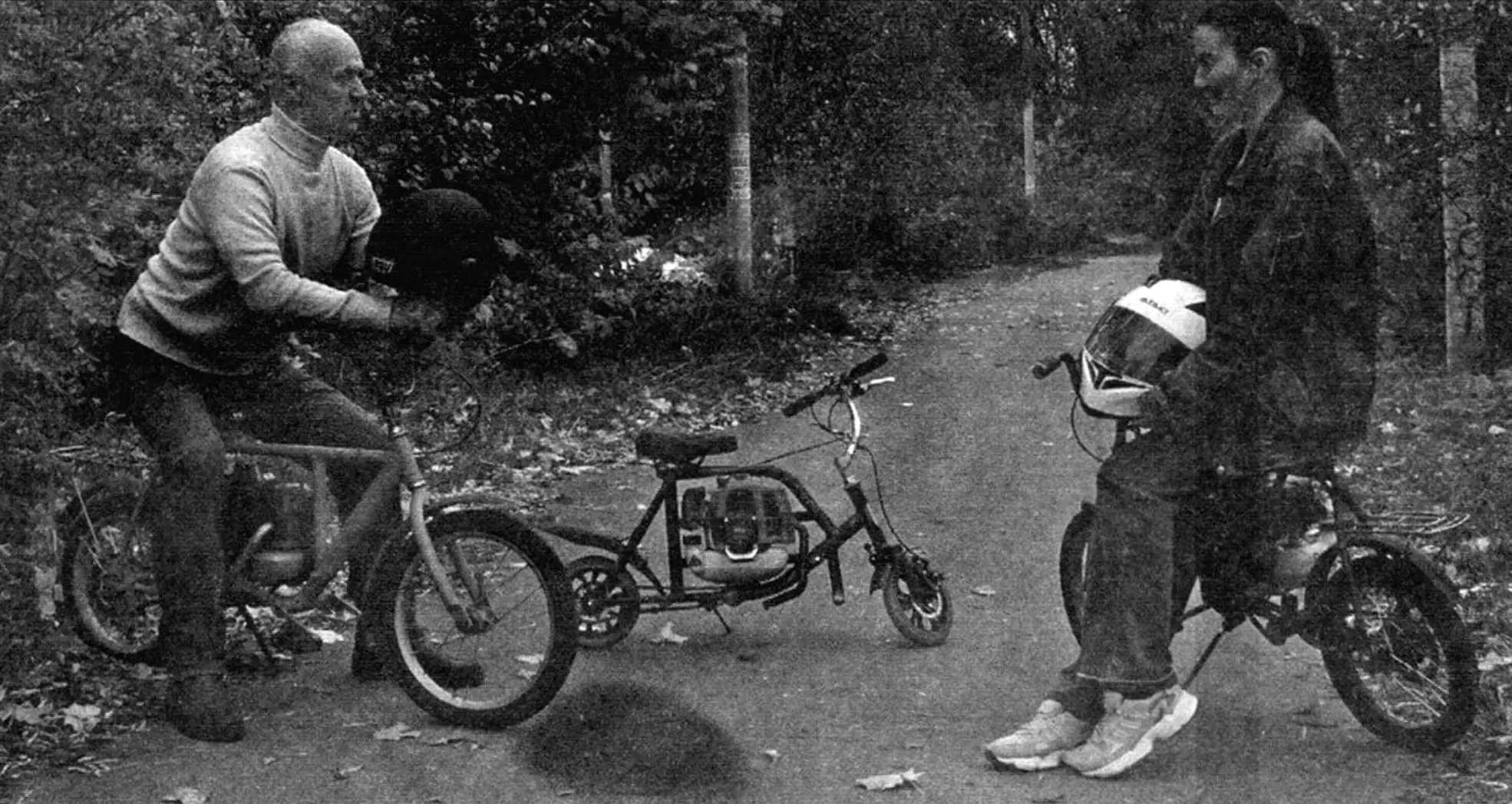
Regular readers of “M-K” are already familiar with Mikhail Landyshev’s original DIY creations. The creative process so captivates Mikhail that, having designed one piece of equipment, he almost immediately proceeds to make a second one. This was the case with tarabaikas and electric bicycles (see “M-K” No. 7-2019 and No. 4-2024). This time, three machines appeared one after another: two motorized bicycles and a motorized scooter. They all have a similar layout, and it’s clear that the author wanted to achieve maximum compactness. As he says, “the garage isn’t made of rubber,” and something large simply won’t fit there anymore.
However, these are all excuses. A more compelling reason for minimizing the size of these vehicles is the need to transport them in the trunk of a passenger car. For example, you might want to ride a motorized bicycle somewhere in nature far from home. If you ride it directly, even with a motor, by the time you get through traffic jams and traffic lights, any desire will disappear. And this isn’t always possible due to distance. Here, you drive a car out of town, take out your mini-transport, ride along the trails, have fun, throw it back in the trunk, and return home. Convenient!
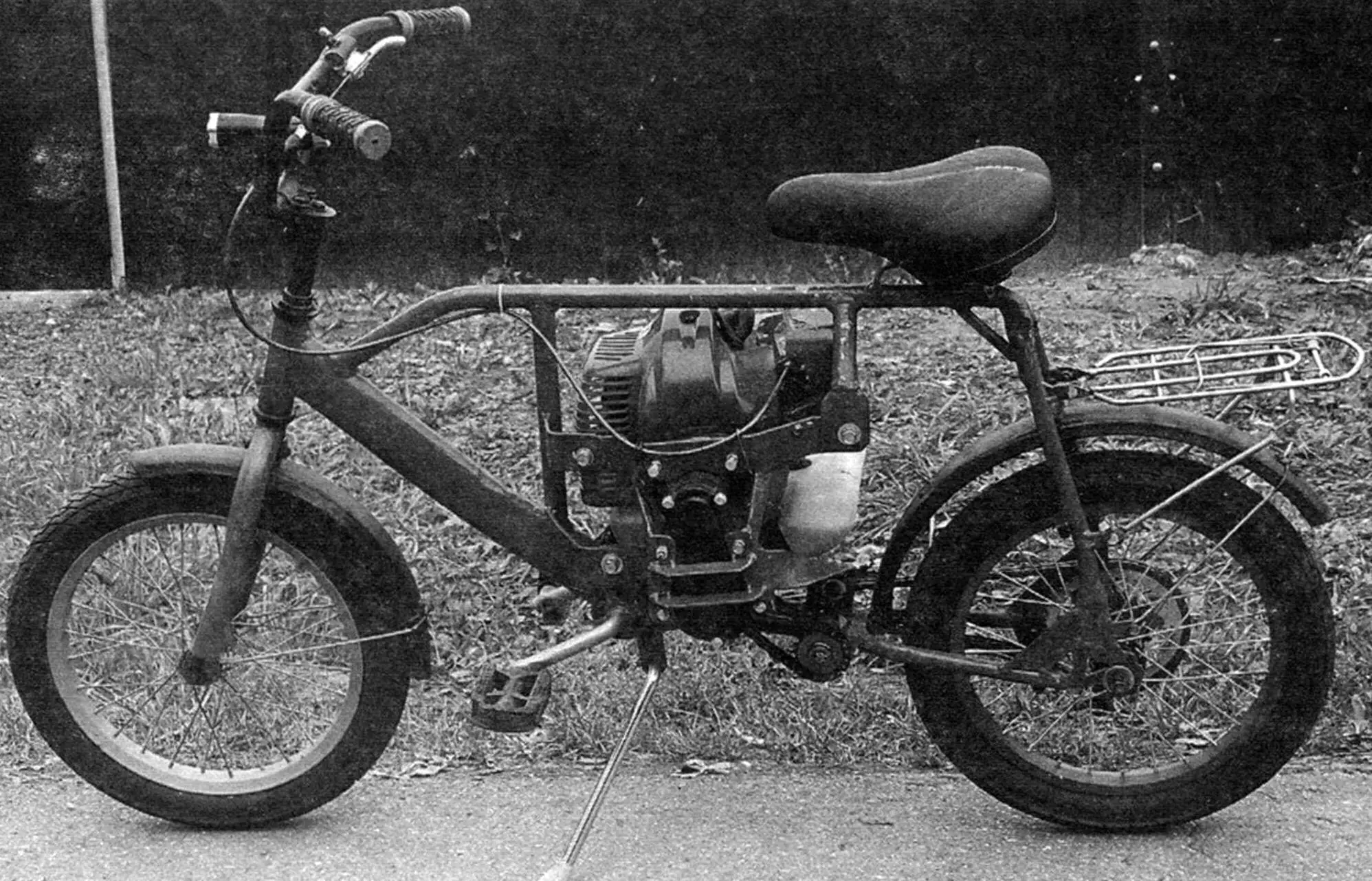
As usual, Mikhail began the story about his DIY creations with his favorite tale, that he once found a rusty bicycle frame and well-worn wheels in a pile of “metal for creativity”… Apparently, that pile is somehow magical: so much has already been found in it and, through the master’s efforts, turned into working equipment. And it seems inexhaustible!
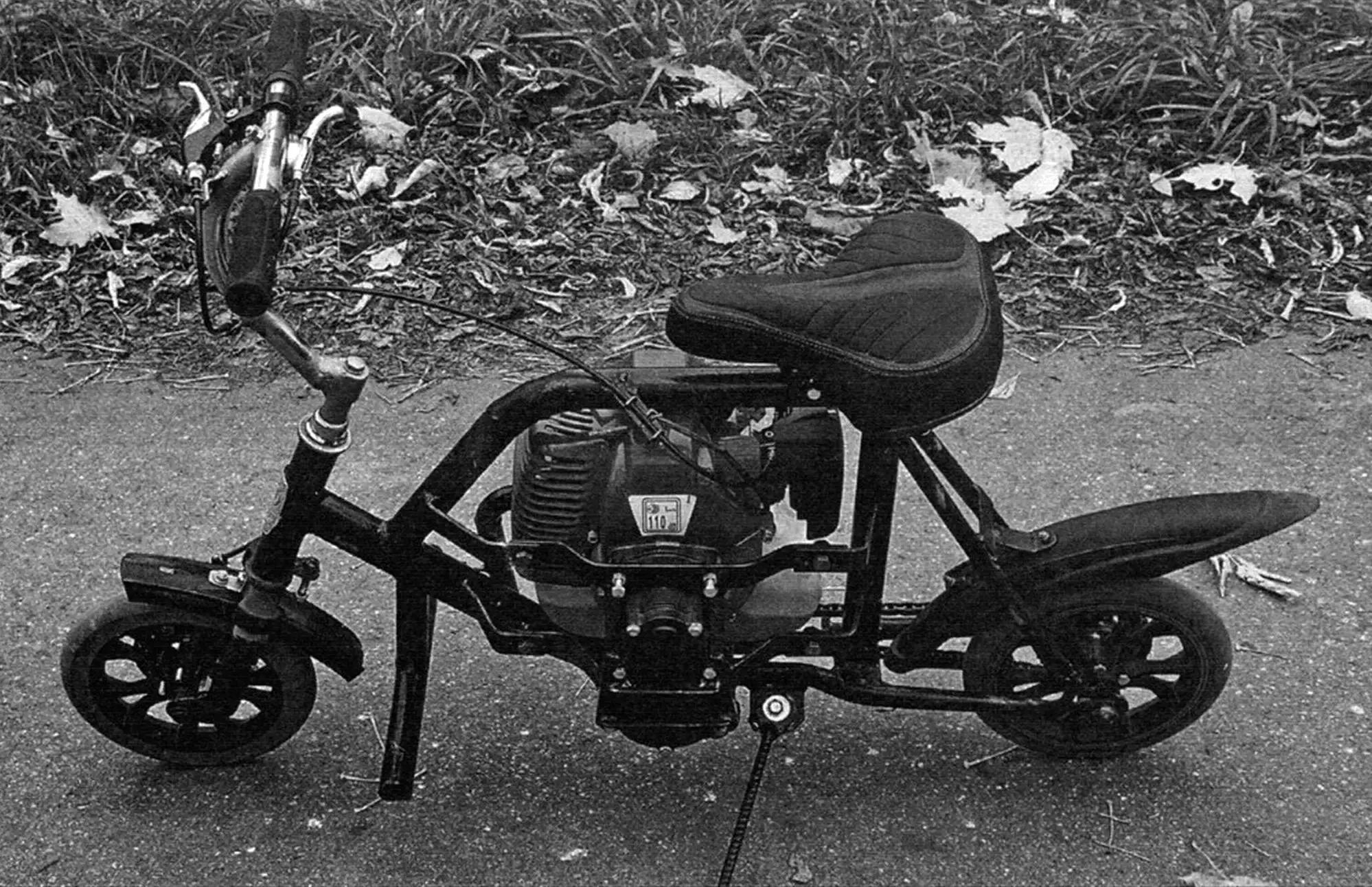
Of course, the frame wasn’t used whole, but only part of it – mainly the steering column with an inclined tube going to the pedal bottom bracket. The front fork and handlebar are also from a bicycle. And then creativity begins. With pipes of suitable diameter and sufficient strength, the frame is brought to the configuration required by the machine’s layout conditions. Interestingly, the engine is located on a movable subframe strictly in the center of the frame in the transverse direction. It would probably be simpler to shift it to the side so that the drive and driven sprocket, located on the rear wheel, would be in line. However, this would inevitably cause the structure to lean to one side due to misalignment, and it would have to be compensated, at least partially, by the rider’s position. Moreover, with such small dimensions, an engine shifted to the side would greatly interfere with seating.
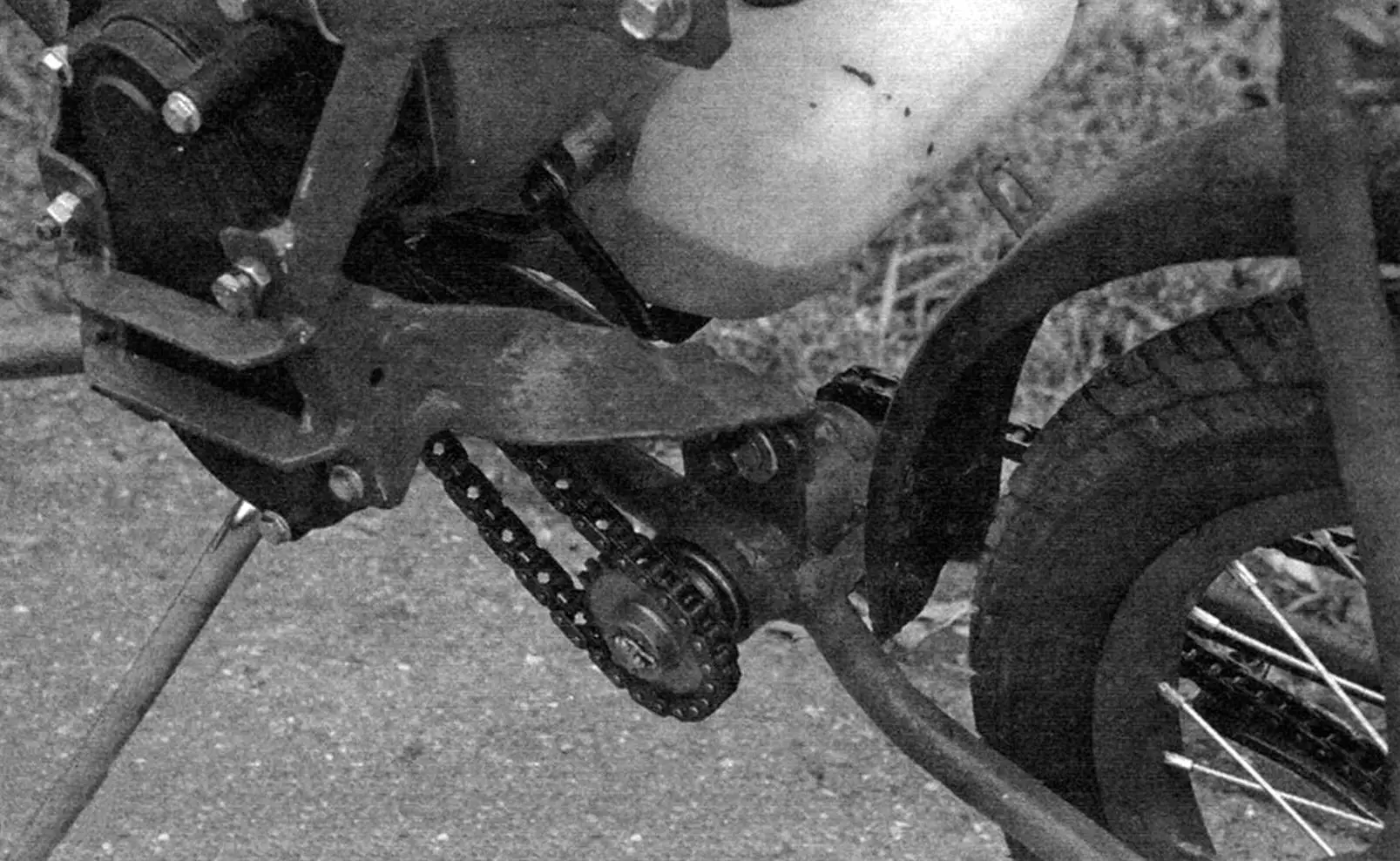
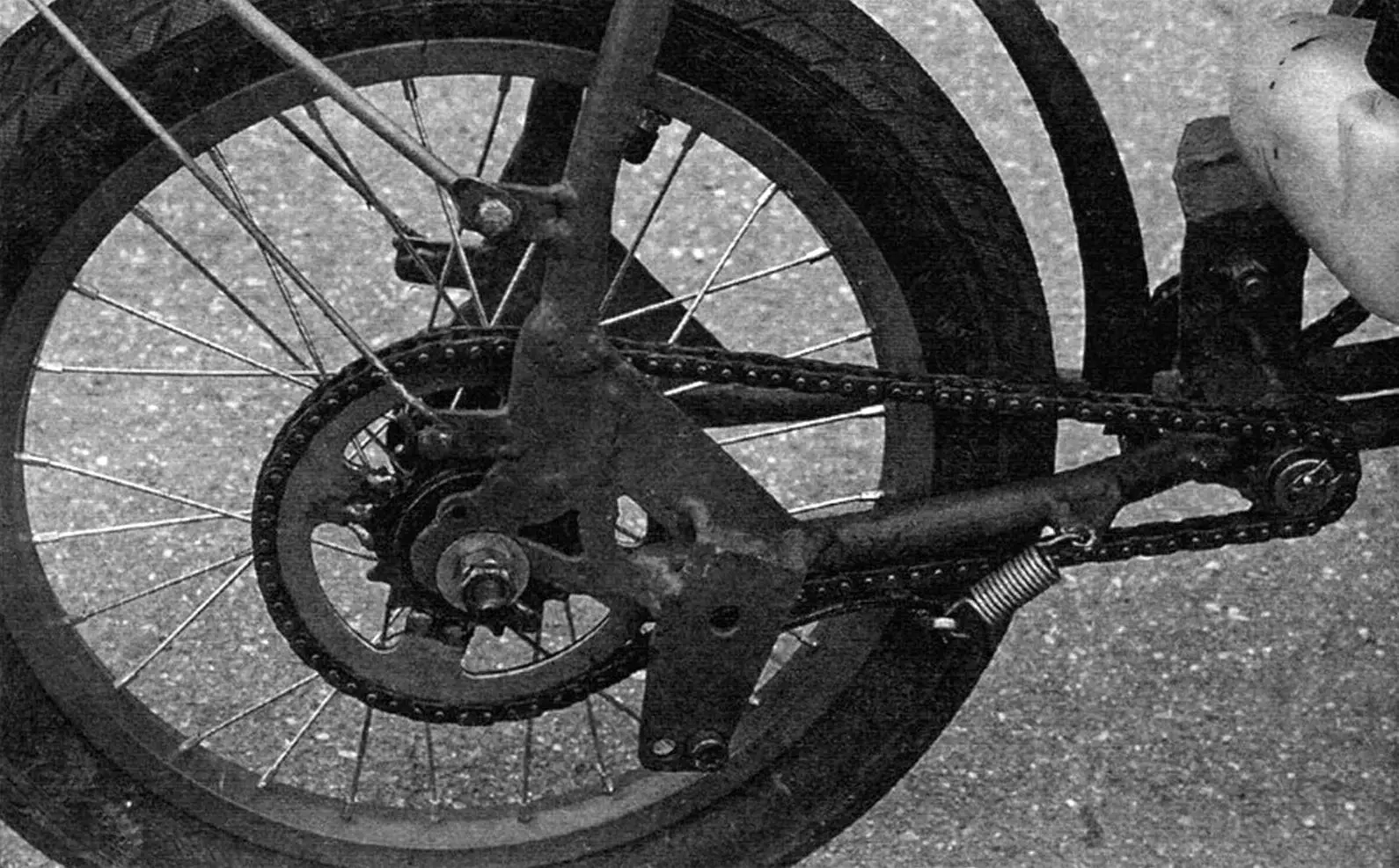
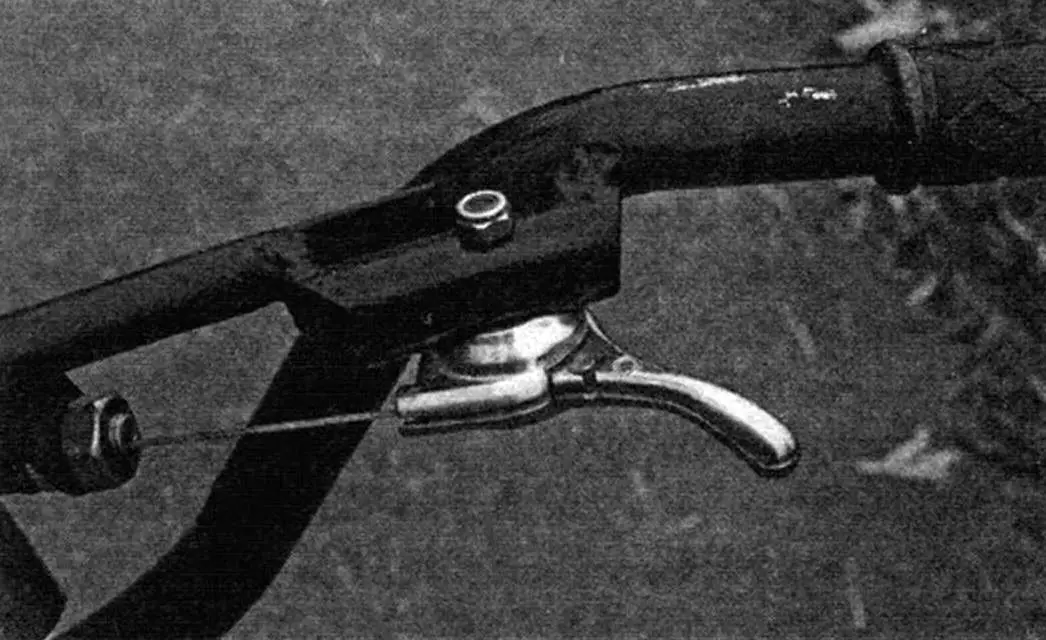
The “engines” on all three machines are absolutely identical. These are compact single-cylinder “Chinese” engines with a displacement of 50 cc, like those used on brush cutters. They are, of course, no longer from the aforementioned “pile,” but new ones, specially purchased for the project. They are sold already equipped with a fuel tank and exhaust muffler, which saves time in implementing the main idea.
The motor is high-revving, so it’s standardly equipped with a reduction chain gearbox with a gear ratio of about 3. Then comes the chain again: torque is transmitted to a transverse intermediate shaft that transfers the drive to the other side of the motorized bicycle. The shaft rotates in a housing made of a thin-walled pipe 40 mm in diameter, on 6202 bearings. The housing is welded to the frame. The sprockets on different sides of the shaft are not the same, so there’s another reduction in revolutions by about two times. The small driven sprocket of the intermediate shaft acts as the drive for the third and final chain drive – to the rear wheel. Here, the most significant reduction in revolutions occurs, and accordingly, an increase in torque on the wheel.
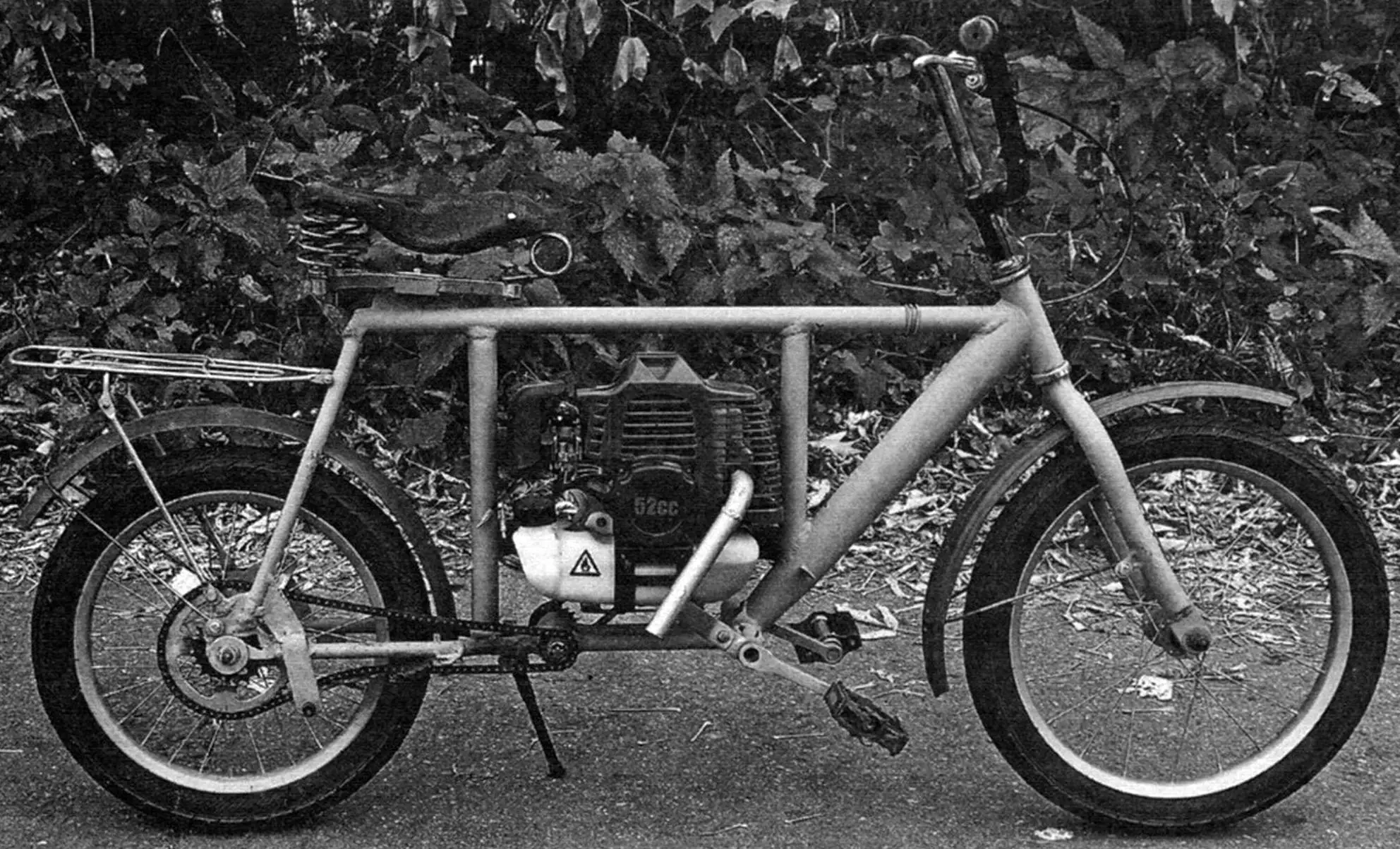
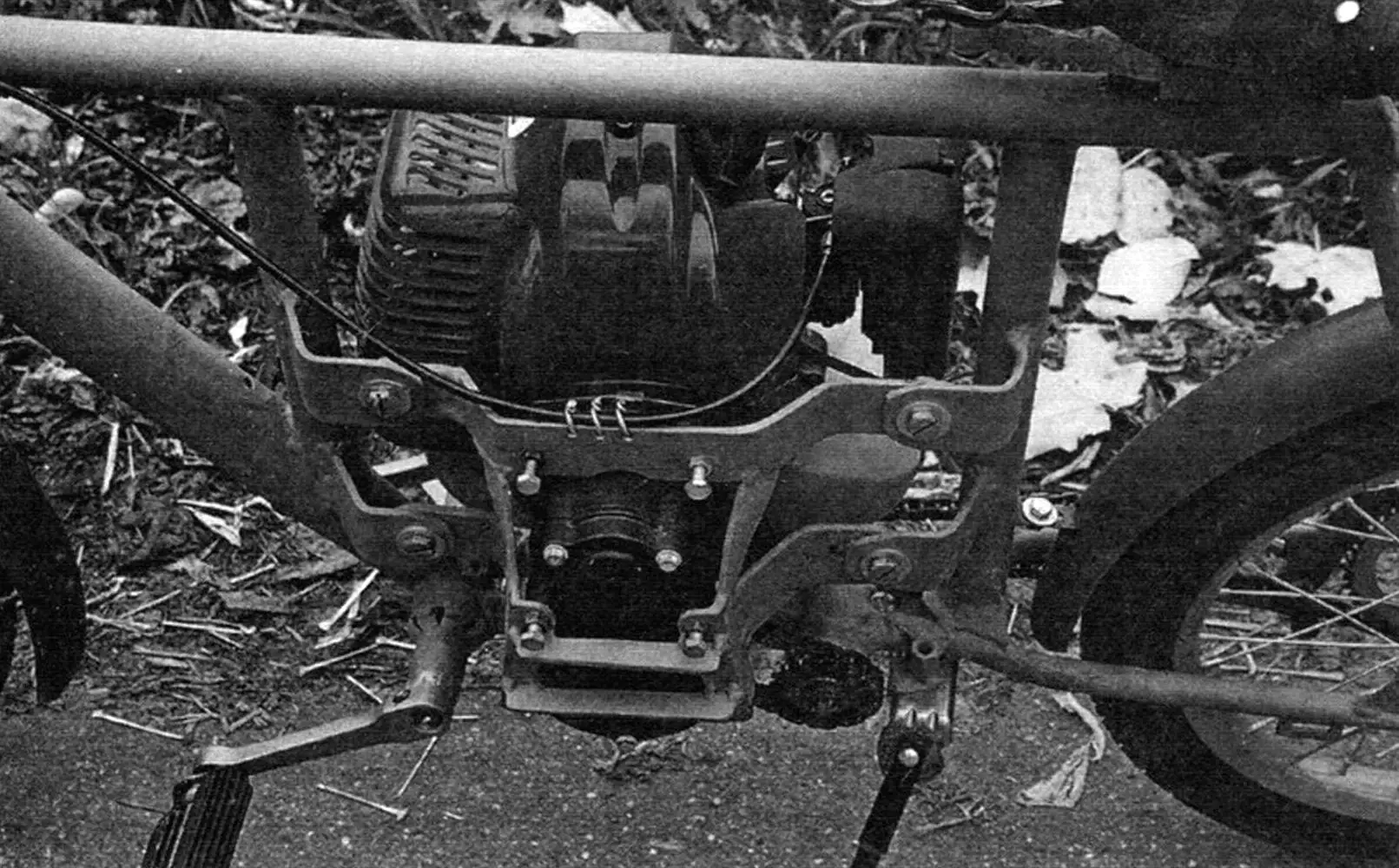
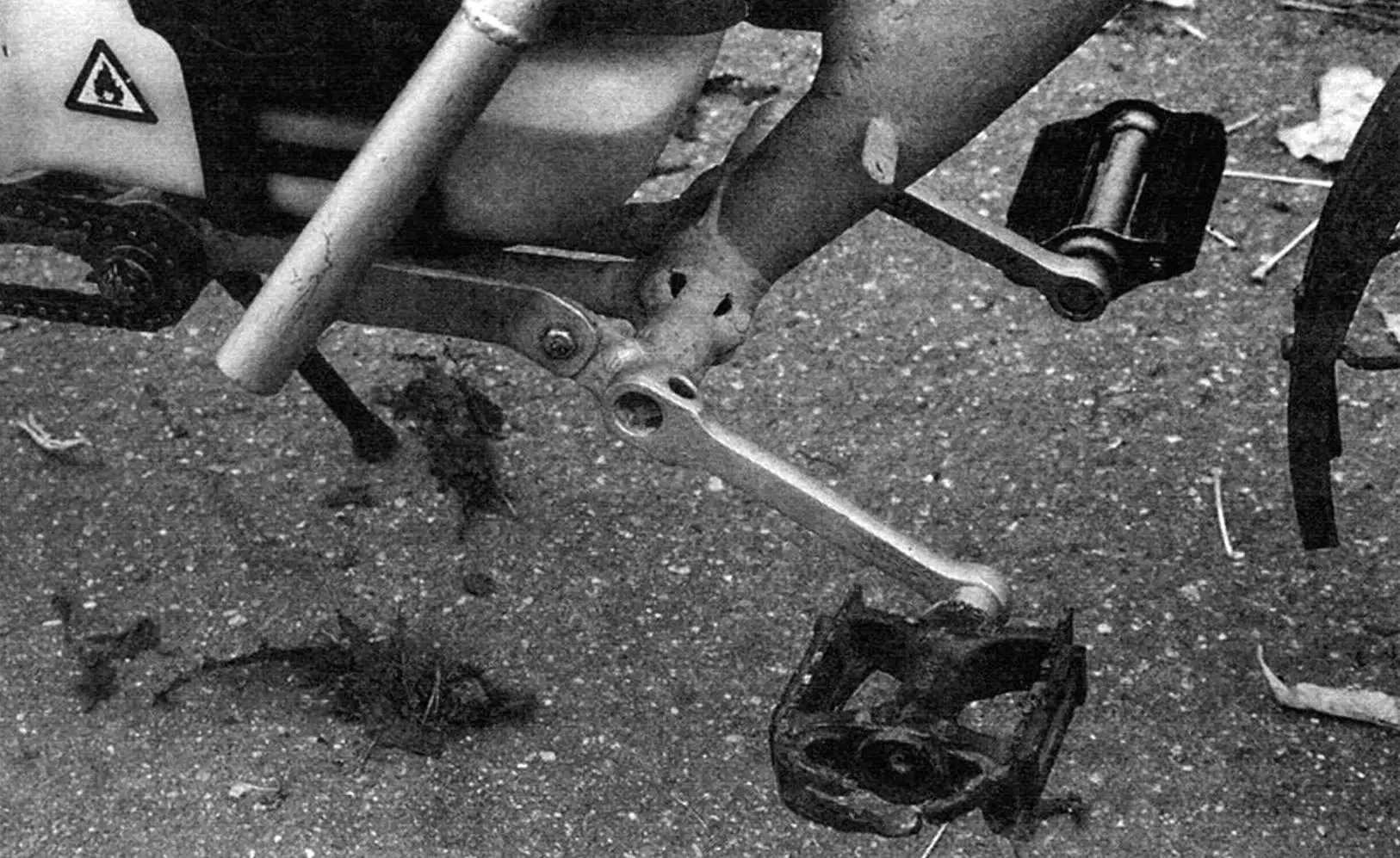
The riding experience on Landyshev’s machine is roughly the same as on a Soviet motorized bicycle with a D-6 engine. There, for a confident start from a standstill, you had to pedal, here – it’s enough to push off slightly with your feet. You don’t have to do this, the motor will handle it, but to increase the service life of the centrifugal clutch, it’s advisable to help it. Why not with pedals? Look carefully at the photo. The pedals are there, but their cranks are welded to the frame! So these are just footrests – a stylization of pedals. And strictly speaking, this is not a motorized bicycle, but a moped with a manual starter. You can accelerate to 30 km/h on it, and more isn’t needed – it’s scary.
A few words about the other little ones. Their concept is similar. Only the larger one has a slightly different frame, 18-inch wheels instead of 16, and there are also some differences in the handlebar and seat. As for the motorized scooter, it has scooter wheels, not bicycle wheels, 230 mm in diameter with solid tires, otherwise – everything is roughly the same.
Mikhail Landyshev’s DIY creations are original and functional. But he builds them not only for practical purposes. His creativity is based on a love of art, on an unstoppable desire to come up with something unusual and realize it in metal. Just as an artist, for example, can paint a picture, or can create a triptych – three paintings at once. Different, but united by one idea. This is exactly the kind of multi-layered work we observe in this case. Bravo, master!
“Modelist-Konstruktor” No. 4’2025, Andrey FAROBIN
Recommend to read
 RANGE IN ITALIAN
In early may 1938 in one of the most beautiful places in the world, the Bay of Naples, reigned naprjazhennejshie waiting. On the vast surface of the water lined up more than two hundred... THE EYE SEES, BUT THE TOOTH IS ITCHING!
So we usually say, seeing on one of the upper branches of a particularly delicious Apple Believe me, you soon forget this saying, if you do a simple capture, depicted in the drawing....
