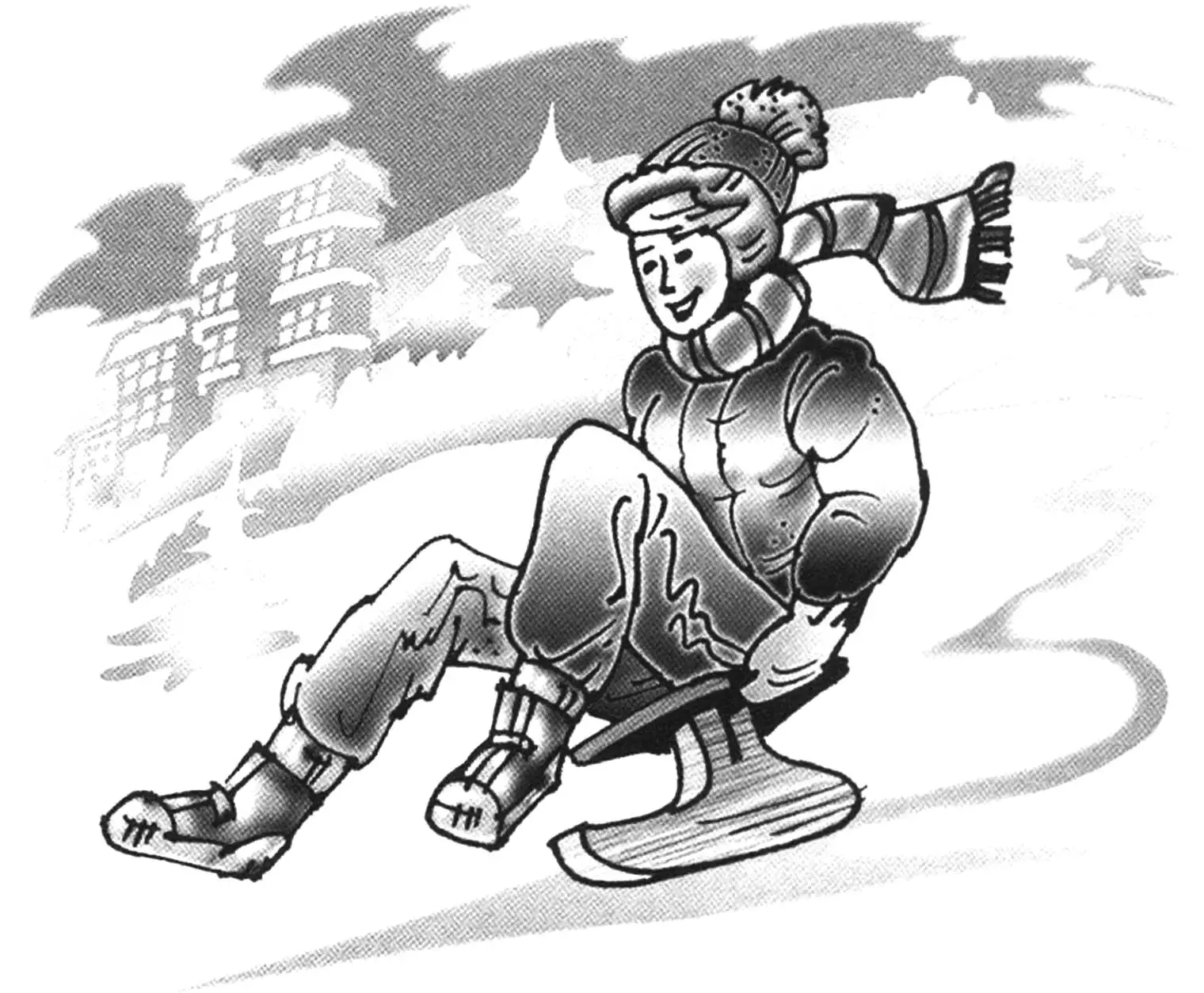
Old people humorously recall fun rides down snowy slopes on primitive sleds — bowl-shaped rounds made from frozen wet hay in old sieves. Or noisy descents “in a small heap” on ordinary sleds, from which the shafts had been removed beforehand…
And today, commerce offers a wide selection of various sleds for this — both metal and plastic, up to steerable “Chuk and Gek” models. And yet the desire to make unusual winter DIY projects does not weaken.
Responding to this persistent interest in extreme types of downhill riding, the Bulgarian magazine “Napravi sam” (Make it yourself) proposed an interesting snow scooter design that will attract teenagers’ attention not only with its accessibility for independent making, but also with the unusual ways of riding.
The originality of the device lies in the fact that it is on a single runner. This, on the one hand, simplifies the making of the snow scooter, and on the other — complicates the actual downhill sliding, which adds the kind of extreme that is so popular with modern youth. And indeed, it’s enough to observe a rapid descent on this device to understand: there’s plenty of adrenaline here. The device behaves like a spirited horse, zigzagging and bouncing on bumps, as if trying to throw off its daring rider.
How the scooter is constructed
Its foundation is, of course, the shaped runner itself, which works simultaneously as both a ski and a seat support. It is made from a wooden board (or plywood laminate) 40 mm thick, which is given the appropriate shape shown on the scale grid. The runner is lined with a metal (s2 mm) or nylon (s3 mm) strip (on screws), and in the upper part on both sides has L-shaped brackets attached with screws (from s20 board or suitable metal ones). The seat is also attached to them with screws (or M3.5 bolts).

1 — runner; 2 — seat bracket (2 pcs.); 3 — seat; 4 — backrest; 5 — handle (2 pcs.); 6 — metal or nylon runner lining; 7 — bolt with nut (4 pcs.); 8 — wooden insert tenon (Ø5, 2 pcs.); 9 — screw (5 pcs.)
The seat is made from plywood (20 mm thick). At the back, closer to the edge, a rounded backrest made of the same plywood is installed (on tenons with glue and additional fastening from below with a screw, also with glue). And since the rider has to hold on tightly so as not to fly off such a saddle, two handles (ordinary brackets) are attached to the sides of the seat from below (on bolts or screws).
As we can see, the device is simple, the materials are accessible, and making it does not present particular difficulty.
Finishing
Since the main material is wood, the finishing is traditional for woodwork. In this case, it’s enough to carefully process all edges with sandpaper so there are no dangerous splinters, and coat (impregnate) the surface with linseed oil so the wood isn’t afraid of moisture. It’s advisable to cover the seat with microporous rubber or felt: it will be softer and “warmer.”
You can add additional appeal and brightness to the device by painting it with oil or enamel paints, or even decorating it with various symbols and signs so beloved by youth — this is already according to the maker’s imagination.
«Modelist-Konstruktor» No. 2’2010
Recommend to read
 SPEED FOR JUNIORS
We offer young modelers-koretnikov apparatus of the class F2A designed to meet the standards of the 1st and 2nd digits. Power circuit model is simplified, as the technology of... “BURAN” WOULD BE SAFER
In the design of the transmission of a snowmobile "Buran" has a centrifugal accelerator, the CVT. During intensive operation of the snowmobile this node will wear out within two seasons....
