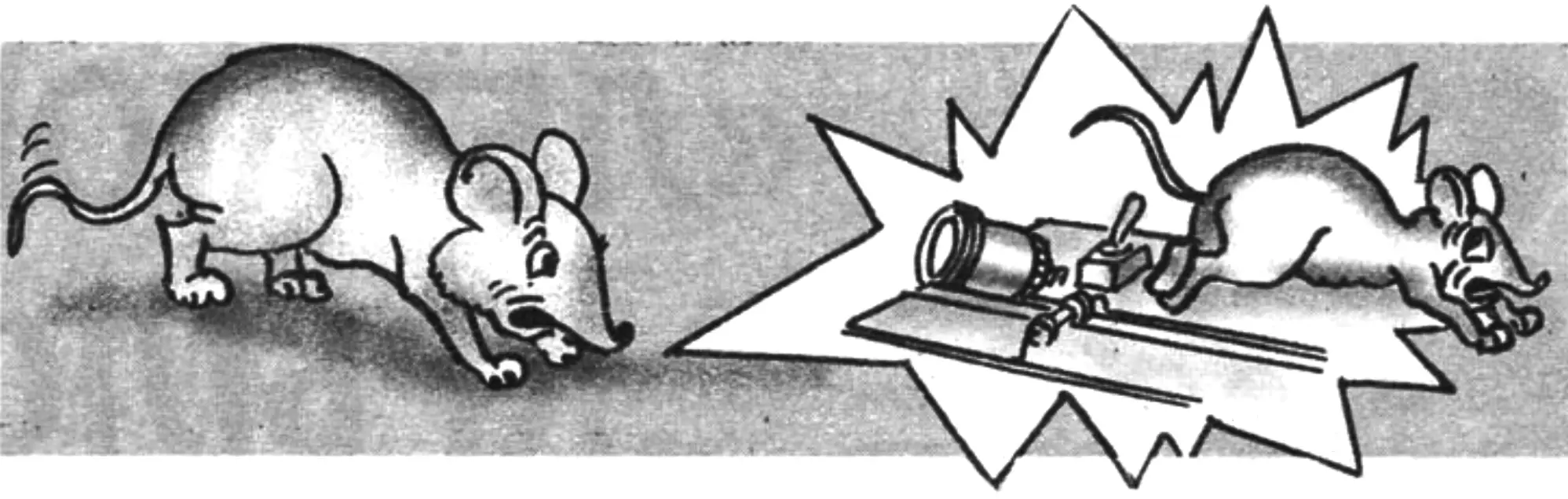
Many people keep various pets, and spending time with them brings plenty of pleasant moments to both children and adults.
However, there are also animals that constantly live near humans and often visit their homes (for example, mice and rats). Yet they are uninvited and even harmful guests, since they are considered (and, probably, not without reason) carriers of pathogens of various dangerous infections.
It is hardly possible to break them of the habit of coming “to visit without an invitation”: their desire to feed is stronger than fear. And then there remains only one way out, however frightening it may sound—to destroy them.
Usually poisonous baits or various traps and snares are used for this. These methods have been tested many times and are widely used, but they are not always effective. After all, rats are rightly considered among the smartest animals: they sense poisoned food and do not take it, while they simply bypass traps and snares or remove the bait from them with such caution and skill that these mechanisms do not even trigger.
Moreover, if rodents do sometimes get caught in traps and snares or eat a poisonous bait, a painful death awaits them, which is, in general, inhumane even toward such harmful creatures.
About ten years ago I worked as a laboratory assistant in a secondary-school physics classroom. And a large gray rat started visiting it from the basement through a gap between the floor and the wall. Several times it came without fear, even in my presence, and left very reluctantly when I threw at it whatever non-breakable object came to hand: a rubber bulb or a cardboard box.
I tried almost all traditional means against it, but with no result.
I had to think about how to outwit it. In the end, I came up with an idea.
In the laboratory, leftover from pre-perestroika times when the school radio engineering club worked successfully and won quite a few victories in radio sports, there was plenty of assorted “electronic junk.” From that I decided to make an “electromine barrier” for the rat, powered by the household AC mains. Leaving the device under voltage overnight unsupervised, contrary to electrical and fire safety rules, was a risky business. So I decided to design another improved device, operating from an electric charge stored in a sufficiently powerful pair (battery) of capacitors. As a result, the “electromine barrier” turned out simple, mobile, and free of any alarming smells or sounds.
The device consisted of a pair of plates made of 1-mm single-sided foil-clad getinax, turned with the conductive layer upward. The strips can also be made of ordinary tinplate, but only if the device is placed for use on a dry electrically insulating base, for example on a wooden floor. At the ends the strips were fastened with two electrolytic capacitors—I soldered their like-polarity leads to each plate, thus obtaining a battery of capacitors connected in parallel. I took capacitors rated 50 µF × 450 V so that for a long time they would retain a sufficiently high voltage to provide the required lethal force even with a slight self-discharge of the battery.
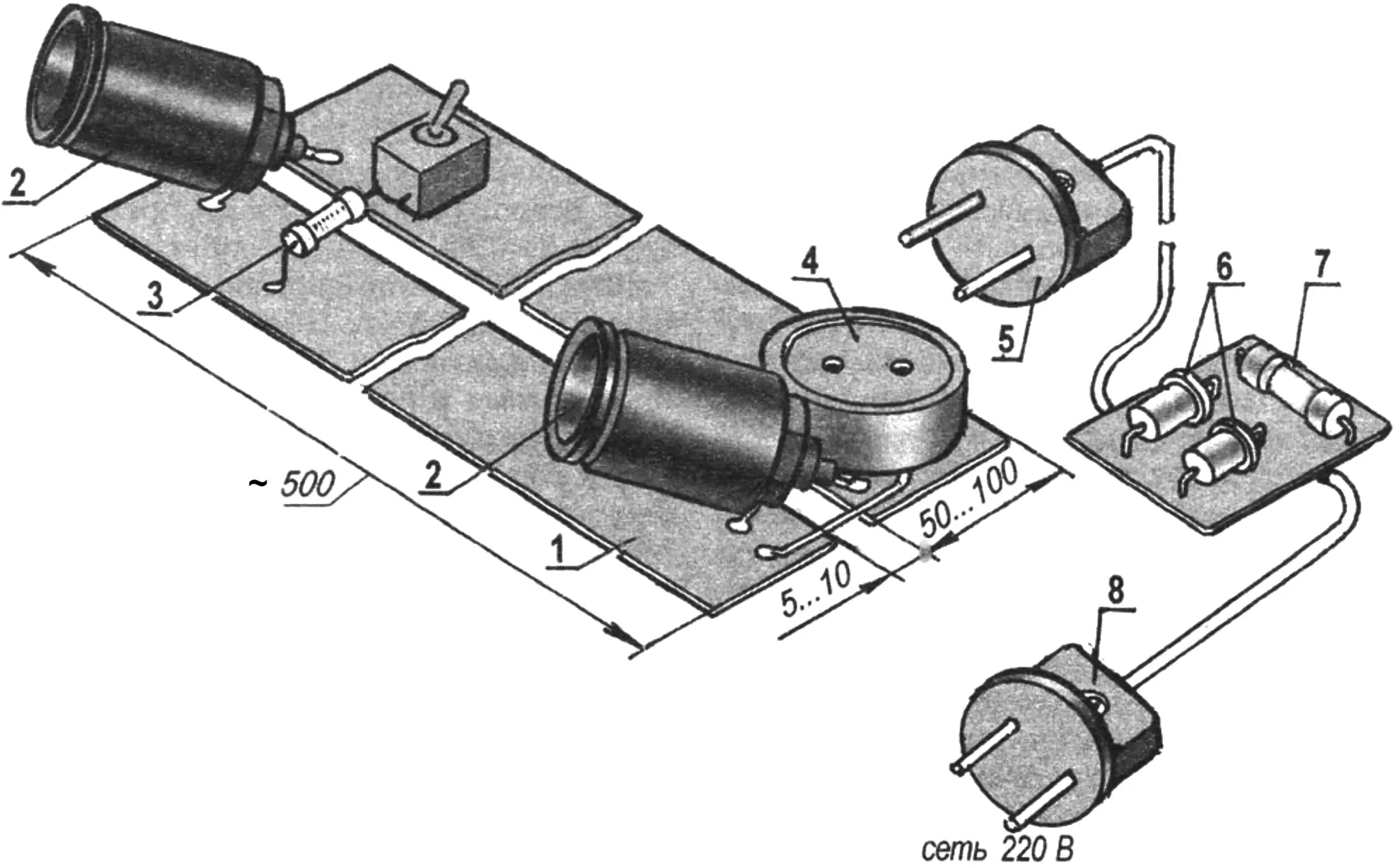
1 — plate (single-sided foil-clad getinax s1, 2 pcs.); 2 — electrolytic capacitor (2 pcs.); 3 — discharge resistor R1; 4 — socket; 5 — plug for connecting the load; 6 — rectifier diodes; 7 — charging resistor R2; 8 — mains plug with cord
The length of the plates was determined by the width of the path that the “electromine” was to cover on the animal’s possible route and was about 500 mm. The width of the plates was about 100 mm, but this is probably the maximum, although making them less than 50 mm is also inadvisable—this harmful rodent can easily jump over the plates; you cannot deny a rat skill and intelligence. The distance between the plates (the gap) was small—only about 10 mm; it should only slightly exceed the size of the foot (paw).
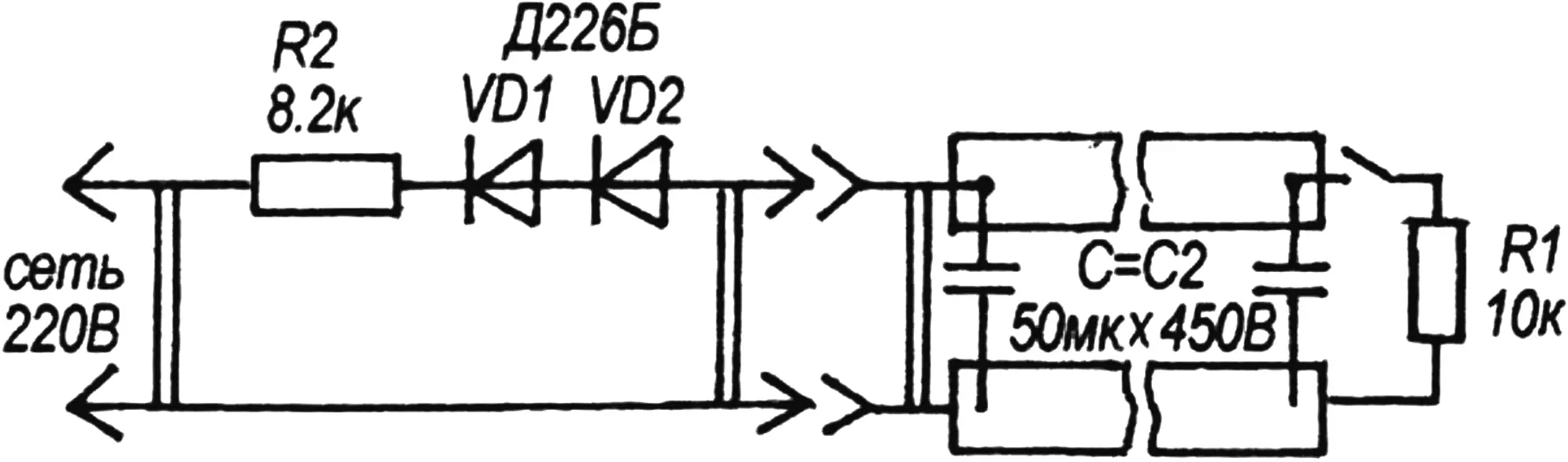
In addition to the capacitors, wires from a socket attached to one of the plates were soldered to the plates. To charge the capacitors, a plug from a simple rectifier consisting of two series-connected D226B diodes was connected to the socket. To reduce the current in the charging circuit, an 8.2 kΩ resistor is connected ahead of the diodes. The other ends of the rectifier were connected to the 220 V mains.
And one more thing. A lead of a two-watt 10 kΩ resistor was soldered to one of the plates. Its other lead remained free and hung over the second strip. By pressing the resistor with a non-conductive object, the capacitors could be discharged in a few seconds and the device made safe.
In the evening before leaving work I charged the device’s capacitors with a homemade rectifier almost to the peak mains voltage (about 300 V). (If a suitable power source had been available, they could also have been charged almost to the capacitors’ maximum allowable voltage.) After that I placed the electromine near the gap through which the rat came and went.
On the third morning the “electromine” worked—near the device lay the defeated opponent.
“Modelist-Konstruktor” No. 1’2008, A. LISOV
Recommend to read
 TIME! AND RAZBOROV
How much trouble beginners (and not only) drivers delivers the operation to dismantle and mounting of tires of the wheels of the cars! Bent rims, ripped the side of the tire, zakazanye... CHAIN — NOSE PLIERS
Respond to readers, share advice. When producing model ships can not do without the device for links of the anchor chains with buttresses. Minor refinement of pliers (or pliers)...
