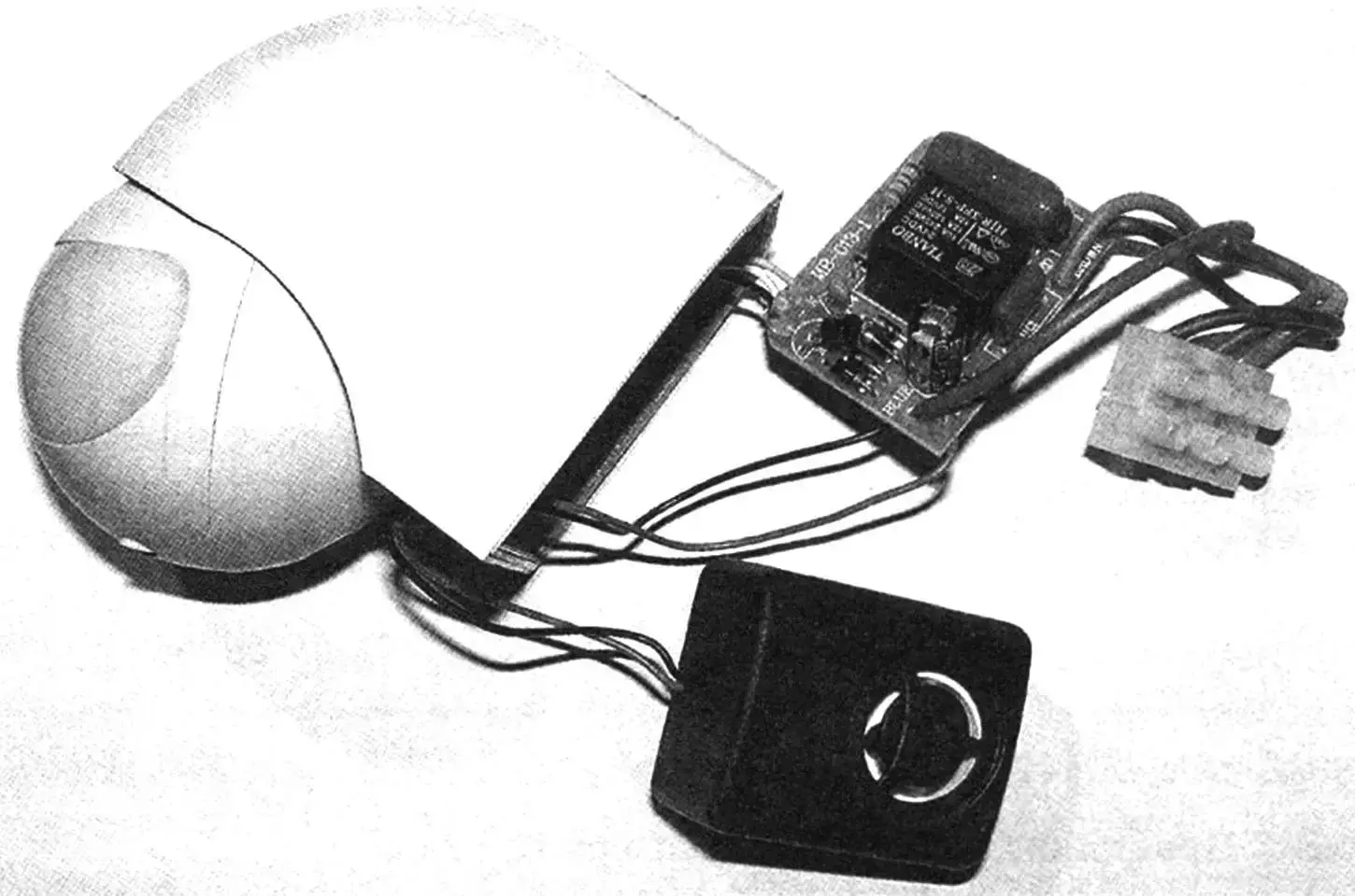
Motion sensor DD-010 disassembled with the control board removed and an additional siren (100 dB sound level) type KPS-4510 connected. Motion sensors (DD) based on Fresnel lenses and pyroelectric detectors can be used not only for their intended purpose – to turn on lights or as an element of a security alarm installed indoors. Cars are perhaps the most promising area for applying ideas for portable motion sensors. With the constant growth in the number of cars owned by the population, the proposal to actively use DD there may be of interest to a wide range of people. And here’s why…
There are frequent cases when a dog or cat uses a parked car as a shelter (from precipitation, other animals, people). In cities, this often happens in parking lots. When the driver starts the engine and suddenly moves off, animals, especially those not entirely healthy, do not always have time to react and jump out from under the car. In villages, this happens even more often.
Based on my experience of raising rabbits outside cages (with free-range around the house – you can read about this in specialized literature), the proposed warning system has already saved the life of more than one animal. In summer, when the car is parked at my country house, ubiquitous rabbits (and they multiply exponentially) climb under the car for the night and even make shallow burrows under the wheels. A motion sensor installed under or on the bumper will timely notify the driver with a sound signal that a “thermal” or animate object has appeared in its “responsibility” zone. The infrared DD will react to any moving factor that has a “thermal” background.
The use of DD will eliminate undesirable consequences for the car driver and the deliberately created situation, popular several years ago, when a short person (for criminal motives) climbed under the car from behind (under a truck – even more conveniently) and, after the car started moving, simulated an accident with minor injuries, demanding material compensation from the driver.
So how to install DD on a car?
As a rule, the electronic “filling” of the sensor is designed for power supply with a constant voltage of 11 – 14 V, which is confirmed by the presence in the same housing with DD of a transformerless power supply with ballast capacitors at the input. To adapt a household DD for a car, you need to supply power from the car battery to the control points of the printed circuit board (MB-013-1 or similar) with designations “+” (black conductor going to the pyroelectric detector board) and “-” (white) in accordance with polarity.
The control point marked on this board with the letter “K” (a yellow wire goes from it to the pyroelectric detector board) has special significance. When the sensor is triggered, voltage (12 V) is present at point “K”; it is the control voltage for the electromagnetic actuator relay YJR-3FF-S-H. The control voltage comes from a key transistor on the pyroelectric detector board, connected in current amplifier mode. This key transistor can control a load with a current of up to 100 mA, which is important to know for connecting an additional relay where it is not provided – in motion sensors for household alarms. The contacts of the actuator relay, in turn, are designed to control a load in a 220 V network (current up to 10 A).
The printed circuit board (MB-013-1) itself with the transformerless power supply, actuator relay and 78L05 regulator of the DD-010 sensor needs to be slightly modified.
1. Carefully cut (with a scalpel or other suitable tool) the conductive tracks on the printed circuit board leading from the elements of the transformerless power supply (from the 78L05 regulator) to the control contacts “+” and “-“. Solder power conductors from the battery to these points themselves (through a switch of any model).
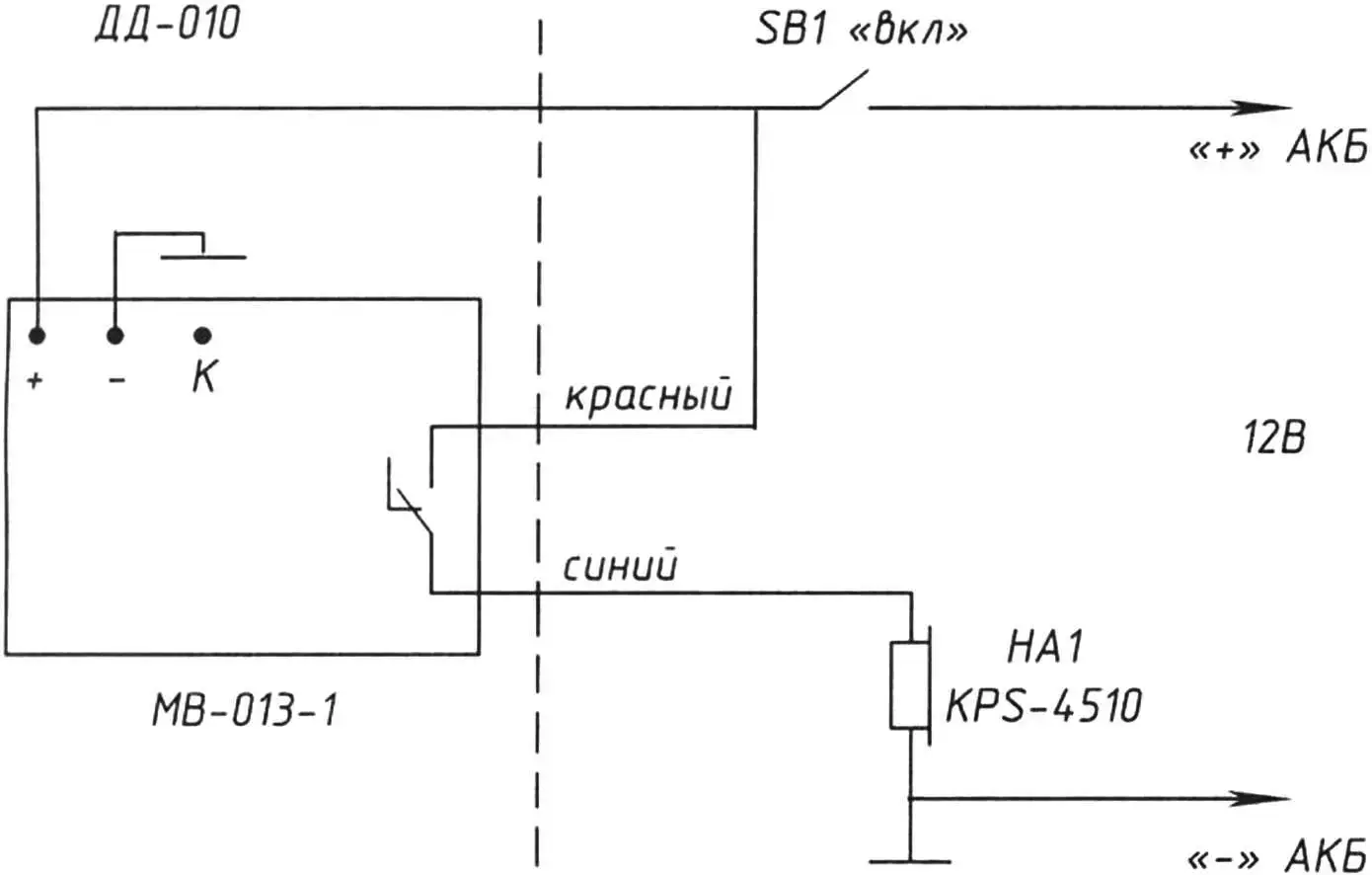
2. Solder conductors to the normally open contacts of the actuator relay, connected in the break of the electrical circuit from the battery to the sound emitter with built-in generator KRI-4332 or similar (see wiring diagram in fig. 1).
After the described simple modification, the DD is installed on the rear bumper of the car and the active surface (Fresnel lens) is turned towards the most likely appearance of a living object. When a heat source (person or animal) appears in the sensor’s response zone (up to 3 m), the sensor triggers, the actuator relay contacts close the sound capsule power circuit, and an alarm signal sounds.
In trucks and buses (due to large dimensions), manufacturers and some drivers, on their own initiative, install additional mirrors to control “invisible” places from the cab: the rear bumper (and the space up to 3 meters from it), the front bumper and the space 1.5-2 meters in front of the cab windshield, along the sides at a level of 1 m from the ground. All these zones are recognized as dangerous and “problematic”, some even call them “dead zones”, in terms of visibility control by the driver from the cab. The use of motion sensors in this case will help prevent hitting a person or animal that accidentally or intentionally ended up at the front or rear bumper of the car.
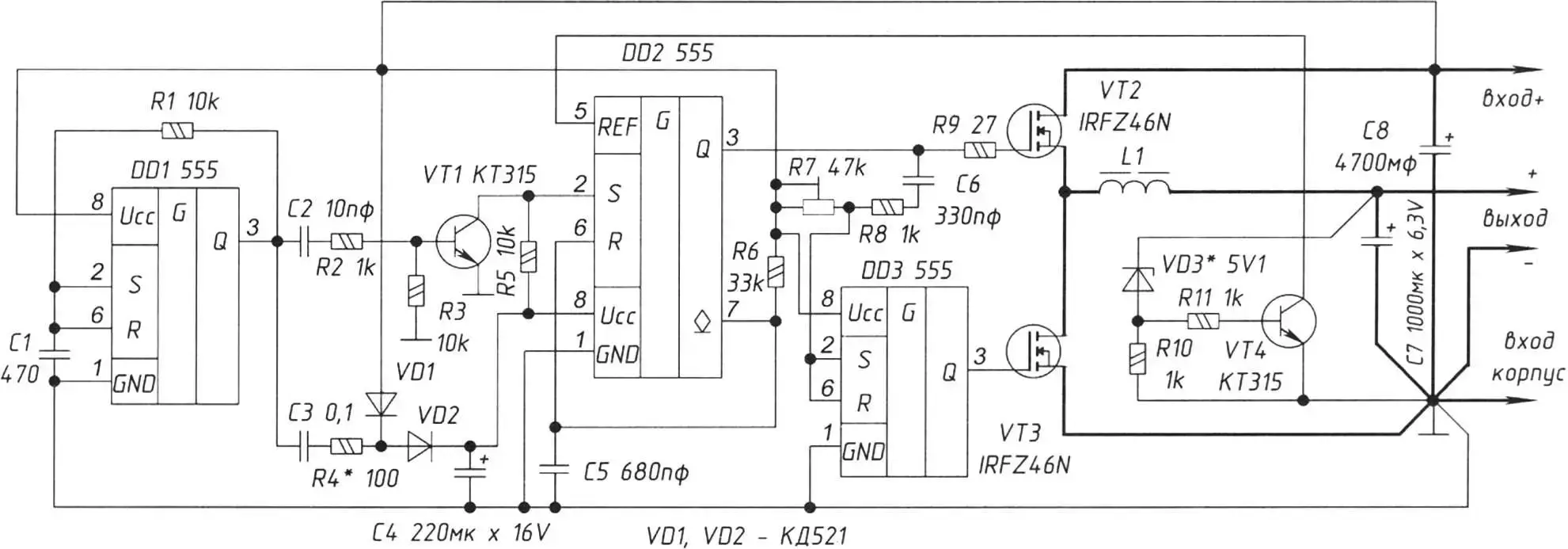
To power the DD in vehicles with a voltage of 24 V in the onboard network, a simple adapter will be required, for example, such as the one whose circuit is shown in fig. 2 (or similar).
Other applications of motion sensor
DD can also be used as an additional element of car security alarm to prevent theft and robbery. For this, DD are installed in the car interior, turned (there may be several of them) towards the most likely appearance of a person (intruder), and the actuator relay contacts are connected accordingly in the break of the car starter or ignition circuit. In terms of connections, there may be other options, such as – to the alarm sound generator (capsule), to the contacts of the limit switch on the door edge and to other contacts involved in the car alarm system; when they open/close, the alarm is triggered and sound-light notification of unauthorized entry into the car occurs with a siren or (if available) using a key fob with radio notification.
A DD installed in the car interior and connected to the power supply of active security alarm elements (for example, in the power circuit in parallel with the shock/vibration sensor), turned towards the door at window level, will trigger even when a person approaches the car at 1.5 – 2 m (sensitivity is adjusted on the DD pyroelectric detector board), which in some cases can prevent a crime, and prevention is better than subsequent correction of the situation. This option is turned on and off, like the standard alarm, from a remote control (key fob), which is very convenient for the car owner.
Of course, for all the cases considered, other models of motion sensors can also be used, including those that do not have a power supply unit and are intended for room security. The methods of modification for adaptation to cars for them are approximately the same (similar to the above recommendations).
A. KASHKAROV, St. Petersburg
Recommend to read
 TERRIBLE, BUT NOT THE SHOOTER
These missiles were never used in combat. Nevertheless, they played a significant role in the balance of power between opposing blocs during the "cold war". The work done in NII-88 in... THE GYM IN YOUR BEDROOM
"Lack of exercise, old age, and shortness of breath..." — sung in the famous song. Indeed, in our time, the widespread mechanization and computerization of society, the preservation of...
