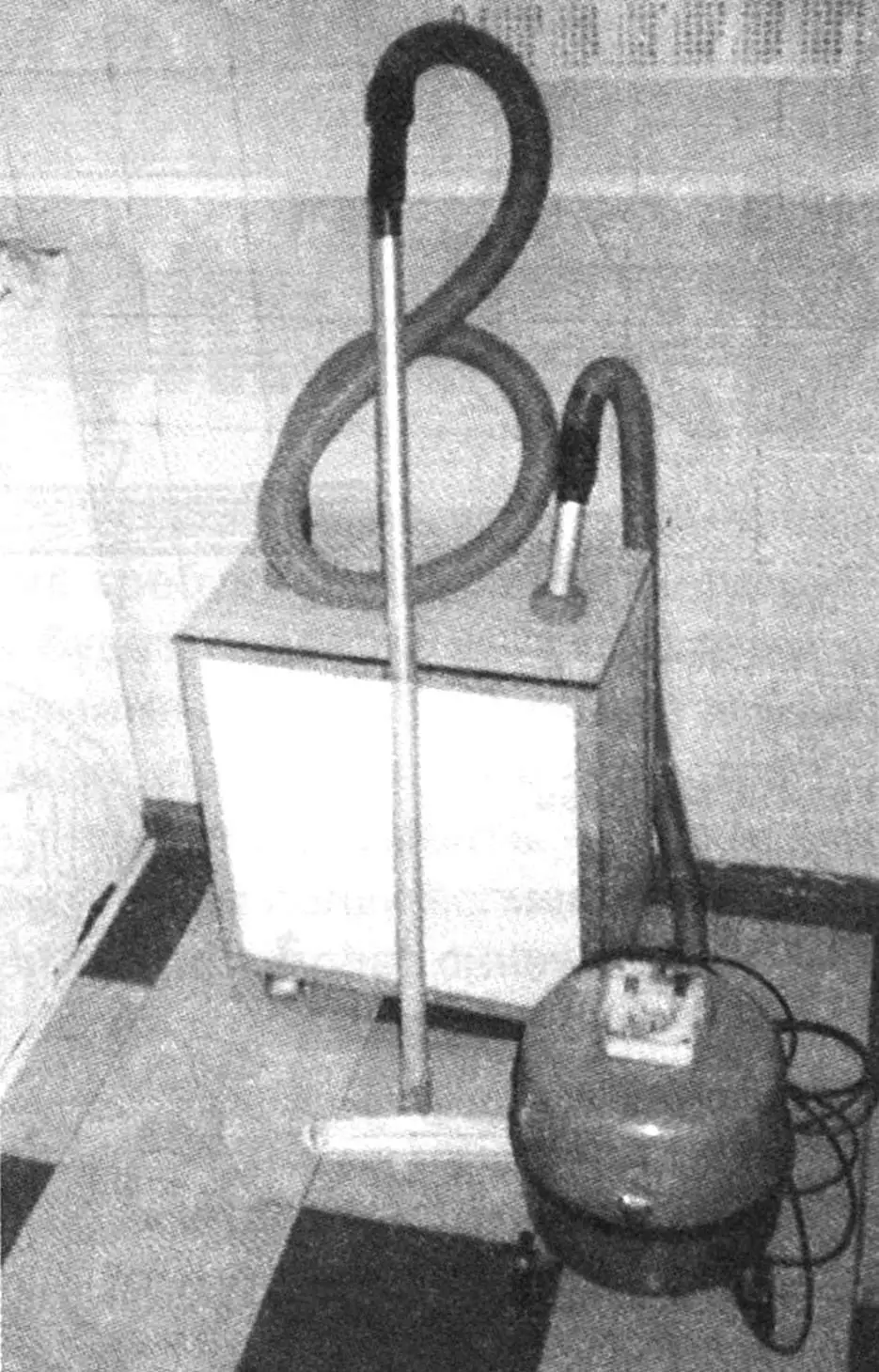
Before any home workshop maker sooner or later faces the problem of cleaning the workshop. However, it is not always possible to get by with a broom or brushes.
An optimal solution could be a household vacuum cleaner. Of course, in stores that sell various powered tools you can find special vacuum cleaners for workshops, but their prices are unacceptably high. At the same time, the dustbin capacity of a household vacuum is annoyingly small—at least for the amount of waste that accumulates in the workshop after working with wood. This is especially true for vacuum cleaners made abroad: in most of them, despite their quite decent power, the dust collection bin is laughably small.
To solve this problem, there are two ways: either make a special workshop cleaning device from parts of a household vacuum cleaner, with a dust collector of the required capacity, or add an extra external dust collector to the household vacuum.
In the first case, the following parts of a household vacuum are needed: a compressor unit with an electric motor, a hose with nozzles, a hose-mounting unit in the housing, and a motor control block. Moreover, the compressor unit with the switch and power cable can be taken as a complete assembly—especially since in Russian-made vacuum cleaners they are mounted in a single unit, with mounting elements as well. Almost everything can be taken from an existing household vacuum (if it is Russian-made; for foreign ones, see below), or you can find it in relevant stores, as well as at junk lots in the markets, where you will certainly find such “stuff” in any reasonably sized settlement.
After that, you just need to build a container of sufficient volume and equip it with a hose-mounting unit, a filtration system, mounting elements for the compressor unit, and furniture swivel casters.
In my case, it is a box with a capacity of about 360 L (1000x600x600 mm), assembled from 12-mm plywood sheets on 40×40 mm bars. The box walls are reinforced with diagonal bars for structural rigidity. (In the initial version, during operation the walls deflected inward so strongly under external pressure that keeping the lid sealed was out of the question.)
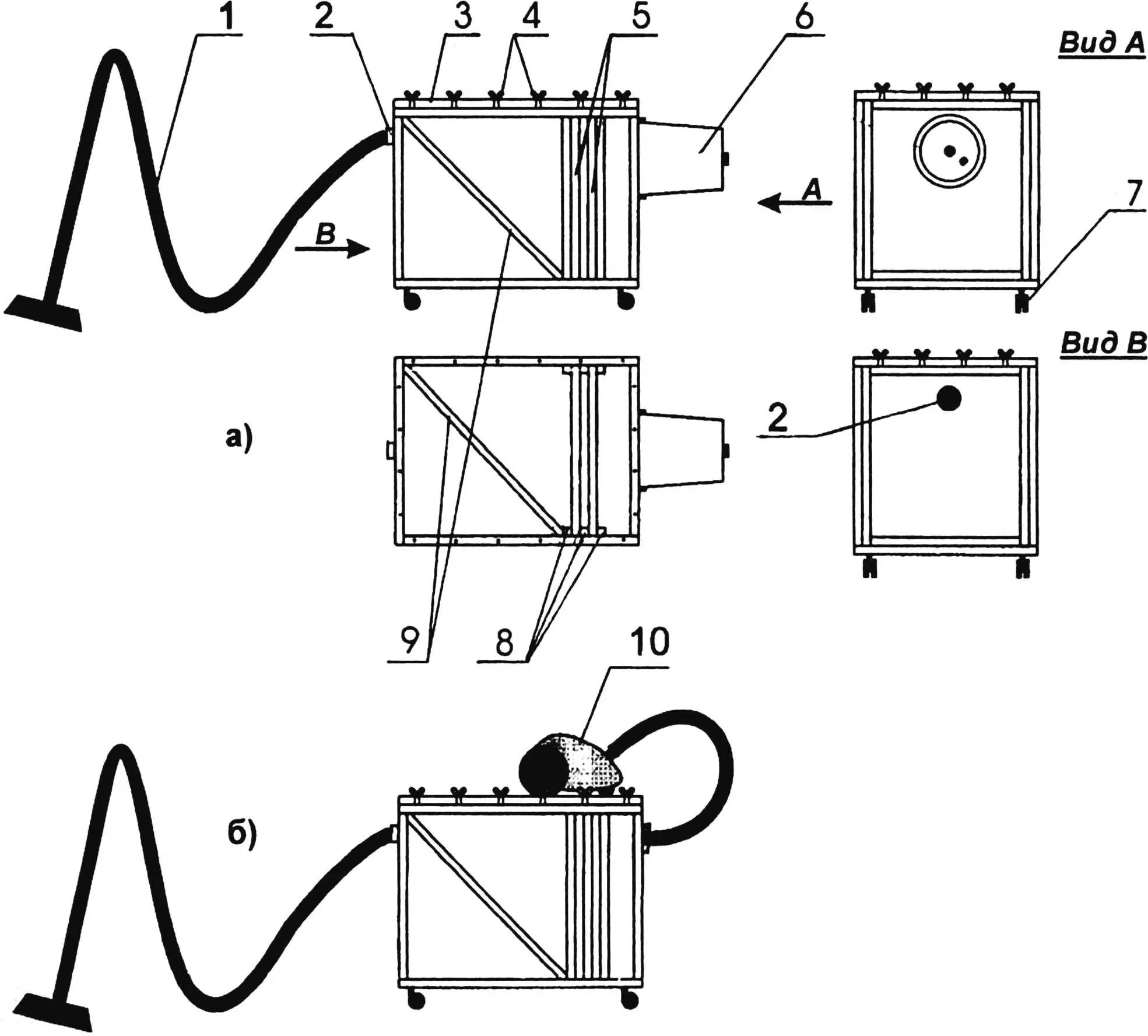
1 — hose; 2 — hose mounting unit; 3 — lid; 4 — lid mounting bolts; 5 — filter frames; 6 — compressor unit; 7 — chassis; 8 — guides for filter frames of the filtration system; 9 — stiffening ribs; 10 — vacuum cleaner of foreign manufacture
Inside the box, near the compressor unit, there are two filter frames. For coarse cleaning, a plastic insect screen is used, and for fine cleaning, a piece of knit fabric. The frames are made of 20×20 mm bars connected with a simple half-lap (half-tree) joint glued together. The fabric and the mesh are attached so that the filters can be replaced quickly if they get damaged or need washing.
The compressor unit is placed on one of the box walls.
The dust collector lid is sealed to the box with twenty bolts with wing (thumb) heads. Sealing is ensured by foam gaskets around the perimeter of the lid.
The hose mounting assembly is taken from a vacuum cleaner and glued into the wall opposite the compressor unit wall, at the top part of the box.
As a chassis, it is convenient to use self-orienting wheels from a baby stroller, preferably with a large diameter. However, in my case, regular furniture swivel casters worked just fine.
Handles are attached to the box so you can take the collected production waste to the nearest trash collection point. Although you could place a special bag for waste collection inside the dust collector, that’s a matter of taste.
It should be noted that this design can also be made stationary, with a much larger-capacity dust collector. But remember that during operation the vacuum creates a very strong negative pressure and, as a result, large loads on the walls of the container. Therefore, you must ensure the rigidity and strength of the dust collector structure.
All of this applies to the case where you have a vacuum cleaner made in Russia.
But what if you have a vacuum cleaner made abroad, whose only removable element is a filter that is essentially a bag about the size of a child’s oven glove?
Here the solution is largely similar to the previous one, with one difference: to the newly built dust collector you need to connect not the compressor unit, but the vacuum cleaner as a whole. To do this, you should fix a mounting unit in the wall behind the frames of the filtration system to provide the factory way of attaching the vacuum’s nozzles to the hose. Use some rarely used nozzle from the vacuum’s kit and glue it into the wall of the dust collector behind the filter elements. As a result, the new dust collector will become, in essence, a kind of additional nozzle for the vacuum you already have.
On the drawings, I intentionally do not give specific dimensions, since it is practically impossible to take into account all possible design variations depending on the features of the existing vacuum cleaners.
Modelist-Konstruktor No. 9’2002, I. Demin
Recommend to read
 THE “TRICK” PLUMBING
If the faucet suddenly broke off the turning tide ("goose"), and the emergency at hand is not, it is enough to turn VGO, placing a flared spout in the hull. Integrity and reliability are... IN FLIGHT – HAND
After a paper dove, the boys are starting to build paper airplanes and send them flying from the balconies of the upper floors. Here it is born the love for model airplanes? We...
